


Tape measure

Encyclopedia
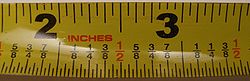
Ruler
A ruler, sometimes called a rule or line gauge, is an instrument used in geometry, technical drawing, printing and engineering/building to measure distances and/or to rule straight lines...
. It consists of a ribbon of cloth, plastic, fiber glass, or metal strip with linear-measurement markings. It is a common measuring tool. Its flexibility allows for a measure of great length to be easily carried in pocket or toolkit and permits one to measure around curves or corners. Today it is ubiquitous, even appearing in miniature form as a keychain fob, or novelty item. Surveyors use tape measures in lengths of over 100 m
Hectometre
A hectometre is a somewhat uncommonly used unit of length in the metric system, equal to one hundred metres. It derives from the Greek word "ekato", meaning "hundred". A regulation football or soccer field is approximately 1 hectometre in length.*For area the square hectometre is a common unit...
(300+ ft).
Uses
Tape measures that were intended for use in tailoringSewing
Sewing is the craft of fastening or attaching objects using stitches made with a needle and thread. Sewing is one of the oldest of the textile arts, arising in the Paleolithic era...
or dressmaking were made from flexible cloth or plastic. Today, measuring tapes made for sewing are made of fiberglass, which does not tear or stretch as easily. Measuring tapes designed for carpentry
Carpenter
A carpenter is a skilled craftsperson who works with timber to construct, install and maintain buildings, furniture, and other objects. The work, known as carpentry, may involve manual labor and work outdoors....
or construction
Construction
In the fields of architecture and civil engineering, construction is a process that consists of the building or assembling of infrastructure. Far from being a single activity, large scale construction is a feat of human multitasking...
often use a stiff, curved metallic ribbon that can remain stiff and straight when extended, but retracts into a coil for convenient storage. This type of tape measure will have a floating tang on the end to aid measuring. The tang will float a distance equal to its thickness, to provide both inside and outside measurements that are accurate. A tape measure of 25 or even 100 feet can wind into a relatively small container. The self-marking tape measure allows the user an accurate one hand measure and mark without an outside device.
History
On 3 January 1922, Hiram Farrand received the patent he filed in 1919. Sometime between 1922 and December 1926 Farrand experimented with the help of The Brown Company in Berlin, New HampshireBerlin, New Hampshire
Berlin is a city along the Androscoggin River in Coos County in northern New Hampshire, United States. The population was 10,051 at the 2010 census. It includes the village of Cascade. Located on the edge of the White Mountains, the city's boundaries extend into the White Mountain National Forest...
. It is there Hiram and W.W. Brown began mass producing the tape measure. Their product was later sold to Stanley Works
Stanley Works
Stanley Black & Decker , formerly known as The Stanley Works, is a manufacturer of tools and hardware and provider of security products and locks headquartered in New Britain, Connecticut...
Design
The design on which most modern spring tape measures are built was patentPatent
A patent is a form of intellectual property. It consists of a set of exclusive rights granted by a sovereign state to an inventor or their assignee for a limited period of time in exchange for the public disclosure of an invention....
ed by a New Haven, Connecticut
New Haven, Connecticut
New Haven is the second-largest city in Connecticut and the sixth-largest in New England. According to the 2010 Census, New Haven's population increased by 5.0% between 2000 and 2010, a rate higher than that of the State of Connecticut, and higher than that of the state's five largest cities, and...
resident named Alvin J. Fellows on 14 July 1868. According to the text of his patent, Fellows' tape measure was an improvement on other versions previously designed.
The spring tape measure has existed since Fellows' patent in 1868, but did not come into wide usage until the early 1900s, when it slowly began to supplant a common folding wooden design of carpenter's ruler.
With the mass production of the integrated circuit
Integrated circuit
An integrated circuit or monolithic integrated circuit is an electronic circuit manufactured by the patterned diffusion of trace elements into the surface of a thin substrate of semiconductor material...
(IC) the tape measure has also entered into the digital age with the digital tape measure. Some incorporate a digital screen to give measurement readouts in multiple formats.
There are also other styles of tape measures that have incorporated laser
Laser
A laser is a device that emits light through a process of optical amplification based on the stimulated emission of photons. The term "laser" originated as an acronym for Light Amplification by Stimulated Emission of Radiation...
s and ultrasonic technology to measure the distance of an object with fairly reliable accuracy.
United States
Justus Roe & Sons began manufacturing steel tape measures in 1865. . Located in Patchogue, Long Island, New York. His original concept was to place metal studs along lengths of wire. Justus Roe, a surveyor and tape-maker by trade, made the longest tape measure in 1956, at 600 feet long. The Northern Virginia Surveyors Association presented the 600' long, gold-plated surveyor's tape measure to Micky Mantle in 1956. It now resides with other such memorabilia, behind glass in the entry area of Mickey Mantle's Steakhouse located in Oklahoma City, Oklahoma.Some tapes sold in the United States have additional marks in the shape of small black diamonds, which appear every 19.2 inches (487.7 mm). These are known as 'black truss' markings, and are used to mark out equal truss lengths for roofing materials (five trusses per standard 8 feet (2.4 m) length of building material).
Many tapes also have special markings every 16 inches, which is a standard interval for studs in housing.