

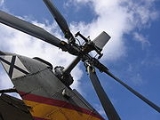
Tail rotor

Encyclopedia
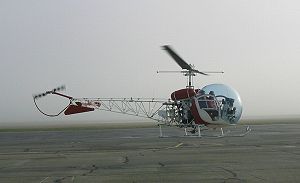
Helicopter
A helicopter is a type of rotorcraft in which lift and thrust are supplied by one or more engine-driven rotors. This allows the helicopter to take off and land vertically, to hover, and to fly forwards, backwards, and laterally...
. The tail rotor's position and distance from the center of gravity allow it to develop thrust in the same direction as the main rotor's rotation, to counter the torque
Torque
Torque, moment or moment of force , is the tendency of a force to rotate an object about an axis, fulcrum, or pivot. Just as a force is a push or a pull, a torque can be thought of as a twist....
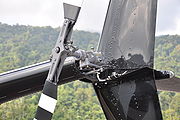
effect created by the main rotor. Tail rotors are simpler than main rotors since they require only collective changes in pitch to vary thrust. The pitch of the tail rotor blades is adjustable by the pilot via the anti-torque pedals, which also provide directional control by allowing the pilot to rotate the helicopter around its vertical axis.
The tail rotor drive system consists of a shaft powered from the main transmission and a gearbox mounted at the end of the tail boom. The drive shaft may consist of one long shaft or a series of shorter shafts connected at both ends with flexible couplings, that allow the drive shaft to flex with the tail boom. The gearbox at the end of the tailboom provides an angled drive for the tail rotor and may also include gearing to adjust the output to the optimum rotational speed for the tail rotor, measured in rotations per minute (RPM)
Revolutions per minute
Revolutions per minute is a measure of the frequency of a rotation. It annotates the number of full rotations completed in one minute around a fixed axis...
. On larger helicopters with a tail pylon, intermediate gearboxes are used to transition the tail rotor drive shaft from along the tailboom to the top of the pylon. The tail rotor pylon may also serve as a vertical stabilizing airfoil, to alleviate the power requirement for the tail rotor in forward flight. The tail rotor pylon may also serve to provide limited antitorque within certain airspeed ranges, in the event that the tail rotor or the tail rotor flight controls fail.
Design
The tail rotor system rotates airfoils, small wings called blades, that vary in pitch in order to vary the amount of thrust they produce. The blades most often utilize a composite materialComposite material
Composite materials, often shortened to composites or called composition materials, are engineered or naturally occurring materials made from two or more constituent materials with significantly different physical or chemical properties which remain separate and distinct at the macroscopic or...
construction, such as a core made of aluminum honeycomb or plasticized paper honeycomb, covered in a skin made of aluminum or carbon fiber composite. Tail rotor blades are made with both symmetrical and asymmetrical airfoil
Airfoil
An airfoil or aerofoil is the shape of a wing or blade or sail as seen in cross-section....
construction. The pitch change mechanism uses a cable control system or control tubes that run from the anti-torque pedals in the cockpit
Cockpit
A cockpit or flight deck is the area, usually near the front of an aircraft, from which a pilot controls the aircraft. Most modern cockpits are enclosed, except on some small aircraft, and cockpits on large airliners are also physically separated from the cabin...
to a mechanism mounted on the tail rotor gearbox. In larger helicopters, the pitch change mechanism is augmented by a hydraulic power control servo. In the event of a hydraulic system failure, the mechanical system is still able to control the tail rotor pitch, though the control resistance felt by the pilot will be considerably greater.
The tail rotor is powered by the helicopter's main power plant, and rotates at a speed proportional to that of the main rotor. In both piston and turbine powered helicopters, the main rotor and the tail rotor are mechanically connected through a freewheeling clutch system, which allows the rotors to keep turning in the event of an engine failure by mechanically de-linking the engine from both the main and tail rotors. During autorotation
Autorotation
In aviation, autorotation refers to processes in both fixed-wing and rotary-wing aircraft. The term means significantly different things in each context....
, the momentum of the main rotor continues to power the tail rotor and allow directional control. To optimize its function for forward flight, the blades of a tail rotor have no twist to reduce the profile drag, because the tail rotor is mounted with its axis of rotation perpendicular to the direction of flight.
Reliability and safety
Fluorescent penetrant inspection
Fluorescent Penetrant Inspection is a type of dye penetrant inspection in which a fluorescent dye is applied to the surface of a non-porous material in order to detect defects that may compromise the integrity or quality of the part in question...
to detect weak parts before they fail completely.
Despite the emphasis on reducing failures, they do occasionally occur, most often due to hard landings and tailstrike
Tailstrike
Tailstrike is an aviation term that describes an event in which the rear end of an aircraft touches the runway. This can happen during takeoff of a fixed-wing aircraft if the pilot pulls up too rapidly, leading to the rear end of the fuselage touching the runway. It can also occur during landing...
s, or foreign object damage
Foreign object damage
Foreign Object Debris is a substance, debris or article alien to a vehicle or system which would potentially cause damage.Foreign Object Damage is any damage attributed to a foreign object that can be expressed in physical or economic terms that may or may not degrade the product's required...
. Though the tail rotor is considered essential for safe flight, the loss of tail rotor function does not necessarily result in a fatal crash. In cases where the failure occurs due to contact with the ground, the aircraft is already at low altitude and the pilot may be able to reduce collective and land the helicopter before it spins completely out of control. Should the tail rotor fail randomly during cruise flight, forward momentum will often provide some directional stability, as many helicopters are equipped with a vertical stabilizer
Vertical stabilizer
The vertical stabilizers, vertical stabilisers, or fins, of aircraft, missiles or bombs are typically found on the aft end of the fuselage or body, and are intended to reduce aerodynamic side slip. It is analogical to a skeg on boats and ships.On aircraft, vertical stabilizers generally point upwards...
. The pilot would then be forced to autorotate
Autorotation
In aviation, autorotation refers to processes in both fixed-wing and rotary-wing aircraft. The term means significantly different things in each context....
and make an emergency landing with significant forward airspeed, which is known as a running landing or roll-on landing.
The tail rotor itself is a hazard to ground crews working near a running helicopter. For this reason, tail rotors are painted with stripes of alternating colors to increase their visibility to ground crews while the tail rotor is spinning.
Alternative technologies
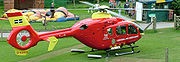
The first is to use a ducted fan
Ducted fan
A ducted fan is a propulsion arrangement whereby a fan, which is a type of propeller, is mounted within a cylindrical shroud or duct. The duct reduces losses in thrust from the tip vortices of the fan, and varying the cross-section of the duct allows the designer to advantageously affect the...
rather than an un-ducted fan. This design is referred to as a fantail, or by the trade name Fenestron
Fenestron
A Fenestron is a shrouded tail rotor of a helicopter that is essentially a ducted fan. The housing is integral with the tail skin, and, like the conventional tail rotor it replaces, is intended to counteract the torque of the main rotor...
, a trademark of Eurocopter. Placing the fan within a duct reduces tip vortex losses
Wingtip vortices
Wingtip vortices are tubes of circulating air that are left behind a wing as it generates lift. One wingtip vortex trails from the tip of each wing. The cores of vortices spin at very high speed and are regions of very low pressure...
, shields the tail rotor from damage, shields ground crews from the hazard of a spinning rotor, and is much quieter than a conventional tail rotor. The ducted fan uses shorter and more numerous blades, but otherwise it is very similar to a conventional tail rotor.
McDonnell Douglas
McDonnell Douglas
McDonnell Douglas was a major American aerospace manufacturer and defense contractor, producing a number of famous commercial and military aircraft. It formed from a merger of McDonnell Aircraft and Douglas Aircraft in 1967. McDonnell Douglas was based at Lambert-St. Louis International Airport...
developed the NOTAR
NOTAR
NOTAR is the name of a helicopter anti-torque system which replaces the use of a tail rotor. Developed by McDonnell Douglas Helicopter Systems , the name is an acronym derived from the phrase NO TAil Rotor...
(NO TAil Rotor) system, which eliminates having any rotating parts out in the open. The NOTAR system uses a variable pitch ducted fan driven by the helicopter's powerplant, but the ducted fan is mounted inside the fuselage ahead of the tail boom, and the exhaust passes through the tail boom to the end, where it is expelled out one side. This creates a boundary layer which causes the downwash from the main rotor to hug the tail boom according to the Coandă effect
Coanda effect
The Coandă effect is the tendency of a fluid jet to be attracted to a nearby surface. The principle was named after Romanian aerodynamics pioneer Henri Coandă, who was the first to recognize the practical application of the phenomenon in aircraft development....
. This creates a force which cancels out the main rotor torque and provides directional control. The advantages of the system are similar to the Fenestron system discussed above.
A way to eliminate the necessity of a tail rotor altogether is to use two main rotors which turn in opposite directions, so that the torque created by one rotor cancels out the torque created by the other. Such a design is commonly seen on heavy lift helicopters such as the CH-47 Chinook
CH-47 Chinook
The Boeing CH-47 Chinook is an American twin-engine, tandem rotor heavy-lift helicopter. Its top speed of 170 knots is faster than contemporary utility and attack helicopters of the 1960s...
and V-22 Osprey
V-22 Osprey
The Bell Boeing V-22 Osprey is an American multi-mission, military, tiltrotor aircraft with both a vertical takeoff and landing , and short takeoff and landing capability...
. Other designs such as the Kamov Ka-50
Kamov Ka-50
The Kamov Ka-50 "Black Shark" is a single-seat Russian attack helicopter with the distinctive coaxial rotor system of the Kamov design bureau. It was designed in the 1980s and adopted for service in the Russian army in 1995...
use coaxial contra-rotating main rotors, which means that both rotors spin around the same axis but in opposite directions. The complexity of any dual main rotor system almost invariably requires the addition of a fly-by-wire
Fly-by-wire
Fly-by-wire is a system that replaces the conventional manual flight controls of an aircraft with an electronic interface. The movements of flight controls are converted to electronic signals transmitted by wires , and flight control computers determine how to move the actuators at each control...
flight control system, which increases costs drastically.
Recent technology in emergency tail rotor recovery systems has been advanced by the US Army in an SBIR research award to EATTS. The emergency anti-torque thruster system (EATTS) would allow a helicopter that has encountered tail rotor failure, or loss of tail rotor effectiveness, to land safely. The system is designed to counteract the torque from the helicopter's main rotor system during tail rotor failure as a result of mechanical problems as well as loss of the tail rotor from RPG hits.