


Tacuinum Sanitatis

Encyclopedia
Health
Health is the level of functional or metabolic efficiency of a living being. In humans, it is the general condition of a person's mind, body and spirit, usually meaning to be free from illness, injury or pain...
, based on the Taqwim al‑sihha ("Maintenance of Health"), an eleventh-century Arab medical treatise by Ibn Butlan
Ibn Butlan
Ibn Butlan was an Iraqi Christian physician of the Islamic Golden Age.He wrote the Taqwim al-Sihhah . The work treated matters of hygiene, dietetics, and exercise. It emphasized the benefits of regular attention to the personal physical and mental well-being...
of Baghdad
Baghdad
Baghdad is the capital of Iraq, as well as the coterminous Baghdad Governorate. The population of Baghdad in 2011 is approximately 7,216,040...
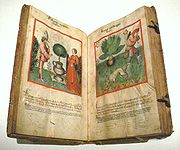
. Aimed at a cultured lay audience, the text exists in several variant Latin versions, the manuscripts of which are characteristically so profusely illustrated that one student called the Taccuinum "a trecento picture book," only "nominally a medical text". Though describing in detail the beneficial and harmful properties of foods and plants, it is far more than a herbal
Herbal
AThe use of a or an depends on whether or not herbal is pronounced with a silent h. herbal is "a collection of descriptions of plants put together for medicinal purposes." Expressed more elaborately — it is a book containing the names and descriptions of plants, usually with information on their...
: listing its contents organically rather than alphabetically, it sets forth the six essential elements for well-being:
- sufficient food and drink in moderation,
- fresh air,
- alternations of activity and rest,
- alternations of sleep and wakefulness,
- secretions and excretions of humours, and finally
- the effects of states of mind.
Illnesses result from imbalance of these elements, therefore a healthy life is lived in harmony.
The terse paragraphs of the treatise were freely translated into Latin in mid-thirteenth-century Palermo
Palermo
Palermo is a city in Southern Italy, the capital of both the autonomous region of Sicily and the Province of Palermo. The city is noted for its history, culture, architecture and gastronomy, playing an important role throughout much of its existence; it is over 2,700 years old...
or Naples, where it continued an Italo-Norman
Italo-Norman
The Italo-Normans, or Siculo-Normans when referring to Sicily, were the Italian-born descendants of the first Norman conquerors to travel to the southern Italy in the first half of the eleventh century...
tradition as one of the prime sites for peaceable inter-cultural contact between the Islamic and European worlds.
Four handsomely illustrated complete late fourteenth-century manuscripts of the Taccuinum, all produced in Lombardy
Lombardy
Lombardy is one of the 20 regions of Italy. The capital is Milan. One-sixth of Italy's population lives in Lombardy and about one fifth of Italy's GDP is produced in this region, making it the most populous and richest region in the country and one of the richest in the whole of Europe...
, survive, in Vienna, Paris, Liège and Rome, as well as scattered illustrations from others, as well as fifteenth-century codices
Codex
A codex is a book in the format used for modern books, with multiple quires or gatherings typically bound together and given a cover.Developed by the Romans from wooden writing tablets, its gradual replacement...
. Unillustrated manuscripts present a series of tables, with a narrative commentary on the facing pages. The Taccuinum was first printed in 1531.
Late Middle Ages
The Late Middle Ages was the period of European history generally comprising the 14th to the 16th century . The Late Middle Ages followed the High Middle Ages and preceded the onset of the early modern era ....
; an indication of that popularity is the use of the word taccuino in modern Italian to mean any kind of pocket handbook, guide, notebook.
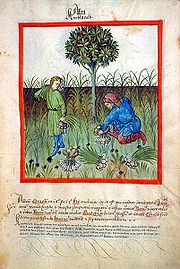
In addition to its importance for the study of medieval medicine, the Tacuinum is also of interest in the study of agriculture and cooking; for example, one of the earliest identifiable image of the carrot
Carrot
The carrot is a root vegetable, usually orange in colour, though purple, red, white, and yellow varieties exist. It has a crisp texture when fresh...
— a modern plant — is found in it. Carrot also appears in The Greek Herbal of Dioscorides
Pedanius Dioscorides
Pedanius Dioscorides was a Greek physician, pharmacologist and botanist, the author of a 5-volume encyclopedia about herbal medicine and related medicinal substances , that was widely read for more than 1,500 years.-Life:...
: Illustrated by a Byzantine A.D. 512
In 2008, the Spanish publishing house M. Moleiro Editor
M. Moleiro Editor
M. Moleiro Editor is a publishing house specialised in identical facsimile reproductions of codices, maps and illuminated manuscripts. Founded in Barcelona in 1991, the firm’s dissemination of many masterpieces in the history of illumination and the great accuracy of its reproductions have made it...
published the first and only facsimile of the Tacuinum Sanitatis kept at the Bibliothèque nationale de France
Bibliothèque nationale de France
The is the National Library of France, located in Paris. It is intended to be the repository of all that is published in France. The current president of the library is Bruno Racine.-History:...
, in a luxury edition limited to 987 copies. This edition was accompanied by a commentary volume by Alain Touwaide (Smithsonian), Eberhard König (Freie Universität Berlin) and Carlos Miranda García-Tejedor (Doctor in History).