


Sword bayonet

Encyclopedia

Bayonet
A bayonet is a knife, dagger, sword, or spike-shaped weapon designed to fit in, on, over or underneath the muzzle of a rifle, musket or similar weapon, effectively turning the gun into a spear...
designed for mounting on a musket
Musket
A musket is a muzzle-loaded, smooth bore long gun, fired from the shoulder. Muskets were designed for use by infantry. A soldier armed with a musket had the designation musketman or musketeer....
or rifle
Rifle
A rifle is a firearm designed to be fired from the shoulder, with a barrel that has a helical groove or pattern of grooves cut into the barrel walls. The raised areas of the rifling are called "lands," which make contact with the projectile , imparting spin around an axis corresponding to the...
. Its use is thought to have begun in the 18th century and to have reached its height of popularity throughout the 19th and into the early 20th centuries. When unmounted from a musket or rifle, sword bayonets with their typical hilt
Hilt
The hilt of a sword is its handle, consisting of a guard,grip and pommel. The guard may contain a crossguard or quillons. A ricasso may also be present, but this is rarely the case...
s and long blades also could be wielded as short swords. While modern military bayonets typically have knife
Knife
A knife is a cutting tool with an exposed cutting edge or blade, hand-held or otherwise, with or without a handle. Knives were used at least two-and-a-half million years ago, as evidenced by the Oldowan tools...
blades, they are usually too short to be called sword bayonets and are more akin to fighting/utility knives
Combat knife
A combat knife is a fighting knife designed solely for military use and primarily intended for hand-to-hand or close combat fighting.Since the end of trench warfare, most military combat knives have been secondarily designed for utility use in addition to their original role as close-quarter combat...
.
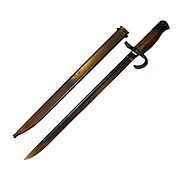
Baker rifle
The Baker rifle was a flintlock rifle used by the Rifle regiments of the British Army during the Napoleonic Wars. It was the first standard-issue, British-made rifle accepted by the British armed forces....
of the Napoleonic era
Napoleonic Wars
The Napoleonic Wars were a series of wars declared against Napoleon's French Empire by opposing coalitions that ran from 1803 to 1815. As a continuation of the wars sparked by the French Revolution of 1789, they revolutionised European armies and played out on an unprecedented scale, mainly due to...
British Army
British Army
The British Army is the land warfare branch of Her Majesty's Armed Forces in the United Kingdom. It came into being with the unification of the Kingdom of England and Scotland into the Kingdom of Great Britain in 1707. The new British Army incorporated Regiments that had already existed in England...
.
Most infantry
Infantry
Infantrymen are soldiers who are specifically trained for the role of fighting on foot to engage the enemy face to face and have historically borne the brunt of the casualties of combat in wars. As the oldest branch of combat arms, they are the backbone of armies...
would routinely keep bayonets fixed to their inaccurate smoothbore muskets throughout a battle. Close order ranks and squares
Infantry square
An infantry square is a combat formation an infantry unit forms in close order when threatened with cavalry attack.-Very early history:The formation was described by Plutarch and used by the Romans, and was developed from an earlier circular formation...
presented a hedge of bayonets to the enemy, which was especially useful for deterring cavalry
Cavalry
Cavalry or horsemen were soldiers or warriors who fought mounted on horseback. Cavalry were historically the third oldest and the most mobile of the combat arms...
. But a fixed bayonet - a pound or so of extra metal on the front of a firearm - seriously affects a firearm’s balance and hampers accurate shooting. A rifleman usually fought without a fixed bayonet since accuracy was the whole point of his rifled weapon. He therefore required a side-arm that could be drawn and used instantly in an emergency so his bayonet had a cutting edge and a grippable hilt. That such bayonets were far heavier than standard socket bayonets was not a disadvantage since they were rarely fixed.
(In truth, most riflemen found it worked better for cutting brush and roasting meat over a fire. (see Rifleman Harris, Costello's, Simmons's diaries) The German Schlachtmesser (battle knife) was better in this respect.)
On occasion riflemen did form up in close order. Since rifles were shorter than muskets their bayonets needed to be longer to produce the same total length; the sword bayonet answered this need.
As well as rifle regiments, other soldiers whose battlefield role did not involve standing shoulder to shoulder in ranks, notably sergeants, also came to use sword bayonets. By the end of the nineteenth century all infantry had become riflemen and the sword bayonet had become the standard infantry bayonet.
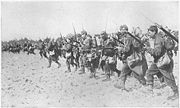
Bayonet mount
A bayonet mount or bayonet connector is a fastening mechanism consisting of a male side with one or more pins, and a female receptor with matching L slots and spring to keep the two parts locked together....
variety, their use on the end of the musket or rifle also became a hindrance during the reloading of the muzzle-loaded
Muzzleloader
A muzzleloader is any firearm into which the projectile and usually the propellant charge is loaded from the muzzle of the gun . This is distinct from the more popular modern designs of breech-loading firearms...
longarm
Long gun
The term long gun is used to describe classes of firearm and cannon with longer barrels than other classes. In small arms, a long gun is designed to be fired braced against the shoulder, in contrast to a handgun, while in artillery a long gun would be contrasted with a howitzer or carronade.-Small...
, (a common problem to all muzzle-loading infantry weapons). A bayonet of similar style and dimension was used on the Lee-Enfield
Lee-Enfield
The Lee-Enfield bolt-action, magazine-fed, repeating rifle was the main firearm used by the military forces of the British Empire and Commonwealth during the first half of the 20th century...
rifle of the early 20th century.
However, the advantages of sword bayonets over spike bayonets are evident. Where a spike bayonet
Spike bayonet
A spike bayonet, also known as a pigsticker in informal contexts, is a blade attachment for a firearm taking the form of a pointed spike rather than a knife. Most early musket bayonets were of this type. From around 1800 knife- or sword style bayonets began to appear, which could also be wielded by...
turns the rifle into a spear, a sword bayonet turns it into a glaive
Glaive
A glaive is a European polearm weapon, consisting of a single-edged blade on the end of a pole. It is similar to the Japanese naginata and the Chinese Guan Dao....
. Unlike spike bayonets, which can be used only for thrusting, sword bayonets can also be used for slashing. Twisting a sword bayonet in the wound was especially lethal. Before the advent of modern medicine after World War I, a soldier struck by a sword bayonet was very unlikely to survive.
While most sword bayonets have straight blades, a popular variant in the 19th century featured sinuous, S-curved blades like those found on the Balkan's and Middle-East's sword called the yataghan. Today, sword bayonets of this style are said to have "yataghan" blades, or to be "yataghan-bladed".
Both sword and spike bayonets lost their popularity after World War I
World War I
World War I , which was predominantly called the World War or the Great War from its occurrence until 1939, and the First World War or World War I thereafter, was a major war centred in Europe that began on 28 July 1914 and lasted until 11 November 1918...
. While sword bayonets can be effective as short swords, they proved to be too unwieldy in cramped quarters in trench warfare
Trench warfare
Trench warfare is a form of occupied fighting lines, consisting largely of trenches, in which troops are largely immune to the enemy's small arms fire and are substantially sheltered from artillery...
, although spike bayonets continued to be used throughout most of the 20th century. A shorter version of the sword bayonet, the knife bayonet
Knife bayonet
A knife bayonet is a knife which can be used both as a bayonet, fighting or utility knife. The knife bayonet became the almost universal form of bayonet in the 20th century due to its versatility and effectiveness...
, was developed. Today, the majority of modern bayonets are knife bayonets.