

Swarf

Encyclopedia
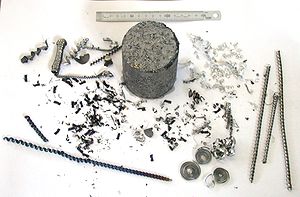
Swarf, also known as turnings, chips, or filings, are shavings and chippings of metal — the debris or waste resulting from metalworking
Metalworking
Metalworking is the process of working with metals to create individual parts, assemblies, or large scale structures. The term covers a wide range of work from large ships and bridges to precise engine parts and delicate jewelry. It therefore includes a correspondingly wide range of skills,...
operations including milling and grinding. It can usually be recycled
Recycling
Recycling is processing used materials into new products to prevent waste of potentially useful materials, reduce the consumption of fresh raw materials, reduce energy usage, reduce air pollution and water pollution by reducing the need for "conventional" waste disposal, and lower greenhouse...
, and this is the preferred method of disposal due to the environmental concerns
Environmentalism
Environmentalism is a broad philosophy, ideology and social movement regarding concerns for environmental conservation and improvement of the health of the environment, particularly as the measure for this health seeks to incorporate the concerns of non-human elements...
regarding potential contamination with cutting fluid
Cutting fluid
Cutting fluid is a type of coolant and lubricant designed specifically for metalworking and machining processes. There are various kinds of cutting fluids, which include oils, oil-water emulsions, pastes, gels, aerosols , and air or other gases. They may be made from petroleum distillates, animal...
or tramp oil. The ideal way to remove these liquids is by the use of a centrifuge
Centrifuge
A centrifuge is a piece of equipment, generally driven by an electric motor , that puts an object in rotation around a fixed axis, applying a force perpendicular to the axis...
which will separate the fluids from the metal, allowing both to be reclaimed and prepared for further treatment.
The terms "swarf" and "chips" are also used to describe the waste shavings, sawdust, and cuttings from woodworking operations, as well as waste in constructed piping, such as welding metal or slag waste that is produced and trapped within the pipe during its assembly, and sometimes in masonry
Masonry
Masonry is the building of structures from individual units laid in and bound together by mortar; the term masonry can also refer to the units themselves. The common materials of masonry construction are brick, stone, marble, granite, travertine, limestone; concrete block, glass block, stucco, and...
.
Cuts, splinters, punctures, airborne chips
Chips can be extremely sharp, and this creates a safety problem, as they can cause serious injuries if not handled correctly. Depending on the composition of the material, it can persist in the environment for a long time before degrading. This, combined with the small size of some chips (e.g. those of brassBrass
Brass is an alloy of copper and zinc; the proportions of zinc and copper can be varied to create a range of brasses with varying properties.In comparison, bronze is principally an alloy of copper and tin...
or bronze
Bronze
Bronze is a metal alloy consisting primarily of copper, usually with tin as the main additive. It is hard and brittle, and it was particularly significant in antiquity, so much so that the Bronze Age was named after the metal...
), allows them to disperse widely by piggy-backing on soft materials and also to penetrate the skin as deep splinters.
It is standard training for machinist
Machinist
A machinist is a person who uses machine tools to make or modify parts, primarily metal parts, a process known as machining. This is accomplished by using machine tools to cut away excess material much as a woodcarver cuts away excess wood to produce his work. In addition to metal, the parts may...
s, and usually a standing workplace rule, to avoid handling swarf with bare hands. Machinists generally adhere to this guideline to the extent practical. Although it isn't uncommon for machinists to touch swarf, it's always a risk-prone behaviour. There are some machining applications in which total avoidance of touching swarf is considered burdensome or impractical by the machinist, but employers should not expect or require that workers do it. Any machining textbook or manufacturing business insurance policy will insist that this not be done.
Similarly, it is also standard training for machinist
Machinist
A machinist is a person who uses machine tools to make or modify parts, primarily metal parts, a process known as machining. This is accomplished by using machine tools to cut away excess material much as a woodcarver cuts away excess wood to produce his work. In addition to metal, the parts may...
s, and usually a standing workplace rule, to minimize or entirely avoid blowing chips away with compressed air, but as with the avoid-handling rule, this rule is often broken, and there are some machining applications in which total avoidance of chip-clearing via air hose is considered burdensome or impractical by the machinist. Some machine tool manuals proscribe this practice both for safety and for the preservation of way wipers and bearing seals. Alternatives to blowing chips away include vacuuming them away with an industrial vacuum (shop vacuum); gently washing them away with a coolant
Cutting fluid
Cutting fluid is a type of coolant and lubricant designed specifically for metalworking and machining processes. There are various kinds of cutting fluids, which include oils, oil-water emulsions, pastes, gels, aerosols , and air or other gases. They may be made from petroleum distillates, animal...
hose discharging at typical garden-hose pressure values; or preventing their generation in the first place (for example, forming threads instead of cutting them).
It is not uncommon for chips flying off the cutter to be ejected with great force and to fly several meters. These flying chips present a hazard that is deflected with safety glasses, face shield
Face shield
A face shield is a device used to protect wearer's entire face from impact hazard such as flying objects and road debris, chemical splashes , or potentially infectious fluid .-Industry:...
s, and other personal protective equipment
Personal protective equipment
Personal protective equipment refers to protective clothing, helmets, goggles, or other garment or equipment designed to protect the wearer's body from injury by blunt impacts, electrical hazards, heat, chemicals, and infection, for job-related occupational safety and health purposes, and in...
, as well as the sheet-metal enclosures (and polycarbonate windows) that surround most commercial CNC machine tools.
Chip breaking
Optimum cutting efficiencies often generate long spring-like swarf. This is hard to deal with as it is bulky and can clog the nozzle of a shop vacuum. Clean-up and disposal of this continuous-cutting swarf is made simpler by using a cutting tool with a chip-breaker. This results in denser, more manageable waste.Machine cleaning and chip handling
Disposing of swarf is a tedious but necessary task. For ease of transport and handling, swarf may be compressed into bricks, which greatly reduces associated problems with storing and cost; it also improves material handling for all concerned with its reclamation and recycling.Recycling
RecyclingRecycling
Recycling is processing used materials into new products to prevent waste of potentially useful materials, reduce the consumption of fresh raw materials, reduce energy usage, reduce air pollution and water pollution by reducing the need for "conventional" waste disposal, and lower greenhouse...
chips rather than putting them in the garbage stream (headed to landfill
Landfill
A landfill site , is a site for the disposal of waste materials by burial and is the oldest form of waste treatment...
ing or incineration
Incineration
Incineration is a waste treatment process that involves the combustion of organic substances contained in waste materials. Incineration and other high temperature waste treatment systems are described as "thermal treatment". Incineration of waste materials converts the waste into ash, flue gas, and...
) has various advantages:
- Environmental
- As mentioned above, keep cutting fluid out of the waste stream
- Reduce the amount of ore mining and metal refining that must be done to meet the annual global demand for metal stocks. For example, it takes at least 4 times the energy per unit of production to produce aluminum billet from mined ore—plus the environmental impact of the mining itself—as it does to produce it from recycled scrap metal stocks (such as chips and bar drops).
- Financial
- There is almost always some money to be made from the stream of recycled chips, whether by the scrap processor, the machine shop, or often both. The scrap value (melt value) of the metal is a net gain beyond any costs of handling and transporting the chips.
Requirements
Machine shops are typically required by the scrap collector to:- segregate metal types (e.g., aluminum chips in separate barrels from steel chips)
- it is usually not required to segregate particular alloys (e.g., to keep 2024 aluminum separate from 6061)
- segregate solid chunks (such as bar end drops and scrapped-out parts) from chips (which are finer and are processed on different material handling equipmentMaterial handling equipmentMaterial handling equipment is all equipment that relates to the movement, storage, control and protection of materials, goods and products throughout the process of manufacturing, distribution, consumption and disposal...
. - drain and/or centrifuge all cutting fluid and way oil out of the chips (within reason)