

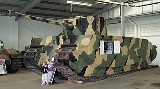
Super-heavy tank

Encyclopedia
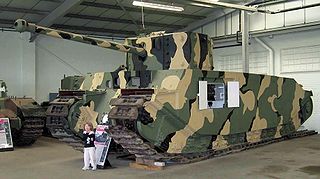
World War I
World War I , which was predominantly called the World War or the Great War from its occurrence until 1939, and the First World War or World War I thereafter, was a major war centred in Europe that began on 28 July 1914 and lasted until 11 November 1918...
and World War II
World War II
World War II, or the Second World War , was a global conflict lasting from 1939 to 1945, involving most of the world's nations—including all of the great powers—eventually forming two opposing military alliances: the Allies and the Axis...
, along with a few in the Cold War
Cold War
The Cold War was the continuing state from roughly 1946 to 1991 of political conflict, military tension, proxy wars, and economic competition between the Communist World—primarily the Soviet Union and its satellite states and allies—and the powers of the Western world, primarily the United States...
.
World War I
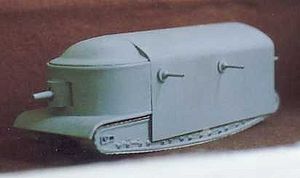
Flying Elephant
The Flying Elephant was a proposed super-heavy tank, planned but never built by the British during World War I.-Development:After the last order for an additional fifty Mark I vehicles in April 1916, it was not certain that any more tanks were to be produced. Everything would depend on the success...
concept as a way to break through any potential defensive line. The Germans developed their K-Wagen (Großkampfwagen). 2 of them were under construction when the war ended and both were demolished.
World War II
During World War II all of the major combatants introduced prototypes for special roles. Adolf HitlerAdolf Hitler
Adolf Hitler was an Austrian-born German politician and the leader of the National Socialist German Workers Party , commonly referred to as the Nazi Party). He was Chancellor of Germany from 1933 to 1945, and head of state from 1934 to 1945...
was a proponent of "war winning" weapons and supported projects like the 188 tonne Maus, and even larger 1,000 tonne Landkreuzer P. 1000 Ratte and 1,500 tonne Landkreuzer P. 1500 Monster
Landkreuzer P. 1500 Monster
The Landkreuzer P 1500 Monster was a German pre-prototype super-heavy tank designed during World War II, representing the apex of the German extreme tank designs.- Conception :...
. The British, Soviets and Americans all built prototype designs similar to the Jagdtiger
Jagdtiger
Jagdtiger is the common name of a German tank destroyer of World War II. The official German designation was Panzerjäger Tiger Ausf. B. The ordnance inventory designation was Sd. Kfz. 186. It saw service in small numbers from late 1944 to the end of the war on both the Western and Eastern Front...
, but none of these saw combat as the need for such a weapon turned out to be extremely limited.
Later
The idea of super-heavy tanks saw less development after the war, except in the Soviet Union where some relatively heavy tank prototypes were tested for the Cold WarCold War
The Cold War was the continuing state from roughly 1946 to 1991 of political conflict, military tension, proxy wars, and economic competition between the Communist World—primarily the Soviet Union and its satellite states and allies—and the powers of the Western world, primarily the United States...
nuclear battlefield. An example would be the Object 279. These might be considered super-heavy by the standards of Soviet tank design, where the emphasis was on small size and low weight, but they were no heavier than the standard U.S. and British heavy tanks of the period.
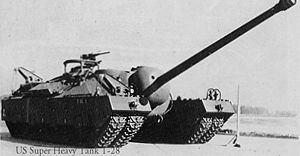
List of super-heavy tanks
American- T-28 Super Heavy TankT-28 Super Heavy TankThe T28 super heavy tank was a prototype heavily armored self-propelled gun designed for the US Army during World War II. It was originally designed to be used to break through German defenses at the Siegfried Line, and was later considered as a possible participant in an invasion of the Japanese...
- self-propelled gun, 86 tons, 5 pilot models built
British
- TOG1 (tank)TOG1 (tank)The Tank, Heavy, TOG 1 was a prototype British heavy tank produced in the early part of the Second World War in the expectation that battlefields might end up like those of the First World War and was designed so it could cross churned up countryside and trenches...
- 80 tons, 1 prototype - TOG2 (tank)TOG2 (tank)The Tank, Heavy, TOG 2 was a prototype British super-heavy tank design produced in the early part of the Second World War in case the battlefields of northern France turned into a morass of mud, trenches and craters as had happened during the First World War....
- 80 tons, 1 prototype - Tortoise heavy assault tankTortoise heavy assault tankThe Tank, Heavy Assault, Tortoise was a British heavy assault tank design developed in World War II but never put into mass production. It was developed for the task of clearing heavily fortified areas and as a result favoured armour protection over mobility.Although heavy, at 78 tons, and not...
- self-propelled gun, 78 tons, 6 pilot models built and tested - Flying ElephantFlying ElephantThe Flying Elephant was a proposed super-heavy tank, planned but never built by the British during World War I.-Development:After the last order for an additional fifty Mark I vehicles in April 1916, it was not certain that any more tanks were to be produced. Everything would depend on the success...
- First World War era project at 100 tons, not built
French
- Char 2CChar 2CThe Char 2C was a French super-heavy tank developed, although never deployed, during World War I. It was the largest operational tank ever.-Development:...
(also known as FCM 2C) - 69 tons, 10 built in the 1920s - FCM F1FCM F1The FCM F1 was a French super-heavy tank developed during the Interbellum by the Forges et Chantiers de la Méditerranée company. Twelve were ordered in 1940 to replace the Char 2C, but France was defeated before construction could begin, a wooden mock-up being all that was finished...
- 139 tons, project only
German
- K-WagenK PanzerkampfwagenThe Großkampfwagen or "K-Wagen" was a German super-heavy tank, two prototypes of which were almost completed by the end of World War I.-History:...
- 120 metric tons, 2 were nearly complete when the war ended. Both were demolished. - Panzer VII LöwePanzer VII LöweThe Panzerkampfwagen VII Löwe was a design for a Super Heavy Tank created by Krupp for the Nazi German government during World War II. The project never left the drawing board, and was dropped in late 1942 in favor of the Panzer VIII Maus....
- 76–90 tons, cancelled in favour of Maus. - Panzer VIII MausPanzer VIII MausPanzerkampfwagen VIII Maus was a German World War II super-heavy tank completed in late 1944. It is the heaviest fully enclosed armoured fighting vehicle ever built. Only two hulls and one turret were completed before the testing grounds were captured by the advancing Soviet forces.These two...
- 188 tons, 2 prototypes. Both were captured by Russians. One can now be seen at the Kubinka Tank MuseumKubinka Tank MuseumThe Kubinka Tank Museum is a large museum of armoured fighting vehicles in Kubinka, just outside Moscow. It has many famous tanks from World War I, World War II and the Cold War. The museum also houses many unique vehicles, such as the Panzer VIII Maus, Troyanov super-heavy tank and a Karl-Gerät...
. - Panzerkampfwagen E-100Panzerkampfwagen E-100The Panzerkampfwagen E-100 was a German super-heavy tank design developed near the end of World War II.-History:The basic design was ordered by the Waffenamt as a parallel development to the Porsche Maus in June 1943...
- 140 tons, 1 hull completed at factory. Captured by Americans and scrapped. - Landkreuzer P. 1000 Ratte - 1000 tons, turret was complete, but the project was cancelled. Turret was used for costal defence.
- Landkreuzer P. 1500 MonsterLandkreuzer P. 1500 MonsterThe Landkreuzer P 1500 Monster was a German pre-prototype super-heavy tank designed during World War II, representing the apex of the German extreme tank designs.- Conception :...
- self-propelled gun, 1500 tons. Tracks were complete when the project was cancelled.
Japanese
- O-IO-IO-I was the name given to a proposed series of Japanese super-heavy tanks, to be used in the Pacific Theater. The vehicle was monstrous, carrying 11 crew in its 100-120ton body, but only one 120ton O-I model was rumored to have been built in 1944 and afterward sent to Manchuria. Exact information...
series- "Super Heavy Tank" - 130 tons. Purportedly one prototype was produced in 1944 and sent to Manchuria.
- "Ultra Heavy Tank" - Modification of the O-1 Super Heavy Tank with four turrets. Project only.
Soviet
- Eighty ton tank - at least 1 prototype built in 1926. 80 tons with two 76 mm main guns and 4 machine guns
- Tank Grote (TG-5 or T-42) - 100 tons with 107 mm main gun and four subturrets. One prototype made - 1931
- KV-4KV-4The KV-4 was a proposed Soviet heavy break-through tank, developed during World War II. Part of the Kliment Voroshilov tank design series, it never progressed past a series of feasibility studies.-Design history:...
- WWII supertank project. Several different designs were proposed (between about 90 and 110 tons and with one 107mm gun and one 45mm gun), but none were made. - KV-IV
- Obyekt 279Obyekt 279Object 279 was a Soviet experimental heavy tank developed at the end of 1959.This special purpose tank was intended to fight on cross country terrain, inaccessible to conventional tanks, acting as a heavy breakthrough tank, and if necessary withstanding even the shockwave of a nuclear explosion...
- 1959, 60 tons, Prototype tested.