

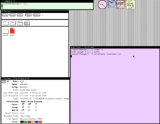
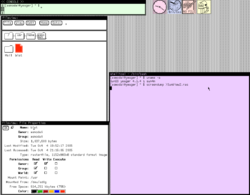
SunView

Encyclopedia
Sun Microsystems
Sun Microsystems, Inc. was a company that sold :computers, computer components, :computer software, and :information technology services. Sun was founded on February 24, 1982...
developed in the early 1980s. It was included as part of SunOS
SunOS
SunOS is a version of the Unix operating system developed by Sun Microsystems for their workstation and server computer systems. The SunOS name is usually only used to refer to versions 1.0 to 4.1.4 of SunOS...
, Sun's UNIX
Unix
Unix is a multitasking, multi-user computer operating system originally developed in 1969 by a group of AT&T employees at Bell Labs, including Ken Thompson, Dennis Ritchie, Brian Kernighan, Douglas McIlroy, and Joe Ossanna...
implementation; unlike later UNIX windowing systems, much of it was implemented in the system kernel. SunView ran on Sun's desktop and deskside workstation
Workstation
A workstation is a high-end microcomputer designed for technical or scientific applications. Intended primarily to be used by one person at a time, they are commonly connected to a local area network and run multi-user operating systems...
s, providing an interactive graphical environment for technical computing, document publishing, medical, and other applications of the 1980s, on high resolution monochrome, greyscale and color displays.
Bundled productivity applications
SunView included a full suite of graphical productivity applications, including an email reader, calendaring tool, text editor, clock, preferences GUIGui
Gui or guee is a generic term to refer to grilled dishes in Korean cuisine. These most commonly have meat or fish as their primary ingredient, but may in some cases also comprise grilled vegetables or other vegetarian ingredients. The term derives from the verb, "gupda" in Korean, which literally...
, and menu management interface. The idea of shipping such clients and the associated server software with the base OS was several years ahead of the rest of the industry.
Sun’s original SunView application suite was later ported to X, featuring the OPEN LOOK
OPEN LOOK
OPEN LOOK is a graphical user interface specification for UNIX workstations. It was originally defined in the late 1980s by Sun Microsystems and AT&T.-History:...
look and feel. Known as the DeskSet productivity tool set, this was one distinguishing element of Sun's OpenWindows
OpenWindows
OpenWindows was a desktop environment for Sun Microsystems workstations which handled SunView, NeWS, and X Window System protocols. OpenWindows was included in later releases of the operating systems SunOS 4 and Solaris, until its removal in Solaris 9 in favor of Common Desktop Environment and...
desktop environment.
The DeskSet tools became a unifying element at the end of the Unix wars
Unix wars
The Unix wars were the struggles between vendors of the Unix computer operating system in the late 1980s and early 1990s to set the standard for Unix thenceforth.- Origins :...
, where the open system
Open system (computing)
Open systems are computer systems that provide some combination of interoperability, portability, and open software standards. The term was popularized in the early 1980s, mainly to describe systems based on Unix,...
s industry was embroiled in a battle which would last for years. As part of the COSE initiative, it was decided that Sun’s bundled applications would be ported yet again, this time to the Motif widget toolkit
Motif (widget toolkit)
In computing, Motif refers to both a graphical user interface specification and the widget toolkit for building applications that follow that specification under the X Window System on Unix and other POSIX-compliant systems. It emerged in the 1980s as Unix workstations were on the rise, as a...
, and the result would be part of CDE
Common Desktop Environment
The Common Desktop Environment is a desktop environment for Unix and OpenVMS, based on the Motif widget toolkit.- Corporate history :...
. This became the standard for a time across all open systems vendors.
The full suite of group productivity applications that Sun had bundled with the desktop workstations turned out to be a significant legacy of SunView. While the underlying windowing infrastructure changed, protocols changed, and windowing systems changed, the Sun applications remained largely the same, maintaining interoperability with previous implementations.
Successors
SunView was intended to be superseded by NeWSNeWS
NeWS was a windowing system developed by Sun Microsystems in the mid 1980s. Originally known as "SunDew", its primary authors were James Gosling and David S. H. Rosenthal...
, a more sophisticated window system based on PostScript; however, the actual successor turned out to be the X Window System
X Window System
The X window system is a computer software system and network protocol that provides a basis for graphical user interfaces and rich input device capability for networked computers...
. Sun's original implementation of X included support for the display of SunView programs, a feature that was phased out after Solaris
Solaris Operating System
Solaris is a Unix operating system originally developed by Sun Microsystems. It superseded their earlier SunOS in 1993. Oracle Solaris, as it is now known, has been owned by Oracle Corporation since Oracle's acquisition of Sun in January 2010....
2.2. Sun provided a toolkit for X called XView
XView
XView is a widget toolkit from Sun Microsystems introduced in 1988. It provides an OPEN LOOK user interface for X Window System applications, with an object-oriented application programming interface for the C programming language...
, with an API
Application programming interface
An application programming interface is a source code based specification intended to be used as an interface by software components to communicate with each other...
similar to that of SunView, simplifying the transition for developers between the two environments.
Sun later announced its migration to the GNOME
GNOME
GNOME is a desktop environment and graphical user interface that runs on top of a computer operating system. It is composed entirely of free and open source software...
desktop environment from CDE, presumably marking the end of the 20-year-plus history of the SunView/DeskSet code base.