


Stjepan Filipovic

Encyclopedia
World War II
World War II, or the Second World War , was a global conflict lasting from 1939 to 1945, involving most of the world's nations—including all of the great powers—eventually forming two opposing military alliances: the Allies and the Axis...
and posthumously declared a People's Hero of Yugoslavia
People's Hero of Yugoslavia
The Order of the People's Hero was a Yugoslav gallantry medal, the second highest military award, and third overall Yugoslav decoration. It was awarded to individuals, military units, political and other organisations who distinguished themselves by extraordinary heroic deeds during war and in...
.
Filipović was born on 27 January 1916 in Opuzen
Opuzen
Opuzen is a small town in Dubrovnik-Neretva County in Croatia. The town is located upstream from the mouth of the river Neretva, in southern Dalmatia...
(in modern-day Dubrovnik-Neretva County
Dubrovnik-Neretva County
The Dubrovnik–Neretva County is the southernmost Croatian county located in south Dalmatia. The county seat is Dubrovnik and other large towns are Korčula, Metković, Opuzen and Ploče...
, Croatia
Croatia
Croatia , officially the Republic of Croatia , is a unitary democratic parliamentary republic in Europe at the crossroads of the Mitteleuropa, the Balkans, and the Mediterranean. Its capital and largest city is Zagreb. The country is divided into 20 counties and the city of Zagreb. Croatia covers ...
), in the last days of the Austro-Hungarian Empire. Before the outbreak of the Second World War he lived in Mostar
Mostar
Mostar is a city and municipality in Bosnia and Herzegovina, the largest and one of the most important cities in the Herzegovina region and the center of the Herzegovina-Neretva Canton of the Federation. Mostar is situated on the Neretva river and is the fifth-largest city in the country...
, Bosnia and Herzegovina
Bosnia and Herzegovina
Bosnia and Herzegovina , sometimes called Bosnia-Herzegovina or simply Bosnia, is a country in Southern Europe, on the Balkan Peninsula. Bordered by Croatia to the north, west and south, Serbia to the east, and Montenegro to the southeast, Bosnia and Herzegovina is almost landlocked, except for the...
and Kragujevac
Kragujevac
Kragujevac is the fourth largest city in Serbia, the main city of the Šumadija region and the administrative centre of Šumadija District. It is situated on the banks of the Lepenica River...
, Serbia
Serbia
Serbia , officially the Republic of Serbia , is a landlocked country located at the crossroads of Central and Southeast Europe, covering the southern part of the Carpathian basin and the central part of the Balkans...
, then both part of the Kingdom of Yugoslavia
Kingdom of Yugoslavia
The Kingdom of Yugoslavia was a state stretching from the Western Balkans to Central Europe which existed during the often-tumultuous interwar era of 1918–1941...
. He joined the workers' movement in 1937, but he was arrested in 1939 and sentenced to a year in prison, then he joined the Communist Party of Yugoslavia in 1940.
Filipović was commander of the Partisans' Tamnavsko-Kolubarski unit in Valjevo
Valjevo
Valjevo is a city and municipality located in western Serbia. It is the center of the Kolubara District, which includes five other smaller municipalities with a total population of almost 180,000 people...
by 1941. He was captured on 24 February 1942 by Axis forces
Axis Powers
The Axis powers , also known as the Axis alliance, Axis nations, Axis countries, or just the Axis, was an alignment of great powers during the mid-20th century that fought World War II against the Allies. It began in 1936 with treaties of friendship between Germany and Italy and between Germany and...
and subsequently hanged in Valjevo
Valjevo
Valjevo is a city and municipality located in western Serbia. It is the center of the Kolubara District, which includes five other smaller municipalities with a total population of almost 180,000 people...
, occupied Yugoslavia
Yugoslavia
Yugoslavia refers to three political entities that existed successively on the western part of the Balkans during most of the 20th century....
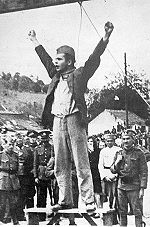
, on 22 May 1942. As the rope was put around his neck, Filipović defiantly thrust his hands out and denounced the Germans and their Axis allies as murderers, shouting "Death to fascism, freedom to the people
Death to fascism, freedom to the people
The slogan Death to fascism, freedom to the people! was a Yugoslav Partisan motto, afterward accepted as the official slogan of the entire resistance movement, and was often quoted in post-war Yugoslavia...
!". He urged the Yugoslav people to resist and implored them to never cease resisting. At this moment, a subsequently-famous photograph was taken from which a statue was cast.
Filipović was declared a National Hero of Yugoslavia on 14 December 1949. The town of Valjevo has a statue dedicated to him, "Stevan Filipović". A monument was also erected in his home town of Opuzen in 1968, but was torn down in 1991.