


Stephen Groombridge

Encyclopedia
Goudhurst
Goudhurst is a village in Kent on the Weald, about south of Maidstone.It stands on a crossroads , where there is a large village pond. It is also in the Cranbrook School catchment area....
– 30 March 1832, Blackheath
Blackheath, London
Blackheath is a district of South London, England. It is named from the large open public grassland which separates it from Greenwich to the north and Lewisham to the west...
) was a British astronomer
Astronomer
An astronomer is a scientist who studies celestial bodies such as planets, stars and galaxies.Historically, astronomy was more concerned with the classification and description of phenomena in the sky, while astrophysics attempted to explain these phenomena and the differences between them using...
.
In 1806, using a then new transit circle
Meridian circle
The meridian circle, transit circle, or transit telescope is an instrument for observing the time of stars passing the meridian, at the same time measuring its angular distance from the zenith...
built by Edward Troughton
Edward Troughton
Edward Troughton FRS was a British instrument maker who was notable for making telescopes and other astronomical instruments.Troughton was born at Corney, Cumberland...
, he began compiling a star catalogue
Star catalogue
A star catalogue, or star catalog, is an astronomical catalogue that lists stars. In astronomy, many stars are referred to simply by catalogue numbers. There are a great many different star catalogues which have been produced for different purposes over the years, and this article covers only some...
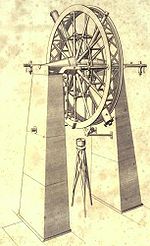
of stars down to about eighth or ninth magnitude. He spent ten years making observations on the Groombridge Transit Circle
Groombridge Transit Circle
Groombridge Transit Circle was a meridian transit circle made by Edward Troughton for Stephen Groombridge in 1806, which Groombridge used to compile data for the star catalogue, Catalogue of Circumpolar Stars. The advantage of a transit circle over a mural circle is that it allows measuring right...
and another ten years doing reductions of the data (correcting for refraction
Refraction
Refraction is the change in direction of a wave due to a change in its speed. It is essentially a surface phenomenon . The phenomenon is mainly in governance to the law of conservation of energy. The proper explanation would be that due to change of medium, the phase velocity of the wave is changed...
, instrument error and clock error). In 1827 he suffered a "severe attack of paralysis" from which he never fully recovered. Others continued the work, continuing with corrections for aberration
Aberration of light
The aberration of light is an astronomical phenomenon which produces an apparent motion of celestial objects about their real locations...
and nutation
Nutation
Nutation is a rocking, swaying, or nodding motion in the axis of rotation of a largely axially symmetric object, such as a gyroscope, planet, or bullet in flight, or as an intended behavior of a mechanism...
among others, and his Catalogue of Circumpolar Stars was published posthumously in 1838 with the help of fellow astronomer George Biddell Airy
George Biddell Airy
Sir George Biddell Airy PRS KCB was an English mathematician and astronomer, Astronomer Royal from 1835 to 1881...
(1801-1892) and others. An earlier edition had been published in 1833 but was found to contain errors and was withdrawn.
A few years later in 1842, one of the stars in his catalogue, Groombridge 1830
Groombridge 1830
Groombridge 1830 is a star in the constellation Ursa Major.-Description:It is a yellowish class G8 subdwarf catalogued by Stephen Groombridge with the Groombridge Transit Circle between 1806 and the 1830s and published posthumously in his star catalog, Catalogue of Circumpolar Stars...
, was discovered by Friedrich Wilhelm Argelander
Friedrich Wilhelm Argelander
Friedrich Wilhelm August Argelander was a German astronomer. He is known for his determinations of stellar brightnesses, positions, and distances.- Life and work :...
to have a very high proper motion
Proper motion
The proper motion of a star is its angular change in position over time as seen from the center of mass of the solar system. It is measured in seconds of arc per year, arcsec/yr, where 3600 arcseconds equal one degree. This contrasts with radial velocity, which is the time rate of change in...
. For many decades its proper motion was the highest known; today it still occupies third place.
Selected writings
- edited by George Biddell Airy; has biographical information for GroombridgeSee also
- 5657 Groombridge, an asteroid named in his honour
- Groombridge 1618Groombridge 1618Groombridge 1618 is a star in the constellation Ursa Major. It is located close to Earth, at a distance of less than 16 light years. This is an orange dwarf star of spectral type K5 V.-Properties:...
, a nearby star - Groombridge 34Groombridge 34Groombridge 34 is a binary star system located about 11.7 light years from our own Sun. It consists of two red dwarf stars in a nearly circular orbit with a separation of about 147 astronomical units. Both stars in this pair exhibit variability due to random flares and they have been given variable...
, a double star. The 16th nearest star system
Further reading
- * Adapted from Sky & Telescope, May, 1974, page 296