
All Topics  
Stede Bonnet


   Email Print
   Bookmark   Link


Stede Bonnet


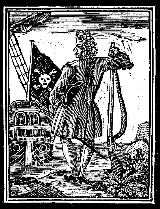
Stede Bonnet (c. 1688 – December 10, 1718) was an early 18th-century Barbadian
Barbados

Barbados , situated just east of the Caribbean Sea, is an independent Continental Island-island nation in the western Atlantic Ocean. Located at roughly 13? North of the equator and 59? West of the prime meridian, it is considered a part of the Lesser Antilles....
 pirate
Piracy

Piracy is a warlike act committed by a foreign nonstate actor, especially robbery or crime committed at sea, on a river, or sometimes on shore, either from a vessel flying no national flag, or one flying a national flag but without authorization from a nation....
, sometimes called "the gentleman pirate" because he was a moderately wealthy landowner before turning to a life of crime. Bonnet was born into a wealthy English
English people

The English are a nation and ethnic group native to England who speak English language in England. The English identity as a people is of early medieval origin, when they were known in Old English as the Anglecynn....
 family on the island of Barbados
Barbados

Barbados , situated just east of the Caribbean Sea, is an independent Continental Island-island nation in the western Atlantic Ocean. Located at roughly 13? North of the equator and 59? West of the prime meridian, it is considered a part of the Lesser Antilles....
, and inherited the family estate after his father's death in 1694. In 1709, he married Mary Allamby, and engaged in some level of militia
Militia

The term militia is commonly used today to refer to a military force composed of ordinary citizens to provide defense, emergency law enforcement, or paramilitary service, in times of emergency without being paid a regular salary or committed to a fixed term of service....
 service.


Discussion
Ask a question about 'Stede Bonnet'
Start a new discussion about 'Stede Bonnet'
Answer questions from other users
Full Discussion Forum


Recent Posts


Encyclopedia


Stede Bonnet (c. 1688 – December 10, 1718) was an early 18th-century Barbadian
Barbados

Barbados , situated just east of the Caribbean Sea, is an independent Continental Island-island nation in the western Atlantic Ocean. Located at roughly 13? North of the equator and 59? West of the prime meridian, it is considered a part of the Lesser Antilles....
 pirate
Piracy

Piracy is a warlike act committed by a foreign nonstate actor, especially robbery or crime committed at sea, on a river, or sometimes on shore, either from a vessel flying no national flag, or one flying a national flag but without authorization from a nation....
, sometimes called "the gentleman pirate" because he was a moderately wealthy landowner before turning to a life of crime. Bonnet was born into a wealthy English
English people

The English are a nation and ethnic group native to England who speak English language in England. The English identity as a people is of early medieval origin, when they were known in Old English as the Anglecynn....
 family on the island of Barbados
Barbados

Barbados , situated just east of the Caribbean Sea, is an independent Continental Island-island nation in the western Atlantic Ocean. Located at roughly 13? North of the equator and 59? West of the prime meridian, it is considered a part of the Lesser Antilles....
, and inherited the family estate after his father's death in 1694. In 1709, he married Mary Allamby, and engaged in some level of militia
Militia

The term militia is commonly used today to refer to a military force composed of ordinary citizens to provide defense, emergency law enforcement, or paramilitary service, in times of emergency without being paid a regular salary or committed to a fixed term of service....
 service. Because of marital problems, and despite his lack of sailing experience, Bonnet decided to turn to piracy in the summer of 1717. He bought a sailing vessel, named it Revenge, and traveled with his paid crew along the American eastern seaboard, capturing other vessels and burning other Barbadian ships.

Bonnet set sail for Nassau
Nassau, Bahamas

Nassau is the Capital , largest city, and commercial centre of the Commonwealth of the Bahamas. The city has a population of 260,000 , nearly 80 percent of the entire population of The Bahamas ....
, Bahamas
The Bahamas

The Bahamas, officially the Commonwealth of The Bahamas, is an independent, sovereign, English language-speaking country consisting of two thousand cays and seven hundred islands that form an archipelago....
, but he was seriously wounded en route during an encounter with a Spanish
Spanish Empire

The Spanish Empire was one of the largest empires in world history, and one of the first global empires. It included territories and colonies ruled by Spain in Europe, the Americas, Africa, Asia and Oceania between the 15th and late 19th centuries....
 warship. After arriving in Nassau, Bonnet met Edward Teach, the infamous pirate Blackbeard
Blackbeard

Edward Thatch , better known as Blackbeard, was a notorious England pirate in the Caribbean Sea and western Atlantic Ocean during the early 18th century, a period referred to as the Golden Age of Piracy....
. Incapable of leading his crew, Bonnet temporarily ceded his ship's command to Blackbeard. Before separating in December 1717, Blackbeard and Bonnet plundered and captured merchant ships along the East Coast. After Bonnet failed to capture the Protestant Caesar, his crew abandoned him to join Blackbeard aboard the Queen Anne's Revenge
Queen Anne's Revenge

Queen Anne's Revenge was the name of the piracy Blackbeard's infamous flagship, used by him for less than a year but an effective tool in his prize taking....
. Bonnet stayed on Blackbeard's ship as a guest, and did not command a crew again until summer 1718, when he was pardoned by North Carolina
Province of North Carolina

The Province of North Carolina was originally part of the Province of Carolina, which was chartered by eight Lords Proprietors. The province later became the U.S....
 governor Charles Eden
Charles Eden

Charles Eden was appointed Governor of North Carolina on July 13, 1713. He is best known for his actions to end piracy in the area. Gentlemen pirate Stede Bonnet and the notorious Blackbeard surrendered to Governor Eden and received the King's Pardon upon promising to change their ways....
 and received clearance to go privateer
Privateer

A privateer was a private warship authorized by a country's government by letters of marque to attack foreign shipping. Strictly, a privateer was only entitled by its state to attack and rob enemy vessels during wartime....
ing against Spanish shipping. Bonnet was tempted to resume his piracy, but did not want to lose his pardon, so he adopted the alias "Captain Thomas" and changed his ship's name to Royal James. He had returned to piracy by July 1718.

In August 1718, Bonnet anchored the Royal James on an estuary of the Cape Fear River
Cape Fear River

The Cape Fear River is a long blackwater river in east central North Carolina in the United States. It flows into the Atlantic Ocean near Cape Fear, from which it takes its name....
 to repair and careen
Careening

Careening a sailing Ship means to beach it at high tide in order, usually, to expose one side or another of the ship's Hull for maintenance below the water line when the tide goes out....
 the ship. In late August and September, Colonel William Rhett
William Rhett

Colonel William Rhett moved to South Carolina in 1698. He soon became successful and gained a high rank and social status as a colonial leader. In 1706 it was Rhett who commanded a flotilla that fought off a Franco-Spanish attack on Charleston, South Carolina....
, with the authorization of South Carolina
Province of South Carolina

The South Carolina Colony was originally part of the Province of Carolina, which was chartered in 1663. The colony later became the U.S. state of South Carolina....
 governor Robert Johnson
Robert Johnson (governor)

Robert Johnson was the Great Britain colonial Governor of the Province of South Carolina in 1717-1719, and again from 1729-1735.His maternal grandson was South Carolina Congressman Ralph Izard....
, led a naval expedition against pirates on the river. Rhett and Bonnet's men fought each other for hours, but the outnumbered pirates ultimately surrendered. Rhett arrested the pirates and brought them to Charleston
Charleston, South Carolina

Charleston is a city in Charleston County, South Carolina in the U.S. state of South Carolina. It is the largest city and county seat of Charleston County....
 in early October. Bonnet escaped on October 24, but was recaptured on Sullivan's Island
Sullivan's Island, South Carolina

Sullivan's Island is a town in Charleston County, South Carolina, South Carolina, United States, on a similarly-named island at the entrance to Charleston Harbor....
. On November 10, Bonnet was brought to trial and charged with two acts of piracy. Judge Nicholas Trott sentenced Bonnet to death. Bonnet wrote to Governor Johnson to ask for clemency
Pardon

A pardon is the forgiveness of a crime and the penalty associated with it. It is granted by a head of state, such as a monarch or president, or by a competent Roman Catholic Church authority....
, but Johnson endorsed the judge's decision, and Bonnet was hanged in Charleston on December 10, 1718.

Pre-criminal life

Bonnet is believed to have been born in 1688, as he was christened at Christ Church parish on July 29, 1688. His parents, Edward and Sarah Bonnet, owned an estate of over four hundred acres southeast of Bridgetown
Bridgetown

The City of Bridgetown, metropolitan pop 96,578 , is the Capital and largest city of the nation of Barbados. Formerly, the Town of Saint Michael the Greater Bridgetown area is located within the Parishes of Barbados of Saint Michael, Barbados....
, which was bequeathed to Bonnet upon his father's death in 1694. It is not known where Bonnet received his education, but many who knew him described him as bookish, and Judge Nicholas Trott alluded to Bonnet's liberal education when sentencing him. Bonnet married Mary Allamby in Bridgetown on November 21, 1709. They had three sons—Allamby, Edward, and Stede—and a daughter, Mary. Allamby died before 1715, while the other children survived to see their father abandon them for piracy. Edward's granddaughter, Anne Thomasine Clarke, was the wife of General Robert Haynes, for 36 years Speaker of the Assembly of Barbados.

In A General History of the Pyrates
A General History of the Pyrates

A General History of the Robberies and Murders of the most notorious Pyrates is a 1724 book containing biography of contemporary pirates. Its author uses the name Charles Johnson , generally considered a pseudonym....
, Charles Johnson
Charles Johnson (pirate biographer)

Captain Charles Johnson is the author of the 1724 book A General History of the Pyrates, though his identity remains a mystery. No record of a captain by this name exists....
 wrote that Bonnet was driven to piracy by Mary's nagging and "[d]iscomforts he found in a married State." Details of Bonnet's military service are unclear, but he held the rank of major
Major

In many European languages, the term Major refers to a military rank, denoting seniority at one of usually various levels of rank, for example: "Sergeant-Major" denoting the most senior ranking sergeant of a large military unit; "Captain-Major", denoting a mid-level command status Officer ...
 in the Barbados militia. The rank was probably due to his land holdings, since deterring slave revolts
Slave rebellion

A slave rebellion is an armed uprising by Slavery. Slave rebellions have occurred in nearly all societies that practice slavery, and are amongst the most feared events for slaveholders....
 was an important function of the militia. Bonnet's militia service coincided with the War of the Spanish Succession
War of the Spanish Succession

War of the Spanish Succession was a war fought in 1701-1714, in which several European powers combined to stop a possible unification of the Kingdoms of Spain and France under a single Bourbon monarch, upsetting the European Balance of power in international relations....
, but there is no record that he took part in the fighting.

Early career as a pirate

During the spring of 1717, Stede Bonnet decided to become a pirate, despite having no knowledge of shipboard life. He bought a sixty-ton
Long ton

Long ton is the name for the unit called the "ton" in the avoirdupois or Imperial unit system of measurements, as formerly used in the United Kingdom and several other Commonwealth of Nations countries....
 sloop
Sloop

A sloop is a sailboat with a fore-and-aft rig and a single mast farther forward than the mast of a cutter . A sloop's fore-triangle is smaller than a cutter's, and a sloop usually bends only one headsail, though this distinction is not definitive....
, which he equipped with six guns
Naval artillery in the Age of Sail

Naval artillery in the Age of Sail encompasses the period of roughly 1571-1863: when large, sail-powered wooden naval warships dominated the high seas, mounting a bewildering variety of different types and sizes of cannon as their main armament....
 and named the Revenge. This was unusual, as most pirates seized their ships by mutiny
Mutiny

Mutiny is a conspiracy among members of a group of similarly-situated individuals to openly oppose, change or overthrow an existing authority....
 or boarding
Boarding (attack)

Boarding, in its simplest sense, refers to the insertion onto a ship's deck of people. However, when it is classified as an attack, in most contexts, it refers to the insertion of personnel that are not members of the crew by another party....
, or else converted a privateer
Privateer

A privateer was a private warship authorized by a country's government by letters of marque to attack foreign shipping. Strictly, a privateer was only entitled by its state to attack and rob enemy vessels during wartime....
 vessel to a pirate ship. Bonnet enlisted a crew of more than seventy men. He relied on his quartermaster and officer for their knowledge of sailing, and as a result, he was not highly respected by his crew. In another break from tradition, Bonnet paid his crew wages, not shares of plunder as most pirates did. Royal Navy intelligence reported that he departed Carlisle Bay, Barbados under cover of darkness.

Bonnet's initial cruise took him to the coast of Virginia near the entrance of the Chesapeake Bay
Chesapeake Bay

The Chesapeake Bay is the largest estuary in the United States. It lies off the Atlantic Ocean, surrounded by Maryland and Virginia. The Chesapeake Bay's drainage basin covers in the District of Columbia and parts of six states: New York, Pennsylvania, Delaware, Maryland, Virginia, and West Virginia....
, where he captured and plundered four vessels, and burned the Barbadian ship Turbet to keep news of his crimes from his home island. He then sailed north to New York
New York

The State of New York is a U.S. state in the Mid-Atlantic States and Northeastern United States regions of the United States and is the nation's List of U.S....
, taking two more ships, and picking up naval supplies and releasing captives at Gardiners Island
Gardiners Island

Gardiners Island is a small island in eastern Suffolk County, New York in the U.S. state of New York, located in Gardiners Bay between the two peninsulas at the eastern end of Long Island....
. By August 1717, Bonnet had returned to the Carolinas, where he attacked two more ships, a brigantine from Boston and a Barbadian sloop. He stripped the brigantine, but brought the cargo-filled Barbadian sloop to an inlet
Inlet

An inlet is a narrow body of water between islands or leading inland from a larger body of water, often leading to an enclosed body of water, such as a Sound , bay , lagoon or marsh....
 off North Carolina to use for careening
Careening

Careening a sailing Ship means to beach it at high tide in order, usually, to expose one side or another of the ship's Hull for maintenance below the water line when the tide goes out....
 and repairing the Revenge. After the Barbadian sloop's tackle was used to careen the Revenge, the ship was dismantled for timber, and the remains were then burned. In September 1717, Bonnet set course for Nassau
Nassau, Bahamas

Nassau is the Capital , largest city, and commercial centre of the Commonwealth of the Bahamas. The city has a population of 260,000 , nearly 80 percent of the entire population of The Bahamas ....
, which was then an infamous pirate den on the island of New Providence
New Providence

New Providence is the most populous island in The Bahamas. While the first European visitors to the Bahama Islands were Bermuda salt rakers gathering sea salt in Grand Turk Island and Inagua after 1670, the first lasting occupation was on Eleuthera and then New Providence shortly thereafter....
 in the Bahamas. En route, he encountered, fought, and escaped from a Spanish man of war
Man of war

The man-of-war was the most powerful type of armed ship from the 16th to the 19th centuries. The term often refers to a ship armed with cannon and propelled primarily by sails, as opposed to a galley which is propelled primarily by oars....
. The Revenge was badly damaged, Bonnet was seriously wounded, and half the crew of the sloop was lost in the encounter. Putting in at Nassau, Bonnet replaced his casualties and refitted the Revenge, increasing the sloop's armament to twelve guns.

Collaboration with Blackbeard

While at Nassau, Bonnet met Captain
Captain (nautical)

The captain or master of a merchant vessel is a licensed mariner in ultimate command of the vessel. A ship's captain is responsible for its safe and efficient operation, including cargo operations and navigation, and ensuring that the vessel complies with local and international laws, as well as company policies....
 Benjamin Hornigold
Benjamin Hornigold

Captain Benjamin Hornigold was an England pirate during the early 18th century. His ship was the starting point for several better known pirates....
 and Edward Teach
Blackbeard

Edward Thatch , better known as Blackbeard, was a notorious England pirate in the Caribbean Sea and western Atlantic Ocean during the early 18th century, a period referred to as the Golden Age of Piracy....
 for the first time; Teach, better known as Blackbeard
Blackbeard

Edward Thatch , better known as Blackbeard, was a notorious England pirate in the Caribbean Sea and western Atlantic Ocean during the early 18th century, a period referred to as the Golden Age of Piracy....
, played a large role in the remainder of Bonnet's life. Disabled by his wounds, Bonnet temporarily ceded command of the Revenge to Blackbeard, but remained aboard as a guest of the more experienced pirate captain. Blackbeard and Bonnet weighed anchor
Anchor

An anchor is an object, often made out of metal, that is used to attach a ship to the bottom of a body of water at a specific point. There are two primary classes of anchors?temporary and permanent....
 and sailed northward to Delaware Bay
Delaware Bay

Delaware Bay is a large estuary outlet of the Delaware River on the Northeast seaboard of the United States whose fresh water mixes for many miles with the waters of the Atlantic Ocean....
, where they plundered eleven ships. On September 29, 1717, the Revenge, captained by Blackbeard, plundered the sloop Betty, which had a cargo full of Madeira wine. Captain Codd, whose merchant ship was taken on October 12, described Bonnet as walking the deck in his nightshirt, lacking any command and still unwell from his wounds. The Revenge later captured and looted the Spofford and Sea Nymph, which were leaving Philadelphia. On October 22, the Revenge stopped and robbed the Robert and Good Intent of their supplies.

Blackbeard and Bonnet left Delaware Bay and returned to the Caribbean
Caribbean Sea

The Caribbean Sea is a sea of the Atlantic Ocean situated in the mid-latitudes of the Western Hemisphere, bounded to the south and west by the Americas, with the North Atlantic Ocean proper to the northeast and the Gulf of Mexico to the northwest....
 in November, where they successfully continued their piracy. On November 17, a 200-ton ship named the Concorde was attacked by two pirate craft nearly away from the island of Martinique
Martinique

Martinique is an island in the eastern Caribbean Sea, having a land area of 1,128 km?. It is an overseas department of France. To the northwest lies Dominica, to the south St Lucia....
. The lieutenant on board described the pirate vessels as one having 12 guns and 120 men and the other having eight guns and 30 men. The crew of the Concorde put up a fight, but surrendered after the pirates bombarded them with "two volleys of cannons and musketry." Blackbeard took the Concorde and sailed south into the Grenadines
Grenadines

The Grenadines are a Caribbean island chain of over 6 islands in the Windward Islands. They are divided between the island nations of Saint Vincent and the Grenadines and Grenada....
, where he renamed the ship Queen Anne's Revenge
Queen Anne's Revenge

Queen Anne's Revenge was the name of the piracy Blackbeard's infamous flagship, used by him for less than a year but an effective tool in his prize taking....
, possibly as an insult to King George I of Great Britain
George I of Great Britain

George I was List of British Monarchs#House of Hanover and King of Ireland from 1 August 1714 until his death, and ruler of Electorate of Hanover in the Holy Roman Empire from 1698....
. Some time after December 19, Bonnet and Blackbeard separated. Bonnet now sailed into the western Caribbean. In March 1718, he encountered the 400-ton merchant vessel Protestant Caesar off Honduras
Honduras

Honduras is a democratic republic in Central America. It was formerly known as Spanish Honduras to differentiate it from British Honduras ....
. The ship escaped him, and his frustrated crew became restive. When Bonnet encountered Blackbeard again shortly afterward, Bonnet's crew deserted him to join Blackbeard. Blackbeard put a henchman named Richards in command of the Revenge. Bonnet, surprised that his colleague had betrayed him, found himself as a guest aboard the Queen Anne's Revenge. Bonnet confided in a few loyal crew members that he was ready to give up his criminal life if he could exile himself in Spain or Portugal. Bonnet would not exercise command again until the summer of 1718.

Under Captain Richards, the Revenge captured a Jamaican sloop, the Adventure, captained by David Herriot. Herriot joined the pirates, and Blackbeard now possessed three ships. Bonnet accompanied Blackbeard to South Carolina
Province of South Carolina

The South Carolina Colony was originally part of the Province of Carolina, which was chartered in 1663. The colony later became the U.S. state of South Carolina....
, where Blackbeard's four vessels blockaded the port of Charleston
Charleston, South Carolina

Charleston is a city in Charleston County, South Carolina in the U.S. state of South Carolina. It is the largest city and county seat of Charleston County....
 in the late spring of 1718. Needing a place to rest and refit their vessels, Blackbeard and Bonnet headed north to Topsail Inlet, where the Queen Anne's Revenge ran aground and was lost. Leaving the remaining three vessels at Topsail Inlet, Blackbeard and Bonnet went ashore and journeyed to Bath
Bath, North Carolina

Bath is a town in Beaufort County, North Carolina, North Carolina, United States. The population was 275 at the United States Census, 2000. Incorporated in 1705, Bath is North Carolina's oldest town, celebrating its 300th anniversary in 2005....
, which was then capital of North Carolina
Province of North Carolina

The Province of North Carolina was originally part of the Province of Carolina, which was chartered by eight Lords Proprietors. The province later became the U.S....
. Once there, both men accepted pardons from Governor Charles Eden
Charles Eden

Charles Eden was appointed Governor of North Carolina on July 13, 1713. He is best known for his actions to end piracy in the area. Gentlemen pirate Stede Bonnet and the notorious Blackbeard surrendered to Governor Eden and received the King's Pardon upon promising to change their ways....
 under King George's Act of Grace, putatively on condition of their renouncing piracy forever. While Blackbeard quietly returned to Topsail Inlet, Bonnet stayed in Bath to get a "clearance" to take the Revenge to Denmark's Caribbean colony of St. Thomas
Saint Thomas, U.S. Virgin Islands

Saint Thomas is an island in the Caribbean Sea, a county and constituent Districts and sub-districts of the United States Virgin Islands of the United States Virgin Islands , an unincorporated territory of the United States....
, where he planned to buy a letter of marque
Letter of marque

A letter of marque is an official warrant or Letters patent from a government authorizing the designated agent to search, seize, or destroy specified assets or personnel belonging to a foreign party which has committed some offense under the Public international law against the assets or citizens of the issuing nation, and has usually been...
 and go privateer
Privateer

A privateer was a private warship authorized by a country's government by letters of marque to attack foreign shipping. Strictly, a privateer was only entitled by its state to attack and rob enemy vessels during wartime....
ing against Spanish shipping. Eden granted Bonnet this clearance.

Resumption of pirate command

Bonnet returned to Topsail Inlet to find that Blackbeard had beached the majority of their former crew, robbed the Revenge and two other vessels of the squadron of most of their supplies, and sailed away for parts unknown aboard the sloop Adventure, carrying all the loot with him. Bonnet now (probably late June or early July of 1718) resumed command of the Revenge. Few, if any, of his original crew from Barbados were still aboard. Bonnet reinforced the Revenge by rescuing a number of men whom Blackbeard had marooned
Marooning

Marooning is leaving someone behind on purpose in an uninhabited area, such as an uninhabited island. The word appears in writing in approximately 1709, and is derived from the term maroon , a word for a fugitive slave, which could be a corruption of Spanish language cimarr?n, meaning "wild"....
 on a sandbar
Bar (landform)

A shoal or sandbar is a somewhat linear landform within or extending into a body of water, typically composed of sand, silt or small pebbles....
 in Topsail Inlet.

Shortly after Bonnet resumed command, a bumboat
Bumboat

A bumboat is a small boat used to ferry supplies to ships moored away from the shore. Originally referring to a scavenger's boat, the name comes from the combination of the Dutch language word for a canoe, "boomschuit" and "boat"....
's crew told him that Blackbeard was moored in Ocracoke Inlet
Ocracoke Inlet

Ocracoke Inlet is an estuary located in the Outer Banks, North Carolina, United States that separates Ocracoke Island and Portsmouth Island. It connects the Atlantic Ocean to the Pamlico Sound....
. Bonnet set sail at once to hunt down his treacherous ex-confederate, but could not find him, and Bonnet never met Blackbeard again. Although Bonnet apparently never discarded his hopes of reaching St. Thomas and getting his letter of marque, two pressing problems now tempted him back into piracy. First, Blackbeard had stolen the food and supplies he and his men needed to subsist (one pirate testified at his trial that no more than ten or eleven barrels remained aboard the Revenge). Second, St. Thomas was now in the midst of the Atlantic hurricane
Atlantic hurricane

North Atlantic tropical cyclones usually form in summer or autumn. Tropical cyclones can be broken down by intensity. Tropical storms have one-minute maximum sustained winds of at least 39 mph , while hurricanes have one-minute maximum sustained exceeding 74 mph ....
 season, which would last until autumn. However, returning to freebooting meant nullifying Bonnet's pardon.

Hoping to preserve his pardon, Bonnet adopted the alias "Captain Thomas" and changed the Revenges name to the Royal James. The name Royal James that Bonnet conferred on his sloop was presumably a reference to the younger Prince James Stuart
James Francis Edward Stuart

Prince James, Prince of Wales was the son of the deposed James II of England. As such, he claimed the English, Scottish and Irish thrones from the death of his father in 1701, when he was proclaimed king of England, Scotland and Ireland by his cousin Louis XIV of France....
, and may suggest that Bonnet or his men had Jacobite
Jacobitism

Jacobitism was the political movement dedicated to the restoration of the House of Stuart kings to the thrones of Kingdom of England, Kingdom of Scotland, and Kingdom of Ireland....
 sympathies. One of Bonnet's prisoners further reported witnessing Bonnet's men drinking to the health of the
Old Pretender and wishing to see him king of the English nation.

Bonnet further tried to disguise his return to piracy by engaging in a pretense of trade with the next two vessels he robbed. Soon afterward, Bonnet quit the charade of trading and reverted to naked piracy. In July 1718, he cruised north to Delaware Bay, pillaging another eleven vessels. He took several prisoners, some of whom joined his pirate crew. While Bonnet set loose most of his prizes after looting them, he retained control of the last two ships he captured: the sloops
Francis and Fortune. On August 1, 1718, the Royal James and the two captured sloops sailed southward from Delaware Bay. The captured sloops lagged behind, and Bonnet threatened to sink them if they did not stay closer. During the passage, Bonnet and his crew divided their loot into shares of about £10 or £11 and distributed them amongst themselves. This is the only time Bonnet is known to have practiced this important pirate custom, and it suggests he had by then abandoned his unorthodox practice of paying regular wages to his crew.

Twelve days out of Delaware Bay, Bonnet entered the estuary
Estuary

An estuary is a semi-enclosed coastal body of water with one or more rivers or streams flowing into it, and with a free connection to the open sea....
 of the Cape Fear River
Cape Fear River

The Cape Fear River is a long blackwater river in east central North Carolina in the United States. It flows into the Atlantic Ocean near Cape Fear, from which it takes its name....
 and anchored near the mouth of a small waterway now known as Bonnet's Creek. The
Royal James had begun to leak badly and was in need of careening
Careening

Careening a sailing Ship means to beach it at high tide in order, usually, to expose one side or another of the ship's Hull for maintenance below the water line when the tide goes out....
. Shortly afterward, a small shallop entered the river and was captured. Bonnet had the shallop broken up to help repair the
Royal James. The work of careening was done, in whole or in part, by the prisoners Bonnet had captured. Bonnet threatened at least one man with marooning if he did not work the Royal James
pumps. Bonnet remained in the Cape Fear River for the next 45 days. According to Bonnet's boatswain
Boatswain

A boatswain or bosun is an licensed mariner of the deck department of a merchant ship. The boatswain supervises the other unlicensed members of the ship's deck department, and typically is not a watchstanding, except on vessels with small crews....
, Ignatius Pell, the pirates intended to wait out the hurricane season there.

Battle of Cape Fear River


By the end of August, news had reached Charleston that Bonnet's vessels were moored in the Cape Fear River. Robert Johnson, governor of South Carolina, authorized Colonel William Rhett
William Rhett

Colonel William Rhett moved to South Carolina in 1698. He soon became successful and gained a high rank and social status as a colonial leader. In 1706 it was Rhett who commanded a flotilla that fought off a Franco-Spanish attack on Charleston, South Carolina....
 to lead a naval expedition against the pirates, even though the Cape Fear River was in North Carolina's jurisdiction
Jurisdiction

In law, jurisdiction is the practical authority granted to a formally constituted legal body or to a political leader to deal with and make pronouncements on legal matters and, by implication, to administer justice within a defined area of responsibility....
. After a false start due to the appearance of another pirate ship near Charleston, Rhett arrived at the mouth of the Cape Fear River on September 26 with two eight-gun sloops and a force of 130 men. Bonnet initially mistook Rhett's squadron for merchantmen and sent three canoe
Canoe

A canoe is a small narrow boat, typically human-powered, though it may also be powered by sails or small electric or gas motors. Canoes usually are pointed at both bow and stern and are normally open on top, but can be covered....
s to capture them. Unfortunately for Rhett, his flagship
Flagship

A flagship is the lead ship in a fleet of vessels, a designation given on account of being either the largest, fastest, newest, most heavily armed or, for publicity purposes, the most well known....
 Henry had run aground in the river mouth, enabling Bonnet's canoe crews to approach, recognize the heavily armed and manned sloops as hostile and return uninjured to warn Bonnet. The sun had set by the time the rising tide lifted the Henry off the river bottom.

The 46 pirates were scattered among the three sloops. During the night, Bonnet brought all of them aboard the Royal James and planned to fight his way out to sea in the morning rather than risk the Cape Fear River's narrow channels in the dark. Bonnet also wrote a letter to Governor Johnson, threatening to burn all the ships in Charleston harbor. At daybreak, on September 27, 1718, Bonnet set sail toward Rhett's force, and all three sloops opened fire, initiating the Battle of Cape Fear River. The two South Carolinian sloops split up in an effort to bracket the Royal James. Bonnet tried to avoid the trap by steering the Royal James close to the river's western shore, but ran aground in the process. Rhett's closing sloops also ran aground, leaving only the Henry in range of the Royal James.

The battle was at a stalemate for the next five or six hours, with all the participants immobilized. Bonnet's men had the advantage that their deck was heeled away from their opponents, giving them cover, while the Henrys deck was tilted toward the pirates, thus exposing Rhett's men to punishing musket volleys. Bonnet's force suffered twelve casualties while killing ten and wounding fourteen of Rhett's 70-man crew. Most of Bonnet's men fought enthusiastically, challenging their enemies to board and fight hand to hand, and tying a knot in their flag as a mock signal to come aboard and render aid. Bonnet himself patrolled the deck with a pistol drawn, threatening to kill any pirate who faltered in the fight. Nevertheless, some of the prisoners who had been forced to join the pirate crew refused to fire on Rhett's men, and one narrowly escaped death at Bonnet's hands in the confusion of the engagement.

The battle was ultimately decided when the rising tide lifted Rhett's sloops free while temporarily leaving the
Royal James stranded. Bonnet was left helpless, watching while the enemy vessels repaired their rigging and closed to board his paralyzed vessel. Outnumbered almost three to one, Bonnet's men would have had little hope of winning a boarding action. Bonnet ordered his gunner, George Ross, to blow up the Royal James's powder magazine. Ross apparently attempted this, but was overruled by the remainder of the crew, who surrendered. Rhett arrested the pirates and returned to Charleston with his prisoners on October 3.

Escape, recapture, and execution


In Charleston, Bonnet was separated from the bulk of his crew and held for three weeks in the provost marshal's house along with his boatswain, Ignatius Pell, and his sailing master, David Herriott. On October 24, Bonnet and Herriott escaped, probably by colluding with local merchant Richard Tookerman. Governor Johnson at once placed a £700 bounty on Bonnet's head and dispatched search teams to track him down. Bonnet and Herriott, accompanied by a slave and an Indian, obtained a boat and made for the north shore of Charleston Harbor, but foul winds and lack of supplies forced the four of them onto Sullivan's Island
Sullivan's Island, South Carolina

Sullivan's Island is a town in Charleston County, South Carolina, South Carolina, United States, on a similarly-named island at the entrance to Charleston Harbor....
. Governor Johnson sent a posse under Rhett to Sullivan's Island to hunt for Bonnet. The posse discovered Bonnet after an extensive search, and opened fire, killing Herriott and wounding the two slaves. Bonnet surrendered and was returned to Charleston. While awaiting trial, some sort of civil uprising in his support took place within the city, an event authorities would later describe as having nearly resulted in the burning of the town and the overthrow of the government.

On November 10, 1718, Bonnet was brought to trial before Sir Nicholas Trott, sitting in his capacity as Vice-Admiralty
Vice admiralty court

Vice admiralty courts were juryless courts located in Kingdom of Great Britain colonies that were granted jurisdiction over local legal matters related to maritime activities, such as disputes between merchants and seamen....
 judge. Trott had already sat in judgment on Bonnet's crew and sentenced most of them to hang
Hanging

Hanging is the lethal suspension of a person by a ligature. The Oxford English Dictionary states that hanging in this sense is "specifically to put to death by suspension by the neck", although it formerly also referred to crucifixion and death by impalement in which the body would remain "hanging"....
. Bonnet was formally charged with only two acts of piracy, against the
Francis and the Fortune, whose commanders were on hand to testify against Bonnet in person. Ignatius Pell had turned King's evidence
Turn state's evidence

To turn state's evidence is when an Suspect or convicted criminal testifies as a witness for the state against his associates or accomplices. Turning state's evidence is occasionally a result of a change of heart or feelings of guilt, but more often is done in response to a generous offer from the prosecution, such as a reduced sentence or a...
 in the trial of Bonnet's crew and now testified, somewhat reluctantly, against Bonnet himself. Bonnet pled not guilty and conducted his own defense without assistance of counsel, cross-examining the witnesses to little avail, and calling a character witness
Character evidence

Character evidence is a term used in the law of evidence to describe any testimony or document submitted for the purpose of proving that a person acted in a particular way on a particular occasion based on the character or disposition of that person....
 in his favor. Trott rendered a damning summation of the evidence, and the jury delivered a guilty verdict. Two days later, after treating the convicted man to a stern lecture on his violation of Christian duties, Trott sentenced Bonnet to death.

While awaiting his execution, Bonnet wrote to Governor Johnson, begging abjectly for clemency and promising to have his own arms and legs cut off as assurance that he would never again commit piracy. Charles Johnson wrote that Bonnet's visibly disintegrating mind moved many Carolinians to pity, particularly the female population, and London papers later reported that the governor delayed his execution seven times. Bonnet was ultimately hanged at White Point
Battery Park (Charleston)

Battery Park , which includes a park known as White Point Gardens, is a landmark promenade in Charleston, South Carolina famous for its stately Antebellum_Architecture#Architecture....
, in Charleston, on December 10, 1718.

Legacy


Bonnet's authority

The actual degree of authority any pirate captain exercised over his crew was questionable, as he had no access to the procedures and sanctions of admiralty law
Admiralty law

Admiralty law is a distinct body of law which governs maritime questions and offenses. It is a body of both domestic law governing maritime activities, and Conflict of laws governing the relationships between private entities which operate vessels on the oceans....
 that supported legitimate captains. Many pirate captains were elected by their crews and could be deposed in the same manner. Because of his ignorance of nautical matters, Bonnet was in an even weaker position than other pirate captains, as is demonstrated by the utter domination Blackbeard exercised over him during their collaboration. During Bonnet's early career, his crew seems to have been less than loyal to him and to have greatly preferred the more charismatic and experienced Blackbeard.

At his trial, Bonnet downplayed his own authority over his pirate crew. He told the court that his crew engaged in piracy against his will, and said he had warned them that he would leave the crew unless they stopped robbing vessels. He further stated that he had been asleep during the capture of the sloop
Francis. The court did not accept these protestations. Boatswain Ignatius Pell testified that Bonnet's quartermaster
Quartermaster

Quartermaster refers to two different military occupations. In land Army, it is a term referring to either an individual soldier or a Military unit, who specializes in supplying and provisioning troops....
, Robert Tucker, had more power than Bonnet. A powerful quartermaster appears to have been a common feature of pirate crews in the early modern era
Early modern Europe

Early modern is the term used by historians to refer to a period in the history of Western Europe and its first colony which spanned the centuries between the end of the Middle Ages and the beginning of the Industrial Revolution, roughly the late 15th century to the late 18th century....
.

Nevertheless, Bonnet's crew represented him as being a leader, and it appears likely that, after his rescue of Blackbeard's marooned crewmen, he became at least a co-equal commander aboard the
Royal James. He appears to have been entrusted with the company's treasure, and made most major command decisions such as the direction of the ship and what vessels to attack. Most significantly, at Delaware Bay he ordered two of his crew to be flogged
Flagellation

Flagellation is the act of whipping the human body. Specialised implements for it include rods, Switch and the cat-o-nine-tails. Typically, whipping is performed on unwilling subjects as a punishment; however, flagellation can also be submitted to willingly, or performed on oneself, in religious or Sadism and masochism contexts....
 for breaches of discipline. Pirates did not lightly submit to flogging, as they resented the frequent use of this punishment in the naval and merchant services from which most of them came, and thus only a leader who commanded the obedience of his crew could successfully order such penalties.

Bonnet's pirate flag

Pirate Flag of Stede Bonnet
Bonnet's flag
Jolly Roger

The Jolly Roger is the name given to any of various flags flown to identify a ship's crew as piracys. The flag most usually identified as the Jolly Roger today is the skull and crossbones, being a flag consisting of a skull above two long bones set in an x mark arrangement on a black field....
 is traditionally represented as a white skull above a horizontal long bone between a heart and a dagger, all on a black field. Despite the frequent appearance of this flag in modern pirate literature, no known early-Georgian
Georgian era

The Georgian era is a period of British history, normally defined as including the reigns of the kings George I of Great Britain, George II of Great Britain, George III of the United Kingdom and George IV of the United Kingdom, i.e....
 period source describes any such device, much less attributes it to Bonnet. This version of Bonnet's flag is probably one of a number of pirate flags appearing on an undated manuscript with unknown provenance
Provenance

Provenance, from the French provenir, "to come from", means the origin, or the wiktionary:Source, of something, or the history of the ownership or location of an object, The term was originally mostly used of works of art, but is now used in similar senses in a wide range of fields, including science and computing....
 in Britain's National Maritime Museum
National Maritime Museum

The National Maritime Museum in Greenwich, England is the leading maritime museum of the United Kingdom and may be the largest museum of its kind in the world....
, which was donated by Dr. Philip Gosse in 1939. Bonnet's crew and contemporaries generally referred to him flying a "bloody flag", which likely means a dark red flag. There is also a report from the 1718
Boston News-Letter
The Boston News-Letter

First published on April 17, 1704, The Boston News-Letter is regarded as the first continuously published newspaper in Thirteen Colonies. It was heavily subsidized by the British government, with a limited circulation....
of Bonnet flying a death's-head flag during his pursuit of the Protestant Caesar, with no mention of color or of any long bone, heart, or dagger.

Walking the plank

Bonnet is alleged to have been one of the few pirates to make his prisoners walk the plank
Walking the plank

Walking the plank was a form of execution or torture practiced by pirates, mutineers and other rogue seafarers. The victim was forced to walk off the end of a wooden plank or beam extended over the side of a ship, falling into the water to drown, sometimes with bound hands or weighed down, often into the vicinity of sharks ....
. No contemporary source makes any mention of Bonnet forcing prisoners to walk the plank, and modern scholars such as Marcus Rediker, Professor of History at the University of Pittsburgh
University of Pittsburgh

The University of Pittsburgh, commonly referred to as Pitt, is a Commonwealth System of Higher Education research university located in Pittsburgh, Pennsylvania, Pennsylvania, United States....
, generally agree that the whole concept of pirates forcing prisoners to walk the plank is largely apocryphal.

Appearances in popular culture

Bonnet is a major character in Tim Powers'
On Stranger Tides
On Stranger Tides

On Stranger Tides is a 1988 fantasy novel written by Tim Powers. It was reprinted in 2006 by Babbage Press with a forthcoming limited edition from Subterranean Publications....
, along with other famous piratical characters, particularly Blackbeard. In this novel, Bonnet takes up piracy after having been framed by Blackbeard, who has used Bonnet's hatred for his wife (only married two years in the novel) against him. Kate Bonnet: The Romance of a Pirate's Daughter, by 19th century author Frank Stockton, is a satirical novel relating the adventures of a fictional daughter of Bonnet named Kate. Bonnet is very briefly mentioned in James A. Michener's
James A. Michener

James Albert Michener was an United States author of more than 40 titles, the majority of which are novels of sweeping sagas, covering the lives of many generations in a particular geographic locale and incorporating historical facts into the story as well....
 historical novel,
Chesapeake
Chesapeake (novel)

Chesapeake is a novel by James A. Michener, published by Random House in 1978. The story deals with several families living in the Chesapeake Bay area, from 1583 to 1978....
. Bonnet is one of the pirates featured in the computer game Sid Meier's Pirates!
Sid Meier's Pirates! (2004)

Sid Meier's Pirates! is a 2004 in video gaming strategy game/action game/adventure game computer game developed by Firaxis Games and video game publisher by Atari....
. Bonnet was portrayed by James Mason
James Mason

James Neville Mason was a three-time Academy Award-nominated British People actor who attained stardom in both United Kingdom and United States films....
 in the 1962 film Hero's Island.

Bonnet's flag is featured in
Pirates of the Caribbean: At World's End as Capitaine Chevalle's flag.

A plaque commemorating Bonnet stands near Bonnet's Creek in Southport, North Carolina
Southport, North Carolina

Southport is a city in Brunswick County, North Carolina, near the mouth of the Cape Fear River. Its population was listed as 2,351 for the 2000 census....
, on the Cape Fear River. The Yacht Basin Provision Company also holds an annual Stede Bonnet Regatta near Southport, commemorating the infamous pirate's dash for the ocean.

Spelled with an unexplained, additional
e, "Steede Bonnet" is the opening track on the 1999 album From Bone to Satellite by the San Francisco–based post-rock
Post-rock

Post-rock is a genre of alternative rock characterized by the use of musical instruments commonly associated with rock music, but using rhythms, harmony, melodies, timbre, and chord progressions that are not found in rock tradition....
 band Tarentel
Tarentel (band)

Tarentel is a band based in San Francisco, California which formed in 1995. Initially, the band consisted of Danny Grody and Jefre Cantu-Ledesma....
.

The
seaquest DSV
SeaQuest DSV

seaQuest DSV is an American science fiction television series created by Rockne S. O'Bannon. It originally aired on NBC between 1993 and 1996....
episode "Greed for a Pirate's Dream," features a group of treasure hunters who find Stede Bonnet's treasure upon an island in imminent danger of volcanic eruption.

External links

  • from A Complete Collection of State Trials and Proceedings for High Treason and Other Crimes and Misdemeanors from the Earliest Period to the Year 1783 by Thomas Bayly Howell and William Cobbett, from Google Books