

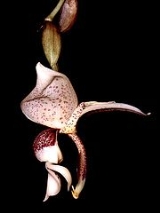
Stanhopea

Encyclopedia
Stanhopea is a genus of the orchid family (Orchidaceae
) from Central and South America. The abbreviation used in horticultural trade is Stan. The genus is named for the 4th Earl of Stanhope
(Philip Henry Stanhope) (1781-1855), president of the Medico-Botanical Society of London (1829-1837). These epiphytic
, but occasionally terrestrial
orchids can be found in damp forests from Mexico
to NW Argentina
. Their ovate pseudobulb
s carry from the top one long, plicate, elliptic leaf
.
It is noted for its complex and usually fragrant flower
s that are generally spectacular and short-lived. Their pendant inflorescence
s are noted for flowering out of the bottom of the containers in which they grow, lending themselves to culture in baskets that have enough open space for the infloresence push through. They are sometimes called upside-down orchids.
Primitive Stanhopeas
Most Stanhopea flowers flash prominent, elegant horns on the epichile. The exception are the species; S. annulata
, S. avicula
, S. cirrhata
, S. ecornuta
and S. pulla
. A second group have short or truncated horns, they include the species; S. candida
, S. grandiflora
, S. reichenbachiana
, S. tricornis
and the natural hybrid S. x herrenhusana. The structure of the labellum of this group is in general, not as complex as other members of the genus.
With most Stanhopea flowers lasting three days or less, the blooms must attract pollinators very quickly. These chemical attractants are generated in the hypochile, attracting the male euglossine
bees to the flower. When the bee touches down on the flower, a great effort is made to collect chemical scent - he eventually slides on the waxy surface of the hypochile, gliding down on the slippery lip to exit the flower. The long column
is touched in the process, resulting in the bee taking up pollinia
at the very tip of the column. When the bee slides down another flower, the pollinia are deposited on the sticky surface of the stigma.
The majority of species are robust plants that grow readily in cultivation. For relatives of Stanhopea see Stanhopeinae
and the closely related sister subtribe Coeliopsidinae
..

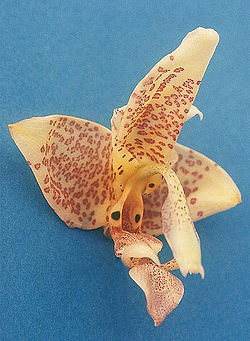
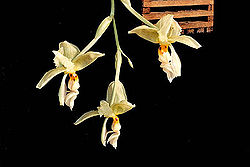 The type species
is Stanhopea insignis
.
Orchidaceae
The Orchidaceae, commonly referred to as the orchid family, is a morphologically diverse and widespread family of monocots in the order Asparagales. Along with the Asteraceae, it is one of the two largest families of flowering plants, with between 21,950 and 26,049 currently accepted species,...
) from Central and South America. The abbreviation used in horticultural trade is Stan. The genus is named for the 4th Earl of Stanhope
Earl Stanhope
Earl Stanhope was a title in the Peerage of Great Britain. It was created in 1718 for James Stanhope, 1st Viscount Stanhope, the principal minister of King George I, with remainder to the heirs male of his body. Stanhope was the son of the Hon. Alexander Stanhope, fifth and youngest son of Philip...
(Philip Henry Stanhope) (1781-1855), president of the Medico-Botanical Society of London (1829-1837). These epiphytic
Epiphyte
An epiphyte is a plant that grows upon another plant non-parasitically or sometimes upon some other object , derives its moisture and nutrients from the air and rain and sometimes from debris accumulating around it, and is found in the temperate zone and in the...
, but occasionally terrestrial
Terrestrial plant
A terrestrial plant is one that grows on land. Other types of plants are aquatic , epiphytic , lithophytes and aerial ....
orchids can be found in damp forests from Mexico
Mexico
The United Mexican States , commonly known as Mexico , is a federal constitutional republic in North America. It is bordered on the north by the United States; on the south and west by the Pacific Ocean; on the southeast by Guatemala, Belize, and the Caribbean Sea; and on the east by the Gulf of...
to NW Argentina
Argentina
Argentina , officially the Argentine Republic , is the second largest country in South America by land area, after Brazil. It is constituted as a federation of 23 provinces and an autonomous city, Buenos Aires...
. Their ovate pseudobulb
Pseudobulb
The pseudobulb is a storage organ derived from the part of a stem between two leaf nodes.It applies to the orchid family , specifically certain groups of epiphytic orchids, and may be single or composed of several internodes with evergreen or deciduous leaves along its length.In some species, it is...
s carry from the top one long, plicate, elliptic leaf
Leaf
A leaf is an organ of a vascular plant, as defined in botanical terms, and in particular in plant morphology. Foliage is a mass noun that refers to leaves as a feature of plants....
.
It is noted for its complex and usually fragrant flower
Flower
A flower, sometimes known as a bloom or blossom, is the reproductive structure found in flowering plants . The biological function of a flower is to effect reproduction, usually by providing a mechanism for the union of sperm with eggs...
s that are generally spectacular and short-lived. Their pendant inflorescence
Inflorescence
An inflorescence is a group or cluster of flowers arranged on a stem that is composed of a main branch or a complicated arrangement of branches. Strictly, it is the part of the shoot of seed plants where flowers are formed and which is accordingly modified...
s are noted for flowering out of the bottom of the containers in which they grow, lending themselves to culture in baskets that have enough open space for the infloresence push through. They are sometimes called upside-down orchids.
Primitive Stanhopeas
Most Stanhopea flowers flash prominent, elegant horns on the epichile. The exception are the species; S. annulata
Stanhopea annulata
Stanhopea annulata is a species of orchid occurring from southern Colombia to Ecuador....
, S. avicula
Stanhopea avicula
Stanhopea avicula is a species of orchid endemic to Panama....
, S. cirrhata
Stanhopea cirrhata
Stanhopea cirrhata is a species of orchid endemic to Central America....
, S. ecornuta
Stanhopea ecornuta
Stanhopea ecornuta is a species of orchid endemic to Central America....
and S. pulla
Stanhopea pulla
Stanhopea pulla is a type of orchid occurring from Costa Rica to northern Colombia....
. A second group have short or truncated horns, they include the species; S. candida
Stanhopea candida
Stanhopea candida is a species of orchid endemic to southern tropical America....
, S. grandiflora
Stanhopea grandiflora
Stanhopea grandiflora is a species of orchid occurring from Trinidad to southern tropical America....
, S. reichenbachiana
Stanhopea reichenbachiana
Stanhopea reichenbachiana is a species of orchid occurring from western Colombia to Ecuador....
, S. tricornis
Stanhopea tricornis
Stanhopea tricornis is a species of orchid endemic to western South America....
and the natural hybrid S. x herrenhusana. The structure of the labellum of this group is in general, not as complex as other members of the genus.
With most Stanhopea flowers lasting three days or less, the blooms must attract pollinators very quickly. These chemical attractants are generated in the hypochile, attracting the male euglossine
Euglossini
Euglossine bees, also called orchid bees, are the only group of corbiculate bees whose non-parasitic members do not all possess eusocial behavior. Most of the species are solitary, though a few are communal, or exhibit simple forms of eusociality...
bees to the flower. When the bee touches down on the flower, a great effort is made to collect chemical scent - he eventually slides on the waxy surface of the hypochile, gliding down on the slippery lip to exit the flower. The long column
Column (botany)
The column, or technically the gynostemium, is a reproductive structure that can be found in several plant families: Aristolochiaceae, Orchidaceae, and Stylidiaceae....
is touched in the process, resulting in the bee taking up pollinia
Pollinium
Pollinium, or plural pollinia, is a coherent mass of pollen grains in a plant.They are the product of only one anther, but are transferred, during pollination, as a single unit. This is regularly seen in plants such as orchids and many species of milkweeds .Most orchids have waxy pollinia...
at the very tip of the column. When the bee slides down another flower, the pollinia are deposited on the sticky surface of the stigma.
The majority of species are robust plants that grow readily in cultivation. For relatives of Stanhopea see Stanhopeinae
Stanhopeinae
Stanhopeinae is a subtribe of plants in the Orchid family.The subtribe in the strict sense, have viscidia and stipes that are thin and strap-like, they are adapted for attachment to edge of the bee's scutellum or to a leg. Pseudobulbs are usually ribbed/four-angled or flattened. Leaves are...
and the closely related sister subtribe Coeliopsidinae
Coeliopsidinae
Coeliopsidinae is a subtribe of plants in the Orchid family. The three members of this subtribe have traditionally been lumped in with Stanhopeinae, but obvious morphological traits and new molecular analysis by Whitten et al...
..
Species
Type species
In biological nomenclature, a type species is both a concept and a practical system which is used in the classification and nomenclature of animals and plants. The value of a "type species" lies in the fact that it makes clear what is meant by a particular genus name. A type species is the species...
is Stanhopea insignis
Stanhopea insignis
Stanhopea insignis is a species of orchid endemic to southern and southeastern Brazil. It is the type species of the genus Stanhopea....
.
- S. anfractaStanhopea anfractaStanhopea anfracta is a species of orchid occurring from southeastern Ecuador to Bolivia....
(SE. Ecuador to Bolivia). - S. annulataStanhopea annulataStanhopea annulata is a species of orchid occurring from southern Colombia to Ecuador....
(S. Colombia to Ecuador). - S. aviculaStanhopea aviculaStanhopea avicula is a species of orchid endemic to Panama....
(Panama). - S. candidaStanhopea candidaStanhopea candida is a species of orchid endemic to southern tropical America....
(S. Trop. America). - S. carchiensis (Colombia to Ecuador).
- S. cirrhataStanhopea cirrhataStanhopea cirrhata is a species of orchid endemic to Central America....
(C. America) - S. confusa G. Gerlach & Beeche (2004) (Costa Rica)
- S. connataStanhopea connataStanhopea connata is a species of orchid found from Colombia to Peru....
(Colombia to Peru). - S. costaricensisStanhopea costaricensisStanhopea costaricensis is a species of orchid endemic to Central America....
(C. America) - S. deltoidea (Peru to Bolivia).
- S. dodsoniana (NC. & S. Mexico).
- S. ecornutaStanhopea ecornutaStanhopea ecornuta is a species of orchid endemic to Central America....
(C. America). - S. embreeiStanhopea embreeiStanhopea embreei is a species of orchid.The classification of this species was published by Calaway H. Dodson in Selbyana, 1: 128. 1975. The original isotype was collected by Dodson. Distribution: Cañar . The holotype is kept at SEL...
(Ecuador). - S. floridaStanhopea floridaStanhopea florida is a species of orchid occurring from Ecuador to Peru....
(Ecuador to Peru). - S. frymireiStanhopea frymireiStanhopea frymirei is a species of orchid endemic to Ecuador....
(Ecuador). - S. gibbosaStanhopea gibbosaStanhopea gibbosa is a species of orchid occurring from Nicaragua to Costa Rica, and possibly found in Panama. There are sources that list it as found in Southern Colombia to Ecuador, but I believe there is no record of plants found there the last two centuries....
(C. America). - S. grandifloraStanhopea grandifloraStanhopea grandiflora is a species of orchid occurring from Trinidad to southern tropical America....
(Trinidad to S. Trop. America). - S. graveolensStanhopea graveolensStanhopea graveolens is a species of orchid occurring from Mexico to Honduras....
(Mexico to C. America, Brazil to NW. Argentina). - S. greeri (Peru).
- S. haselovianaStanhopea haselovianaStanhopea haseloviana is a species of orchid endemic to northern Peru....
(N. Peru). - S. hernandeziiStanhopea hernandeziiStanhopea hernandezii is a species of orchid endemic to central and southwestern Mexico....
(C. & SW. Mexico). - S. impressa (Colombia to Ecuador).
- S. inodora (Mexico - Chiapas) to C. America).
- S. insignisStanhopea insignisStanhopea insignis is a species of orchid endemic to southern and southeastern Brazil. It is the type species of the genus Stanhopea....
(SE. & S. Brazil) - S. intermediaStanhopea intermediaStanhopea intermedia is a species of orchid - endemic to southwestern Mexico....
(SW. Mexico). - S. jenischianaStanhopea jenischianaStanhopea jenischiana is a species of orchid - endemic to southwestern Mexico....
(W. South America). - S. lietzeiStanhopea lietzeiStanhopea lietzei is a species of orchid endemic to eastern and southern Brazil....
(E. & S. Brazil). - S. lowii (Colombia).
- S. maculosaStanhopea maculosaStanhopea maculosa is a species of orchid endemic to western Mexico ....
(W. Mexico). - S. madouxiana (Colombia).
- S. maduroi (Panama)
- S. manriquei Jenny & Nauray (2004) (Peru)
- S. martianaStanhopea martianaStanhopea martiana is a species of orchid endemic to southwestern Mexico....
(SW. Mexico). - S. napoensis (Ecuador)
- S. naurayi Jenny (2005) (Peru)
- S. nigripesStanhopea nigripesStanhopea nigripes is a species of orchid endemic to Peru....
(Peru). - S. novogaliciana (Mexico - Nayarit, Jalisco).
- S. oculataStanhopea oculataStanhopea oculata is a species of orchid occurring from Mexico to Colombia and southeastern Brazil....
(Mexico to Colombia, SE. Brazil) - S. ospinae (Colombia).
- S. panamensis (Panama).
- S. peruviana (Peru).
- S. platycerasStanhopea platycerasStanhopea platyceras is a species of orchid endemic to Colombia.-External links:*...
(Colombia) - S. posadae (Jenny et Braem 2004) (Colombia).
- S. pozoiStanhopea pozoiStanhopea pozoi is a species of orchid endemic to Colombia....
(Ecuador to Peru). - S. pseudoradiosaStanhopea pseudoradiosaStanhopea pseudoradiosa is a species of orchid - endemic to southwestern Mexico....
(SW. Mexico). - S. pullaStanhopea pullaStanhopea pulla is a type of orchid occurring from Costa Rica to northern Colombia....
(Costa Rica to Colombia). - S. quadricornis (Guatemala).
- S. radiosaStanhopea radiosaStanhopea radiosa is a species of orchid endemic to western Mexico ....
(W. Mexico). - S. reichenbachianaStanhopea reichenbachianaStanhopea reichenbachiana is a species of orchid occurring from western Colombia to Ecuador....
(Colombia). - S. ruckeriStanhopea ruckeriFor Stanhopea inodora Rchb.f, see Stanhopea graveolens.Stanhopea ruckeri is a species of orchid occurring from Mexico to Central America....
(Mexico to C. America). - S. saccataStanhopea saccataStanhopea saccata is a species of orchid occurring from Mexico to Central America....
(Mexico -Chiapas to C. America). - S. schilleriana (C. America).
- S. shuttleworthiiStanhopea shuttleworthiiStanhopea saccata is a species of orchid endemic to Colombia ....
(Colombia). - S. stevensoniiStanhopea stevensoniiStanhopea stevensonii is a species of orchid endemic to Colombia ....
(Colombia). - S. tigrinaStanhopea tigrinaStanhopea tigrina is a species of plant in the Orchidaceae family endemic to Mexico...
(Mexico). - S. tigrina var nigroviolacea (Mexico)
- S. tricornisStanhopea tricornisStanhopea tricornis is a species of orchid endemic to western South America....
(W. South America). - S. wardiiStanhopea wardiiStanhopea wardii is a species of orchid found from Nicaragua to Venezuela....
(C. America to Venezuela). - S. warszewiczianaStanhopea warszewiczianaStanhopea warszewicziana is a species of orchid found from Costa Rica to western Panama....
(Costa Rica). - S. xytriophoraStanhopea xytriophoraStanhopea xytriophora is a species of orchid found from southern Peru to Bolivia....
(Peru to Bolivia).
Natural hybrids
- Stanhopea × fowlieana (Stanhopea costaricensis × Stanhopea ecornuta) (Costa Rica)
- Stanhopea × herrenhusana (Stanhopea reichenbachiana × Stanhopea tricornis) (Colombia)
- Stanhopea × horichiana (Stanhopea ecornuta × Stanhopea wardii) (Costa Rica)
- Stanhopea × lewisae (Stanhopea ecornuta × Stanhopea inodora) (Guatemala)
- Stanhopea × thienii (Stanhopea annulata × Stanhopea impressa) (Ecuador)
Intergeneric hybrids
- × Aciopea (Acineta × Stanhopea). Aciopea Guillermo Gaviria (Acineta erythroxantha × Stanhopea wardii) was registered Nov-Dec 2004 by Guillermo Gaviria-Correa (Colombia).
- × Aciopea is abbreviated Aip..
- × Cirrhopea (Cirrhaea × Stanhopea)
- × Coryhopea (Coryanthes × Stanhopea)
- × Stangora (Gongora × Stanhopea)
- × Stanhocycnis (Polycycnis × Stanhopea)