

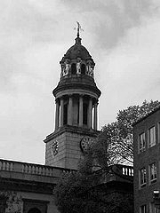
St Marylebone Parish Church

Encyclopedia
First church
The first church for the parish (then including TyburnTyburn
Tyburn is a former village just outside the then boundaries of London that was best known as a place of public execution.Tyburn may also refer to:* Tyburn , river and historical water source in London...
) was built in the vicinity of the present Marble Arch
Marble Arch
Marble Arch is a white Carrara marble monument that now stands on a large traffic island at the junction of Oxford Street, Park Lane, and Edgware Road, almost directly opposite Speakers' Corner in Hyde Park in London, England...
c.1200, and dedicated to St John the Evangelist.
Second church
Francis Bacon
Francis Bacon, 1st Viscount St Albans, KC was an English philosopher, statesman, scientist, lawyer, jurist, author and pioneer of the scientific method. He served both as Attorney General and Lord Chancellor of England...
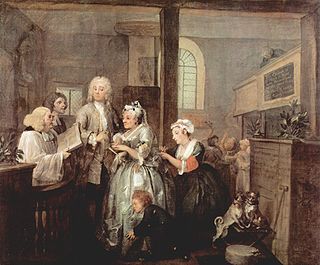
was married in 1606, and its interior was portrayed by William Hogarth
William Hogarth
William Hogarth was an English painter, printmaker, pictorial satirist, social critic and editorial cartoonist who has been credited with pioneering western sequential art. His work ranged from realistic portraiture to comic strip-like series of pictures called "modern moral subjects"...
in the marriage scene from his famous series "A Rake's Progress
A Rake's Progress
A Rake's Progress is a series of eight paintings by 18th century English artist William Hogarth. The canvases were produced in 1732–33 then engraved and published in print form in 1735...
" (1735). By 1722, its congregation was so large it needed a chapel of ease
Chapel of ease
A chapel of ease is a church building other than the parish church, built within the bounds of a parish for the attendance of those who cannot reach the parish church conveniently....
in the form of the Marybone Chapel
Marybone Chapel
The Marybone Chapel or Marylebone Chapel also known until 1832 as the Oxford Chapel after its founder Edward Harley, 2nd Earl of Oxford and Earl Mortimer, and now known as St Peter's Vere Street, was a former Anglican church off Oxford Street, London. It was designed by James Gibbs in 1722...
.
Third church
A new, small church was built on the same site in 1740. Charles WesleyCharles Wesley
Charles Wesley was an English leader of the Methodist movement, son of Anglican clergyman and poet Samuel Wesley, the younger brother of Anglican clergyman John Wesley and Anglican clergyman Samuel Wesley , and father of musician Samuel Wesley, and grandfather of musician Samuel Sebastian Wesley...
lived and worked in the area and sent for this church's rector John Harley and told him "Sir, whatever the world may say of me, I have lived, and I die, a member of the Church of England
Church of England
The Church of England is the officially established Christian church in England and the Mother Church of the worldwide Anglican Communion. The church considers itself within the tradition of Western Christianity and dates its formal establishment principally to the mission to England by St...
. I pray you to bury me in your churchyard." On his death, his body was carried to the church by eight clergymen of the Church of England and a memorial stone to him stands in the gardens in the High Street, close to his burial spot. One of his sons, Samuel
Samuel Wesley
Samuel Wesley was an English organist and composer in the late Georgian period. Wesley was a contemporary of Mozart and was called by some "the English Mozart."-Personal life:...
, was later organist of the present church.
Also in this phase of the church Lord Byron was baptised (in 1788), Nelson's daughter Horatia was baptised (Nelson was a worshipper here), and Richard Brinsley Sheridan
Richard Brinsley Sheridan
Richard Brinsley Butler Sheridan was an Irish-born playwright and poet and long-term owner of the London Theatre Royal, Drury Lane. For thirty-two years he was also a Whig Member of the British House of Commons for Stafford , Westminster and Ilchester...
was married to Elizabeth Ann Linley
Elizabeth Ann Linley
Elizabeth Ann Sheridan was the second daughter of the composer Thomas Linley and his wife Mary Johnson, and was herself the wife of the playwright Richard Brinsley Sheridan.-Life:Of the 7 Linley children destined for musical careers, it is said that Elizabeth had the greatest talent and beauty...
. This is also the Church in which Diplomat Sir William Hamilton married Emma Hart (Amy Lyon), later the lover of Admiral Horatio Nelson
Fourth (and present) church
Construction of a new church was first considered in 1770, with plans prepared by Sir William ChambersWilliam Chambers (architect)
Sir William Chambers was a Scottish architect, born in Gothenburg, Sweden, where his father was a merchant. Between 1740 and 1749 he was employed by the Swedish East India Company making several voyages to China where he studied Chinese architecture and decoration.Returning to Europe, he studied...
and leadership given by the 3rd
William Cavendish-Bentinck, 3rd Duke of Portland
William Henry Cavendish-Bentinck, 3rd Duke of Portland, KG, PC was a British Whig and Tory statesman, Chancellor of the University of Oxford and Prime Minister. He was known before 1762 by the courtesy title Marquess of Titchfield. He held a title of every degree of British nobility—Duke,...
and 4th
William Bentinck, 4th Duke of Portland
William Henry Cavendish Cavendish-Scott-Bentinck, 4th Duke of Portland PC, FRS, FSA , styled Marquess of Titchfield until 1809, was a British politician who served in various positions in the governments of George Canning and Lord Goderich.-Background and education:Portland was the eldest son of...
Dukes of Portland (owners of much of the area, by now a wealthy residential area to the west of London that had outgrown the previous church), but the scheme was abandoned and the land donated for it in Paddington Street purchased for a burial ground. In 1810-11 the present site was secured, plans made up by Chambers's pupil Thomas Hardwick
Thomas Hardwick
Thomas Hardwick was a British architect and a founding member of the Architect's Club in 1791.-Early life and career :Hardwick was born in Brentford, the son of a master mason turned architect also named Thomas Hardwick Thomas Hardwick (1752–1829) was a British architect and a founding...
and the foundation stone laid on 5 July 1813. Originally only intended as a Chapel of Ease, it was during construction decided to enlarge the building into the Parish Church, with the addition of the present tower and a wider front with Corinthian columns. A vaulted crypt (the parish burial ground until being bricked up in 1853, and since 1987 - after reinterment of its 850 coffins at Brookwood Cemetery
Brookwood Cemetery
Brookwood Cemetery is a burial ground in Brookwood, Surrey, England. It is the largest cemetery in the United Kingdom and one of the largest in western Europe.-History:...
in Surrey - a Healing and Counselling Centre) extended under the whole church, with extensive catacombs under the west side, and a double gallery ran round the entire church. In the south corners were two rooms fitted with fireplaces which served as family pews, and other church furniture included a large pulpit and reading desk and high box pew
Box pew
Box pew is a type of church pew that is encased in panelling and was prevalent in England and other Protestant countries from the 16th to early 19th century.-History in England:...
s. At an overall cost of £80,000, the church was completed in 1817.
Behind the altar hung an oil painting of the Holy Family by Benjamin West
Benjamin West
Benjamin West, RA was an Anglo-American painter of historical scenes around and after the time of the American War of Independence...
(1738–1820), a local resident, below the organ case and console and the choir loft. The painting and some marble tablets were scraped and cut by a madman in 1859. Another resident was Charles Dickens
Charles Dickens
Charles John Huffam Dickens was an English novelist, generally considered the greatest of the Victorian period. Dickens enjoyed a wider popularity and fame than had any previous author during his lifetime, and he remains popular, having been responsible for some of English literature's most iconic...
(1812–1870), in Devonshire Terrace, whose son was baptised in this church (a ceremony fictionalised in "Dombey and Son
Dombey and Son
Dombey and Son is a novel by the Victorian author Charles Dickens. It was first published in monthly parts between October 1846 and April 1848 with the full title Dealings with the Firm of Dombey and Son: Wholesale, Retail and for Exportation...
"). Robert Browning
Robert Browning
Robert Browning was an English poet and playwright whose mastery of dramatic verse, especially dramatic monologues, made him one of the foremost Victorian poets.-Early years:...
and Elizabeth Barrett were married in this phase of the church in 1846 (their marriage certificate is preserved in the church archives). The church was also used in location filming for the 1957
1957 in film
The year 1957 in film involved some significant events.-Events:* October 21 - The movie Jailhouse Rock, starring Elvis Presley, opens.-Top grossing films : After theatrical re-issue-Awards:...
movie recounting their story, The Barretts of Wimpole Street
The Barretts of Wimpole Street (1957 film)
The Barretts of Wimpole Street is a 1957 film originating from the United Kingdom, and was a re-make of the earlier 1934 version by the same director, Sidney Franklin. Both films are based on the play The Barretts of Wimpole Street by Rudolf Besier...
.
1882 rebuild
In 1882 the energetic new Rector, the Revd W. Barker led the parish council to extensively redevelop the church, to (in Barker's words) "bring it more into harmony with the arrangements and decorations suited to the religious demands of the present day". The new plans, by Thomas HarrisThomas Harris (architect)
-Work:Though his parentage and early career are unknown, he was established in independent practice in London by 1851. His works include Milner Field in Bingley , Bedstone Court and Stokesay Court in Shropshire and the remodelling of St Marylebone Parish Church in London.-Writings:Harris was also...
(architect and churchwarden of the parish), removed the end wall and the upper galleries along the sides of the church (uncovering the windows' full length and letting in more light), created a chancel for a robed choir (with new carved mahogany choir stalls with angel ends) and a sanctuary within the new apse, and added a marble mosaic floor, a fine marble pulpit and two balustrades (with Alpha and Omega on the latter). This new scheme combined Neo-Classicism with Pre-Raphaelitism, and included a gilded cross in the ceiling above the site of the original altar. Funded by subscription, it began in 1884 (with a memorial stone, laid by Mrs Gladstone, wife of the Prime Minister
William Ewart Gladstone
William Ewart Gladstone FRS FSS was a British Liberal statesman. In a career lasting over sixty years, he served as Prime Minister four separate times , more than any other person. Gladstone was also Britain's oldest Prime Minister, 84 years old when he resigned for the last time...
, in the outside wall of the apse) and was completed a year later.
Post-war
A bomb fell in the churchyard close by during the second world war, blowing out out all the windows, piercing the ceiling over the reredos in two places with pieces of iron railing from the school playground and necessitating the church's closure for repairs until 1949, when fragments of the original coloured glass incorporated in the new windows and a Browning Chapel created at the back of the church to commemorate the Browning's marriage here. This chapel later became a parish room known as the Browning Room, with the chapel transferred to the side of the church as the Holy Family Chapel. This Room did contain several items of Browning furniture which have since largely been stolen.Organ
The church contains a four manual organ by Rieger OrgelbauRieger Orgelbau
Rieger Orgelbau is an Austrian firm of organ builders, known generally as Rieger. The firm was founded by Franz Rieger. From 1873 it was known as Rieger & Söhne, and from 1879 as Gebrüder Rieger, after his sons took over. At the end of World War II, the firm was nationalised by the Czech government...
. A specification of the organ can be found on the National Pipe Organ Register.
Organists
- Samuel WesleySamuel WesleySamuel Wesley was an English organist and composer in the late Georgian period. Wesley was a contemporary of Mozart and was called by some "the English Mozart."-Personal life:...
1817 - 1834 - William Hodge
- Frederick B. Kiddle ???? - 1913
- Douglas Edward HopkinsDouglas Edward HopkinsDouglas Edward Hopkins was an cathedral organist, who served at Peterborough Cathedral and Canterbury Cathedral.-Background:Douglas Edward Hopkins was born on 23 December 1902 in London....
1965 - 1971 (formerly organist of Canterbury CathedralCanterbury CathedralCanterbury Cathedral in Canterbury, Kent, is one of the oldest and most famous Christian structures in England and forms part of a World Heritage Site....
) - Michael HowardMichael Howard (musician)Michael Stockwin Howard was an English choral conductor, organist and composer. He was an important part of the Early Music movement in the middle of the last century, in particular as a celebrated interpreter of 16th century polyphony In his later years he made notable recordings of the late...
1971 - 1979 - David Dunnett
- Margaret Phillips 1980 - 1991
- Peter Barley 1991 - 2001 (afterwards organist of St. Patrick's Cathedral, DublinSt. Patrick's Cathedral, DublinSaint Patrick's Cathedral , or more formally, the Cathedral of the Blessed Virgin Mary and St Patrick is a cathedral of the Church of Ireland in Dublin, Ireland which was founded in 1191. The Church has designated it as The National Cathedral of Ireland...
) - Steven Grahl 2001 - current