

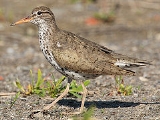
Spotted Sandpiper

Encyclopedia
The Spotted Sandpiper is a small shorebird, 18–20 cm long. Together with its sister species, the Common Sandpiper
(A. hypoleucos) they make up the genus
Actitis. They replace each other geographically; stray birds may settle down with breeders of the other species and hybridize.
Their breeding habitat is near fresh water across most of Canada
and the United States
. They migrate
to the southern United States and South America
, and are very rare vagrants to western Europe
. These are not gregarious birds and are seldom seen in flocks.
Adults have short yellowish legs and an orange bill with a dark tip. The body is brown on top and white underneath with black spots. Non-breeding bird
s, depicted below, do not have the spotted underparts, and are very similar to the Common Sandpiper of Eurasia
; the main difference is the more washed-out wing pattern visible in flight and the normally light yellow legs and feet of the Spotted Sandpiper. The Actitis species have a distinctive stiff-winged flight low over the water.
Spotted Sandpipers nest on the ground. During each summer breeding season, females may mate with and lay clutches for more than one male, leaving incubation to them. Male parents of first clutches may father chicks in later male's clutchs, probably due to sperm storage within female reproductive tracts, which is common in birds. Females that fail to find additional mates usually help incubate and rear chicks. "Prior to incubation, blood plasma concentrations of testosterone and dihydrotestosterone are substantially higher in males than in females" and these levels plummet 25-fold in males as incubation proceeds. Additionally, mated females have testosterone concentrations that are 7 times higher than those of unmated females.
These birds forage on ground or water, picking up food by sight. They may also catch insects in flight. They eat insects, crustaceans and other invertebrate
s. As they forage, they can be recognized by their constant nodding and teetering.
Common Sandpiper
The Common Sandpiper is a small Palearctic wader. This bird and its American sister species, the Spotted Sandpiper , make up the genus Actitis. They are parapatric and replace each other geographically; stray birds of either species may settle down with breeders of the other and hybridize...
(A. hypoleucos) they make up the genus
Genus
In biology, a genus is a low-level taxonomic rank used in the biological classification of living and fossil organisms, which is an example of definition by genus and differentia...
Actitis. They replace each other geographically; stray birds may settle down with breeders of the other species and hybridize.
Their breeding habitat is near fresh water across most of Canada
Canada
Canada is a North American country consisting of ten provinces and three territories. Located in the northern part of the continent, it extends from the Atlantic Ocean in the east to the Pacific Ocean in the west, and northward into the Arctic Ocean...
and the United States
United States
The United States of America is a federal constitutional republic comprising fifty states and a federal district...
. They migrate
Bird migration
Bird migration is the regular seasonal journey undertaken by many species of birds. Bird movements include those made in response to changes in food availability, habitat or weather. Sometimes, journeys are not termed "true migration" because they are irregular or in only one direction...
to the southern United States and South America
South America
South America is a continent situated in the Western Hemisphere, mostly in the Southern Hemisphere, with a relatively small portion in the Northern Hemisphere. The continent is also considered a subcontinent of the Americas. It is bordered on the west by the Pacific Ocean and on the north and east...
, and are very rare vagrants to western Europe
Europe
Europe is, by convention, one of the world's seven continents. Comprising the westernmost peninsula of Eurasia, Europe is generally 'divided' from Asia to its east by the watershed divides of the Ural and Caucasus Mountains, the Ural River, the Caspian and Black Seas, and the waterways connecting...
. These are not gregarious birds and are seldom seen in flocks.
Adults have short yellowish legs and an orange bill with a dark tip. The body is brown on top and white underneath with black spots. Non-breeding bird
Bird
Birds are feathered, winged, bipedal, endothermic , egg-laying, vertebrate animals. Around 10,000 living species and 188 families makes them the most speciose class of tetrapod vertebrates. They inhabit ecosystems across the globe, from the Arctic to the Antarctic. Extant birds range in size from...
s, depicted below, do not have the spotted underparts, and are very similar to the Common Sandpiper of Eurasia
Eurasia
Eurasia is a continent or supercontinent comprising the traditional continents of Europe and Asia ; covering about 52,990,000 km2 or about 10.6% of the Earth's surface located primarily in the eastern and northern hemispheres...
; the main difference is the more washed-out wing pattern visible in flight and the normally light yellow legs and feet of the Spotted Sandpiper. The Actitis species have a distinctive stiff-winged flight low over the water.
Spotted Sandpipers nest on the ground. During each summer breeding season, females may mate with and lay clutches for more than one male, leaving incubation to them. Male parents of first clutches may father chicks in later male's clutchs, probably due to sperm storage within female reproductive tracts, which is common in birds. Females that fail to find additional mates usually help incubate and rear chicks. "Prior to incubation, blood plasma concentrations of testosterone and dihydrotestosterone are substantially higher in males than in females" and these levels plummet 25-fold in males as incubation proceeds. Additionally, mated females have testosterone concentrations that are 7 times higher than those of unmated females.
These birds forage on ground or water, picking up food by sight. They may also catch insects in flight. They eat insects, crustaceans and other invertebrate
Invertebrate
An invertebrate is an animal without a backbone. The group includes 97% of all animal species – all animals except those in the chordate subphylum Vertebrata .Invertebrates form a paraphyletic group...
s. As they forage, they can be recognized by their constant nodding and teetering.
External links
- Spotted Sandpiper Species Account - Cornell Lab of Ornithology
- Spotted Sandpiper Information and Photos - South Dakota Birds and Birding
- Spotted Sandpiper Actitis macularia - USGS Patuxent Bird Identification InfoCenter