

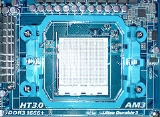
Socket AM3

Encyclopedia
Socket AM3 is a CPU socket
for AMD
processors
. AM3 was launched as the successor to Socket AM2+
on February 9, 2009, alongside the initial grouping of Phenom II
processors designed for it. The sole principal change from AM2+ to AM3 is support for DDR3 SDRAM
.
The "AM3 Processor Functional Data Sheet" AMD document number 40778 has been made publicly available @ http://support.amd.com/us/Processor_TechDocs/46878.pdf
As AM3 processors also support DDR2, they are backwards-compatible with Socket AM2/AM2+, contingent upon a BIOS
update for the motherboard. Manufacturers including Asus
, Gigabyte
, and others have labeled existing AM2/AM2+ boards as being "AM3 Ready" or similar, indicating that BIOS support is provided for the specified boards. This allows existing AM2/AM2+ systems to upgrade the CPU without having to upgrade any other components.
microarchitecture and will retain compatibility with AM3 processors. The set of features is not yet known.
An early preview of a motherboard from MSI, indicates Socket AM3+ is also known as Socket AM3b. The pin-count for this revised socket is 942-pins.
Some manufacturers have announced that some of their AM3 motherboards will support AM3+ CPUs, after a simple BIOS upgrade. Mechanical compatibility has been confirmed and it's possible AM3+ CPUs will work in AM3 boards, provided they can supply enough peak current. Another issue might be the use of the sideband temperature sensor interface for reading the temperature from the CPU. Also, certain power-saving features may not work, due to lack of support for rapid VCore switching. Note that use of AM3+ CPUs in AM3 boards may not be officially supported by AMD.
CPU socket
A CPU socket or CPU slot is a mechanical component that provides mechanical and electrical connections between a microprocessor and a printed circuit board . This allows the CPU to be replaced without soldering....
for AMD
Advanced Micro Devices
Advanced Micro Devices, Inc. or AMD is an American multinational semiconductor company based in Sunnyvale, California, that develops computer processors and related technologies for commercial and consumer markets...
processors
Central processing unit
The central processing unit is the portion of a computer system that carries out the instructions of a computer program, to perform the basic arithmetical, logical, and input/output operations of the system. The CPU plays a role somewhat analogous to the brain in the computer. The term has been in...
. AM3 was launched as the successor to Socket AM2+
Socket AM2+
Socket AM2+ is a CPU socket, which is the immediate successor to Socket AM2 that is used by several AMD processors such as Athlon 64 X2. Socket AM2+ is a mid-migration from Socket AM2 to Socket AM3 and both AM2+ and AM2 socket CPUs and motherboards have the potential to operate together...
on February 9, 2009, alongside the initial grouping of Phenom II
Phenom II
Phenom II is a family of AMD's multi-core 45 nm processors using the AMD K10 microarchitecture, succeeding the original Phenom. Advanced Micro Devices released the Socket AM2+ version of Phenom II in December 2008, while Socket AM3 versions with DDR3 support, along with an initial batch of...
processors designed for it. The sole principal change from AM2+ to AM3 is support for DDR3 SDRAM
DDR3 SDRAM
In computing, DDR3 SDRAM, an abbreviation for double data rate type three synchronous dynamic random access memory, is a modern kind of dynamic random access memory with a high bandwidth interface. It is one of several variants of DRAM and associated interface techniques used since the early 1970s...
.
The "AM3 Processor Functional Data Sheet" AMD document number 40778 has been made publicly available @ http://support.amd.com/us/Processor_TechDocs/46878.pdf
Compatibility
Socket AM3 breaks compatibility with AM2/AM2+ processors due to a subtle change in key placement. The AM3 socket has 941 pin contacts in a different layout while AM2+ processors have 940 pins. Tom's Hardware removed the two obstructing key pins from an AM2+ Phenom processor in order to fit it into an AM3 socket. The processor did not work in the AM3 socket, but still worked in an AM2+ socket, suggesting that compatibility issues run deeper than merely the key pins. It is likely due to the fact that the built-in memory controller in AM2/AM2+ processors only supports DDR2 (unlike AM3 processors, which support both DDR2 & DDR3 memory).As AM3 processors also support DDR2, they are backwards-compatible with Socket AM2/AM2+, contingent upon a BIOS
BIOS
In IBM PC compatible computers, the basic input/output system , also known as the System BIOS or ROM BIOS , is a de facto standard defining a firmware interface....
update for the motherboard. Manufacturers including Asus
ASUS
ASUSTeK Computer Incorporated is a multinational computer technology and consumer electronics product manufacturer headquartered in Taipei, Taiwan. Its product range includes motherboards, desktops, laptops, monitors, tablet PCs, servers and mobile phones...
, Gigabyte
Gigabyte Technology
Gigabyte Technology Co., Ltd. is a Taiwan-based manufacturer of computer hardware products best known for its motherboards. The company is publicly held and traded on the Taiwan Stock Exchange .-Company:...
, and others have labeled existing AM2/AM2+ boards as being "AM3 Ready" or similar, indicating that BIOS support is provided for the specified boards. This allows existing AM2/AM2+ systems to upgrade the CPU without having to upgrade any other components.
Socket AM3+
AM3+ is a modification of the AM3 Socket designed for future "Zambezi" CPUs which use the new BulldozerBulldozer (processor)
Bulldozer is the codename Advanced Micro Devices has given to one of the next-generation CPU cores after the K10 microarchitecture for the company's M-SPACE design methodology, with the core specifically aimed at 10-watt to 125-watt TDP computing products. Bulldozer is a completely new design...
microarchitecture and will retain compatibility with AM3 processors. The set of features is not yet known.
An early preview of a motherboard from MSI, indicates Socket AM3+ is also known as Socket AM3b. The pin-count for this revised socket is 942-pins.
Some manufacturers have announced that some of their AM3 motherboards will support AM3+ CPUs, after a simple BIOS upgrade. Mechanical compatibility has been confirmed and it's possible AM3+ CPUs will work in AM3 boards, provided they can supply enough peak current. Another issue might be the use of the sideband temperature sensor interface for reading the temperature from the CPU. Also, certain power-saving features may not work, due to lack of support for rapid VCore switching. Note that use of AM3+ CPUs in AM3 boards may not be officially supported by AMD.