
All Topics  
Social class in ancient Rome


   Email Print
   Bookmark   Link


Social class in ancient Rome


Social class
Social class

Social class refers to the hierarchy distinctions between individuals or groups in societies or cultures. Usually most societies have some notion of social class , but concretely defined social classes are not found in every known type of human societies....
 in ancient Rome
Ancient Rome

Ancient Rome was a civilization that grew out of a small agricultural community founded on the Italian Peninsula as early as the 10th century BC....
 played a major role in the lives of Romans. Ancient Roman society was hierarchical
Social hierarchy

Social hierarchy is a multi-tiered pyramid-like social or functional structure having an apex as the centralization of power. The term can also be applied to animal societies, but the term dominance hierarchy is preferred most times....
. Free-born Roman citizens
Roman citizenship

Citizenship in ancient Rome was a privileged social status afforded to certain individuals with respect to laws, property, and governance.It is hard to offer meaningful generalities across the entire Roman period, as the nature and availability of citizenship was affected by legislation, for example, the Lex Iulia....
 were divided into several classes, both by ancestry and by property. There were also several classes of non-citizens with different legal rights, along with slaves
Slavery in antiquity

Slavery in the ancient world, specifically, in Mediterranean cultures, comprised a mixture of debt-slavery, slavery as a punishment for crime, and the enslavement of prisoner of war....
  who had none.

broadest division was by ancestry, between patrician
Patrician

The term "patrician" originally referred to a group of elitism citizens in ancient Rome, including both their natural and adopted members. In the late Roman empire, the class was broadened to include high council officials, and after the fall of the Western Empire became a term for Byzantine Imperial governors in the West....
s, those who could trace their ancestry to the first Senate
Roman Senate

The Senate of the Roman Republic was a political institution in the ancient Roman Republic. According to the Greek historian Polybius, our principal source on the Constitution of the Roman Republic, the Roman Senate was the predominant branch of government....
 established by Romulus
Romulus

Romulus may refer to any of these articles:...
, and plebeians
Plebs

The Plebs was the general body of Roman citizens in Ancient Rome. They were distinct from the higher class of the patricians. A member of the plebs was known as a plebeian ....
, all other citizens.


Discussion
Ask a question about 'Social class in ancient Rome'
Start a new discussion about 'Social class in ancient Rome'
Answer questions from other users
Full Discussion Forum


Recent Posts


Encyclopedia


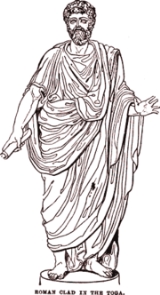
Toga Illustration
Social class
Social class

Social class refers to the hierarchy distinctions between individuals or groups in societies or cultures. Usually most societies have some notion of social class , but concretely defined social classes are not found in every known type of human societies....
 in ancient Rome
Ancient Rome

Ancient Rome was a civilization that grew out of a small agricultural community founded on the Italian Peninsula as early as the 10th century BC....
 played a major role in the lives of Romans. Ancient Roman society was hierarchical
Social hierarchy

Social hierarchy is a multi-tiered pyramid-like social or functional structure having an apex as the centralization of power. The term can also be applied to animal societies, but the term dominance hierarchy is preferred most times....
. Free-born Roman citizens
Roman citizenship

Citizenship in ancient Rome was a privileged social status afforded to certain individuals with respect to laws, property, and governance.It is hard to offer meaningful generalities across the entire Roman period, as the nature and availability of citizenship was affected by legislation, for example, the Lex Iulia....
 were divided into several classes, both by ancestry and by property. There were also several classes of non-citizens with different legal rights, along with slaves
Slavery in antiquity

Slavery in the ancient world, specifically, in Mediterranean cultures, comprised a mixture of debt-slavery, slavery as a punishment for crime, and the enslavement of prisoner of war....
  who had none.

Patricians and Plebeians

The broadest division was by ancestry, between patrician
Patrician

The term "patrician" originally referred to a group of elitism citizens in ancient Rome, including both their natural and adopted members. In the late Roman empire, the class was broadened to include high council officials, and after the fall of the Western Empire became a term for Byzantine Imperial governors in the West....
s, those who could trace their ancestry to the first Senate
Roman Senate

The Senate of the Roman Republic was a political institution in the ancient Roman Republic. According to the Greek historian Polybius, our principal source on the Constitution of the Roman Republic, the Roman Senate was the predominant branch of government....
 established by Romulus
Romulus

Romulus may refer to any of these articles:...
, and plebeians
Plebs

The Plebs was the general body of Roman citizens in Ancient Rome. They were distinct from the higher class of the patricians. A member of the plebs was known as a plebeian ....
, all other citizens. Originally, all public offices were open only to patricians, and the classes could not intermarry. Contemporary politicians and writers (Coriolanus
Coriolanus

Gaius Marcius Coriolanus was a possibly legendary ancient Rome general who lived in the 5th century BC. He received his toponymy title "Coriolanus" because of his exceptional valor in a Roman siege of the Volscian city of Corioli....
, for example) in the Kingdom and early Republic thought of plebeians as rabble barely capable of sentient thought. However, the plebeians, by withdrawing their labour, had the power to force change. A series of social struggles (see Conflict of the Orders
Conflict of the Orders

The Conflict of the Orders, also referred to as the Struggle of the Orders, was a political struggle between the plebss and Patricians of the ancient Roman Republic, in which the Plebeians sought political equality with the Patricians....
) saw the plebs secede from the city on three occasions, the last in 297 BC, until their demands were met. They won the right to stand for office, the abolition of the intermarriage law, and the office of tribune
Tribune

Tribune was a title shared by 10 elected officials in the Roman Republic. Tribunes had the power to convene the Plebeian Council and to act as its president, which also gave them the exclusive right to propose legislation before it....
 of the plebs. This office, founded in 494 BC as a result of a plebeian secession, was the main legal bulwark against the powers of the patrician class. The tribunes originally had the power to protect any plebeian from a patrician magistrate. Later revolts forced the Senate to grant the tribunes additional powers, such as the right to veto
Veto

A veto, Latin for "I forbid", is used to denote that a certain party has the right to stop unilaterally a piece of legislation. In practice, the veto can be absolute or limited ...
 legislation. A tribune's person was sacrosanct, and he was obliged to keep an open house at all times while in office.

Following these changes the distinction between patrician and plebeian status became less important. Over time, some patrician families fell on hard times, some plebeian families rose in status, and the composition of the ruling class changed. Some patricians, notably Publius Clodius Pulcher
Publius Clodius Pulcher

Publius Clodius Pulcher , was a Roman Republic politician of the Populares cause, who passed several significant laws but was chiefly remembered for his feuds with Titus Annius Milo and Marcus Tullius Cicero and for his introduction of the grain dole....
, petitioned to be assigned plebeian status, partly in order to run for the position of tribune but also partly to lessen the patrician tax burden. Rome's growing economic power as a trading nation left many patrician families behind; those that could not adjust to the new commercial realities of Roman society often found themselves in the embarrassing position of having to marry their daughters to wealthier plebeians or even freedmen. A plebeian, such as Marius
Gaius Marius

Gaius Marius was a Roman Republic general and politician elected consul an unprecedented seven times during his career. He was also noted for his dramatic Marian Reforms of Roman legion, authorizing recruitment of landless citizens and reorganizing the structure of the legions into separate Cohort ....
 or Cicero
Cicero

Marcus Tullius Cicero was a Ancient Rome philosopher, statesman, lawyer, political theorist, and Constitution of the Roman Republic. Cicero is widely considered one of Rome's greatest rhetoric and prose stylists....
, who was the first of his line to become consul
Consul

Consul was the highest elected office of the Roman Republic and an appointive office under the Roman Empire. The title was also used in other city states, and revived in modern states, notably French Republic before the Napoleon I of Franceic counter-revolution....
, was known as a novus homo
Novus homo

Novus homo was the term in ancient Rome for a man who was the first in his family to serve in the Roman Senate or, more specifically, to be elected as consul....
 ("new man"), and he and his descendants became nobiles ("nobles"); however they remained plebeian. Some religious offices remained reserved for patricians, but otherwise the distinction was largely a matter of prestige.

Property-based classes

At the same time, the census
Censor (ancient Rome)

A Censor was a Magistratus of high rank in the ancient Roman Republic. This position was responsible for maintaining the census, supervising public morality, and overseeing certain aspects of the government's finances....
 divided citizens into six complex classes based on property. The richest were the senatorial class, who were worth at least 1,000,000 sestertii
Sestertius

The sestertius, or sesterce, was an Ancient Rome coin. During the Roman Republic it was a small, silver coin issued only on rare occasions....
. Membership of the Senatorial class did not necessarily entail membership of the Senate. The wealth of the Senatorial class was based on ownership of large agricultural estates, and its members were forbidden from enagaging in commercial activity. With a few exceptions, all political posts were filled by men from the Senatorial class. Below them were the equites
Equestrian (Roman)

The Roman equestrian order constituted the lower of the two aristocratic classes of ancient Rome, ranking below the Roman senate Order . A member of the order was known as an eques , which in Latin has the general meaning of any person mounted on a horse , but in this context carries the specific meaning of "knight"....
 ("equestrians" or "knights"), with 400,000 sestertii, who could engage in commerce and formed an influential business class. Certain political and quasi-political positions were filled by equites, including tax farming
Tax farming

Tax farming was originally a Ancient Rome practice whereby the burden of tax collection was reassigned by the Roman State to private individuals or groups....
 and, under the Principate, leadership of the Praetorian Guard
Praetorian Guard

The Praetorian Guard was a special force of guards used by Roman empire List of Roman Emperorss. Before being appropriated for the use of the Emperors' personal guards, the title was used for the guards of Roman generals, at least since the rise to prominence of the Scipio family around 275 BC....
. Petronius
Petronius

Gaius Petronius Arbiter was a Roman Empire courtier during the reign Nero. He is speculated to be the author of the Satyricon, a satire believed to have been written during the Neronian age....
 satirizes the wealth of the equites class in his Satyricon
Satyricon

Satyricon is a Latin language work of fiction in a mixture of prose and poetry. It is believed to have been written by Petronius, though the manuscript tradition identifies the author as a certain Titus Petronius....
, describing a sumptuous dinner party hosted by the disagreeable knight Trimalchio. Below the equites were three more classes of property-owning citizens; and lastly the proletarii, who had no property at all.

Originally the census was to determine military service, with the equites those who could afford to maintain a war-horse. The proletarii were ineligible to serve until the military reforms of Gaius Marius
Gaius Marius

Gaius Marius was a Roman Republic general and politician elected consul an unprecedented seven times during his career. He was also noted for his dramatic Marian Reforms of Roman legion, authorizing recruitment of landless citizens and reorganizing the structure of the legions into separate Cohort ....
 in 108 BC. During the Republic the census classes also served as Rome's electoral college. Citizens in each class were enrolled in centuria
Centuria

Centuria is a Latin substantive from the stem centum , denoting units consisting of 100 men. It also denotes a Roman unit of land area: 1 centuria = 100 Jugerum....
e
("centuries"), and in elections each centuria cast a single vote; however the higher classes had more centuries, each with fewer members, than the lower, meaning that the votes of the wealthy counted for more than the votes of the poor. Voting also took place in class order, and a result declared as soon as a majority was reached, so the proletarii, who were all enrolled in a single century, rarely got to vote at all.

Non-citizens


Women

Free-born women belonged to the social class of their fathers until marriage, at which time they joined the class of their husband. Freed women were able to marry but were barred from marriage with senators or knights and did not join their husband's class. Slaves were not allowed to marry.

Foreigners

The Latin Right
Latin Right

The Latin Right was a civic status given by the Romans, intermediate between full Roman citizenship and non-citizen status . The most important tenets of the Latin right were commercium, conubium, and ius migrationis....
, a form of citizenship with fewer rights than full Roman citizenship, was conferred originally on the allied cities of Latium
Latium

Lazio, called Latium in English language, is a Regions of Italy of central Italy, bordered by Tuscany, Umbria, and Marche to the north, Abruzzo to the east, Campania to the south, and the Tyrrhenian Sea to the west....
 and gradually extended to communities throughout the empire. Latin citizens had rights under Roman law, but not the vote, although their leading magistrates could become full citizens. Free-born foreign subjects were known as peregrini
Peregrinus (Roman)

Peregrinus was the term used during the early Roman empire, from 30 BC to 212 AD, to denote a free provincial subject of the empire who was not a Roman citizen....
, and laws existed to govern their conduct and disputes. These distinctions continued until AD 212, when Caracalla
Caracalla

Caracalla , born Lucius Septimius Bassianus and later called Marcus Aurelius Antoninus and Marcus Aurelius Severus Antoninus, was the eldest son of Septimius Severus and Roman Emperor from 211 – 217....
 extended full Roman citizenship to all free-born men in the empire.

Freedmen

Freedmen (liberti) were freed slaves, who had a form of Latin Right; their free-born children were full citizens. Their status varied from generation to generation through the Republic; Livy states that freedmen in the Early Republic mainly joined the lower sub-classes of the plebeians, while Juvenal, writing during the Empire when financial considerations alone dictated economic class, describes freedmen who had been accepted into the equestrian class.

Freedmen made up the bulk of the civil service during the early Empire. Many became enormously wealthy as the result of bribes, fraud, or other forms of corruption, or were gifted large estates by the Emperor they served. Other freedmen engaged in commerce, amassing vast fortunes often only rivalled by those of the wealthiest patricians. The majority of freedmen, however, joined the plebeian classes, and often worked as farmers or tradesman.

Although freedmen were not allowed to vote during the Republic and the early Empire, children of freedmen were automatically granted the status of citizen. The Augustan poet Horace
Horace

This article is about the Roman poet Horace. For other uses, see Horace .Quintus Horatius Flaccus, , known in the English language world as Horace, was the leading Roman Empire Lyric poetry during the time of Augustus....
 was himself the child of a freedman from Venusia
Venosa

Venosa is a town and comune in the province of Potenza, in the Southern Italian region of Basilicata, in the Vulture area. It is bounded by the comuni of Barile, Ginestra, Lavello, Maschito, Montemilone, Palazzo San Gervasio, Rapolla and Spinazzola....
 in southern Italy.

Many of the Satires of Juvenal contain angry denouncements of the pretensions of wealthy freedmen, some 'with the chalk of the slave market still on their heel'. Although himself the son of a freedman, Juvenal saw these successful men as nouveaux riches who were far too ready to show off their (often ill-gotten) wealth.

Slaves

Slaves (servi) were for the most part descended from debtors and from prisoners of war, especially women and children captured during sieges and other military campaigns in Italy, Spain, and Carthage. In the later years of the Republic and into the Empire, more slaves came from newly conquered areas of Gaul
Gaul

Gaul is the name used for the region of Western Europe comprising part of present day northern Italy, France, Belgium, western Switzerland and the parts of the Netherlands and Germany on the west bank of the River Rhine....
, Britain
Roman Britain

Roman Britain refers to those parts of the island of Great Britain controlled by the Roman Empire between AD 43 and 410. The Romans referred to their province as Britannia....
, North Africa
North Africa

North Africa or Northern Africa is the northernmost region of the African continent, separated by the Sahara from Sub-Saharan Africa.Geopolitically, the United Nations subregion of Northern Africa includes the following seven countries or territories:...
, the Middle East
Middle East

File:GreaterMiddleEast1.pngThe Middle East is a region that spans southwestern Asia, western Asia, and northeastern Africa. It has no clear boundaries, often used as a synonym to Near East, in opposition to Far East....
, and what is now eastern Turkey
Turkey

Turkey , known officially as the Republic of Turkey , is a Eurasian country that stretches across the Anatolian peninsula in southwest Asia and Thrace in the Balkans region of Southern Europe....
.

Slaves originally had no rights whatsoever and could be disposed of by their owners at any time. As time went on, however, the Senate and later the emperors enacted legislation meant to protect the lives and health of slaves. However, until slavery was abolished Roman men habitually used their slaves for sexual purposes. Horace, for instance, writes of his love for his young, attractive slaves, and in the epode Parentis olim chides Macaenas for eating garlic & onions and forcing his slave of the night to retreat to the edge of the bed. All children born to female slaves were legally slaves, although many testators (Tacitus, among others) freed the slaves whom they believed to be their natural children.

See also

  • Ancient Rome
    Ancient Rome

    Ancient Rome was a civilization that grew out of a small agricultural community founded on the Italian Peninsula as early as the 10th century BC....
  • Culture of ancient Rome
    Culture of ancient Rome

    Ancient Rome culture evolved throughout the almost 1200-year history of that civilization. The term refers to the culture of the Roman Republic, later the Roman Empire, which, at peak, covered an area from Cumbria and Morocco to the Euphrates....