
Home      Discussion      Topics      Dictionary      Almanac
Signup       Login
Snus

Snus

Overview
Snus or Swedish snuff
Snuff
Snuff is a product made from ground or pulverised tobacco leaves. It is an example of smokeless tobacco. It originated in the Americas and was in common use in Europe by the 17th century...

, is a moist powder tobacco product originated from a variant of dry snuff
Snuff
Snuff is a product made from ground or pulverised tobacco leaves. It is an example of smokeless tobacco. It originated in the Americas and was in common use in Europe by the 17th century...

 in the early 19th century in Sweden
Sweden
Sweden , officially the Kingdom of Sweden , is a Nordic country on the Scandinavian Peninsula in Northern Europe. Sweden borders with Norway and Finland and is connected to Denmark by a bridge-tunnel across the Öresund....

, consumed by placing it under the lip for extended periods of time. The precursor of snus, the dry form of snuff inhaled through the nose, was introduced in Europe much earlier. Snus is a form of snuff that is used in a manner similar to American dipping tobacco
Dipping tobacco
Dipping tobacco, traditionally referred to as moist snuff, is a type of finely ground or shredded, moistened smokeless tobacco product. It is commonly and idiomatically known by various terms – most often as dip and sometimes rub or chew...

, but typically does not result in the need for spitting. Snus is also unique in that it is steam-pasteurized rather than fire-cured, is not fermented and contains no added sugar. The sale of snus is illegal in the European Union
European Union
The European Union is an economic and political union of 27 independent member states which are located primarily in Europe. The EU traces its origins from the European Coal and Steel Community and the European Economic Community , formed by six countries in 1958...

, but due to exemptions, it is still manufactured and consumed primarily in Norway and Sweden. Its popularity is growing in the United States
United States
The United States of America is a federal constitutional republic comprising fifty states and a federal district...

 as an alternative to smoking and traditional "chewing" tobacco. In Sweden, snus is often used to quit smoking, which has led to a significant decrease in the prevalence of smoking among men. In fact, Sweden has the lowest male smoking rate in the European Union. Females in Sweden, who are less likely to use snus, have similar smoking rates to neighbouring countries.
Discussion
Ask a question about 'Snus'
Start a new discussion about 'Snus'
Answer questions from other users
Full Discussion Forum
 
Recent Discussions
Encyclopedia
Snus or Swedish snuff
Snuff
Snuff is a product made from ground or pulverised tobacco leaves. It is an example of smokeless tobacco. It originated in the Americas and was in common use in Europe by the 17th century...

, is a moist powder tobacco product originated from a variant of dry snuff
Snuff
Snuff is a product made from ground or pulverised tobacco leaves. It is an example of smokeless tobacco. It originated in the Americas and was in common use in Europe by the 17th century...

 in the early 19th century in Sweden
Sweden
Sweden , officially the Kingdom of Sweden , is a Nordic country on the Scandinavian Peninsula in Northern Europe. Sweden borders with Norway and Finland and is connected to Denmark by a bridge-tunnel across the Öresund....

, consumed by placing it under the lip for extended periods of time. The precursor of snus, the dry form of snuff inhaled through the nose, was introduced in Europe much earlier. Snus is a form of snuff that is used in a manner similar to American dipping tobacco
Dipping tobacco
Dipping tobacco, traditionally referred to as moist snuff, is a type of finely ground or shredded, moistened smokeless tobacco product. It is commonly and idiomatically known by various terms – most often as dip and sometimes rub or chew...

, but typically does not result in the need for spitting. Snus is also unique in that it is steam-pasteurized rather than fire-cured, is not fermented and contains no added sugar. The sale of snus is illegal in the European Union
European Union
The European Union is an economic and political union of 27 independent member states which are located primarily in Europe. The EU traces its origins from the European Coal and Steel Community and the European Economic Community , formed by six countries in 1958...

, but due to exemptions, it is still manufactured and consumed primarily in Norway and Sweden. Its popularity is growing in the United States
United States
The United States of America is a federal constitutional republic comprising fifty states and a federal district...

 as an alternative to smoking and traditional "chewing" tobacco. In Sweden, snus is often used to quit smoking, which has led to a significant decrease in the prevalence of smoking among men. In fact, Sweden has the lowest male smoking rate in the European Union. Females in Sweden, who are less likely to use snus, have similar smoking rates to neighbouring countries.

Previously, Swedish snus was only available by mail order within the United States; however, an increasing number of tobacco retailers have begun to stock popular Swedish snus products. R. J. Reynolds Tobacco Company, Philip Morris USA
Philip Morris USA
Philip Morris USA is the United States tobacco division of Altria Group, Inc. Philip Morris USA brands include Marlboro, Virginia Slims, Benson and Hedges, Merit, Parliament, Alpine, Basic, Cambridge, Bucks, Dave's, Chesterfield, Collector's Choice, Commander, English Ovals, Lark, L&M, Players and...

, and U.S. Smokeless Tobacco Company
U.S. Smokeless Tobacco Company
U.S. Smokeless Tobacco Company manufactures dipping tobacco and is a subsidiary of Altria.Its corporate headquarters are located in Stamford, Connecticut, and it maintains factories in Clarksville and Nashville, Tennessee, Franklin Park, Illinois, and Hopkinsville, Kentucky.Copenhagen and Skoal...

 now produce similar products called Camel Snus, Marlboro Snus, and Skoal Snus, respectively. While it's packaged in much the same way (moist tobacco in a small pouch), production methods vary considerably from traditional Scandinavian methods. Additionally, differences in the way American snus is formulated may also diminish some of the possible benefits. Swedish Match
Swedish Match
Swedish Match is a Swedish company based in Stockholm that makes snus, tobacco, cigars , Red Man Chewing Tobacco, dipping tobacco, matches and lighters. It was founded as Svenska Tändsticksaktiebolaget by Ivar Kreuger in 1917 in Jönköping...

, the leading manufacturer of Swedish snus, is currently test-marketing snus in Canada, Russia and several regions throughout the United States.

History


In the 16th century snuff
Snuff
Snuff is a product made from ground or pulverised tobacco leaves. It is an example of smokeless tobacco. It originated in the Americas and was in common use in Europe by the 17th century...

 (pulverized tobacco), the precursor of snus (moist snuff), was introduced to France by Jean Nicot
Jean Nicot
Jean Nicot was a French diplomat and scholar.Born in Nîmes, in the south of France, he was French ambassador in Lisbon, Portugal from 1559 to 1561....

, who worked at the court of King Henry II of France
Henry II of France
Henry II was King of France from 31 March 1547 until his death in 1559.-Early years:Henry was born in the royal Château de Saint-Germain-en-Laye, near Paris, the son of Francis I and Claude, Duchess of Brittany .His father was captured at the Battle of Pavia in 1525 by his sworn enemy,...

. He recommended snuff to Catherine de' Medici
Catherine de' Medici
Catherine de' Medici was an Italian noblewoman who was Queen consort of France from 1547 until 1559, as the wife of King Henry II of France....

 as a migraine remedy. As she became a regular user of snuff it became a fashion amongst the court and upper class citizens of France.

This trend of inhaling snuff through the nose also spread to Sweden at the beginning of the 17th century. Later in the 19th century Swedish producers began to manufacture local brands of moist snuff placed under the upper lip which did not require spitting, and became known as snus. As of today, Ettan, registered since 1822, remains the oldest snus still sold.

A wide-spread urban legend holds that snus and other forms of smokeless tobacco contain fragments or particles of glass as an aid to absorbing nicotine into the user's blood. However, mucous membranes readily absorb free-nicotine; the key to absorbing nicotine is having it in an unprotonated form in which it is freely available. Thus, the prick or burning sensation in the palate is a result of food additives, such as table salt, and/or sodium carbonate (E500); a food additive which is used to increase the pH of the tobacco, and the bioavailability of the nicotine, thereby decreasing the amount of time for nicotine to enter the bloodstream.
The burning sensation occurs, often because the tobacco is much higher in pH than the mouth and saliva. The greater the difference in pH between the user's mouth and the snus, the more vigorously the tissues respond to the more alkaline snus, precipitating an exothermic acid-base reaction, in a manner similar to pouring hydrogen-peroxide on a wound, or baking soda into vinegar and observing the fizzing. This causes inflammation of the tissues, and sometimes can be perceived by the user as painful.

Confusion of snus and snuff


Confusingly, the English word snuff is translated to snus in Swedish and the word snuff is, often incorrectly and outside Sweden, used to refer to both the inhaled form and the placed under the lip form of snus/snuff.

However, snuff intended to be inhaled through the nose is referred to as torrsnus (dry snus) or more correctly as luktsnus (smelling-snus) in Swedish. The moist form of snuff placed under the upper lip is just called snus in Swedish, and the correct word for referring to this form would be snus in English as well.

Moreover, what may add to the confusion is that the word snuff may also refer to dipping tobacco (also known as moist snuff which may confuse even more), which is applied to the lower lip and the gums rather than inhaled or placed under the upper lip. Thus all three forms are different products.

Difference between dip, chew, snuff and snus


Some forms of tobacco consumed in the mouth may be categorized as:
  • Snus (Scandinavian), a moist Scandinavian form of snuff which is placed under the upper lip which does not result in the need for spitting.
  • Snus (American), similar to Scandinavian form of snus. Most American Snus generally have a lower moisture content and lower pH, resulting in lower bioavailability of nicotine than Swedish varieties
  • Chewing tobacco
    Chewing tobacco
    Chewing tobacco Chewing tobacco Chewing tobacco (also known colloquially as hoobastank, backy, tobac, doogooos,Hogleg, chewpoos, chits, chewsky, chawsky, dip, flab, chowers, guy, or a wad, as well as referred to as dipsky, snuff, a pinch, a yopper, a Packing a bomb, a tobbackey or packing a...

    , tobacco furnished as long strands which is placed between the cheek and gum or teeth.
  • Nasal snuff (luktsnus in Swedish and luktesnus in Norwegian), a dry form of snuff which is insufflated or "snuffed" through the nose.
  • Dipping tobacco
    Dipping tobacco
    Dipping tobacco, traditionally referred to as moist snuff, is a type of finely ground or shredded, moistened smokeless tobacco product. It is commonly and idiomatically known by various terms – most often as dip and sometimes rub or chew...

    (also known as dip, spit tobacco or confusingly even moist snuff), a moist and American form of traditional snuff which is placed between the lower lip and the gums and often causes excess saliva while dipping.

Types


There are many types of snus on the market:
  • Loose snus is a moist powder which can be portioned and packed into a cylindrical or spherical shape with the fingertips or a purpose-made cylindrical device. The end result is often referred to as a pris (pinch), buga, prilla, or prell (slang). As well, some users (usually long time users) simply pinch the tobacco and place it in their upper lip (farmer's pinch or læmpert).
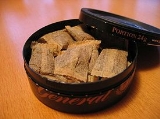
  • Portion snus is prepackaged moist powder in small teabag-like sachets. It comes in smaller quantities than the loose powder but is considered more convenient and discreet than loose snus. Moreover, there are two variants of Portion snus:
    • Original Portion, introduced in 1977, is the traditional form of portion snus. The sachet material is moisturized during the manufacturing process, resulting in a brown, moist pouch.
    • White Portion is a milder-tasting and slightly slower release form of portion snus. The sachet material is not moisturized during the manufacturing process, resulting in a white, dry pouch. The tobacco within the portion material has the same moisture content as original portion snus, but the nicotine and flavor are somewhat slower in delivery due to the drier sachet. "White portion" refers to the style, not the color, as many white portion snus use a black material instead of white, yet are "white portion". Examples include General Onyx and Grovsnus Svart (black).


Portioned snus is available in three different sizes: mini, normal/large (most common) and maxi. The weights may vary, but most snus labels share their weight. Mini portions typically weigh close to 0.5g, normal (large) portions weigh around 1g, and Maxi portions weigh up to 1.7g, depending on brand. Some brands also offer the choice of "regular" and "long" versions of the normal size sachet, which are similar in content weight. These long portions differ from traditional sachets by being slimmer but longer, to fit against the gums more comfortably.

The nicotine content of snus varies between brands, with the most common strength being 8mg of nicotine per gram of tobacco. In recent years, snus manufacturers have released stark (strong or sterk) and extra stark (extra strong or extra sterk) varieties with greater nicotine content. Stark varieties contain, on average, 11 mg of nicotine per gram of tobacco, while Extra Stark varieties may contain up to 22mg of nicotine per gram of tobacco.

Contents


Swedish snus is made from air dried tobacco from various parts of the world. In earlier times tobacco for making snus used to be laid out for drying in Scania
Scania
Scania is the southernmost of the 25 traditional non-administrative provinces of Sweden, constituting a peninsula on the southern tip of the Scandinavian peninsula, and some adjacent islands. The modern administrative subdivision Skåne County is almost, but not totally, congruent with the...

 and Mälardalen. Later Kentucky
Kentucky
The Commonwealth of Kentucky is a state located in the East Central United States of America. As classified by the United States Census Bureau, Kentucky is a Southern state, more specifically in the East South Central region. Kentucky is one of four U.S. states constituted as a commonwealth...

 tobaccos were used. The ground tobacco is mixed with water, salt, and an alkylizing agent (today this is) sodium carbonate
Sodium carbonate
Sodium carbonate , Na2CO3 is a sodium salt of carbonic acid. It most commonly occurs as a crystalline heptahydrate, which readily effloresces to form a white powder, the monohydrate. Sodium carbonate is domestically well-known for its everyday use as a water softener. It can be extracted from the...

 and aroma and is prepared through heating. In Sweden, snus is regulated as a food product, and for this reason, all ingredients are listed on the label of each individual package (can) of snus. Moist snus contains more than 50% water, and the average use of snus in Sweden is approximately 800 grams (16 units) per person each year. 12% (1.1 million people) of the population in Sweden use snus http://www.tobaksfakta.org/Default.aspx?id=3436. Unlike dipping tobacco and chew, most snus today does not undergo the fermentation
Fermentation (biochemistry)
Fermentation is the process of extracting energy from the oxidation of organic compounds, such as carbohydrates, using an endogenous electron acceptor, which is usually an organic compound. In contrast, respiration is where electrons are donated to an exogenous electron acceptor, such as oxygen,...

 process, but is instead steam-pasteurized. Although steam-pasteurization is remarkably complex, it has the advantages of inhibiting the formation of bacteria that facilitate the growth of tobacco-specific nitrosamines (TSNAs) while preserving the desired texture and mouthfeel of the snus.

Snus is sold mainly in Sweden and Norway, and has more recently been introduced to South Africa and the United States. It can be found in various places frequented by Scandinavia
Scandinavia
Scandinavia is a cultural, historical and ethno-linguistic region in northern Europe that includes the three kingdoms of Denmark, Norway and Sweden, characterized by their common ethno-cultural heritage and language. Modern Norway and Sweden proper are situated on the Scandinavian Peninsula,...

n tourists like Murmansk
Murmansk
Murmansk is a city and the administrative center of Murmansk Oblast, Russia. It serves as a seaport and is located in the extreme northwest part of Russia, on the Kola Bay, from the Barents Sea on the northern shore of the Kola Peninsula, not far from Russia's borders with Norway and Finland...

 in Russia
Russia
Russia or , officially known as both Russia and the Russian Federation , is a country in northern Eurasia. It is a federal semi-presidential republic, comprising 83 federal subjects...

 (with the notable exception of countries in the EU; see below). It is sold in small tins, which in the earlier years were made of porcelain
Porcelain
Porcelain is a ceramic material made by heating raw materials, generally including clay in the form of kaolin, in a kiln to temperatures between and...

, wood, silver
Silver
Silver is a metallic chemical element with the chemical symbol Ag and atomic number 47. A soft, white, lustrous transition metal, it has the highest electrical conductivity of any element and the highest thermal conductivity of any metal...

 or gold
Gold
Gold is a chemical element with the symbol Au and an atomic number of 79. Gold is a dense, soft, shiny, malleable and ductile metal. Pure gold has a bright yellow color and luster traditionally considered attractive, which it maintains without oxidizing in air or water. Chemically, gold is a...

. At the time of writing, portioned snus usually comes in plastic tins of 24 portions, containing about a gram of snus each, while loose snus is mostly sold in compressed paper tins with plastic lids, at 45g (50g before 2008). Mini-portion and medium-portion snus is an increasingly popular format of snus. Most of these products come in tins containing 20 portions, of either .65 or .5 grams each for a total of just under 13 or 10 grams of snus, particularly with those for whom concealing their use of smokeless tobacco in places is of utmost importance.

Despite weight, the price of both 10g, 13g, 24g, and 45g tins is approximately -5 in Sweden and -10 in Norway as Norwegian consumption taxes are considerably higher. Prices in the US vary per tin, depending on brand and source. Local or state taxes may also add considerably to this price, and vary widely across states.

Health consequences


Since snus is not intended nor recommended for inhalation, it does not affect the lung
Lung
The lung is the essential respiration organ in many air-breathing animals, including most tetrapods, a few fish and a few snails. In mammals and the more complex life forms, the two lungs are located near the backbone on either side of the heart...

s as cigarette
Cigarette
A cigarette is a small roll of finely cut tobacco leaves wrapped in a cylinder of thin paper for smoking. The cigarette is ignited at one end and allowed to smoulder; its smoke is inhaled from the other end, which is held in or to the mouth and in some cases a cigarette holder may be used as well...

s do. Because it is steam-cured, rather than fire-cured like smoking tobacco or other chewing tobacco, it contains lower concentrations of nitrosamine
Nitrosamine
Nitrosamines are chemical compounds of the chemical structure R1N-N=O, some of which are carcinogenic.-Usages:Nitrosamines are used in manufacture of some cosmetics, pesticides, and in most rubber products. -Occurrences:...

s and other carcinogens that form from the partially anaerobic heating of proteins; 2.8 parts per mil for Ettan brand compared to as high as 127.9 parts per mil in some American brands, according to a study by the Commonwealth of Massachusetts Department of Health. The World Health Organization
World Health Organization
The World Health Organization is a specialized agency of the United Nations that acts as a coordinating authority on international public health. Established on 7 April 1948, with headquarters in Geneva, Switzerland, the agency inherited the mandate and resources of its predecessor, the Health...

 (WHO) acknowledges that Swedish men have the lowest rate of lung cancer
Lung cancer
Lung cancer is a disease characterized by uncontrolled cell growth in tissues of the lung. If left untreated, this growth can spread beyond the lung in a process called metastasis into nearby tissue and, eventually, into other parts of the body. Most cancers that start in lung, known as primary...

 in Europe, partly due to the low tobacco smoking
Tobacco smoking
Tobacco smoking is the practice where tobacco is burned and the resulting smoke is inhaled. The practice may have begun as early as 5000–3000 BCE. Tobacco was introduced to Eurasia in the late 16th century where it followed common trade routes...

 rate, but does not argue for substituting snus for smoking, citing that the effects of snus still remain unclear. Around 2005 several reports, partially funded by the snus industry, pointed to the fact that no carcinogenic effects could be attributed to Nordic snus and this resulted in the removal of the warning label that claimed snus could cause cancer. It was replaced with the more vague label "May affect your health negatively". Research is still going on but at the moment no conclusive reports have been made regarding the health effects of snus.

Many cardiologists believe that nicotine products (oral) contribute to the potentiation of sympathetic nerve tone, and may aggravate hypertension due to the effects of nicotine on cholinergic and dopaminergic neurotransmission. At higher doses, tachycardia and reflex bradycardia can also occur, trigerring serious arrythmias or even cardiac arrest in sensitive individuals. Further studies are needed in this regard.

The European Union
European Union
The European Union is an economic and political union of 27 independent member states which are located primarily in Europe. The EU traces its origins from the European Coal and Steel Community and the European Economic Community , formed by six countries in 1958...

 banned the sale of snus in 1992, after a 1985 WHO study concluded that "oral use of snuffs of the types used in North America and western Europe is carcinogen
Carcinogen
A carcinogen is any substance, radionuclide, or radiation that is an agent directly involved in causing cancer. This may be due to the ability to damage the genome or to the disruption of cellular metabolic processes...

ic to humans", but a WHO committee on tobacco has also acknowledged that evidence is inconclusive regarding health consequences for snus consumers.http://www.irishtimes.com/newspaper/health/2009/0421/1224245059341.html. Only Sweden and EFTA
EFTA
EFTA may refer to:* European Family Therapy Association, an NGO.* European Fair Trade Association, an association of eleven Fair Trade importers in nine European countries....

-member Norway are exempt from this ban. A popular movement during the run-up to the 1994 referendum for Sweden's EU membership made exemption from the EU sale ban of snus a condition of the membership treaty.

Recent actions by many European governments to limit the use of cigarettes has led to calls to lift the ban on snus, as it is generally considered to be less harmful than cigarette smoke, both to the user and to others.

Debate among public health researchers


There is some debate among public health
Public health
Public health is "the science and art of preventing disease, prolonging life and promoting health through the organized efforts and informed choices of society, organizations, public and private, communities and individuals" . It is concerned with threats to health based on population health...

 researchers over the use of "safer" tobacco or nicotine delivery systems, generally dividing along two lines of thought. A minority (primarily in the European Union and Canada) believes in "harm reduction
Harm reduction
Harm reduction refers to a range of public health policies designed to reduce the harmful consequences associated with recreational drug use and other high risk activities...

," where the belief is generally that, while it should remain a goal to reduce addiction to nicotine in the population as a whole, the reduction of harm to the health of those who choose to use nicotine should override the need to reduce overall nicotine addiction. For example, some research http://www.tobaccoprogram.org/pdf/TC12349.pdf available today shows that snus use reduces or eliminates the risk of cancers associated with the use of other tobacco products such as "chewing tobacco
Chewing tobacco
Chewing tobacco Chewing tobacco Chewing tobacco (also known colloquially as hoobastank, backy, tobac, doogooos,Hogleg, chewpoos, chits, chewsky, chawsky, dip, flab, chowers, guy, or a wad, as well as referred to as dipsky, snuff, a pinch, a yopper, a Packing a bomb, a tobbackey or packing a...

" (the type primarily used in the United States and Canada, created in a process similar to cigarette tobacco) and cigarettes. It is hypothesized that the widespread use of snus by Swedish men (estimated at 30% of Swedish male ex-smokers), displacing tobacco smoking and other varieties of snuff, is responsible for the incidence of tobacco-related mortality in men being significantly lower in Sweden than any other European country; in contrast, since women traditionally are less likely to use snus, their rate of tobacco-related deaths in Sweden can be compared to that of other European countries.

Snus may be less harmful than other tobacco products; according to Kenneth Warner, director of the University of Michigan Tobacco Research Network,
"The Swedish government has studied this stuff to death, and to date, there is no compelling evidence that it has any adverse health consequences. ... Whatever they eventually find out, it is dramatically less dangerous than smoking." http://books.google.com/books?id=VHdZw2zOuzoC&pg=PA375&lpg=PA375&dq=kenneth+warner+the+swedish+government+has+studied+this+stuff+to+death+and+to+date+there+is+no+compelling+evidence+that+it+has+any+adverse+health+consequences+whatever+they+eventually+find+out+it+is+dramatically+less+dangerous+than+smoking&source=web&ots=cx51KVW46S&sig=Foo-qrULHni9qURU1Izv5ZmBUPE


Ongoing discussion and debates among primary scientific researchers of the effects of snus use on life expectancy appears to indicate that there is a significant increase in life expectancy among persons who previously smoked tobacco and switch to snus, depending on the age of the persons who switch, even when it is assumed that 100% of the risk of cardiovascular diseases among smokers transfers to snus users. It is also noted, in the correspondence seen in the previous citation that concerns about the effect of marketing by the tobacco industry, as influenced by the results of these scientific studies, is of primary concern to many researchers in the field, including the risk of emboldening the industry to attempt to increase snus sales among young people and promote dual-use of snus and smoked tobacco, and that the use of medical nicotine, rather than snus, can better target at-risk populations, given better access and pricing. However, a growing consensus among researchers of smoking cessation have found NRT products to be minimally effective because tobacco users are often seeking the combination of MAO inhibitors (which are found in tobacco)and nicotine. MAO inhibitors in tobacco act to amplify the rewarding effects of nicotine, but may also act as a form of self-medication for people with depression. This would explain the association between mental illness and smoking, the minimal efficacy of NRT and the findings from numerous studies that smokers will choose a denicotinized cigarette over a dose of nicotine. These denicotinized cigarettes can also reduce subjective measures of craving in abstinent smokers.

Opponents of snus sales maintain that, nevertheless, even the low nitrosamine levels in snus cannot be completely risk free, but snus proponents point out that inasmuch as snus is used as a substitute for smoking or a means to quit smoking, the net overall effect is positive, similar to the effect of nicotine patches.

In addition, this eliminates any exposure to second-hand smoke, further reducing possible harm to other non-tobacco users. This is seen by public health advocates who believe in "harm reduction" as a reason for recommending snus as well as other nicotine replacement therapies
Nicotine replacement therapy
Nicotine replacement therapy is the remedial administration of nicotine to the body by means other than tobacco, usually as part of smoking cessation. Common forms of nicotine replacement therapy are nicotine patches and nicotine gum...

 rather than continued use of cancer-causing nicotine delivery systems.

This does not, however, eliminate any harm to health caused by the nicotine itself. Current research focuses on possible long-term side effects of nicotine on blood pressure
Blood pressure
Blood pressure is the pressure exerted by circulating blood upon the walls of blood vessels, and is one of the principal vital signs. When used without further specification, "blood pressure" usually refers to the arterial pressure of the systemic circulation. During each heartbeat, BP varies...

, hypertension
Hypertension
Hypertension or high blood pressure is a cardiac chronic medical condition in which the systemic arterial blood pressure is elevated. What that means is that the heart is having to work harder than it should to pump the blood around the body. Blood pressure involves two measurements, systolic and...

 and possible risk of pancreatic cancer
Pancreatic cancer
Pancreatic cancer refers to a malignant neoplasm of the pancreas. The most common type of pancreatic cancer, accounting for 95% of these tumors is adenocarcinoma, which arises within the exocrine component of the pancreas. A minority arises from the islet cells and is classified as a...

 due to tobacco-specific nitrosamines
Tobacco-specific nitrosamines
Tobacco-specific nitrosamines comprise one of the most important groups of carcinogens in tobacco products, particularly cigarettes and American style dipping snuff.-Background:...

 (TSNAs). TSNAs are the only component of tobacco shown to induce pancreatic cancer in laboratory animals. Nicotine may also exacerbate pancreatic illness, because nicotine stimulates the gastrointestinal tract
Gastrointestinal tract
The human gastrointestinal tract refers to the stomach and intestine, and sometimes to all the structures from the mouth to the anus. ....

's production of cholecystokinin
Cholecystokinin
Cholecystokinin is a peptide hormone of the gastrointestinal system responsible for stimulating the digestion of fat and protein...

, which stimulates pancreatic growth and may be implicated in pancreatic cancer. Thus far the evidence specifically implicating snus in pancreatic cancer is only suggestive. It should also be noted that the probability of developing pancreatic cancer from cigarettes is higher than the suggested chance of developing pancreatic cancer from snus.

The effects of Swedish snus on blood pressure has been studied at Umeå University in a randomly selected population sample of 4,305 Swedish men between 25 and 74 years of age. In the study, published in November 2008, the researchers found no elevation of blood pressure in snus users who had never been smokers compared to non tobacco users. In fact, snus users had lower systolic blood pressure than non tobacco users in the unadjusted data.

Further reading


A number of peer-reviewed studies of snus use have been published:

Cardiovascular diseases


Cancer


Medical community discussions and reports


Articles


Non-medical blogs and commentary