Home      Discussion      Topics      Dictionary      Almanac
Signup       Login
Small circle

Small circle

Overview
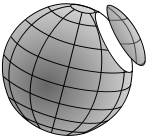
A small circle of a sphere
Sphere
A sphere is a perfectly round geometrical object in three-dimensional space, such as the shape of a round ball. Like a circle in two dimensions, a perfect sphere is completely symmetrical around its center, with all points on the surface lying the same distance r from the center point...

 is the circle constructed by a plane crossing the sphere not in its center. Small circles always have smaller diameter
Diameter
In geometry, a diameter of a circle is any straight line segment that passes through the center of the circle and whose endpoints are on the circle. The diameters are the longest chords of the circle...

s than the sphere itself (compare great circle
Great circle
A great circle of a sphere is a circle that runs along the surface of that sphere so as to cut it into two equal halves, as distinct from a small circle. The great circle therefore has both the same circumference and the same center as the sphere...

). Small circles cannot be parallel, because parallelism doesn't exist in spherical geometry. They may look parallel but they are no more parallel than concentric circles on a plane.
The small circle does not have the smallest curvature
Curvature
In mathematics, curvature refers to any of a number of loosely related concepts in different areas of geometry. Intuitively, curvature is the amount by which a geometric object deviates from being flat, or straight in the case of a line, but this is defined in different ways depending on the context...

 and hence, a segment on its circumference does not represent the shortest path between two point
Point (geometry)
In geometry, topology and related branches of mathematics a spatial point describes a specific object within a given space that consists of neither volume, area, length, nor any other higher dimensional analogue. Thus, a point is a 0-dimensional object...

s on a spherical surface
Surface
In mathematics, specifically in topology, a surface is a two-dimensional topological manifold. The most familiar examples are those that arise as the boundaries of solid objects in ordinary three-dimensional Euclidean space R3 — for example, the surface of a ball...

.

Except for 90 Degrees North
North Pole
The North Pole, also known as the Geographic North Pole or Terrestrial North Pole, is, subject to the caveats explained below, defined as the point in the northern hemisphere where the Earth's axis of rotation meets the Earth's surface...

 or South
South Pole
The South Pole, also known as the Geographic South Pole or Terrestrial South Pole, is one of the two points where the Earth's axis of rotation intersects the surface. It is the southernmost point on the surface of the Earth and lies on the opposite side of the Earth from the North Pole...

 and the Equator
Equator
The equator is the intersection of the Earth's surface with the plane perpendicular to the Earth's axis of rotation and containing the Earth's center of mass. In simpler language, it is an imaginary line on the Earth's surface equidistant from the North Pole and South Pole that divides the Earth...

, all parallels of latitude
Latitude
Latitude, usually denoted by the Greek letter phi gives the location of a place on Earth north or south of the equator. Lines of Latitude are the imaginary horizontal lines shown running east-to-west on maps that run either north or south of the equator...

 upon the Earth
Earth
Earth is the third planet from the Sun. It is the fifth largest of the eight planets in the solar system, and the largest of the terrestrial planets in the Solar System in terms of diameter, mass and density...

 are small circles (or at least close approximations, as the Earth varies from a true sphere to a relatively minor extent).
Discussion
Ask a question about 'Small circle'
Start a new discussion about 'Small circle'
Answer questions from other users
Full Discussion Forum
 
Encyclopedia
A small circle of a sphere
Sphere
A sphere is a perfectly round geometrical object in three-dimensional space, such as the shape of a round ball. Like a circle in two dimensions, a perfect sphere is completely symmetrical around its center, with all points on the surface lying the same distance r from the center point...

 is the circle constructed by a plane crossing the sphere not in its center. Small circles always have smaller diameter
Diameter
In geometry, a diameter of a circle is any straight line segment that passes through the center of the circle and whose endpoints are on the circle. The diameters are the longest chords of the circle...

s than the sphere itself (compare great circle
Great circle
A great circle of a sphere is a circle that runs along the surface of that sphere so as to cut it into two equal halves, as distinct from a small circle. The great circle therefore has both the same circumference and the same center as the sphere...

). Small circles cannot be parallel, because parallelism doesn't exist in spherical geometry. They may look parallel but they are no more parallel than concentric circles on a plane.
The small circle does not have the smallest curvature
Curvature
In mathematics, curvature refers to any of a number of loosely related concepts in different areas of geometry. Intuitively, curvature is the amount by which a geometric object deviates from being flat, or straight in the case of a line, but this is defined in different ways depending on the context...

 and hence, a segment on its circumference does not represent the shortest path between two point
Point (geometry)
In geometry, topology and related branches of mathematics a spatial point describes a specific object within a given space that consists of neither volume, area, length, nor any other higher dimensional analogue. Thus, a point is a 0-dimensional object...

s on a spherical surface
Surface
In mathematics, specifically in topology, a surface is a two-dimensional topological manifold. The most familiar examples are those that arise as the boundaries of solid objects in ordinary three-dimensional Euclidean space R3 — for example, the surface of a ball...

.

Except for 90 Degrees North
North Pole
The North Pole, also known as the Geographic North Pole or Terrestrial North Pole, is, subject to the caveats explained below, defined as the point in the northern hemisphere where the Earth's axis of rotation meets the Earth's surface...

 or South
South Pole
The South Pole, also known as the Geographic South Pole or Terrestrial South Pole, is one of the two points where the Earth's axis of rotation intersects the surface. It is the southernmost point on the surface of the Earth and lies on the opposite side of the Earth from the North Pole...

 and the Equator
Equator
The equator is the intersection of the Earth's surface with the plane perpendicular to the Earth's axis of rotation and containing the Earth's center of mass. In simpler language, it is an imaginary line on the Earth's surface equidistant from the North Pole and South Pole that divides the Earth...

, all parallels of latitude
Latitude
Latitude, usually denoted by the Greek letter phi gives the location of a place on Earth north or south of the equator. Lines of Latitude are the imaginary horizontal lines shown running east-to-west on maps that run either north or south of the equator...

 upon the Earth
Earth
Earth is the third planet from the Sun. It is the fifth largest of the eight planets in the solar system, and the largest of the terrestrial planets in the Solar System in terms of diameter, mass and density...

 are small circles (or at least close approximations, as the Earth varies from a true sphere to a relatively minor extent). An observer standing on such a circle and viewing its path toward an unobstructed horizon, would perceive it to bend away from his line of sight, an effect of the inequality between the amount of curvature to his left and right.

By contrast, all meridians of longitude
Longitude
Longitude , identified by the Greek letter lambda , is the geographic coordinate most commonly used in cartography and global navigation for east-west measurement...

are great circles.