


Sinon

Encyclopedia
Greek mythology
Greek mythology is the body of myths and legends belonging to the ancient Greeks, concerning their gods and heroes, the nature of the world, and the origins and significance of their own cult and ritual practices. They were a part of religion in ancient Greece...
, Sinon (Greek
Greek language
Greek is an independent branch of the Indo-European family of languages. Native to the southern Balkans, it has the longest documented history of any Indo-European language, spanning 34 centuries of written records. Its writing system has been the Greek alphabet for the majority of its history;...
: "Σίνων", from the verb "σίνομαι" - sinomai, "to harm, to hurt") a son of Aesimus (son of Autolycus
Autolycus
In Greek mythology, Autolycus was a son of Hermes and Chione. He was the husband of Neaera, or according to Homer, of Amphithea...
), or of the crafty Sisyphus
Sisyphus
In Greek mythology Sisyphus was a king punished by being compelled to roll an immense boulder up a hill, only to watch it roll back down, and to repeat this throughout eternity...
, was a Greek warrior during the Trojan War
Trojan War
In Greek mythology, the Trojan War was waged against the city of Troy by the Achaeans after Paris of Troy took Helen from her husband Menelaus, the king of Sparta. The war is among the most important events in Greek mythology and was narrated in many works of Greek literature, including the Iliad...
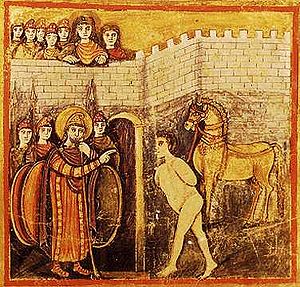
. He pretended to have deserted the Greeks and, as a Trojan captive, told the Trojans that the giant wooden horse the Greeks had left behind was intended as a gift to the gods to ensure their safe voyage home. He told them that the horse was made so big that the Trojans would not be able to move it into their city, because if they did they would be invincible to later Achaean invasion. His story convinced the Trojans because it included the former details as well as an explanation that he was left behind to die by the doing of Odysseus who was his enemy. The Trojans brought the Trojan Horse
Trojan Horse
The Trojan Horse is a tale from the Trojan War about the stratagem that allowed the Greeks finally to enter the city of Troy and end the conflict. In the canonical version, after a fruitless 10-year siege, the Greeks constructed a huge wooden horse, and hid a select force of men inside...
into their city against the advice of Cassandra
Cassandra
In Greek mythology, Cassandra was the daughter of King Priam and Queen Hecuba of Troy. Her beauty caused Apollo to grant her the gift of prophecy...
(given the gift of prophecy by Apollo, but condemned to never be believed for not returning his love) and Laocoön
Laocoön
Laocoön the son of Acoetes is a figure in Greek and Roman mythology.-History:Laocoön is a Trojan priest of Poseidon , whose rules he had defied, either by marrying and having sons, or by having committed an impiety by making love with his wife in the presence of a cult image in a sanctuary...
(because two serpents came out of the water and strangled him and his sons, which the Trojans saw as a punishment for attacking the horse with a spear). Inside the giant wooden horse were Greek soldiers, who, as night fell, disembarked from the horse and opened the city gates, thus sealing the fate of Troy. He was also an Achaean spy that told the Greeks when the soldiers in the horse had begun their fight.
This scene is not in either the Iliad or the Odyssey but is in the Aeneid; it is central to the perspective Virgil builds (in support of the actual Roman sentiment) of the Greeks as cunning, deceitful, and treacherous.
Sinon as portrayed in Quintus of Smyrna's The Trojan Epic
The Trojans, ready to attack the Greek camp, see smoke coming from the Greek camp and cautiously approach. When they arrive at the camp they find only Sinon alongside the Trojan Horse. The reader later finds out that it was Sinon who started the fire signal that drew the Trojans to the Greek camp. The rest of the camp is deserted. The Trojans circle him and gently ask him questions but when he doesn't answer they grow angry and begin to threaten and stab him. When he still doesn't answer, the Trojans cut off his ears and nose. Finally he tells them that the Greeks have fled and they built the Trojan Horse to honor Athena. Sinon claims that OdysseusOdysseus
Odysseus or Ulysses was a legendary Greek king of Ithaca and the hero of Homer's epic poem the Odyssey. Odysseus also plays a key role in Homer's Iliad and other works in the Epic Cycle....
wanted to sacrifice him but he managed to escape and hide in a marsh. When they gave up looking for him and left he returned to the Trojan Horse. Sinon claims that the Greeks stopped looking for him out of respect for Zeus
Zeus
In the ancient Greek religion, Zeus was the "Father of Gods and men" who ruled the Olympians of Mount Olympus as a father ruled the family. He was the god of sky and thunder in Greek mythology. His Roman counterpart is Jupiter and his Etruscan counterpart is Tinia.Zeus was the child of Cronus...
. All the Trojans believe this story, except Laocoön
Laocoön
Laocoön the son of Acoetes is a figure in Greek and Roman mythology.-History:Laocoön is a Trojan priest of Poseidon , whose rules he had defied, either by marrying and having sons, or by having committed an impiety by making love with his wife in the presence of a cult image in a sanctuary...
who, along with his two sons, is promptly attacked by a giant sea serpent. Following this, believing that Laocoön
Laocoön
Laocoön the son of Acoetes is a figure in Greek and Roman mythology.-History:Laocoön is a Trojan priest of Poseidon , whose rules he had defied, either by marrying and having sons, or by having committed an impiety by making love with his wife in the presence of a cult image in a sanctuary...
was attacked because he offended the Gods, the rest of the Trojans begin to believe Sinon's story. Feeling bad for Sinon, and fearing wrath from the Gods, the Trojans bring Sinon and the Trojan Horse into Troy.
Sinon in Other Literature
In the Divine ComedyThe Divine Comedy
The Divine Comedy is an epic poem written by Dante Alighieri between 1308 and his death in 1321. It is widely considered the preeminent work of Italian literature, and is seen as one of the greatest works of world literature...
Dante
DANTE
Delivery of Advanced Network Technology to Europe is a not-for-profit organisation that plans, builds and operates the international networks that interconnect the various national research and education networks in Europe and surrounding regions...
sees Sinon in the tenth level of the eighth circle of Hell
Hell
In many religious traditions, a hell is a place of suffering and punishment in the afterlife. Religions with a linear divine history often depict hells as endless. Religions with a cyclic history often depict a hell as an intermediary period between incarnations...
where, along with other falsifiers of words, he is condemned to suffer a burning fever for all eternity.
William Shakespeare
William Shakespeare
William Shakespeare was an English poet and playwright, widely regarded as the greatest writer in the English language and the world's pre-eminent dramatist. He is often called England's national poet and the "Bard of Avon"...
referred to Sinon on several occasions in his work, using him as a symbol of treachery.