


Silicone resin

Encyclopedia
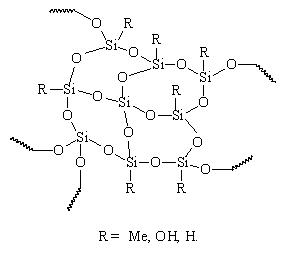
Silicone resins are a type of silicone
Silicone
Silicones are inert, synthetic compounds with a variety of forms and uses. Typically heat-resistant and rubber-like, they are used in sealants, adhesives, lubricants, medical applications , cookware, and insulation....
material which is formed by branched, cage-like oligosiloxanes with the general formula of RnSiXmOy, where R is a non reactive substituent, usually Me or Ph, and X is a functional group H
Hydrogen
Hydrogen is the chemical element with atomic number 1. It is represented by the symbol H. With an average atomic weight of , hydrogen is the lightest and most abundant chemical element, constituting roughly 75% of the Universe's chemical elemental mass. Stars in the main sequence are mainly...
, OH, Cl
Chlorine
Chlorine is the chemical element with atomic number 17 and symbol Cl. It is the second lightest halogen, found in the periodic table in group 17. The element forms diatomic molecules under standard conditions, called dichlorine...
or OR
Alkoxy group
In chemistry, the alkoxy group is an alkyl group singular bonded to oxygen thus: R—O. The range of alkoxy groups is great, the simplest being methoxy . An ethoxy group is found in the organic compound phenetol, C6H5OCH2CH3 which is also known as ethoxy benzene...
. These groups are further condensed in many applications, to give highly crosslinked, insoluble polysiloxane networks.
When R is methyl, the four possible functional siloxane monomeric units are described as follows:
- "M" stands for Me3SiO,
- "D" for Me2SiO2,
- "T" for MeSiO3 and
- "Q" for SiO4.
Note that a network of only Q groups becomes fused quartz
Fused quartz
Fused quartz and fused silica are types of glass containing primarily silica in amorphous form. They are manufactured using several different processes...
.
The most abundant silicone resins are built of D and T units (DT resins) or from M and Q units (MQ resins), however many other combinations (MDT, MTQ, QDT) are also used in industry.
Silicone resins represent a broad range of products. Materials of molecular weight in the range of 1000-10 000 are very useful in pressure sensitive adhesives, silicone rubbers, coatings and additives.
Silicone resins are prepared by hydrolytic
Hydrolysis
Hydrolysis is a chemical reaction during which molecules of water are split into hydrogen cations and hydroxide anions in the process of a chemical mechanism. It is the type of reaction that is used to break down certain polymers, especially those made by condensation polymerization...
condensation
Condensation reaction
A condensation reaction is a chemical reaction in which two molecules or moieties combine to form one single molecule, together with the loss of a small molecule. When this small molecule is water, it is known as a dehydration reaction; other possible small molecules lost are hydrogen chloride,...
of various silicone precursors. In early processes of preparation of silicone resins sodium silicate
Sodium silicate
Sodium silicate is the common name for a compound sodium metasilicate, Na2SiO3, also known as water glass or liquid glass. It is available in aqueous solution and in solid form and is used in cements, passive fire protection, refractories, textile and lumber processing, and automobiles...
and various chlorosilane
Chlorosilane
Chlorosilanes are a group of reactive, chlorine-containing chemical compounds, related to silane and used in many chemical processes. Each such chemical has at least one silicon-chlorine bond.-Synthesis:...
s were used as starting materials. Although the starting materials were the least expensive ones (something typical for industry), structural control of the product was very difficult. More recently, a less reactive tetraethoxysilane - (TEOS) or ethyl polysilicate and various disiloxanes are used as starting materials.