

Show People

Encyclopedia
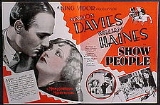
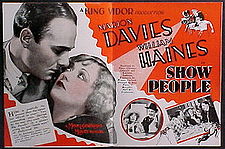
Show People is a 1928 comedy silent film
directed by King Vidor
. The movie was a starring vehicle for actress Marion Davies
and actor William Haines
and included notable cameo appearances by many of the film personalities of the day, including stars Charlie Chaplin
, Douglas Fairbanks
, William S. Hart
and John Gilbert
, and writer Elinor Glyn
. Vidor also appears in a cameo as himself, as does Davies (to a decidedly unimpressed reaction by herself in character as Peggy Pepper). The film is a lighthearted look at Hollywood
at the end of the silent film era (it was released the year after breakthrough talking picture
The Jazz Singer
), and is considered Davies' best role. The film was re-released in the 1980s, with a new orchestral score by Carl Davis
.
In 2003, Show People was selected for preservation in the United States National Film Registry
by the Library of Congress
as being "culturally, historically, or aesthetically significant".
 Young Peggy Pepper (Marion Davies
) wants to be in motion pictures, so her father (Dell Henderson
) drives them both across the country from their home in Georgia to Hollywood
. After some initial disillusionment, she meets Billy Boone (William Haines
) in a studio commissary and he tells her to show up at his set if she wants work. Peggy goes, gets sprayed with seltzer water
at her first entrance, and is at first shocked and dismayed to find she is doing slapstick
comedy in low-budget "Comet" productions, but she decides to "take it on the chin" and, with Billy's loving support, becomes a success.
Soon enough, Peggy is signed to a contract by the prestigious "High Art" studio and, as "Patricia Pepoire", becomes a real movie star. She has fulfilled her dream of playing serious, dramatic roles, but she cuts off contact with Billy and the old comedy troupe, and soon becomes so conceited that her boring performances begin to drive away her public. Fortunately, on the day of her marriage to her co-star, phony-count
Andre Telefair (Paul Ralli), Billy bursts in and, by means of another shpritz of seltzer in her face, as well as a custard pie in Andre's, brings her to her senses, rescuing her career and both of their happiness.
Uncredited cameos:
(1927), she too often appeared in extravagant, costly period romance films at the behest of her newspaper tycoon lover William Randolph Hearst
, who supposedly enjoyed seeing his mistress in fancy costume. For example: Janice Meredith (1924), Yolanda
(1924), Bride's Play (1922) and the infamously expensive When Knighthood Was in Flower
(1922), all financially backed by Hearst's Hollywood film company, Cosmopolitan Productions
. Lucille Ball
frequently cited Davies as a major comedic influence and all of Ball's facial techniques and comic behaviors evident in I Love Lucy
are startlingly apparent in Davies' performance in this film.
The film has a remarkable number of cameo appearances from some of the top stars of the day, including Charlie Chaplin
, Douglas Fairbanks
, William S. Hart
, and others. Many agreed to appear out of friendship with Davies, Hearst, and director Vidor, but the positive publicity value of cooperating with Hearst and MGM also played a factor.
Originally the script called for Peggy to get hit in the face with a pie after being pressed into the comedy movie shoot. William Randolph Hearst objected to this, fearing for Marion Davies' dignity, and as a compromise the scene was changed to have Peggy soaked with spray from a seltzer bottle.
Davies' peculiar lip pucker after she becomes "Patricia Pepoire" was an imitation of Mae Murray
whom Davies bore a resemblance to. This movie is similar in theme to the lost Paramount
cameo filled comedy Hollywood
directed by James Cruze
in which a young woman and her elderly grandfather go to Hollywood for her to become a star. Peggy's story was inspired in part by that of Gloria Swanson
, who got her start as one of the Sennett Bathing Beauties at Mack Sennett
's Keystone Studios
before hitting it big as a dramatic actress, and who later married a French nobleman
. The character of Andre was seen at the time as a satire of John Gilbert. The closing scene on the set of a war movie may be a nod to King Vidor's smash hit of three years before, The Big Parade
.
Silent film
A silent film is a film with no synchronized recorded sound, especially with no spoken dialogue. In silent films for entertainment the dialogue is transmitted through muted gestures, pantomime and title cards...
directed by King Vidor
King Vidor
King Wallis Vidor was an American film director, film producer, and screenwriter whose career spanned nearly seven decades...
. The movie was a starring vehicle for actress Marion Davies
Marion Davies
Marion Davies was an American film actress. Davies is best remembered for her relationship with newspaper tycoon William Randolph Hearst, as her high-profile social life often obscured her professional career....
and actor William Haines
William Haines
Charles William "Billy" Haines was an American film actor and interior designer. He was a star of the silent era until the 1930s, when Haines' career was cut short by MGM Studios due to his refusal to deny his homosexuality...
and included notable cameo appearances by many of the film personalities of the day, including stars Charlie Chaplin
Charlie Chaplin
Sir Charles Spencer "Charlie" Chaplin, KBE was an English comic actor, film director and composer best known for his work during the silent film era. He became the most famous film star in the world before the end of World War I...
, Douglas Fairbanks
Douglas Fairbanks
Douglas Fairbanks, Sr. was an American actor, screenwriter, director and producer. He was best known for his swashbuckling roles in silent films such as The Thief of Bagdad, Robin Hood, and The Mark of Zorro....
, William S. Hart
William S. Hart
William Surrey Hart was an American silent film actor, screenwriter, director and producer. He is remembered for having "imbued all of his characters with honor and integrity."-Biography:...
and John Gilbert
John Gilbert (actor)
John Gilbert was an American actor and a major star of the silent film era.Known as "the great lover," he rivaled even Rudolph Valentino as a box office draw...
, and writer Elinor Glyn
Elinor Glyn
Elinor Glyn , born Elinor Sutherland, was a British novelist and scriptwriter who pioneered mass-market women's erotic fiction. She popularized the concept It...
. Vidor also appears in a cameo as himself, as does Davies (to a decidedly unimpressed reaction by herself in character as Peggy Pepper). The film is a lighthearted look at Hollywood
Cinema of the United States
The cinema of the United States, also known as Hollywood, has had a profound effect on cinema across the world since the early 20th century. Its history is sometimes separated into four main periods: the silent film era, classical Hollywood cinema, New Hollywood, and the contemporary period...
at the end of the silent film era (it was released the year after breakthrough talking picture
Sound film
A sound film is a motion picture with synchronized sound, or sound technologically coupled to image, as opposed to a silent film. The first known public exhibition of projected sound films took place in Paris in 1900, but decades would pass before sound motion pictures were made commercially...
The Jazz Singer
The Jazz Singer (1927 film)
The Jazz Singer is a 1927 American musical film. The first feature-length motion picture with synchronized dialogue sequences, its release heralded the commercial ascendance of the "talkies" and the decline of the silent film era. Produced by Warner Bros. with its Vitaphone sound-on-disc system,...
), and is considered Davies' best role. The film was re-released in the 1980s, with a new orchestral score by Carl Davis
Carl Davis
Carl Davis CBE is an American born conductor and composer who has made his home in the UK since 1961. In 1970 he married the English actress Jean Boht....
.
In 2003, Show People was selected for preservation in the United States National Film Registry
National Film Registry
The National Film Registry is the United States National Film Preservation Board's selection of films for preservation in the Library of Congress. The Board, established by the National Film Preservation Act of 1988, was reauthorized by acts of Congress in 1992, 1996, 2005, and again in October 2008...
by the Library of Congress
Library of Congress
The Library of Congress is the research library of the United States Congress, de facto national library of the United States, and the oldest federal cultural institution in the United States. Located in three buildings in Washington, D.C., it is the largest library in the world by shelf space and...
as being "culturally, historically, or aesthetically significant".
Plot
Marion Davies
Marion Davies was an American film actress. Davies is best remembered for her relationship with newspaper tycoon William Randolph Hearst, as her high-profile social life often obscured her professional career....
) wants to be in motion pictures, so her father (Dell Henderson
Dell Henderson
George Delbert Henderson was a Canadian actor, director and writer in films from the early silent days.-Biography:Henderson was a frequent associate of film pioneer D.W. Griffith and, on a less prolific basis, Mack Sennett...
) drives them both across the country from their home in Georgia to Hollywood
Hollywood, Los Angeles, California
Hollywood is a famous district in Los Angeles, California, United States situated west-northwest of downtown Los Angeles. Due to its fame and cultural identity as the historical center of movie studios and movie stars, the word Hollywood is often used as a metonym of American cinema...
. After some initial disillusionment, she meets Billy Boone (William Haines
William Haines
Charles William "Billy" Haines was an American film actor and interior designer. He was a star of the silent era until the 1930s, when Haines' career was cut short by MGM Studios due to his refusal to deny his homosexuality...
) in a studio commissary and he tells her to show up at his set if she wants work. Peggy goes, gets sprayed with seltzer water
Carbonated water
Carbonated water is water into which carbon dioxide gas under pressure has been dissolved, a process that causes the water to become effervescent....
at her first entrance, and is at first shocked and dismayed to find she is doing slapstick
Slapstick
Slapstick is a type of comedy involving exaggerated violence and activities which may exceed the boundaries of common sense.- Origins :The phrase comes from the batacchio or bataccio — called the 'slap stick' in English — a club-like object composed of two wooden slats used in Commedia dell'arte...
comedy in low-budget "Comet" productions, but she decides to "take it on the chin" and, with Billy's loving support, becomes a success.
Soon enough, Peggy is signed to a contract by the prestigious "High Art" studio and, as "Patricia Pepoire", becomes a real movie star. She has fulfilled her dream of playing serious, dramatic roles, but she cuts off contact with Billy and the old comedy troupe, and soon becomes so conceited that her boring performances begin to drive away her public. Fortunately, on the day of her marriage to her co-star, phony-count
Count
A count or countess is an aristocratic nobleman in European countries. The word count came into English from the French comte, itself from Latin comes—in its accusative comitem—meaning "companion", and later "companion of the emperor, delegate of the emperor". The adjective form of the word is...
Andre Telefair (Paul Ralli), Billy bursts in and, by means of another shpritz of seltzer in her face, as well as a custard pie in Andre's, brings her to her senses, rescuing her career and both of their happiness.
Cast
- Marion DaviesMarion DaviesMarion Davies was an American film actress. Davies is best remembered for her relationship with newspaper tycoon William Randolph Hearst, as her high-profile social life often obscured her professional career....
as Peggy Pepper - William HainesWilliam HainesCharles William "Billy" Haines was an American film actor and interior designer. He was a star of the silent era until the 1930s, when Haines' career was cut short by MGM Studios due to his refusal to deny his homosexuality...
as Billy Boone - Dell HendersonDell HendersonGeorge Delbert Henderson was a Canadian actor, director and writer in films from the early silent days.-Biography:Henderson was a frequent associate of film pioneer D.W. Griffith and, on a less prolific basis, Mack Sennett...
as General Marmaduke Oldfish Pepper - Paul Ralli as Andre Telefair
- Tenen HoltzTenen HoltzTenen Holtz was a Russian actor. He appeared in nearly 60 films between 1926 and 1961.He was born Elihu "Elye" Tenenholtz in the hamlet of Azran, near the city of Rovne and came to the United States the age of ten...
as Casting director - Harry GribbonHarry GribbonHarry Gribbon was an American film actor. He appeared in 144 films between 1915 and 1938.He was born in New York, New York, and died in Los Angeles, California. He was the brother of actor Eddie Gribbon....
as Jim - Comedy director - Kalla Pasha as Comic chef (uncredited)
- Sidney BraceySidney BraceySidney Bracey was an Australian-born American film actor. After a stage career in Australia, on Broadway and in Britain, he appeared in 321 films between 1909 and 1942.-Life and career:...
as Dramatic director - Polly MoranPolly MoranPolly Moran was an American actress and comedian.Born in Chicago, Illinois, Moran started out in vaudeville, and widely toured North America, as well as various other locations that included Europe and South Africa...
as Peggy's maid - Albert Conti as Producer
- Ray Cooke as Director's assistant (uncredited)
- Lillian Lawrence as Comedy player at banquet (uncredited)
- Dorothy Vernon as Comedy player at banquet (uncredited)
- Pat Harmon as Studio Gateman (uncredited)
- Bert Roach as Heavyset man in casting agency (uncredited)
- Rolfe SedanRolfe SedanRolfe Sedan was an American character actor.Born Edward Sedan in New York City, his mother was a Broadway theatre fashion designer and his father a symphony conductor....
as Portrait photographer (uncredited) - Coy Watson as Messenger boy (uncredited)
- Bess FlowersBess FlowersBess Flowers was an American actress. By some counts considered the most prolific actress in the history of Hollywood, she was known as "The Queen of the Hollywood Extras," appearing in over 700 movies in her 41 year career....
as Undetermined bit role (uncredited)
Uncredited cameos:
- Renée AdoréeRenée AdoréeRenée Adorée was a French actress who had appeared in Hollywood silent movies during the 1920s.-Early life:...
- at banquet - George K. ArthurGeorge K. ArthurGeorge K. Arthur was an English actor and producer. He appeared in 59 films between 1919 and 1935. He won an Academy Award for Best Short Film in 1956 for the film The Bespoke Overcoat....
- at banquet - Eleanor BoardmanEleanor BoardmanEleanor Boardman was an American film actress, popular during the era of silent movies.-Early life and career:...
- clip from Bardelys the MagnificentBardelys the MagnificentBardelys the Magnificent is a 1926 silent romantic drama film. It was directed by King Vidor starring John Gilbert and Eleanor Boardman, based on a novel by Rafael Sabatini. It was the second film of the 19 year old John Wayne, who had a minor role... - Charlie ChaplinCharlie ChaplinSir Charles Spencer "Charlie" Chaplin, KBE was an English comic actor, film director and composer best known for his work during the silent film era. He became the most famous film star in the world before the end of World War I...
- outside movie theater - Lew CodyLew CodyLew Cody, birth name Louis Joseph Côté was an American actor whose career spanned the silent film and early sound film age....
- at High Art Studios - Karl DaneKarl DaneKarl Dane was a Danish comedian and actor known for his work in American films, mainly of the silent film era. He worked alongside Rudolph Valentino, John Gilbert, and King Vidor. In 1926, he teamed up with George K. Arthur to form the successful comedy duo Dane & Arthur...
- at banquet - Marion DaviesMarion DaviesMarion Davies was an American film actress. Davies is best remembered for her relationship with newspaper tycoon William Randolph Hearst, as her high-profile social life often obscured her professional career....
- cameo as herself in addition to starring as Peggy - Douglas FairbanksDouglas FairbanksDouglas Fairbanks, Sr. was an American actor, screenwriter, director and producer. He was best known for his swashbuckling roles in silent films such as The Thief of Bagdad, Robin Hood, and The Mark of Zorro....
- at banquet - John GilbertJohn Gilbert (actor)John Gilbert was an American actor and a major star of the silent film era.Known as "the great lover," he rivaled even Rudolph Valentino as a box office draw...
- outside film studio, again in clip from Bardelys the MagnificentBardelys the MagnificentBardelys the Magnificent is a 1926 silent romantic drama film. It was directed by King Vidor starring John Gilbert and Eleanor Boardman, based on a novel by Rafael Sabatini. It was the second film of the 19 year old John Wayne, who had a minor role...
, then again at banquet - Elinor GlynElinor GlynElinor Glyn , born Elinor Sutherland, was a British novelist and scriptwriter who pioneered mass-market women's erotic fiction. She popularized the concept It...
- at High Art Studios - William S. HartWilliam S. HartWilliam Surrey Hart was an American silent film actor, screenwriter, director and producer. He is remembered for having "imbued all of his characters with honor and integrity."-Biography:...
- at banquet - Leatrice JoyLeatrice JoyLeatrice Joy was an American actress most prolific during the early silent film era.-Early life and career:...
- at banquet - Rod La RocqueRod La Rocque-Biography:He was born Roderick La Rocque in Chicago, Illinois. He began appearing in stock theater at the age of seven and eventually ended up at the Essanay Studios in Chicago where he found steady work until the studios closed. He then moved to New York City and worked on the stage until he was...
- at banquet - Mae MurrayMae MurrayMae Murray was an American actress, dancer, film producer, and screenwriter. Murray rose to fame during the silent film era and was known as "The Girl with the Bee-Stung Lips" and "The Gardenia of the Screen"....
- at banquet - Louella ParsonsLouella ParsonsLouella Parsons was the first American news-writer movie columnist in the United States. She was a gossip columnist who, for many years, was an influential arbiter of Hollywood mores, often feared and hated by the individuals, mostly actors, whose careers she could negatively impact via her...
- at banquet - Aileen PringleAileen PringleAileen Pringle was an American stage and film actress during the silent film era.-Early life:Born Aileen Bisbee into a prominent and wealthy San Francisco, California family and educated in Europe, Pringle began her acting career shortly after her 1916 marriage to Charles McKenzie Pringle, the son...
- at banquet - Dorothy SebastianDorothy SebastianDorothy Sebastian was an American film and stage actress.-Early life and career:Sebastian was born and raised in Birmingham, Alabama. In her youth she hoped to be a dancer and later a film actress. Her family frowned on both ambitions, however, so she fled to New York at the age of 15...
- at banquet - Norma TalmadgeNorma TalmadgeNorma Talmadge was an American actress and film producer of the silent era. A major box office draw for more than a decade, her career reached a peak in the early 1920s, when she ranked among the most popular idols of the American screen.Her most famous film was Smilin’ Through , but she also...
- at banquet - Estelle TaylorEstelle TaylorEstelle Taylor was an American Hollywood actress whose career was most prominent during the silent film era of the 1920s....
- at banquet - King VidorKing VidorKing Wallis Vidor was an American film director, film producer, and screenwriter whose career spanned nearly seven decades...
as director of war film - Claire WindsorClaire WindsorClaire Windsor was a notable American film actress of the silent screen era.-Early life:Windsor was born Clara Viola Cronk in 1892 to George Edwin and Rosella R. Fearing Cronk in Marvin, Phillips County, Kansas of Scandinavian heritage. Her parents later moved to Cawker City, Kansas when she was...
- at banquet
Production
Show People offers an entertaining inside look at 1920s Hollywood and reflects on the actual acting career of starlet Marion Davies. Though one of the great comic talents of her day, featured in many of the decade's successful comedies, such as Tillie the ToilerTillie the Toiler
Tillie the Toiler was a newspaper comic strip created by cartoonist Russ Westover who initially worked on his concept of a flapper character in a strip he titled Rose of the Office...
(1927), she too often appeared in extravagant, costly period romance films at the behest of her newspaper tycoon lover William Randolph Hearst
William Randolph Hearst
William Randolph Hearst was an American business magnate and leading newspaper publisher. Hearst entered the publishing business in 1887, after taking control of The San Francisco Examiner from his father...
, who supposedly enjoyed seeing his mistress in fancy costume. For example: Janice Meredith (1924), Yolanda
Yolanda
Yolanda is a given name, of Greek origin but existing in many languages, meaning Violet. The form of the name in Greek is Iolanthe. In Czech and Slovak the name is spelled Jolantha...
(1924), Bride's Play (1922) and the infamously expensive When Knighthood Was in Flower
When Knighthood Was in Flower (1922 film)
When Knighthood Was in Flower is a 1922 silent historical film based on the novel by Charles Major and play by Paul Kester. The film was produced by William Randolph Hearst for his 'live-in companion' Marion Davies and distributed by Paramount Pictures. The director was veteran Robert G. Vignola...
(1922), all financially backed by Hearst's Hollywood film company, Cosmopolitan Productions
Cosmopolitan Productions
Cosmopolitan Productions, also often referred to as Cosmopolitan Pictures, was an American film company based in New York City from 1918 to 1923 and Hollywood until 1938.- History :...
. Lucille Ball
Lucille Ball
Lucille Désirée Ball was an American comedian, film, television, stage and radio actress, model, film and television executive, and star of the sitcoms I Love Lucy, The Lucy–Desi Comedy Hour, The Lucy Show, Here's Lucy and Life With Lucy...
frequently cited Davies as a major comedic influence and all of Ball's facial techniques and comic behaviors evident in I Love Lucy
I Love Lucy
I Love Lucy is an American television sitcom starring Lucille Ball, Desi Arnaz, Vivian Vance, and William Frawley. The black-and-white series originally ran from October 15, 1951, to May 6, 1957, on the Columbia Broadcasting System...
are startlingly apparent in Davies' performance in this film.
The film has a remarkable number of cameo appearances from some of the top stars of the day, including Charlie Chaplin
Charlie Chaplin
Sir Charles Spencer "Charlie" Chaplin, KBE was an English comic actor, film director and composer best known for his work during the silent film era. He became the most famous film star in the world before the end of World War I...
, Douglas Fairbanks
Douglas Fairbanks
Douglas Fairbanks, Sr. was an American actor, screenwriter, director and producer. He was best known for his swashbuckling roles in silent films such as The Thief of Bagdad, Robin Hood, and The Mark of Zorro....
, William S. Hart
William S. Hart
William Surrey Hart was an American silent film actor, screenwriter, director and producer. He is remembered for having "imbued all of his characters with honor and integrity."-Biography:...
, and others. Many agreed to appear out of friendship with Davies, Hearst, and director Vidor, but the positive publicity value of cooperating with Hearst and MGM also played a factor.
Originally the script called for Peggy to get hit in the face with a pie after being pressed into the comedy movie shoot. William Randolph Hearst objected to this, fearing for Marion Davies' dignity, and as a compromise the scene was changed to have Peggy soaked with spray from a seltzer bottle.
Davies' peculiar lip pucker after she becomes "Patricia Pepoire" was an imitation of Mae Murray
Mae Murray
Mae Murray was an American actress, dancer, film producer, and screenwriter. Murray rose to fame during the silent film era and was known as "The Girl with the Bee-Stung Lips" and "The Gardenia of the Screen"....
whom Davies bore a resemblance to. This movie is similar in theme to the lost Paramount
Paramount Pictures
Paramount Pictures Corporation is an American film production and distribution company, located at 5555 Melrose Avenue in Hollywood. Founded in 1912 and currently owned by media conglomerate Viacom, it is America's oldest existing film studio; it is also the last major film studio still...
cameo filled comedy Hollywood
Hollywood (1923 film)
Hollywood was a silent comedy film directed by James Cruze, co-written by Frank Condon and Thomas J. Geraghty, and released by Paramount Pictures.The film has become famous as having featured cameos of more than thirty famous Hollywood stars...
directed by James Cruze
James Cruze
James Cruze was a silent film actor and film director.-Life:Cruze was born as Jens Vera Cruz Bosen. The Vera Cruz middle name came from the battle of Vera Cruz. He was raised in The Church of Jesus Christ of Latter-day Saints, but did not practice the religion after his teenage years...
in which a young woman and her elderly grandfather go to Hollywood for her to become a star. Peggy's story was inspired in part by that of Gloria Swanson
Gloria Swanson
Gloria Swanson was an American actress, singer and producer. She was one of the most prominent stars during the silent film era as both an actress and a fashion icon, especially under the direction of Cecil B. DeMille, made dozens of silents and was nominated for the first Academy Award in the...
, who got her start as one of the Sennett Bathing Beauties at Mack Sennett
Mack Sennett
Mack Sennett was a Canadian-born American director and was known as the innovator of slapstick comedy in film. During his lifetime he was known at times as the "King of Comedy"...
's Keystone Studios
Keystone Studios
Keystone Studios was an early movie studio founded in Edendale, California in 1912 as the Keystone Pictures Studio by Mack Sennett with backing from Adam Kessel and Charles O. Bauman, owners of the New York Motion Picture Company...
before hitting it big as a dramatic actress, and who later married a French nobleman
Henri de la Falaise
Henry de La Falaise, Marquis de La Coudraye, born James Henry Le Bailly de La Falaise , was a French nobleman, translator, film director, film producer, sometimes actor and war hero who was best known for his high-profile marriages to two leading Hollywood actresses.His actual surname was Le...
. The character of Andre was seen at the time as a satire of John Gilbert. The closing scene on the set of a war movie may be a nod to King Vidor's smash hit of three years before, The Big Parade
The Big Parade
The Big Parade is a 1925 silent film. It tells the story of an idle rich boy who joins the US Army's Rainbow Division and is sent to France to fight in World War I, becomes friends with two working class men, experiences the horrors of trench warfare, and finds love with a French girl.The film was...
.