

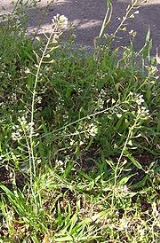
Shepherd's Purse

Encyclopedia
Capsella bursa-pastoris, known by its common name shepherd's-purse because of its triangular, purse-like pods, is a small (up to 0.5m) annual and ruderal species
, and a member of the Brassicaceae
or mustard family. It is native to eastern Europe
and Asia minor
but is naturalized and considered a common weed in many parts of the world, especially in colder climates, including Britain, where it is regarded as an archaeophyte
, North America
and China but also in the Mediterranean and North Africa. Capsella bursa-pastoris is closely related to the model organism
Arabidopsis thaliana
and is also used as a model organism due to the variety of genes expressed throughout its life cycle that can be compared to genes that are well studied in A. thaliana. Unlike most flowering plants, it flowers
almost all year round. Like many other annual ruderals exploiting disturbed ground, C. bursa-pastoris reproduces entirely from seed, has a long soil seed bank
, and short generation time and is capable of producing several generations each year.
of lobed leaves at the base. From the base emerges a stem about 0.2 to 0.5 meters tall, which bears a few pointed leaves which partly grasp the stem. The flowers are white and small, in loose raceme
s, and produce seed pods which are heart-shaped.
Like a number of other plants in several plant families, its seeds contain a substance known as mucilage
, a condition known as myxospermy. The adaptive value of myxospermy is unknown, although the fact that mucilage becomes sticky when wet has led some to propose that C. bursa-pastoris traps insects which then provide nutrients to the seedling, which would make it protocarnivorous
.
and the surrounding Jiangnan
region as food, where they are stir-fried with rice cakes
and other ingredients or as part of the filling in wonton
s. It is one of the ingredients of the symbolic dish consumed in the Japanese spring-time festival, Nanakusa-no-sekku
. In Korea it is known as naengi and its roots are one of the ingredients of the characteristic Korean dish, namul
(fresh greens and wild vegetables).
Fumaric acid
is one active substance that has been isolated. Although fumaric acid and its derivatives are used with success in many conditions, there is no direct evidence that plant extract has been used with similar success.
Ruderal species
A ruderal species is a plant species that is first to colonize disturbed lands. The disturbance may be natural , or due to human influence – constructional , or agricultural .Ruderal species typically dominate the disturbed area...
, and a member of the Brassicaceae
Brassicaceae
Brassicaceae, a medium sized and economically important family of flowering plants , are informally known as the mustards, mustard flowers, the crucifers or the cabbage family....
or mustard family. It is native to eastern Europe
Europe
Europe is, by convention, one of the world's seven continents. Comprising the westernmost peninsula of Eurasia, Europe is generally 'divided' from Asia to its east by the watershed divides of the Ural and Caucasus Mountains, the Ural River, the Caspian and Black Seas, and the waterways connecting...
and Asia minor
Asia Minor
Asia Minor is a geographical location at the westernmost protrusion of Asia, also called Anatolia, and corresponds to the western two thirds of the Asian part of Turkey...
but is naturalized and considered a common weed in many parts of the world, especially in colder climates, including Britain, where it is regarded as an archaeophyte
Archaeophyte
An archaeophyte is a plant species which is non-native to a geographical region, but which was an introduced species in "ancient" times, rather than being a modern introduction. Those arriving after are called neophytes...
, North America
North America
North America is a continent wholly within the Northern Hemisphere and almost wholly within the Western Hemisphere. It is also considered a northern subcontinent of the Americas...
and China but also in the Mediterranean and North Africa. Capsella bursa-pastoris is closely related to the model organism
Model organism
A model organism is a non-human species that is extensively studied to understand particular biological phenomena, with the expectation that discoveries made in the organism model will provide insight into the workings of other organisms. Model organisms are in vivo models and are widely used to...
Arabidopsis thaliana
Arabidopsis thaliana
Arabidopsis thaliana is a small flowering plant native to Europe, Asia, and northwestern Africa. A spring annual with a relatively short life cycle, arabidopsis is popular as a model organism in plant biology and genetics...
and is also used as a model organism due to the variety of genes expressed throughout its life cycle that can be compared to genes that are well studied in A. thaliana. Unlike most flowering plants, it flowers
Phenology
Phenology is the study of periodic plant and animal life cycle events and how these are influenced by seasonal and interannual variations in climate...
almost all year round. Like many other annual ruderals exploiting disturbed ground, C. bursa-pastoris reproduces entirely from seed, has a long soil seed bank
Soil Seed Bank
The soil seed bank refers to the natural storage of seeds, often dormant, within the soil of most ecosystems. The study of soil seed banks started in 1859 when Charles Darwin observed the emergence of seedlings using soil samples from the bottom of a lake. The first scientific paper on the subject...
, and short generation time and is capable of producing several generations each year.
Description
C. bursa-pastoris plants grow from a rosetteRosette (botany)
In botany, a rosette is a circular arrangement of leaves, with all the leaves at a single height.Though rosettes usually sit near the soil, their structure is an example of a modified stem.-Function:...
of lobed leaves at the base. From the base emerges a stem about 0.2 to 0.5 meters tall, which bears a few pointed leaves which partly grasp the stem. The flowers are white and small, in loose raceme
Raceme
A raceme is a type of inflorescence that is unbranched and indeterminate and bears pedicellate flowers — flowers having short floral stalks called pedicels — along the axis. In botany, axis means a shoot, in this case one bearing the flowers. In a raceme, the oldest flowers are borne...
s, and produce seed pods which are heart-shaped.
Like a number of other plants in several plant families, its seeds contain a substance known as mucilage
Mucilage
Mucilage is a thick, gluey substance produced by most plants and some microorganisms. It is a polar glycoprotein and an exopolysaccharide.It occurs in various parts of nearly all classes of plant, usually in relatively small percentages, and is frequently associated with other substances, such as...
, a condition known as myxospermy. The adaptive value of myxospermy is unknown, although the fact that mucilage becomes sticky when wet has led some to propose that C. bursa-pastoris traps insects which then provide nutrients to the seedling, which would make it protocarnivorous
Protocarnivorous plant
A protocarnivorous plant , according to some definitions, traps and kills insects or other animals but lacks the ability to either directly digest or absorb nutrients from its prey like a carnivorous plant...
.
Uses
C. bursa-pastoris is gathered from the wild or grown for food to supplement animal feed, for cosmetics, and for medicinal purposes. It is commonly used as food in ShanghaiShanghai
Shanghai is the largest city by population in China and the largest city proper in the world. It is one of the four province-level municipalities in the People's Republic of China, with a total population of over 23 million as of 2010...
and the surrounding Jiangnan
Jiangnan
Jiangnan or Jiang Nan is a geographic area in China referring to lands immediately to the south of the lower reaches of the Yangtze River, including the southern part of the Yangtze Delta...
region as food, where they are stir-fried with rice cakes
Nian gao
Niángāo, Year cake or Chinese New Year's cake is a food prepared from glutinous rice and consumed in Chinese cuisine. It is available in Asian supermarkets and from health food stores. While it can be eaten all year round, traditionally it is most popular during Chinese New Year...
and other ingredients or as part of the filling in wonton
Wonton
Not to be confused with WantonA wonton is a type of dumpling commonly found in a number of Chinese cuisines.-Filling:...
s. It is one of the ingredients of the symbolic dish consumed in the Japanese spring-time festival, Nanakusa-no-sekku
Nanakusa-no-sekku
The Festival of Seven Herbs, or Nanakusa no sekku , is the long-standing Japanese custom of eating seven-herb rice porridge on January 7 .The nanakusa are seven edible wild herbs of spring...
. In Korea it is known as naengi and its roots are one of the ingredients of the characteristic Korean dish, namul
Namul
Namul is a general term for a Korean seasoned vegetable dish. The name of the dish may vary slightly depending on what vegetables are used and how they are prepared, but they will nonetheless still be a type of namul....
(fresh greens and wild vegetables).
Fumaric acid
Fumaric acid
Fumaric acid or trans-butenedioic acid is the chemical compound with the formula HO2CCH=CHCO2H. This white crystalline compound is one of two isomeric unsaturated dicarboxylic acids, the other being maleic acid. In fumaric acid the carboxylic acid groups are trans and in maleic acid they are cis...
is one active substance that has been isolated. Although fumaric acid and its derivatives are used with success in many conditions, there is no direct evidence that plant extract has been used with similar success.
Parasites
- White rust Albugo candidaAlbugo candidaWhite rust, Albugo candida is a species from family Albuginaceae; however, all the other species in this family are called "white rust." Like other water moulds which are plant pathogens, it is sometimes called a fungus, although water moulds are not classified in the kingdom Fungi.Synonyms:*...
- One species of downy mildew Hyaloperonospora parasiticaHyaloperonospora parasiticaHyaloperonospora parasitica is a species from the family Peronosporaceae. It has been considered for a long time to cause downy mildew of a variety of species within the Brassicaceae family such as oilseed rape and cauliflower, on which the disease can cause economically important damage by killing...