


Shechita

Encyclopedia
Ritual slaughter
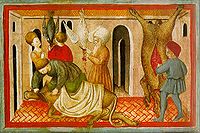
Ritual slaughter is the practice of slaughtering livestock for meat in a ritual manner. Ritual slaughter involves a prescribed method of slaughtering an animal for food production purposes...
of mammals and birds according to Jewish dietary laws
Kashrut
Kashrut is the set of Jewish dietary laws. Food in accord with halakha is termed kosher in English, from the Ashkenazi pronunciation of the Hebrew term kashér , meaning "fit" Kashrut (also kashruth or kashrus) is the set of Jewish dietary laws. Food in accord with halakha (Jewish law) is termed...
. The act is performed by severing the trachea
Vertebrate trachea
In tetrapod anatomy the trachea, or windpipe, is a tube that connects the pharynx or larynx to the lungs, allowing the passage of air. It is lined with pseudostratified ciliated columnar epithelium cells with goblet cells that produce mucus...
, oesophagus, carotid arteries and jugular veins using an extremely sharp blade ("chalef"), and allowing the blood to drain out
Exsanguination
Exsanguination is the fatal process of hypovolemia , to a degree sufficient enough to cause death. One does not have to lose literally all of one's blood to cause death...
.
The animal must be killed with respect
Respect
Respect denotes both a positive feeling of esteem for a person or other entity , and also specific actions and conduct representative of that esteem. Respect can be a specific feeling of regard for the actual qualities of the one respected...
and compassion
Compassion
Compassion is a virtue — one in which the emotional capacities of empathy and sympathy are regarded as a part of love itself, and a cornerstone of greater social interconnection and humanism — foundational to the highest principles in philosophy, society, and personhood.There is an aspect of...
by a shochet (ritual slaughterer), a religious Jew who is duly licensed and trained. The animal can be in a number of positions; when the animal is lying on its back, this is referred to as shechita munachat; in a standing position it is known as shechita me'umedet.
If the hindquarters of kosher mammals are to be eaten by Jews, they must be 'porged' - stripped of veins, chelev
Chelev
The Hebrew noun chelev is the term given to some kinds of animal fats in Judaism.The fat of animal sacrifices is subject to specific regulations in the Hebrew Bible....
(caul fat
Caul fat
Caul fat is the thin membrane which surrounds the stomach internal organs of some animals, such as hogs, cows, sheep, and pigs, also known as the greater omentum. It is often used as a natural sausage casing and to encase fegatelli , faggots , or pâté . Caul fat is also known as Lace...
and suet
Suet
Suet is raw beef or mutton fat, especially the hard fat found around the loins and kidneys.Suet has a melting point of between 45° and 50°C and congelation between 37° and 40°C....
) and sinews in accordance with a strict procedure. Because of the expense of porging and the skill required to properly separate out the forbidden parts, a large portion of the meat of kosher mammals slaughtered through shechita in the United States winds up on the non-kosher market.
Preparation
The animal must be kosher (i.e., mammals that chew their cud and have cloven hoovesCloven hoof
A cloven hoof is a hoof split into two toes. This is found on members of the mammalian order Artiodactyla. Examples of mammals that possess this type of hoof are deer and sheep. In folklore and popular culture, a cloven hoof has long been associated with the Devil.The two digits of cloven hoofed...
, or birds that are not birds of prey and for which there is an established tradition that the bird is kosher or similar to one that is).
Before slaughtering, the animal must be healthy, uninjured and viable. The animal cannot be stunned by electronarcosis, captive-bolt shot to the brain, or gas, as is common practice in modern animal slaughter, for this would inflict such injuries to the animal rendering the shechita invalid. After shechita the shochet may feel the area around the lungs, for scabbing or lesions, which would render the animal not kosher.
Shechita's source in the Oral Torah
Though referenced in the TorahTorah
Torah- A scroll containing the first five books of the BibleThe Torah , is name given by Jews to the first five books of the bible—Genesis , Exodus , Leviticus , Numbers and Deuteronomy Torah- A scroll containing the first five books of the BibleThe Torah , is name given by Jews to the first five...
, (Deut. 12:21) none of the basic practices of shechita are described in this place, or anywhere else in Torah (Five books of Moses). Instead, they have been handed down in Judaism's traditional Oral Torah
Oral Torah
The Oral Torah comprises the legal and interpretative traditions that, according to tradition, were transmitted orally from Mount Sinai, and were not written in the Torah...
, and codified in halakha
Halakha
Halakha — also transliterated Halocho , or Halacha — is the collective body of Jewish law, including biblical law and later talmudic and rabbinic law, as well as customs and traditions.Judaism classically draws no distinction in its laws between religious and ostensibly non-religious life; Jewish...
in various sources, most notably the Shulchan Aruch
Shulchan Aruch
The Shulchan Aruch also known as the Code of Jewish Law, is the most authoritative legal code of Judaism. It was authored in Safed, Israel, by Yosef Karo in 1563 and published in Venice two years later...
.
Duties of the shochet
To fulfill the basic law of shechita, the majority of both the tracheaVertebrate trachea
In tetrapod anatomy the trachea, or windpipe, is a tube that connects the pharynx or larynx to the lungs, allowing the passage of air. It is lined with pseudostratified ciliated columnar epithelium cells with goblet cells that produce mucus...
and esophagus
Esophagus
The esophagus is an organ in vertebrates which consists of a muscular tube through which food passes from the pharynx to the stomach. During swallowing, food passes from the mouth through the pharynx into the esophagus and travels via peristalsis to the stomach...
(windpipe and food pipe) of a mammal, or the majority of either one of these in the case of birds, must be incised with a back and forth motion without violating one of the five major prohibited techniques, or various more detailed rules. The five major forbidden techniques include: pressing, pausing, tearing, piercing, or covering. A shochet must have studied these laws and demonstrate a thorough understanding of them, as well as have been carefully trained, before he is allowed to 'shekht' meat unaided.
Pressing is accomplished when the shochet pushes the knife into the animal's throat, chops rather than slices, or positions the animal improperly so that either its head presses down on the blade as it expires or the shochet must push the knife into the throat against the force of gravity. There are those who feel that it is forbidden to have the animal in an upright position during shechita due to the prohibition of pressing. They feel that the animal must be on its back, lying on its side, suspended upside down by a rope or chain, or - as is done in most commercial slaughter houses - placed in a barrel-like pen that restrains the animal's limbs while it is turned on its back for slaughter. However, an expert shochet can slaughter the animal while it is upright without pressing the knife. This method is employed in most smaller operations in America.
Pausing is performed by the shochet if he stops the slaughtering process after either the trachea or esophagus has been cut, but before they have been cut the majority of the way through. Pausing can happen accidentally if muscle contractions in the animal's neck pull one of these organs out of contact with the blade. The latter case is especially common in turkeys.
Piercing is the result of stabbing the animal in the throat, slicing the trachea or esophagus with a serrated knife, slaughtering with a rusty knife or one that has an imperfection that rises above the blade's surface, burning the animal's throat, or slaughtering with a knife that is so hot it would cause a person not to touch it. Burning is always considered piercing in shechita, regardless of the motion of the knife.
Tearing is caused by using a knife with an imperfection on the blade, such as a scratch or nick, that causes a section of blade to be lower than the surface of the blade.
Covering is accomplished by either cutting into the animal's throat so deeply that the entire width of the knife disappears in the wound, using a knife that is too short so that the end disappears in the wound, or by having a foreign object fall over the knife so the shochet loses sight of the incision.
Giving of the Gifts
Once the animal has been checked and found to be kosher, it is a MitzvahMitzvah
The primary meaning of the Hebrew word refers to precepts and commandments as commanded by God...
for the shochet to give the foreleg, cheeks, and abomasum
Giving of the foreleg, cheeks and abomasum
The gift of the shoulder, cheeks and maw of an animal sacrifice to the priesthood in Ancient Israel was commanded in the Hebrew Bible.After the destruction of the Second Temple at the Siege of Jerusalem animal sacrifices ceased. However in rabbinical interpretation a continuing application of the...
to a Kohen
Kohen
A Kohen is the Hebrew word for priest. Jewish Kohens are traditionally believed and halachically required to be of direct patrilineal descent from the Biblical Aaron....
. Beit Din -in terms of the root of the obligation, has the Halachic authority to excommunicate a shochet who refuses to perform this Mitzvah. In any case, it is desired that the shochet himself refuse to perform the shechita unless the animal's owner expresses his agreement to give the gifts.
The Rishonim
Rishonim
"Rishon" redirects here. For the preon model in particle physics, see Harari Rishon Model. For the Israeli town, see Rishon LeZion.Rishonim were the leading Rabbis and Poskim who lived approximately during the 11th to 15th centuries, in the era before the writing of the Shulkhan Arukh and...
point out the Shochet cannot claim that since the animal does not belong to him, he cannot give the gifts without the owner's consent. On the contrary, since the average shochet is reputed to be well versed and knowledgeable in the laws of Shechitah ("Dinnei Shechita"), Beith Din relies on him to withhold his shechita so long as the owner refuses to give the gifts;
Minor rules
The animal's blood may not be collected in a bowl, a pit, or a body of water, as these resemble ancient forms of idol worship. If the shochet accidentally slaughters with a knife dedicated to idol worship, he must remove an amount of meat equivalent to the value of the knife and destroy it. If he slaughtered with such a knife on purpose, the animal is forbidden as not kosher. It is forbidden to slaughter an animal in front of other animals, or to slaughter an animal and its young on the same day, even separately. This is forbidden no matter how far away the animals are from each other. An animal's "young" is defined as either its own offspring, or another animal that follows it around, even if of another species.The knife
The knife used for shechita is called a hallaf by Ashkenazim or a sakin (Hebrew: סכין) by all Jews. By biblical law the knife may be made from anything not attached directly or indirectly to the ground and capable of being sharpened and polished to the necessary level of sharpness and smoothness required for shechita. The MinhagMinhag
Minhag is an accepted tradition or group of traditions in Judaism. A related concept, Nusach , refers to the traditional order and form of the prayers...
now is to use a metal knife. Anything but a metal knife today would render the animal unfit to eat except in certain narrow circumstances.
The knife must be minimally 1.5 or 2 times as long as the animal's neck is wide, depending on the species of animal and the number of strokes needed to slaughter the animal, but not so long that the weight of the knife exceeds the weight of the animal's head. If the knife is too large, it is assumed to cause pressing. The knife must not have a point. It is feared a point may slip into the wound during slaughter and cause piercing. The blade may also not be serrated, as serrations cause tearing.
The blade may not have imperfections in it. All blades are assumed by Jewish law to be imperfect, so the knife must be checked before each session. The shochet must run his fingernail up and down both sides of the blade and on the cutting edge to determine if he can feel any imperfections. He then uses a number of increasingly fine abrasive stones to sharpen and polish the blade until it is perfectly sharp and smooth. After the slaughter, the shochet must check the knife again in the same way to be certain the first inspection was properly done, and to ensure the blade was not damaged during shechita. If the blade is found to be damaged, the meat may not be eaten by Jews. If the blade falls or is lost before the second check is done, the first inspection is relied on and the meat is permitted.
In previous centuries the hallaf was made of forged steel, which was not reflective and was difficult to make both smooth and sharp. The Baal Shem Tov, fearing that Sabbateans were scratching the knives in a way not detectable by normal people, introduced the Hasidische
Hasidic Judaism
Hasidic Judaism or Hasidism, from the Hebrew —Ḥasidut in Sephardi, Chasidus in Ashkenazi, meaning "piety" , is a branch of Orthodox Judaism that promotes spirituality and joy through the popularisation and internalisation of Jewish mysticism as the fundamental aspects of the Jewish faith...
Hallaf. The Hasidische Hallaf differs from the previously used knife in that it was made from molten steel and polished to a mirror gloss in which scratches could be seen as well as felt. The new knife was controversial and was one of four reasons listed in the Brody Cherem for the excommunication
Excommunication
Excommunication is a religious censure used to deprive, suspend or limit membership in a religious community. The word means putting [someone] out of communion. In some religions, excommunication includes spiritual condemnation of the member or group...
of the Chassidim
Hasidic Judaism
Hasidic Judaism or Hasidism, from the Hebrew —Ḥasidut in Sephardi, Chasidus in Ashkenazi, meaning "piety" , is a branch of Orthodox Judaism that promotes spirituality and joy through the popularisation and internalisation of Jewish mysticism as the fundamental aspects of the Jewish faith...
.
Today the Hasidische Hallaf is the only commercially available knife for shechita and is universally accepted.
Bedikah
An animal must be checked again after it has been shekhted to see if there wereany internal injuries that would have rendered the animal unhealthy before the slaughter, but were simply not visible because they were internal. The inspector must check certain organs, such as the lungs, for any scarring which would render the animal treif (not kosher).
Glatt
Glatt means "smooth" in German and Yiddish. In the context of kosher meat, it refers to the smoothness, or lack of blemish, in the internal organs of the animal. In the case of a scab or lesion on a cow’s lungs specifically, there is debate between AshkenazicAshkenazi Jews
Ashkenazi Jews, also known as Ashkenazic Jews or Ashkenazim , are the Jews descended from the medieval Jewish communities along the Rhine in Germany from Alsace in the south to the Rhineland in the north. Ashkenaz is the medieval Hebrew name for this region and thus for Germany...
customs and Sephardic
Sephardi Jews
Sephardi Jews is a general term referring to the descendants of the Jews who lived in the Iberian Peninsula before their expulsion in the Spanish Inquisition. It can also refer to those who use a Sephardic style of liturgy or would otherwise define themselves in terms of the Jewish customs and...
customs. Ashkenazic Jews hold that if the patch can be removed and the lungs are still airtight (a process that is tested by filling the lungs with air and then submerging them in water and looking for escaping air) then the animal is still kosher, while Sephardic Jews hold that if there is any sort of scabbing or lesion on the lungs, then the animal is not kosher. “Glatt” meat would literally mean that the animal has passed the stringent Sephardic requirements, although today the word is rarely used in that context.
Porging
After the animal has been thoroughly inspected, there are still steps that have to be taken before the animal can be sold as kosher. The TorahTorah
Torah- A scroll containing the first five books of the BibleThe Torah , is name given by Jews to the first five books of the bible—Genesis , Exodus , Leviticus , Numbers and Deuteronomy Torah- A scroll containing the first five books of the BibleThe Torah , is name given by Jews to the first five...
prohibits the eating of certain fats and organs, such as the kidneys and intestines, so they must be removed from the animal. These fats are typically known as “chelev”. Chelev
Chelev
The Hebrew noun chelev is the term given to some kinds of animal fats in Judaism.The fat of animal sacrifices is subject to specific regulations in the Hebrew Bible....
prohibition only applies to domesticated animals, such as cattle and sheep. For wild animals, such as deer, this prohibition is not applicable. There is also a biblical prohibition against eating the sciatic nerve
Sciatic nerve
The sciatic nerve is a large nerve fiber in humans and other animals. It begins in the lower back and runs through the buttock and down the lower limb...
(gid hanasheh
Gid hanasheh
The gid hanasheh is the sciatic nerve that may not be eaten by Jews according to Halacha . The laws of prohibition regarding the gid hanasheh are found in Masechet Chullin Perek 7.-Source:...
), so that, too, must be removed.
The removal of the chelev and the gid hanasheh, called nikkur
Nikkur
Nikkur is the process of making an animal kosher by removing chelev and the gid hanasheh .It is much easier to perform nikkur on the front part of the animal...
, is considered complicated and tedious, and hence labor intensive, and even more specialized training is necessary to perform the act properly. While the small amounts of chelev in the front half of the animal are relatively easy to remove, the back half of the animal is far more complicated, and it is where the sciatic nerve is located.
In countries such as America, where there exists a large nonkosher meat market, the hindquarters of the animal (where many of these forbidden meats are located) is sold to Gentiles so as to simplify the process. This tradition goes back for centuries where local Muslims accept meat slaughtered by Jews as consumable; however, the custom was not universal throughout the Muslim world
Muslim world
The term Muslim world has several meanings. In a religious sense, it refers to those who adhere to the teachings of Islam, referred to as Muslims. In a cultural sense, it refers to Islamic civilization, inclusive of non-Muslims living in that civilization...
, and some Muslims (particularly on the Indian subcontinent
Indian subcontinent
The Indian subcontinent, also Indian Subcontinent, Indo-Pak Subcontinent or South Asian Subcontinent is a region of the Asian continent on the Indian tectonic plate from the Hindu Kush or Hindu Koh, Himalayas and including the Kuen Lun and Karakoram ranges, forming a land mass which extends...
) did not accept these hindquarters as halal
Halal
Halal is a term designating any object or an action which is permissible to use or engage in, according to Islamic law. The term is used to designate food seen as permissible according to Islamic law...
. On the other hand, in countries like Israel, specially trained men are hired to prepare the hindquarters for sale as kosher.
Blood
The blood must also be removed from the meat, as there is a biblical prohibition against the eating of blood as well. All large arteries and veins are removed, as well as any bruised meat or coagulated blood. Then the meat has to be purged of all remaining blood (kashering). The process is generally done by letting the meat soak for around 30 minutes, covering it with salt and then allowing it to drain. In Sephardi traditions, one generally leaves the salt on for a full hour and then rinses the meat thoroughly. The meat is then considered kashered. However, if the meat has been left for more than three days after being slaughtered without being kashered, then the blood is considered to have “set” in the meat, and it is no longer salvageable to eat except when prepared through broiling with appropriate drainage.Significance in Jewish tradition
The laws of shechita are not given in the text of the Torah. Rather, the Torah only writes that the slaughter shall be "as I have instructed you." In Orthodox JudaismOrthodox Judaism
Orthodox Judaism , is the approach to Judaism which adheres to the traditional interpretation and application of the laws and ethics of the Torah as legislated in the Talmudic texts by the Sanhedrin and subsequently developed and applied by the later authorities known as the Gaonim, Rishonim, and...
this is taken as one proof that Moses received an Oral Torah
Oral Torah
The Oral Torah comprises the legal and interpretative traditions that, according to tradition, were transmitted orally from Mount Sinai, and were not written in the Torah...
along with the text,
Animal welfare controversies
The prohibition of stunning and the treatment of the slaughtered animal expressed in shechita law limits the extent to which Jewish slaughterhouses can industrialize their procedures. The most industrialized attempt at a kosher slaughterhouseSlaughterhouse
A slaughterhouse or abattoir is a facility where animals are killed for consumption as food products.Approximately 45-50% of the animal can be turned into edible products...
, Agriprocessors
Agriprocessors
Agriprocessors was the corporate identity of a slaughterhouse and meat-packaging factory based in Postville, Iowa, best known as a facility for the glatt kosher processing of cattle, as well as chicken, turkey, duck, and lamb. Agriprocessors' meat and poultry products were marketed under the brand...
of Postville, Iowa
Iowa
Iowa is a state located in the Midwestern United States, an area often referred to as the "American Heartland". It derives its name from the Ioway people, one of the many American Indian tribes that occupied the state at the time of European exploration. Iowa was a part of the French colony of New...
, became the center of controversy in 2004, after People for the Ethical Treatment of Animals
People for the Ethical Treatment of Animals
People for the Ethical Treatment of Animals is an American animal rights organization based in Norfolk, Virginia, and led by Ingrid Newkirk, its international president. A non-profit corporation with 300 employees and two million members and supporters, it claims to be the largest animal rights...
released gruesome undercover video of cattle struggling to their feet with their tracheas and esophagi ripped out after shechita. Some of the cattle actually got up and stood for a minute or so after being dumped from the rotating pen.http://www.goveg.com/feat/agriprocessors Temple Grandin
Temple Grandin
Temple Grandin is an American doctor of animal science and professor at Colorado State University, bestselling author, and consultant to the livestock industry on animal behavior...
said: "I've been in at least 30 other kosher slaughter plants, and I had never ever seen that kind of procedure done before. … I've seen kosher slaughter really done right, so the problem here is not kosher slaughter."
The UK Farm Animal Welfare Council
Farm Animal Welfare Council
The Farm Animal Welfare Council was an independent advisory body established by the Government of Great Britain in 1979. FAWC has published its Final Report before its closure on 31 March 2011...
said that the method by which Kosher and Halal
Halal
Halal is a term designating any object or an action which is permissible to use or engage in, according to Islamic law. The term is used to designate food seen as permissible according to Islamic law...
meat is produced causes "significant pain and distress" to animals and should be banned. According to FAWC it can take up to two minutes for cattle to bleed to death. Compassion in World Farming
Compassion In World Farming
Compassion in World Farming is a campaigning and lobbying animal welfare organisation, with headquarters in the UK, branches in eight European countries and international representatives in China, Australia and South Africa...
also supported the recommendation saying "We believe that the law must be changed to require all animals to be stunned before slaughter." The UK government rejected FAWC's recommendations.
Various research papers on cattle slaughter collected by Compassion In World Farming
Compassion In World Farming
Compassion in World Farming is a campaigning and lobbying animal welfare organisation, with headquarters in the UK, branches in eight European countries and international representatives in China, Australia and South Africa...
mention that "after the throat is cut, large clots can form at the severed ends of the carotid arteries, leading to occlusion of the wound (or 'ballooning' as it is known in the slaughtering trade)". Nick Cohen wrote in the New Statesman, "Occlusions slow blood loss from the carotids and delay the decline in blood pressure that prevents the suffering brain from blacking out. In one group of calves, 62.5 per cent suffered from ballooning. Even if the slaughterman is a master of his craft and the cut to the neck is clean, blood is carried to the brain by vertebral arteries and it keeps cattle conscious of their pain."
Temple Grandin
Temple Grandin
Temple Grandin is an American doctor of animal science and professor at Colorado State University, bestselling author, and consultant to the livestock industry on animal behavior...
, a leading designer of animal handling systems gives the various researcher's times to lose consciousness. She is opposed to shackling and hoisting as a method of handling animals and wrote, on visiting a shechita slaughterhouse, "I will never forget having nightmares after visiting the now defunct Spencer Foods plant in Spencer, Iowa fifteen years ago. Employees wearing football helmets attached a nose tong to the nose of a writhing beast suspended by a chain wrapped around one back leg. Each terrified animal was forced with an electric prod to run into a small stall which had a slick floor on a forty-five degree angle. This caused the animal to slip and fall so that workers could attach the chain to its rear leg [in order to raise it into the air]. As I watched this nightmare, I thought, 'This should not be happening in a civilized society.' In my diary I wrote, 'If hell exists, I am in it.' I vowed that I would replace the plant from hell with a kinder and gentler system." Temple Grandin has worked closely with Jewish slaughters to design handling systems for cattle, and has said: "When the cut is done correctly, the animal appears not to feel it. From an animal welfare standpoint, the major concern during ritual slaughter are the stressful and cruel methods of restraint (holding) that are used in some plants."
See also
- KashrutKashrutKashrut is the set of Jewish dietary laws. Food in accord with halakha is termed kosher in English, from the Ashkenazi pronunciation of the Hebrew term kashér , meaning "fit" Kashrut (also kashruth or kashrus) is the set of Jewish dietary laws. Food in accord with halakha (Jewish law) is termed...
- Tza'ar ba'alei chayimTza'ar ba'alei chayimTza'ar ba'alei chayim is the Jewish principle which bans inflicting unnecessary pain on animals. This concept is not clearly enunciated in the written Torah, but was accepted by the Talmud as being a Biblical mandate...
- Ritual slaughterRitual slaughterRitual slaughter is the practice of slaughtering livestock for meat in a ritual manner. Ritual slaughter involves a prescribed method of slaughtering an animal for food production purposes...
- Giving of the Foreleg, Cheeks, and Abomasum
- Islamic and Jewish dietary laws compared
- Zabiha (Muslim method of ritual slaughter)
- JhatkaJhatkaJhatka or Chatka meat is meat from an animal which has been killed by a single strike of a sword or axe to sever the head, as opposed to Jewish slaughter or Islamic slaughter in which the animal is killed by ritually slicing the throat.-Jhatka meat and Sikhs:Jhatka for Sikhs is the...
(Hindu method of ritual slaughter) - Legal aspects of ritual slaughter
- DIALRELDIALRELDIALREL was a project financed by the EU...
External links
- Religious Slaughter in Europe : Consumer Deception and DialRel’s Failure Hanen Rezgui (ASIDCOM, France), Joe M. Regenstein (Cornell University, USA), Abdel’ Aziz Di-Spigno (ASIDCOM, France)
- Shechita at The Orthodox Union
- The Scientific Approach to Resolving Conflicts between Veterinary Science and Shechita. Israel Journal of Veterinary Medicine. Volume 54 (1), 1999
- Shechita - The Jewish Religious Humane Method of Animal Slaughter for Food
- Shechita - A Photo Essay
- Laws of Judaism concerning food including laws of ritual slaughter.
- Shechita UK
- Temple Grandin's recommended ritual slaughter practices
- What's the truth about nikkur achoraim? Rabbi Dr. Ari Z. Zivotofsky
- Is Shechita cruel? at OzTorah
- Dr Ari Z. Zivotofsky Birds that are kosher. Preserving the Kashrus Mesorah
- Ari Z. Zivotofsky, Ph.D., Shu”B Bar Ilan University, Israel. Religious rules and requirements - Judaism.
News