

Senecio iscoensis

Encyclopedia
Senecio iscoensis or Aetheolaena senecioidesis is a species of Senecio
in the Asteraceae
family that is found only in subtropical and tropical dry shrubland
in Ecuador
.
It is threatened by habitat loss.
It is known from three collections in the central and northern Andes
. First recorded by Luis Sodiro
, probably at the Hacienda Isco, it is also recorded from the foothills of Volcán Antisana
and probably inside the reserve of the Antisana Ecological Reserve,
a privately-owned reserve that preserves the native flora and fauna of the Northern Andean páramo
.
S. icoensis might be a synonym of S. antisanae
.
 Neotropic
:
Senecio
Senecio is a genus of the daisy family that includes ragworts and groundsels. The flower heads are normally rayed, completely yellow, and the heads are borne in branched clusters...
in the Asteraceae
Asteraceae
The Asteraceae or Compositae , is an exceedingly large and widespread family of vascular plants. The group has more than 22,750 currently accepted species, spread across 1620 genera and 12 subfamilies...
family that is found only in subtropical and tropical dry shrubland
Shrubland
Shrubland, scrubland, scrub or brush is a plant community characterized by vegetation dominated by shrubs, often also including grasses, herbs, and geophytes. Shrubland may either occur naturally or be the result of human activity...
in Ecuador
Ecuador
Ecuador , officially the Republic of Ecuador is a representative democratic republic in South America, bordered by Colombia on the north, Peru on the east and south, and by the Pacific Ocean to the west. It is one of only two countries in South America, along with Chile, that do not have a border...
.
It is threatened by habitat loss.
It is known from three collections in the central and northern Andes
Andes
The Andes is the world's longest continental mountain range. It is a continual range of highlands along the western coast of South America. This range is about long, about to wide , and of an average height of about .Along its length, the Andes is split into several ranges, which are separated...
. First recorded by Luis Sodiro
Luis Sodiro
Luis Sodiro was a field botanist who described a large number of species from the area around Quito, Ecuador in the early 20th century.-Sources:* *; International Aroid Society; retrieved 28 December 2007....
, probably at the Hacienda Isco, it is also recorded from the foothills of Volcán Antisana
Antisana
Antisana is a stratovolcano of the northern Andes, in Ecuador. It is the fourth highest volcano in Ecuador, at , and is located 50 km SE of the capital city of Quito.Antisana presents one of the most challenging technical climbs in the Ecuadorian Andes....
and probably inside the reserve of the Antisana Ecological Reserve,
a privately-owned reserve that preserves the native flora and fauna of the Northern Andean páramo
Páramo
The term páramo can refer to a variety of ecosystems. Some ecologists describe the páramo broadly as “all high, tropical, montane vegetation above the continuous timberline”. A more narrow term classifies the páramo according to its regional placement - specifically located in “the northern Andes...
.
S. icoensis might be a synonym of S. antisanae
Senecio antisanae
Senecio antisanae is a species of Senecio in the Asteraceae family found only in the subtropical or tropical moist montane region of Ecuador. It is threatened by habitat loss....
.
Distribution
Neotropic
In biogeography, the Neotropic or Neotropical zone is one of the eight terrestrial ecozones. This ecozone includes South and Central America, the Mexican lowlands, the Caribbean islands, and southern Florida, because these regions share a large number of plant and animal groups.It is sometimes used...
:
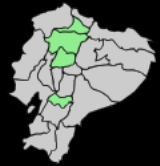
- Western South America: EcuadorEcuadorEcuador , officially the Republic of Ecuador is a representative democratic republic in South America, bordered by Colombia on the north, Peru on the east and south, and by the Pacific Ocean to the west. It is one of only two countries in South America, along with Chile, that do not have a border...
(PichinchaPichincha ProvincePichincha is a province of Ecuador located in the northern sierra region; its capital and largest city is Quito. It is bordered by Imbabura & Esmeraldas to the north, Cotopaxi & Santo Domingo de los Tsáchilas to the south, Napo & Sucumbíos to the east, and Esmeraldas & Santo Domingo de los...
, ImbaburaImbabura ProvinceImbabura is a province in Ecuador. The capital is Ibarra. The people of the province speak Spanish and the Imbaburan Quechua language.Imbabura Volcano is located in the province. Best reached from the town of La Esperanza, the 4,609-meter-high mountain can be climbed in a single day.- Cantons...
, CotopaxiCotopaxi ProvinceCotopaxi is one of the provinces of Ecuador. The capital is Latacunga. The province contains the Cotopaxi Volcano, an intermittent volcano with a height of 19,388 feet.- Cantons :The province is divided into 7 cantons...
, CañarCañar ProvinceCañar is a province in Ecuador. The capital is Azogues. At the time of census 2005 the province had a population of 221,045. It contains the 16th-century ruins of Ingapirca, the best-known Inca settlement in Ecuador and a product of their conquest of the indigenous Cañari.- Cantons :The province...
)