
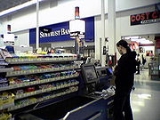
Self checkout machines are automated alternatives to the traditional
cashierA cashier is a person who scans the goods through a machine called a cash register that the consumer wishes to purchase at the retail store. After all of the goods have been scanned, the cashier then collects payment for the goods or services exchanged. In one form or another, cashiers have been...
-staffed checkout at retailers. They have been implemented most often in stores like those which sell groceries, and other large scale stores.
History
The first supermarket self checkout system in the world was installed in 1992 in the Price Chopper Supermarkets in Clifton Park, New York. The system was invented by Dr.
Howard Schneider, as described in United States Patent Nos. 5083638, 5,168,961 which were granted in 1992. The self-checkout machines were called "robots" by Schneider who thought that a new class of "service robots" could be created to perform service work and provide a platform for his ideas on
artificial intelligenceArtificial intelligence is the intelligence of machines and the branch of computer science which aims to create it. Textbooks define the field as "the study and design of intelligent agents,"...
. The company, Optimal Robotics, was founded in Montreal in 1991 (in Schneider's garage, the same address listed on the patents) to design, build and market these service robots.
The Optimal Robotics "self-checkout robots" performed well at Price Chopper Supermarkets and in the 1990's went on to be implemented in the Kroger Supermarket chain and then in many supermarket chains throughout United States, Canada, U.K. and Australia.
Optimal RoboticsOptimal Robotics, with name changed to Optimal Group is based in Montreal and currently operates two main divisions:WowWee -- producer of high tech toys -- designed in Hong Kong but sold throughout the world. An example of their toys is the HomoSapiens robot....
went public on NASDAQ in the mid 1990s with a new management and Dr. Schneider leaving the company. Eventually Optimal Robotics sold the technology to NCR and to Fujitsu and got out of the robot/self-checkout business and changed their name to the Optimal Group.
NCR
NCR CorporationNCR Corporation is a technology company specializing in products for the retail, financial, travel, healthcare, food service, entertainment, gaming and public sector industries. Its main products are self-service kiosks, point-of-sale terminals, automated teller machines, check processing...
first prototyped their self-checkout machines in 1997. By 2003, these automated checkouts had become widespread, with most being supplied by NCR, Fujitsu/ICL and IBM.
There has been little improvement since the 1990s in the design or operation of the typical self checkout systems used in the retail environment. For example,at the time of this writing a recent United States Patent No. 7,516,819 issued on April 14, 2009 to
Michael JohnsonMichael Johnson or Mike Johnson may refer to:In music:*Michael Johnson *Mike Johnson *Mike Johnson *Michael Johnson...
and co-inventors at
IBMInternational Business Machines Corporation, abbreviated IBM, is a multinational computer technology and IT consulting corporation headquartered in Armonk, Town of North Castle, New York, United States. The company is one of the few information technology companies with a continuous history dating...
, is extremely similar to the prior patents issued for self-checkout. In this recent patent, titled, "Self-checkout system with plurality of capacity-detecting loading stations" the invention claims a multiple of scales and if a wrong weight occurs the scanner is shut down and won't scan the next item (something that actually the Optimal Robotics original supermarket checkout machine did, and something that current
NCRNCR can refer to several topics:* nCr as an abbreviation of the mathematics formula "from n choose r"* NCR Corporation, a technology company specializing in solutions for businesses...
and
Fujitsuis a Japanese multinational computer hardware and IT services company headquartered in the Shiodome City Center complex in Minato, Tokyo.. Fujitsu's central focus is on providing IT-driven business solutions, but the company and its subsidiaries also offer a diversity of products and services in...
models have done and continue to do).
Description
In self-checkout systems, the
customerA customer, also called client, buyer, or purchaser, is usually used to refer to a current or potential buyer or user of the products of an individual or organization, called the supplier, seller, or vendor. This is typically through purchasing or renting goods or services...
is permitted to scan the
barcodeA barcode is an optical machine-readable representation of data. Originally, barcodes represented data in the widths and the spacings of parallel lines, and may be referred to as linear or 1D barcodes or symbologies...
s on their own items, and manually identify items such as
fruitThe term fruit has different meanings dependent on context, and the term is not synonymous in food preparation and biology. Fruits are the means by which flowering plants disseminate seeds, and the presence of seeds indicates that a structure is most likely a fruit, though not all seeds come from...
s and
vegetableA vegetable is an edible plant or part of a plant. However, the word is not scientific, and its meaning is largely based on culinary and cultural tradition. Therefore the application of the word is somewhat arbitrary and subjective. For example, some people consider mushrooms to be vegetables,...
s (usually with a
touchscreenA touchscreen is a display that can detect the presence and location of a touch within the display area. The term generally refers to touch or contact to the display of the device by a finger or hand. Touchscreens can also sense other passive objects, such as a stylus. However, if the object...
display), which are then weighed where applicable, and place the items into a bagging area. The weight observed in the bagging area is verified against previously stored information to ensure that the correct item is bagged, allowing the customer to proceed only if the observed and expected weights match.
There is a fair amount of technology, both electronic and software (artificial intelligence) involved in the operation of the machines. For example, the main reason the Optimal Robotics self-checkout system, based on Schneider's patents, did so well compared to the other model on the market at the time, eg, the CheckRobot model marketed by IBM in the 1990s, is because it had self-learning functions, ie, it didn't have to be programmed with the weight, color, etc of a new product, but learned these features on its own. The first time the Optimal machine saw a new product it actually allowed the customer to scan and bag the product without interference and assumed the customer was honest (the customer would not know it was the first time it was presenting an item to the machine and would not want to try to steal something fearing an alarm would be triggered and the item rejected), and it accumulated data on the product. As the machine saw the items more times it learned what the weight tolerances of this product were, what the color tolerances were (there were color cameras overhead on the early Optimal machines), etc. This information was passed onto other self checkout machines. So in essence the machines learned on their own, and provided seemingly reliable service to the supermarket with little intervention on behalf of the supermarket. As well, similar computer routines were required to keep the machine functioning smoothly. For example, in United States Patent No. 5,125,465 awarded to Dr. Howard Schneider of Optimal Robotics on June 30, 1992, a mechanism to allow the customer to keep scanning one item after another quickly, ie, more quickly than the scales could mechanically react to, is given:
In some self-checkout systems, rather than weighing items in the bagging area, a
conveyor beltA belt conveyor consists of two or more pulleys, with a continuous loop of material - the conveyor belt - that rotates about them. One or both of the pulleys are powered, moving the belt and the material on the belt forward. The powered pulley is called the drive pulley while the unpowered pulley...
is provided to move items from the
barcodeA barcode is an optical machine-readable representation of data. Originally, barcodes represented data in the widths and the spacings of parallel lines, and may be referred to as linear or 1D barcodes or symbologies...
scanner to the bagging area. In such a system, the item is verified while it is on the conveyor belt.
There is normally an attendant watching over several self checkout machines, to provide assistance, prevent
theftIn criminal law, theft is the illegal taking of another person's property without that person's freely-given consent. The word is also used as an informal shorthand term for some crimes against property, such as burglary, embezzlement, larceny, looting, robbery, shoplifting, fraud and sometimes...
through exploitation of the machines' weaknesses, and to enforce payment. Attendant assistance is also required for the purchase of age-restricted items.
Payment on these machines can be accepted by various methods; card via
EFTPOSEFTPOS is an Australian and New Zealand financial network for processing credit cards, debit cards and charge card payments at "Point of Sale" and transacting at ATMs....
,
credit cardA credit card is part of a system of payments named after the small plastic card issued to users of the system. It is a card entitling its holder to buy goods and services based on the holder's promise to pay for these goods and services...
,
cashCash refers to money in the physical form of currency, such as banknotes and coins.In bookkeeping and finance, "cash" refers to current assets comprised of currency or currency equivalents that can be accessed immediately or near-immediately .Cash is a prompt or instant payment for goods and...
via
coinA coin is a piece of hard material, usually metal or a metallic material and sometimes made of synthetic materials, usually in the shape of a disc, and most often issued by a government. Coins are used as a form of money in transactions of various kinds, from the everyday circulation coins to the...
slot and bank note scanner, and in-store gift cards where applicable. Most coupons also have barcodes and can be scanned the same way that items are scanned although some require attendant entry.
Advantages
The benefit to the customer is in the reduced checkout time because stores are often able to efficiently run two to six self checkout units where it normally would have had one cashier.
Some customers appreciate the ability not to have to deal with anyone. Self checkout may create an illusion of privacy and anonymity, when in fact the self checkout attendant can track the progress of customers on all machines via a separate terminal known as a RAP (Remote Attendant Post).).
The benefit to the retailer in providing self checkout machines is in reduced staffing requirements since one attendant is all that is required to run 4 to 6 checkout lanes at one time.).).
Disadvantages
The time efficiency requires that the customers using the machine be reasonably competent. An inexperienced customer can cause the same sort of delays as an inexperienced cashier on a conventional register.
As the weight observed in the bagging scale is checked to allow the customer to proceed only if the observed and expected weights match, it is difficult to reconcile with the use of
environmentallyEnvironmentalism is a broad philosophy and social movement regarding concerns for environmental conservation and improvement of the state of the environment...
preferable alternatives to shop-provided
bagA bag is a non-rigid mostly semi-rigid container, made of paper, cloth, plastic, leather, or some other flexible material.A bag is used for packaging and/or carrying items...
s, for example,
basketA basket is a container which is traditionally constructed from stiff fibres, often made of willow. . The top is either left open or the basket may be fitted with a lid....
s, rucksacks, and other reusable (but heavier) carriers. Conveyor belt-based verification avoids this problem.
Another problem which frequently occurs is the bagging
scaleA weighing scale is a measuring instrument for determining the weight or mass of an object. A spring scale measures weight by the distance a spring deflects under its load. A balance compares the unknown weight to a standard weight using a horizontal lever...
failing to register properly the weight of the items purchased. The systems often falsely report that unscanned items have been bagged, or that scanned items were not placed in the bag. These false alerts halt the checkout process and require the store attendant to come and approve the weight exception, often eliminating any time savings that could have been realized by using self-checkout instead of waiting in line for a regular register. This issue sometimes occurs because of weight fluctuations on the bag scale caused by the platter being improperly positioned or calibrated.
Self-checkout is vulnerable to some shoplifting techniques. However, in many cases the machine will pick up the attempt to steal or else cause the shopper to alter behavior (eg, put an item not on the scales but somewhere else where it should not be put and will be noticed by the system supervisor). For example, in 2007, a man was charged with replacing the tag of a plasma TV with a $4.88 DVD, and trying to purchase it through self-checkout.
Alternative system
An alternative system consists of a portable barcode scanner that is used by the customer to scan and bag items while shopping. When the customer has finished shopping, the scanner is brought to a checkout
kioskIn the Mediterranean Basin and the Near East, a kiosk is a small, separated garden pavilion open on some or all sides. Kiosks were common in Persia, India, Pakistan, and in the Ottoman Empire from the 13th century onward...
, where the information from the barcode scanner is downloaded to the kiosk, usually in conjunction with a
customer loyalty cardLoyalty programs are structured marketing efforts that reward, and therefore encourage, loyal buying behavior — behavior which is potentially of benefit to the firm....
. The customer pays and receives a receipt at the checkout kiosk. The integrity of the system is maintained through the use of random audits or RFID.
Theft on these services is reduced by a combination of a high barrier to entry, and occasional audits of customers' shopping, where customers chosen at random are taken to a specialised till and have their shopping scanned in the usual way.