
All Topics  
Barcode


   Email Print
   Bookmark   Link


Barcode


A bar code (also barcode) is an optical machine-readable
Machine-readable

The term machine-readable refers to information encoded in a form which can be, scanned or sensed by a machine or computer and interpreted by its hardware and software....
 representation of data. Originally, bar codes represented data in the widths (lines) and the spacings of parallel lines and may be referred to as linear or 1D (1 dimensional) barcodes or symbologies. But they also come in patterns of squares, dots, hexagons and other geometric patterns within images termed 2D (2 dimensional) matrix codes or symbologies.


Discussion
Ask a question about 'Barcode'
Start a new discussion about 'Barcode'
Answer questions from other users
Full Discussion Forum


Encyclopedia


A bar code (also barcode) is an optical machine-readable
Machine-readable

The term machine-readable refers to information encoded in a form which can be, scanned or sensed by a machine or computer and interpreted by its hardware and software....
 representation of data. Originally, bar codes represented data in the widths (lines) and the spacings of parallel lines and may be referred to as linear or 1D (1 dimensional) barcodes or symbologies. But they also come in patterns of squares, dots, hexagons and other geometric patterns within images termed 2D (2 dimensional) matrix codes or symbologies. In spite of there being no bars, 2D systems are generally referred to as barcodes as well.

The first use of barcodes was to automate grocery checkout systems, a task where they have become almost universal today. Their use has spread to many other roles as well, tasks that are generically referred to as Auto ID Data Capture
Automated identification and data capture

Automatic Identification and Data Capture refers to the methods of automatically identifying objects, collecting data about them, and entering that data directly into computer systems ....
 (AIDC). Newer systems, like RFID, are attempting to make inroads in the AIDC market, but the simplicity, universality and low-cost of barcodes has limited the role of these newer systems. It will cost about US$0.005 to implement a barcode compared to passive RFID which still costs about US$0.07 to US$0.30 per tag.

Barcodes can be read by optical scanners called barcode reader
Barcode reader

A barcode reader is an electronic device for reading printed barcodes. Like a flatbed scanner, it consists of a light source, a lens and a light sensor translating optical impulses into electrical ones....
s or scanned from an image by special software. In Japan
Japan

Japan is an island country in East Asia. Located in the Pacific Ocean, it lies to the east of the Sea of Japan, People's Republic of China, North Korea, South Korea and Russia, stretching from the Sea of Okhotsk in the north to the East China Sea and Taiwan in the south....
, most cell phones have built-in scanning software for 2D codes, and similar software is becoming available on smartphone
Smartphone

A smartphone is a mobile phone offering advanced capabilities beyond a typical mobile phone, often with personal computer-like functionality. There is no industry standard definition of a smartphone....
 platforms.

History

In 1932 Wallace Flint started a project at the Harvard University Graduate School of Business Administration
Harvard Business School

Harvard Business School is a business school in the United States. It is one of the graduate schools of Harvard University.Founded in 1908, Harvard Business School started with 59 students....
 to better automate customer purchasing. As punch card
Punch card

A punch card or punched card , is a piece of paperboard that contains digital information represented by the presence or absence of holes in predefined positions....
s were all the rage at the time, the system they envisioned used a catalog of items with corresponding punch cards for each one. The customer would hand the cards to a clerk who would load them into a reader. The item would then be found and retrieved from a fully automated warehouse. An itemized bill was automatically produced. In spite of its promise, punch card systems were expensive and the country was in the midst of the Great Depression
Great Depression

File:International depression.pngThe Great Depression was a worldwide economic Recession starting in most places in 1929 and ending at different times in the 1930s or early 1940s for different countries....
. The project never went anywhere, but Flint's efforts would later prove decisive...

Silver, Woodland and Johanson

In 1948 Bernard Silver, a graduate student at Drexel Institute of Technology in Philadelphia, overheard the president of a local food chain asking one of the deans to research a system to automatically read product information during checkout. Silver told his friends Norman Joseph Woodland and Jordin Johanson about the request, and the three started working on a variety of systems. Their first working system used ultraviolet
Ultraviolet

Ultraviolet light is electromagnetic radiation with a wavelength shorter than that of visible light, but longer than x-rays, in the range 400 nanometer to 10 nm, and energies from 3 Electron volt to 124 eV....
 ink, but this proved to fade and was fairly expensive.

Convinced that the system was workable with further development, Woodland quit his position at Drexel, moved into his father's apartment in Florida, and continued working on the system. His next inspiration came from Morse code
Morse code

Morse code is a type of character encoding that transmits telegraphic information using rhythm. Morse code uses a standardized sequence of short and long elements to represent the alphanumeric, punctuation and special characters of a given message....
, and he formed his first barcode when "I just extended the dots and dashes downwards and made narrow lines and wide lines out of them." To read them, he adapted technology from optical soundtrack
Soundtrack

The term soundtrack refers to three related concepts: recorded music accompanying and synchronized to the images of a motion picture, television program or video game; a commercially released soundtrack album of music as featured in the soundtrack of a film or TV show; and the physical area of a film that contains the synchronized recorded so...
s in movies, using a 500 watt light bulb shining through the paper onto an RCA935 photomultiplier
Photomultiplier

Photomultiplier tubes , members of the class of vacuum tubes, and more specifically phototubes, are extremely sensitive detectors of light in the ultraviolet, visible light, and near-infrared ranges of the electromagnetic spectrum....
 tube (from a movie projector) on the far side. He later decided that the system would work better if it were printed as a circle instead of a line, which would allow it to be scanned in any direction.

On 20 October 1949, They filed a patent application for "Classifying Apparatus and Method". In it they described both the linear and "bullseye" printing patterns, as well as the mechanical and electronic systems needed to read the code. The patent was issued on 7 October 7 1952 as . In 1951 Woodland and Johanson moved to IBM
IBM

International Business Machines Corporation, abbreviated IBM and nicknamed "Big Blue" , is a multinational corporation computer technology and consulting corporation headquartered in Armonk, New York, New York, United States....
 and continually tried to interest them in developing the system. They eventually commissioned a report on the idea, which concluded that it was both feasible and interesting, but that the information coming out of it would require equipment that was some time off in the future.

In 1952 Philco
Philco

Philco, the Philadelphia Storage Battery Company , was a pioneer in early battery, radio and television production as well as former employer of Philo Farnsworth, inventor of cathode ray tube television....
 purchased their patent, and later sold it to RCA
RCA

RCA Corporation, founded as Radio Corporation of America, was an electronics company in existence from 1919 to 1986. Today, the RCA is owned by the France conglomerate Thomson SA through RCA Trademark Management S.A., a company owned by Thomson....
.

Collins at Sylvania

During his undergraduate degree, David Collins worked at the Pennsylvania Railroad
Pennsylvania Railroad

The Pennsylvania Railroad was an United States railroad, founded in 1846. Commonly referred to as the "Pennsy," the PRR was headquartered in Philadelphia, Pennsylvania....
 and became aware of the need to automatically identify train cars. Immediately after receiving his master's degree from MIT in 1959, he started work at Sylvania
Sylvania

Sylvania literally means "forest land" in Latin. It is used to mean several different things:...
, working on the problem. He developed a system using blue and yellow reflective stripes attached to the side of the cars, encoding a six-digit company ID and a four-digit car number. Light reflected off the stripes was fed into one of two photomultipliers, filtered for blue or yellow.

The Boston and Maine Railroad
Boston and Maine Railroad

The Boston and Maine Corporation , known as the Boston and Maine Railroad until 1964, was the dominant railroad of the northern New England region of the United States for a century....
 tested the system on their gravel cars in 1961. The tests continued until 1967, when the Association of American Railroads
Association of American Railroads

The Association of American Railroads is an industry trade group representing primarily the major freight Rail transport of North America . Amtrak and some regional Commuter rail in North America are also members....
 (AAR) selected it as a standard across the entire North American fleet. The first installations started on 10 October 1967. However, the economic downturn and rash of bankruptcies in the industry in the early 1970s greatly slowed the rollout, and it wasn't until 1974 that 95% of the fleet was labeled. To add to its woes, the system was found to be easily fooled by dirt in certain applications, and the accuracy was greatly affected. The AAR abandoned the system in the late 1970s, and it was not until the mid-1980s that they introduced a similar system, this time based on radio tags.

The railway project proved to be a bust. However, a toll bridge in New Jersey requested that a similar system be developed so that it could quickly scan for cars that had paid for a monthly pass. Then the U.S. Post Office requested that a similar system be developed so that it could keep track of which trucks had entered the yard and when. These applications required special retroreflective labels. Finally, KalKan dog food asked the Sylvania team to develop a simpler (and cheaper) version which they could put on cases of dog food for inventory control. This, in turn, led to the grocery industry's interest.

Computer Identics

Collins had already left Sylvania by this point. In 1967, with the railway system maturing, he went to management looking for funding for a project to develop a black and white version of the code for other industries. They declined, saying that the railway project was large enough and they saw no need to branch out so quickly.

Collins quit and formed Computer Identics. Computer Identics started working with Helium-neon laser
Helium-neon laser

A helium-neon laser, usually called a HeNe laser, is a type of small gas laser. HeNe lasers have many industrial and scientific uses, and are often used in laboratory demonstrations of optics....
 in place of light bulbs, scanning through space with a mirror to locate the bar code anywhere up to several feet in front of the scanner. This made the entire scanning process much simpler and more reliable, as well as allowing it to deal with ripped codes by reading the intact portions.

Computer Identics installed their first two systems in early 1969, one at a General Motors
General Motors

General Motors Corporation , founded in 1908, is the world's second-largest automaker after Toyota, ranked by 2008 global unit sales. GM was the global sales leader for 77 consecutive calendar years from 1931 to 2008....
 factory in Pontiac, Michigan
Pontiac, Michigan

Pontiac is a city in the U.S. state of Michigan named after the Ottawa Chief Pontiac. As of the United States 2000 Census, the city had a total population of 66,337....
, and another at a distribution center at the General Trading Company in Carlsbad, New Jersey. The GM system was used to identify car axles in inventory, of the 18 different kinds produced at the factory. The General Trading Company was used to keep track of their 100 models of door.

UPC


In 1966 the National Association of Food Chains (NAFC) held a meeting where they discussed the idea of using automated checkout systems. RCA
RCA

RCA Corporation, founded as Radio Corporation of America, was an electronics company in existence from 1919 to 1986. Today, the RCA is owned by the France conglomerate Thomson SA through RCA Trademark Management S.A., a company owned by Thomson....
, having purchased rights to the original Woodland patent, had attended the meeting and set up an internal project to develop a system based on the bullseye code. The Kroger
Kroger

File:KrogerGulfton1.JPGThe Kroger Co. is an United States Retailing supermarket chain and parent company, founded by Bernard Henry Kroger in 1883 in Cincinnati, Ohio....
 grocery chain volunteered to test it.

In mid-1970, the NAFC started an ad hoc committee to look into bar codes, the Uniform Grocery Product Code Council. The committee set guidelines for bar code development and created a symbol selection subcommittee to help standardize the approach. In cooperation with McKinsey & Co. (a consulting firm), they developed a standardized 11-digit code to identify any product. The committee then sent out a contract tender to develop a system to print and read the code. The request went to Singer, National Cash Register (NCR), Litton Industries
Litton Industries

Named after inventor Charles Litton Sr., Litton Industries was a large defense contractor in the United States, bought by the Northrop Grumman Corporation in 2001....
, RCA, Pitney-Bowes, IBM and many others. A wide variety of barcode approaches were studied; linear codes, RCA's bullseye, and other systems with starburst patterns or odder varieties.

In the spring of 1971 RCA demonstrated their bullseye code at another industry meeting. IBM executives at the meeting noticed the crowds at the RCA booth, and immediately set out to develop their own system. Alec Jablonover, a marketing specialist at IBM, remembered that the company still employed the system's inventor. Woodland was set up in new facilities in North Carolina, where IBM's version of the encoding was developed.

In July 1972 RCA began an eighteen-month test of their system in a Kroger store in Cincinnati. Barcodes were printed on small pieces of adhesive paper, and attached by hand by store employees when they were adding price tags. The code proved to have a serious problem. During printing, presses sometimes smear ink in the direction the paper is running, with the bullseye code this rendered the code unreadable in most orientations. A linear code, like the one being developed by Woodland at IBM, was printed in the direction of the stripes, so extra ink simply makes the code "taller", and it remains readable.

On 3 April 1973 the IBM UPC code was selected by NAFC as their standard. NCR installed a testbed system at a Marsh supermarket in Troy, Ohio
Troy, Ohio

Troy is a city in Miami County, Ohio, Ohio, United States. The population was 21,999 at the United States Census, 2000. It is the county seat of Miami County, Ohio and is part of the Dayton, Ohio Metropolitan Statistical Area....
, near the factory that was producing the equipment. On 26 June 1974, Clyde Dawson pulled a 10-pack of Wrigley's Juicy Fruit
Juicy Fruit

----Juicy Fruit is a brand of chewing gum made by Wrigley's. Introduced in the United States in 1893, Juicy Fruit almost immediately became one of the best-selling brands in the country, and remains so today....
 gum out of his basket and it was scanned by Sharon Buchanan at 8:01 am. The pack of gum and the receipt are now on display in the Smithsonian Institution
Smithsonian Institution

The Smithsonian Institution is an educational and research institute and associated museum complex, administered and funded by the government of the United States and by funds from its Financial endowment, contributions, and profits from its shops and its magazine....
.

Economic studies conducted for the grocery industry committee projected over $40 million in savings to the industry from scanning by the mid-1970s. Those numbers were not achieved in that time frame and there were those who predicted the demise of barcode scanning. The usefulness of the barcode required the adoption of expensive scanners by a critical mass of retailers while manufacturers simultaneously adopted barcode labels. Neither wanted to move first and results weren't promising for the first couple of years, with Business Week proclaiming "The Supermarket Scanner That Failed."

IBM later designed five versions of the UPC symbology for future industry requirements — UPC A, B, C, D, and E The U.P.C. made its first commercial appearance at the Marsh Supermarket
Marsh Supermarkets

Marsh Supermarkets is a retail food chain headquartered in Indianapolis, Indiana, Indiana, with stores throughout Indiana and parts of Ohio....
 in Troy, Ohio in June 1974.

Use

Since their invention in the 20th century, barcodes — especially the UPC
Universal Product Code

The Universal Product Code is a barcode#Symbologies , that is widely used in the United States and Canada for tracking trade items in stores....
 — have slowly become an essential part of modern civilization. Their use is widespread, and the technology behind barcodes is constantly improving. Some modern applications of barcodes include:
  • Practically every item purchased from a grocery store
    Grocery store

    A grocery store is a store established primarily for the retailing of food. A grocer, the owner of a grocery store, stocks different kinds of foods from assorted places and cultures, and sells them to customers....
    , department store
    Department store

    A department store is a retail establishment which specializes in selling a wide range of products without a single predominant Merchandise#Product_line....
    , and mass merchandiser has a UPC barcode on it. This greatly helps in keeping track of the large number of items in a store and also reduces instances of shoplifting
    Shoplifting

    Shoplifting is theft of goods from a retail establishment by an ostensible patron. It is one of the most common property crimes dealt with by police and courts....
     (since shoplifters could no longer easily switch price tags from a lower-cost item to a higher-priced one). Since the adoption of barcodes, both consumers and retailers have benefited from the savings generated.
  • Document Management tools often allow for barcoded sheets to facilitate the separation and indexing of documents that have been imaged in batch scanning applications.
  • The tracking of item movement, including rental cars, airline luggage, nuclear waste, mail and parcels.
  • Since 2005, airlines use an IATA-standard 2D bar code on boarding passes (BCBP
    BCBP

    BCBP is the name of the standard used by more than 200 airlines. BCBP defines the 2-Dimensional bar code printed on a boarding pass or sent to a mobile phone for electronic boarding passes....
    ), and since 2008 2D bar codes sent to mobile phones enable electronic boarding passes.
  • Recently, researchers have placed tiny barcodes on individual bee
    Bee

    Bees are flying insects closely related to wasps and ants. Bees are a monophyly lineage within the superfamily Apoidea, presently classified by the unranked taxon name Anthophila....
    s to track the insects' mating habits.
  • Many tickets now have barcodes that need to be validated before allowing the holder to enter sports arenas, cinemas, theatres, fairgrounds, transportation etc.
  • Used on automobiles, can be located on front or back.
  • Joined with in-motion checkweighers to identify the item being weighed in a conveyor line for data collection
    Data collection

    Data collection is a term used to describe a process of preparing and collecting data - for example as part of a process improvement or similar project....
  • Some 2D barcodes embed an hyperlink
    Hyperlink

    In computing, a hyperlink, usually shortened to link, is a directly followable reference within a hypertext document.The area from which the hyperlink can be activated is called its anchor; its target is what the link points to, which may be another location within the same page or document, another page or document, or a...
     to a web page
    Web page

    A web page or webpage is a resource of information that is suitable for the World Wide Web and can be accessed through a web browser.This information is usually in HyperText Markup Language or eXtensible HyperText Markup Language format, and may provide Navigation bar to other web pages via hypertext Hyperlink....
    . A capable cellphone might be used to read the barcode and browse the linked website.
  • In the 1970s and 1980s, software source code was occasionally encoded in a bar code and printed on paper. Cauzin Softstrip
    Cauzin Softstrip

    Cauzin Softstrip was the first commercial Bar code#2D barcodes format. Introduced in 1985, it could store up to 1000 bytes per square inch, which was 20 to 100 times more than the bar codes of the day....
     and PAPERBYTE are bar code symbologies specifically designed for this application.


Symbologies

The mapping between messages and barcodes is called a symbology. The specification of a symbology includes the encoding of the single digits/characters of the message as well as the start and stop markers into bars and space, the size of the quiet zone required to be before and after the barcode as well as the computation of a checksum
Checksum

A checksum or hash sum is a fixed-size data computed from an arbitrary block of digital data for the purpose of error detection that may have been introduced during its telecommunications or computer storage....
.

Linear symbologies can be classified mainly by two properties:
  • Continuous vs. discrete: Characters in continuous symbologies usually abut, with one character ending with a space and the next beginning with a bar, or vice versa. Characters in discrete symbologies begin and end with bars; the intercharacter space is ignored, as long as it is not wide enough to look like the code ends.
  • Two-width vs. many-width: Bars and spaces in two-width symbologies are wide or narrow; how wide a wide bar is exactly has no significance as long as the symbology requirements for wide bars are adhered to (usually two to three times wider than a narrow bar). Bars and spaces in many-width symbologies are all multiples of a basic width called the module; most such codes use four widths of 1, 2, 3 and 4 modules.


Some symbologies use interleaving
Interleaving

Interleaving in computer science is a way to arrange data in a non-contiguous way in order to increase performance.It is used in:* time-division multiplexing in telecommunications...
. The first character is encoded using black bars of varying width. The second character is then encoded, by varying the width of the white spaces between these bars. Thus characters are encoded in pairs over the same section of the barcode. Interleaved 2 of 5
Interleaved 2 of 5

Interleaved 2 of 5 is a continuous two-width barcode symbology encoding numerical digits. It is used commercially on 135 film and on cartons of some products, while the products inside are labeled with Universal Product Code or European Article Number....
 is an example of this.

Stacked symbologies consist of a given linear symbology repeated vertically in multiple.

There is a large variety of 2D symbologies. The most common are matrix codes, which feature square or dot-shaped modules arranged on a grid pattern. 2-D symbologies also come in a variety of other visual formats. Aside from circular patterns, there are several 2-D symbologies which employ steganography
Steganography

Steganography is the art and science of writing hidden messages in such a way that no-one apart from the sender and intended recipient suspects the existence of the message, a form of security through obscurity....
 by hiding an array of different-sized or -shaped modules within a user-specified image (for example, DataGlyphs).

Scanner/symbology interaction

Linear symbologies are optimized to be read by a laser scanner, which sweeps a beam of light across the barcode in a straight line, reading a slice of the bar code light-dark patterns. In the 1990s development of CCD imagers to read bar codes was pioneered by Welch Allyn. Imaging does not require moving parts, like a laser scanner does. In 2007, linear imaging was surpassing laser scanning as the preferred scan engine for its performance and durability.

Stacked symbologies are also optimized for laser scanning, with the laser making multiple passes across the barcode.

2-D symbologies cannot be read by a laser as there is typically no sweep pattern that can encompass the entire symbol. They must be scanned by an image-based scanner employing a charge coupled device (CCD) or other digital camera sensor technology.

Scanners (barcode readers)

The earliest, and still the cheapest, barcode scanners are built from a fixed light and a single photosensor that is manually "scrubbed" across the barcode.

Barcode scanners can be classified into three categories based on their connection to the computer. The older type is the RS-232 barcode scanner. This type requires special programming for transferring the input data to the application program. Another type connects between a computer and its PS/2 or AT keyboard by the use of an adaptor cable. The third type is the USB barcode scanner, which is a more modern and more easily installed device than the RS-232 scanner. Like the keyboard interface scanner, this has the advantage that it does not need any code or program for transferring input data to the application program; when you scan the barcode its data is sent to the computer as if it had been typed on the keyboard.

Verifier (Pika inspection)

Barcode verifiers are primarily used by businesses that print barcodes, but any trading partner in the supply chain could test barcode quality. It is important to "grade" a barcode to ensure that any scanner in the supply chain can read the barcode. Retailers levy large fines and penalties for non-compliant barcodes.

Barcode verifiers work in a way similar to a scanner but instead of simply decoding a barcode, a verifier performs a series of eight tests. Each test is given a grade from 0.0 to 4.0 (F to A) and the lowest of any of the tests is the scan grade. For most applications a 2.5 (C) grade is the minimum acceptable grade.

Barcode Verifier Standards:
  • Barcode verifiers should comply with the ISO 15426-1 (linear barcode verifier compliance standard) or ISO 15426-2 (2d barcode verifier compliance standard)
  • The current international barcode quality specification is ISO/IEC 15416 (linear bar codes) and ISO/IEC 15415 (2D barcodes)
  • The European Standard EN 1635 has been withdrawn and replaced by ISO/IEC 15416
  • The original U.S. barcode quality specification was ANSI X3.182. UPC Codes used in the US ANSI/UCC5.


Barcode Verifier Manufacturers (partial list):
  • Auto ID Solutions (2D)
  • Motorola Symbol (2D, linear)
  • Axicon (linear and 2D)(www.axicon.com)
  • Code Corporation (linear and 2D)
  • Cognex Corporation (2D, UID)
  • Honeywell (linear and 2D)
  • REA Elektronik GmbH (linear)
  • RJS/Printronix (linear)
  • Microscan(UID, Data Matrix(2D), linear)
  • Stratix (linear)
  • Webscan (linear and 2D)


Barcode Verifier Test Code Manufacturers ((traceable reflectance and linear measure) used to check proper function of verifiers)
  • Applied Image Inc. (Rochester, NY, USA) (m)


Benefits

In point-of-sale management, the use of barcodes can provide very detailed up-to-date information on key aspects of the business, enabling decisions to be made much more quickly and with more confidence. For example:
  • Fast-selling items can be identified quickly and automatically reordered to meet consumer demand,
  • Slow-selling items can be identified, preventing a build-up of unwanted stock,
  • The effects of repositioning a given product within a store can be monitored, allowing fast-moving more profitable items to occupy the best space,
  • Historical data can be used to predict seasonal fluctuations very accurately.
  • Items may be repriced on the shelf to reflect both sale prices and price increases.


Besides sales and inventory tracking, barcodes are very useful in shipping/receiving/tracking.
  • When a manufacturer packs a box with any given item, a Unique Identifying Number (UID) can be assigned to the box.
  • A relational database can be created to relate the UID to relevant information about the box; such as order number, items packed, qty packed, final destination, etc…
  • The information can be transmitted through a communication system such as Electronic Data Interchange (EDI) so the retailer has the information about a shipment before it arrives.
  • Tracking results when shipments are sent to a Distribution Center (DC) before being forwarded to the final destination.
  • When the shipment gets to the final destination, the UID gets scanned, and the store knows where the order came from, what's inside the box, and how much to pay the manufacturer.


The reason bar codes are business-friendly is that bar code scanners are relatively low cost and extremely accurate compared to key-entry– only about 1 substitution error in 15,000 to 36 trillion characters entered. The error rate depends on the type of barcode.

Types of barcodes


Linear barcodes

Symbology Cont/Disc Two/Many Uses
Plessey
Plessey

The Plessey Company plc was a United Kingdom-based international electronics, defence and telecommunications company. It originated in 1917, growing and diversifying into electronics....
 
Continuous Two Catalogs, store shelves, inventory
U.P.C.
Universal Product Code

The Universal Product Code is a barcode#Symbologies , that is widely used in the United States and Canada for tracking trade items in stores....
 
Continuous Many Worldwide retail, GS1
GS1

GS1 is a global organization dedicated to the design and implementation of global standards and solutions to improve the efficiency and visibility of Supply Chain globally and across multiple sectors....
 approved
Codabar
Codabar

Codabar is a linear barcode barcode developed in 1972 by Pitney Bowes Corp. . It is also known as Codeabar, Ames Code, NW-7, Monarch, Code 2 of 7, Rationalized Codabar, ANSI/AIM BC3-1995 or USD-4....
 
Discrete Two Old format used in libraries, blood banks, airbills
Code 25 – Non-interleaved 2 of 5
Two-out-of-five code

In telecommunication, a two-out-of-five code is an m of n codes that provides exactly ten possible combinations, and thus is popular for representing decimal digits using five bits....
 
Continuous Two Industrial (NO
Norway

Norway , officially the Kingdom of Norway, is a constitutional monarchy in Northern Europe that occupies the western portion of the Scandinavian Peninsula....
)
Code 25 – Interleaved 2 of 5
Interleaved 2 of 5

Interleaved 2 of 5 is a continuous two-width barcode symbology encoding numerical digits. It is used commercially on 135 film and on cartons of some products, while the products inside are labeled with Universal Product Code or European Article Number....
 
Continuous Two Wholesale, Libraries (NO
Norway

Norway , officially the Kingdom of Norway, is a constitutional monarchy in Northern Europe that occupies the western portion of the Scandinavian Peninsula....
)
Code 39
Code 39

__FORCETOC__Code 39 is a barcode symbology that can encode uppercase letters , digits and a handful of special characters like the $ sign. The barcode itself does not contain a check digit , but it can be considered self-checking by some, on the grounds that a single erroneously interpreted bar cannot generate another valid character....
 
Discrete Two Various
Code 93
Code 93

Code 93 is a barcode symbology designed in 1982 by Intermec to provide a higher density and data security enhancement to Code 39. It is an alphanumeric, variable length symbology....
 
Continuous Many Various
Code 128
Code 128

Code 128 is a very high-density barcode symbology, used extensively world wide in shipping and packaging industries. It is used for alphanumeric or numeric-only barcodes....
 
Continuous Many Various
Code 128A Continuous Many Various
Code 128B Continuous Many Various
Code 128C Continuous Many Various
Code 11
Code 11

Code 11 is a barcode symbology developed by Intermec in 1977. It is used primarily in telecommunications. The symbol can encode any length string consisting of the digits 0-9 and the dash character ....
 
Discrete Two Telephones
CPC Binary
CPC Binary Barcode

CPC Binary Barcode is Canada Post's proprietary symbology used in its automated mail sortation operations. This barcode is used on regular-size pieces of mail, especially mail sent using Canada Post's service....
 
Discrete Two Post office
DUN 14 Continuous Many Various
EAN 2
EAN 2

The EAN/2 is a supplement to the EAN-13 and UPC-A barcodes. It is often used on magazines and periodicals to indicate an issue number.Encoding...
 
Continuous Many Addon code (Magazines), GS1
GS1

GS1 is a global organization dedicated to the design and implementation of global standards and solutions to improve the efficiency and visibility of Supply Chain globally and across multiple sectors....
 approved
EAN 5
EAN 5

The EAN/5 is a supplement to the European_Article_Number-13 barcode used on books. It is used to give a suggestion for the price of the book.ISBN Encoding ? Country and Currency Values Description...
 
Continuous Many Addon code (Books), GS1
GS1

GS1 is a global organization dedicated to the design and implementation of global standards and solutions to improve the efficiency and visibility of Supply Chain globally and across multiple sectors....
 approved
EAN 8
EAN 8

An EAN-8 is a barcode and is derived from the longer European Article Number code. It was introduced for use on small packages where an EAN-13 barcode would be too large; for example on cigarettes, pencils and chewing gum packets....
, EAN 13
Continuous Many Worldwide retail, GS1
GS1

GS1 is a global organization dedicated to the design and implementation of global standards and solutions to improve the efficiency and visibility of Supply Chain globally and across multiple sectors....
 approved
GS1-128
GS1-128

GS1-128 is an application standard of the GS1 implementation using the Code 128 barcode specification. The former correct name was UCC/EAN-128....
 (formerly known as UCC/EAN-128), incorrectly referenced as EAN 128 and UCC 128
Continuous Many Various, GS1
GS1

GS1 is a global organization dedicated to the design and implementation of global standards and solutions to improve the efficiency and visibility of Supply Chain globally and across multiple sectors....
 approved
GS1 DataBar formerly Reduced Space Symbology (RSS) Continuous Many Various, GS1
GS1

GS1 is a global organization dedicated to the design and implementation of global standards and solutions to improve the efficiency and visibility of Supply Chain globally and across multiple sectors....
 approved
ITF-14
ITF-14

ITF-14 is the GS1 implementation of an Interleaved 2 of 5 bar code to encode a Global Trade Item Number. ITF-14 symbols are generally used on packaging levels of a product, such as a case box of 24 cans of soup....
 
Continuous Many Non-retail packaging levels, GS1
GS1

GS1 is a global organization dedicated to the design and implementation of global standards and solutions to improve the efficiency and visibility of Supply Chain globally and across multiple sectors....
 approved
Latent image barcode

A latent image bar code reader located in relation to a filmstrip transport path for reading bar code data imprinted on the edge of a filmstrip....
 
Neither Tall/short Color print film
Color print film

Color print film is the most common type of photographic film in consumer use. Print film produces a Negative when it is developed, requiring it to be reversed again when it is printed on to photographic paper....
Pharmacode
Pharmacode

Pharmacode, also known as Pharmaceutical Binary Code, is a barcode standard, used in the pharmaceutical industry as a packing control system....
 
Neither Two Pharmaceutical Packaging
PLANET
Postal Alpha Numeric Encoding Technique

The Postal Alpha Numeric Encoding Technique barcode is used by the United States Postal Service to identify and track pieces of mail during delivery - the Post Office's "CONFIRM" services....
 
Continuous Tall/short United States Postal Service
POSTNET
POSTNET

POSTNET is a barcode symbology that is used by the United States Postal Service to assist in directing mail. The ZIP Code or ZIP+4 code is encoded in half- and full-height bars....
 
Continuous Tall/short United States Postal Service
Intelligent Mail Barcode

The Intelligent Mail barcode is a 65-bar code planned for use on mail in the United States. The hope is that it may provide information and benefits to both mailers and postal officials....
 
Continuous Tall/short United States Postal Service, replaces both POSTNET and PLANET symbols (Previously known as OneCode)
MSI
MSI Barcode

MSI is a barcode symbology developed by the MSI Data Corporation, based on the original Plessey#Plessey barcodes symbology. It is a continuous symbology that is not self-checking....
 
Continuous Two Used for warehouse shelves and inventory
PostBar
PostBar

PostBar, also known as CPC 4-State, is the black-ink barcode system used by Canada Post in its automated mail sorting and delivery operations....
 
Discrete Many Post office
RM4SCC
RM4SCC

RM4SCC is the name of the barcode symbology used by the Royal Mail for its Cleanmail service. It enables UK postcodes to easily be read by a machine at high speed....
 / KIX
Continuous Tall/short Royal Mail / Royal TPG Post
Telepen
Telepen

Telepen is a name of a Barcode symbology designed in 1972 in the UK to express all 128 ASCII characters without using shift characters for code switching, unlike Code 128, while only using two different widths for bars and spaces....
 
Continuous Two Libraries, etc (UK)


2D barcodes

A matrix code, also known as a 2D barcode or simply a 2D code, is a two-dimensional way of representing information. It is similar to a linear (1-dimensional) barcode, but has more data representation capability.
SymbologyNotes
3-DIDeveloped by Lynn Ltd.
ArrayTagFrom ArrayTech Systems.
Aztec Code
Aztec Code

Aztec Code is a 2 dimensional matrix style bar code symbology. Aztec Code was invented by Andrew Longacre, Jr. of Welch Allyn Inc. in 1995 . The code was published by International in 1997 and although the code is patented, it has been released to the public domain....
Designed by Andrew Longacre at Welch Allyn (now Hand Held Products). Public domain.
Small Aztec CodeSpace-saving version of Aztec code.
Chromatic Alphabet an artistic proposal by C. C. Elian; divides the visible spectrum into 26 different wavelengths. http://www.ccelian.com/chromalpha.html - hue
Hue

Hue is one of the main properties of a color described with names such as "red", "yellow", etc. The two other main properties are lightness and colorfulness....
s.
Chromocode uses black, white, and 4 saturated colors.
CodablockStacked 1D barcodes.
Code 1Public domain.
Code 16KBased on 1D Code 128.
Code 49Stacked 1D barcodes from Intermec Corp.
ColorCode ColorZip developed colour barcodes that can be read by camera phones from TV screens; mainly used in Korea.
CP CodeFrom CP Tron, Inc.
d-touch readable when printed on deformable gloves and stretched and distorted
DataGlyphsFrom Palo Alto Research Center (also known as Xerox PARC). See http://www.dataglyphs.com for details.
DatamatrixFrom RVSI Acuity CiMatrix/Siemens. Public domain. Increasingly used throughout the United States.
Datastrip CodeFrom Datastrip, Inc.
Dot Code ADesigned for the unique identification of items.
EZcode
EZcode

A EZcode is a Barcode#2D barcodes a.k.a. 2D codes created by ETH Zurich and licensed by Scanbuy.EZcode is a 2-dimensional code that was created and designed specifically for mobile phones....
Designed for decoding by cameraphones. http://www.scanbuy.com
High Capacity Color Barcode

File:High Capacity Color Barcode.pngA High Capacity Color Barcode , also branded Microsoft Tag, is a type of barcode that uses coloured triangles, instead of black-and-white lines or squares used by other barcode systems....
Developed by Microsoft
Microsoft

Microsoft Corporation is a multinational corporation computer technology corporation that develops, manufactures, licenses, and supports a wide range of computer software products for computing devices....
; licensed by ISAN-IA.
HueCodeFrom Robot Design Associates. Uses greyscale or colour.
INTACTA.CODEFrom INTACTA Technologies, Inc.
InterCodeFrom Iconlab, Inc. The standard 2D barcode in South Korea. All 3 South Korean mobile carriers put the scanner program of this code into their handsets to access mobile internet, as a default embedded program.
MaxiCode
MaxiCode

MaxiCode is a public domain, machine readable symbol system originally created and used by United Parcel Service. Suitable for tracking and managing the shipment of packages, it resembles a barcode, but uses dots arranged in a hexagonal grid instead of bars....
Used by United Parcel Service
United Parcel Service

United Parcel Service, Inc. , commonly referred to as UPS, is the world's largest package delivery company. UPS delivers more than 15 million packages a day to 6.1 million customers in more than 200 countries and territories around the world....
. Now Public Domain
mCodeDeveloped by Nextcode Corporation specifically for camera phone scanning applications. Designed to enable advanced cell mobile applications with standard camera phones.
MiniCodeFrom Omniplanar, Inc.
PDF417
PDF417

PDF417 is a stacked linear bar code symbol used in a variety of applications, primarily transport, identification cards, and inventory management....
Originated by Symbol Technologies
Symbol Technologies

Symbol Technologies is a manufacturer and worldwide supplier of mobile data capture and delivery equipment. The company specializes in barcode scanners, mobile computers, RFID systems and Wireless LAN infrastructure....
. Public Domain.
Micro PDF417Facilitates codes too small to be used in PDF417.
PDMarkDeveloper by Ardaco.
PaperDiskHigh density code — used both for data heavy applications (10K-1 MB) and camera phones (50+ bits). Developed and patented by Cobblestone Software.
OptarDeveloped by and published as free software. Aims at maximum data storage density, for storing data on paper. 200kB per A4 page with laser printer.
QR Code
QR Code

A QR Code is a Barcode#2D_barcodes created by Japanese corporation Denso in 1994. The "QR" is derived from "Quick Response", as the creator intended the code to allow its contents to be decoded at high speed....
Developed, patented and owned by TOYOTA subsidiary Denso Wave initially for car parts management. Now public domain. Can encode Japanese Kanji and Kana characters, music, images, URLs, emails. De-facto standard for Japanese cell phones.
QuickMark CodeFrom .
Semacode
Semacode

Semacode is a software company based in Waterloo, Ontario, Canada. It is also this company's trade name for machine-readable International Organization for Standardization /IEC 16022 Data matrix symbols which encode internet Uniform Resource Locator ....
A Data Matrix code used to encode URL
Uniform Resource Locator

In Information technology, a Uniform Resource Locator is a type of Uniform Resource Identifier that specifies where an identified resource is available and the mechanism for retrieving it....
s for applications using cellular phones with camera
Camera

A camera is a device that records images, either as a still photograph or as moving images known as videos or movies. The term comes from the camera obscura , an early mechanism of projecting images where an entire room functioned as a real-time imaging system; the modern camera evolved from the camera obscura....
s.
SmartCodeFrom InfoImaging Technologies.
Snowflake CodeFrom Marconi Data Systems, Inc.
ShotCode
ShotCode

ShotCode is a circular barcode created by High Energy Magic of Cambridge University. It uses a dartboard-like circle, with a bulls eye in the centre and datacircles surrounding it....
Circular barcodes for camera phones by OP3. Originally from High Energy Magic Ltd in name Spotcode. Before that probably known as TRIPCode.
SuperCodePublic domain.
TrillcodeFrom Lark Computers. Designed to work with mobile devices camera or webcam PC. Can encode a variety of "actions".
UltraCodeBlack-and-white & colour versions. Public domain. Invented by Jeffrey Kaufman and Clive Hohberger.
UnisCode also called "Beijing U Code"; a colour 2D barcode developed by Chinese company UNIS
VeriCode, VSCodeFrom Veritec, Inc.
WaterCodeHigh-density 2D Barcode(440 Bytes/cm2) From MarkAny Inc.


Examples

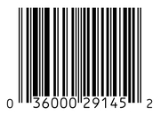
Image:UPC-A-036000291452.png|GTIN-12 number encoded in UPC-A barcode symbol. First and last digit are always placed outside the symbol to indicate Quiet Zones that are necessary for barcode scanners to work properly. Image:EAN-13-5901234123457.svg|EAN-13 (GTIN-13) number encoded in EAN-13 barcode symbol. First digit is always placed outside the symbol, additionally right quiet zone indicator (>) is used to indicate Quiet Zones that are necessary for barcode scanners to work properly. Image:Code93.png|"Wikipedia" encoded in Code 93
Code 93

Code 93 is a barcode symbology designed in 1982 by Intermec to provide a higher density and data security enhancement to Code 39. It is an alphanumeric, variable length symbology....
Image:Wikipedia barcode 128.svg|'Wikipedia" encoded in Code 128
Code 128

Code 128 is a very high-density barcode symbology, used extensively world wide in shipping and packaging industries. It is used for alphanumeric or numeric-only barcodes....
Image:Semacode.svg|Semacode of the URL for Wikipedia's article on Semacode
Semacode

Semacode is a software company based in Waterloo, Ontario, Canada. It is also this company's trade name for machine-readable International Organization for Standardization /IEC 16022 Data matrix symbols which encode internet Uniform Resource Locator ....
Image:Lorem_Ipsum.png|Lorem Ipsum boilerplate text as four segment DataMatrix 2D Image:azteccodeexample.jpg|"This is an example Aztec symbol for Wikipedia" encoded in Aztec Code
Aztec Code

Aztec Code is a 2 dimensional matrix style bar code symbology. Aztec Code was invented by Andrew Longacre, Jr. of Welch Allyn Inc. in 1995 . The code was published by International in 1997 and although the code is patented, it has been released to the public domain....
Image:EZcode.png|Text 'EZcode' File:High Capacity Color Barcode.png| High Capacity Color Barcode of the URL for Wikipedia's article on High Capacity Color Barcode
High Capacity Color Barcode

File:High Capacity Color Barcode.pngA High Capacity Color Barcode , also branded Microsoft Tag, is a type of barcode that uses coloured triangles, instead of black-and-white lines or squares used by other barcode systems....
Image:Dataglyph511140.png|"Wikipedia, The Free Encyclopedia" in several languages encoded in DataGlyphs Image:35mm film audio macro.jpg|Two different 2D barcodes used in film: Dolby Digital
Dolby Digital

File:Dolby-Digital.svgDolby Digital is the marketing name for a series of lossy data compression technologies developed by Dolby Laboratories....
 between the sprocket holes with the "Double-D" logo in the middle, and Sony Dynamic Digital Sound in the blue area to the left of the sprocket holes. Image:WikiQRCode.png|The QR Code
QR Code

A QR Code is a Barcode#2D_barcodes created by Japanese corporation Denso in 1994. The "QR" is derived from "Quick Response", as the creator intended the code to allow its contents to be decoded at high speed....
 for the Wikipedia URL. "Quick Response", the most popular 2D barcode in Japan is promoted by Google. It is open in that the specification is disclosed and the patent
Patent

A patent is a set of exclusive rights granted by a state to an inventor or his assignee for a term of patent in exchange for a disclosure of an invention....
 is not exercised.


See also

  • Automated identification and data capture
    Automated identification and data capture

    Automatic Identification and Data Capture refers to the methods of automatically identifying objects, collecting data about them, and entering that data directly into computer systems ....
     (AIDC)
  • Barcode printer
    Barcode printer

    File:2008TaipeiPack Linx Barcode Printer.jpgA barcode printer is a computer peripheral for printing barcode labels or tags that can be attached to physical objects....
  • Barcode scanner
  • BCBP
    BCBP

    BCBP is the name of the standard used by more than 200 airlines. BCBP defines the 2-Dimensional bar code printed on a boarding pass or sent to a mobile phone for electronic boarding passes....
     (Bar Coded Boarding Passes)
  • Data Matrix
    Data Matrix

    A Data Matrix code is a two-dimensional matrix barcode consisting of black and white "cells" or modules arranged in either a square or rectangle pattern....
  • Global Trade Item Number
    Global Trade Item Number

    Global Trade Item Number is an identifier for trade items developed by GS1 . Such identifiers are used to look up product information in a database which may belong to a retailer, manufacturer, collector, researcher, or other entity....
  • Inventory control system
    Inventory control system

    An inventory control system is an integrated package of software and hardware used in warehouse operations, and elsewhere, to monitor the quantity, location and status of inventory as well as the related shipping, receiving, picking and putaway processes...
  • ISBN
  • Physical world hyperlinks
  • RFID
  • Semacode
    Semacode

    Semacode is a software company based in Waterloo, Ontario, Canada. It is also this company's trade name for machine-readable International Organization for Standardization /IEC 16022 Data matrix symbols which encode internet Uniform Resource Locator ....
  • Sms barcode
    Sms barcode

    SMS Barcode is an integration between barcode and mobile SMS service. Built on mobile picture message, the technology allows sending barcode, supports both 1D and 2D barcode symbologies, to the mobile unit....
  • Supply Chain Management
    Supply chain management

    Supply chain management is the management of a Supply chain network of interconnected businesses involved in the ultimate provision of product and service packages required by end customers ....
  • Universal Product Code
    Universal Product Code

    The Universal Product Code is a barcode#Symbologies , that is widely used in the United States and Canada for tracking trade items in stores....
     (UPC)


Further reading

  • Automating Management Information Systems: Barcode Engineering and Implementation – Harry E. Burke, Thomson Learning, ISBN 0-442-20712-3
  • Automating Management Information Systems: Principles of Barcode Applications – Harry E. Burke, Thomson Learning, ISBN 0-442-20667-4
  • The Bar Code Book – Roger C. Palmer, Helmers Publishing, ISBN 0-911261-09-5, 386 pages
  • The Bar Code Manual – Eugene F. Brighan, Thompson Learning, ISBN 0-03-016173-8
  • Handbook of Bar Coding Systems – Harry E. Burke, Van Nostrand Reinhold Company, ISBN 978-0-442-21430-2, 219 pages
  • Information Technology for Retail:Automatic Identification & Data Capture Systems - Girdhar Joshi, Oxford University Press, ISBN 0-19-569796-0, 416 pages
  • Lines of Communication – Craig K. Harmon, Helmers Publishing, ISBN 0-911261-07-9, 425 pages
  • Punched Cards to Bar Codes – Benjamin Nelson, Helmers Publishing, ISBN 0-911261-12-5, 434 pages
  • Revolution at the Checkout Counter: The Explosion of the Bar Code – Stephen A. Brown, Harvard Univ Press, ISBN 0-674-76720-9
  • Reading Between The Lines – Craig K. Harmon and Russ Adams, Helmers Publishing, ISBN 0-911261-00-1, 297 pages
  • The Black and White Solution: Bar Code and the IBM PC – Russ Adams and Joyce Lane, Helmers Publishing, ISBN 0-911261-01-X, 169 pages
  • Sourcebook of Automatic Identification and Data Collection – Russ Adams, Van Nostrand Reinhold, ISBN 0-442-31850-2, 298 pages


External links

  • , a MediaWiki extension, visualizing Code39/Codabar/EAN-13/EAN-8/UPC-A barcodes by specifying only the numbers/symbols in the wiki-text.