

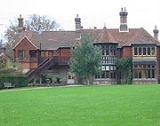
Selborne

Encyclopedia
Selborne is a village
in the East Hampshire
district of Hampshire
, England
. It is 3.9 miles (6.3 km) south of Alton
. It will be just within the extreme northern boundary of the proposed South Downs National Park
, which is due to take effect in mid-2010.
The nearest railway station is Alton
, 3.9 miles (6.3 km) north of the village. Liss
is only fractionally further away to the east, with frequent trains on the Portsmouth
-Waterloo line.
and Petersfield
.
At the back of the village, behind the Selborne Arms and Gilbert White's Field Studies Centre, there is the Zig-Zag Path, which was cut into the hillside in the 1760s by Gilbert White and his brother John, to provide easier access to the Hanger and Selborne Common
.
A complete history of Selborne, from its geology through its establishment as a settlement in the Dark Ages to the present day, including a study of local architecture, was locally published in March 2009: "Knights, Priests & Peasants" was written by Dr. Edward Yates, a retired academic polymath and long-time resident of the village. Its 400 pages include oral histories from the turn of the 19th/20th centuries.
, Gilbert White
(1720–1793), who wrote The Natural History and Antiquities of Selborne
.
First published in 1789, the book has not been out of print in over 200 years. White is recognised as being the first ecologist or environmentalist
. Most of his observations on wildlife
remain pertinent, although he did have some strange theories; most notorious is his belief that not all swallows, martins and swifts migrated, but that some might hibernate instead, although he mocked the peculiar Swedish notion that swallows spent the winter beneath the surface of the local ponds. White was writing before seasonal migration was fully understood. However, White was the first person to discover that swifts mate on the wing.
White's home, The Wakes, has been converted into a museum, known as Gilbert White's House. This museum also contains the Oates Museum and family archive. This comprises an exhibition relating to the life of Captain Lawrence Oates
, who died on Robert Falcon Scott
's ill-fated expedition to Antarctica in the early 20th century, and Frank Oates
, his uncle. Frank Oates was an explorer and naturalist, who mounted expeditions in the late 19th century into Central America and Africa.
The Wakes was substantially refurbished and updated in 2003–2004. The costs of £1.3m were covered by a combination of personal, institutional and charity grants amounting to 50% of the total, matched by a grant from the National Lottery
Heritage Fund. It is open throughout the year, attracting an annual average of 30,000 visitors. This tourism helps to support two pubs and a thriving village shop, which the resident population alone would make unviable. Many people combine their visit to The Wakes with one to Jane Austen
’s House in nearby Chawton
.
Village
A village is a clustered human settlement or community, larger than a hamlet with the population ranging from a few hundred to a few thousand , Though often located in rural areas, the term urban village is also applied to certain urban neighbourhoods, such as the West Village in Manhattan, New...
in the East Hampshire
East Hampshire
East Hampshire is a local government district in Hampshire, England. Its council is based in Petersfield. Other towns are Alton, Horndean and Whitehill-Bordon....
district of Hampshire
Hampshire
Hampshire is a county on the southern coast of England in the United Kingdom. The county town of Hampshire is Winchester, a historic cathedral city that was once the capital of England. Hampshire is notable for housing the original birthplaces of the Royal Navy, British Army, and Royal Air Force...
, England
England
England is a country that is part of the United Kingdom. It shares land borders with Scotland to the north and Wales to the west; the Irish Sea is to the north west, the Celtic Sea to the south west, with the North Sea to the east and the English Channel to the south separating it from continental...
. It is 3.9 miles (6.3 km) south of Alton
Alton, Hampshire
Alton is a historic market town and civil parish in the East Hampshire district of the English county of Hampshire. It had a population of 16,584 at the 1991 census and is administered by East Hampshire district council. It is located on the source of the River Wey and is the highest town in...
. It will be just within the extreme northern boundary of the proposed South Downs National Park
South Downs National Park
The South Downs National Park is England's newest National Park, having become fully operational on 1 April 2011. The park, covering an area of in southern England, stretches for from Winchester in the west to Eastbourne in the east through the counties of Hampshire, West Sussex and East Sussex...
, which is due to take effect in mid-2010.
The nearest railway station is Alton
Alton railway station
Alton railway station is a railway station in the town of Alton, in the English county of Hampshire. The station is the terminus for two railway lines; the Alton Line which runs to Brookwood and onto London Waterloo and the Mid Hants Watercress Railway, which runs to Alresford. The latter once ran...
, 3.9 miles (6.3 km) north of the village. Liss
Liss
Liss is a village and civil parish in the East Hampshire district of Hampshire, England. It is 3.3 miles northeast of Petersfield, on the A3 road, on the Hampshire/West Sussex border....
is only fractionally further away to the east, with frequent trains on the Portsmouth
Portsmouth
Portsmouth is the second largest city in the ceremonial county of Hampshire on the south coast of England. Portsmouth is notable for being the United Kingdom's only island city; it is located mainly on Portsea Island...
-Waterloo line.
The village
St Mary's Church dates back to the late 12th century. There are the Selborne Village Stores/Post Office and a primary school. Furthermore there are two public houses the "Selborne Arms" and "The Queen's Hotel". A bus service that runs through the village links it to AltonAlton, Hampshire
Alton is a historic market town and civil parish in the East Hampshire district of the English county of Hampshire. It had a population of 16,584 at the 1991 census and is administered by East Hampshire district council. It is located on the source of the River Wey and is the highest town in...
and Petersfield
Petersfield
Petersfield can refer to any of the following places:*Petersfield, Hampshire, a market town in England*Petersfield, Jamaica, a small town in the parish of Westmoreland*Petersfield, Manitoba, in Canada*Petersfield, an area of Cambridge, England...
.
At the back of the village, behind the Selborne Arms and Gilbert White's Field Studies Centre, there is the Zig-Zag Path, which was cut into the hillside in the 1760s by Gilbert White and his brother John, to provide easier access to the Hanger and Selborne Common
Selborne Common
Selborne Common comprises of woodland and relict wood-pasture to the west and south of Selborne, at , in the English county of Hampshire. It is owned and managed by the National Trust.-Topography:...
.
A complete history of Selborne, from its geology through its establishment as a settlement in the Dark Ages to the present day, including a study of local architecture, was locally published in March 2009: "Knights, Priests & Peasants" was written by Dr. Edward Yates, a retired academic polymath and long-time resident of the village. Its 400 pages include oral histories from the turn of the 19th/20th centuries.
Gilbert White
Selborne is famous for its association with the 18th-century naturalistNatural history
Natural history is the scientific research of plants or animals, leaning more towards observational rather than experimental methods of study, and encompasses more research published in magazines than in academic journals. Grouped among the natural sciences, natural history is the systematic study...
, Gilbert White
Gilbert White
Gilbert White FRS was a pioneering English naturalist and ornithologist.-Life:White was born in his grandfather's vicarage at Selborne in Hampshire. He was educated at the Holy Ghost School and by a private tutor in Basingstoke before going to Oriel College, Oxford...
(1720–1793), who wrote The Natural History and Antiquities of Selborne
The Natural History and Antiquities of Selborne
The Natural History and Antiquities of Selborne, or just The Natural History of Selborne is a book by pioneering English naturalist and ornithologist Gilbert White first published in 1789...
.
First published in 1789, the book has not been out of print in over 200 years. White is recognised as being the first ecologist or environmentalist
Environmentalist
An environmentalist broadly supports the goals of the environmental movement, "a political and ethical movement that seeks to improve and protect the quality of the natural environment through changes to environmentally harmful human activities"...
. Most of his observations on wildlife
Wildlife
Wildlife includes all non-domesticated plants, animals and other organisms. Domesticating wild plant and animal species for human benefit has occurred many times all over the planet, and has a major impact on the environment, both positive and negative....
remain pertinent, although he did have some strange theories; most notorious is his belief that not all swallows, martins and swifts migrated, but that some might hibernate instead, although he mocked the peculiar Swedish notion that swallows spent the winter beneath the surface of the local ponds. White was writing before seasonal migration was fully understood. However, White was the first person to discover that swifts mate on the wing.
White's home, The Wakes, has been converted into a museum, known as Gilbert White's House. This museum also contains the Oates Museum and family archive. This comprises an exhibition relating to the life of Captain Lawrence Oates
Lawrence Oates
Captain Lawrence Edward Grace Oates was an English Antarctic explorer, known for the manner of his death, when he walked from a tent into a blizzard, with the words "I am just going outside and may be some time"....
, who died on Robert Falcon Scott
Robert Falcon Scott
Captain Robert Falcon Scott, CVO was a Royal Navy officer and explorer who led two expeditions to the Antarctic regions: the Discovery Expedition, 1901–04, and the ill-fated Terra Nova Expedition, 1910–13...
's ill-fated expedition to Antarctica in the early 20th century, and Frank Oates
Frank Oates
Frank Oates was a British naturalist, explorer and uncle to Antarctic explorer Lawrence Oates. He was one of the first Europeans to see the Victoria Falls.-Early life:...
, his uncle. Frank Oates was an explorer and naturalist, who mounted expeditions in the late 19th century into Central America and Africa.
The Wakes was substantially refurbished and updated in 2003–2004. The costs of £1.3m were covered by a combination of personal, institutional and charity grants amounting to 50% of the total, matched by a grant from the National Lottery
National Lottery (United Kingdom)
The National Lottery is the state-franchised national lottery in the United Kingdom and the Isle of Man.It is operated by Camelot Group, to whom the licence was granted in 1994, 2001 and again in 2007. The lottery is regulated by the National Lottery Commission, and was established by the then...
Heritage Fund. It is open throughout the year, attracting an annual average of 30,000 visitors. This tourism helps to support two pubs and a thriving village shop, which the resident population alone would make unviable. Many people combine their visit to The Wakes with one to Jane Austen
Jane Austen
Jane Austen was an English novelist whose works of romantic fiction, set among the landed gentry, earned her a place as one of the most widely read writers in English literature, her realism and biting social commentary cementing her historical importance among scholars and critics.Austen lived...
’s House in nearby Chawton
Chawton
Chawton is a village and civil parish in the East Hampshire district of Hampshire, England. It is 1.6 miles southwest of Alton, just south of the A31 which runs between Farnham and Winchester. The village is famous as the home of Jane Austen for the last eight years of her life...
.
Local business
- Selborne Pottery, established in 1985, manufactures and sells a range of hand thrown and decorated stoneware pottery using rich copper red and cobalt blue glazesCeramic colorants'Ceramic colorants' are added to a glaze or a clay to create color. Carbonates and oxides of certain metals, characterize most colorants including the commonly used cobalt carbonate, cobalt oxide, chrome oxide, red iron oxide, and copper carbonate...
. Each piece of pottery is hand thrown and turned on a wheel; no industrial techniques or moulds are used in the making process. The pottery has a shop in the village, and also has 'seconds' available.
- Selborne Biological Services, originally formed in 1974 on a 100 acre (0.404686 km²) farm in Selborne, makes animal-derived products for the biotech, pharmaceutical, veterinary, and diagnostics industries. They moved their main production facilities to TasmaniaTasmaniaTasmania is an Australian island and state. It is south of the continent, separated by Bass Strait. The state includes the island of Tasmania—the 26th largest island in the world—and the surrounding islands. The state has a population of 507,626 , of whom almost half reside in the greater Hobart...
in 1992 following the BSEBovine spongiform encephalopathyBovine spongiform encephalopathy , commonly known as mad-cow disease, is a fatal neurodegenerative disease in cattle that causes a spongy degeneration in the brain and spinal cord. BSE has a long incubation period, about 30 months to 8 years, usually affecting adult cattle at a peak age onset of...
outbreak in the UK in the late 1980s, but maintain a European sales, marketing and distribution centre in Selborne.
- Tower Brick & Tile Company Limited have been making handmade Selborne bricks and roof tiles at their site near Selborne since 1872. However, the company went into administration on 6 November 2009.
- Selborne Gallery is the only art gallery in Britain devoted entirely to the work of mouth and foot painting artists. Formed in 1992, it was visited by Prince CharlesCharles, Prince of WalesPrince Charles, Prince of Wales is the heir apparent and eldest son of Queen Elizabeth II and Prince Philip, Duke of Edinburgh. Since 1958 his major title has been His Royal Highness The Prince of Wales. In Scotland he is additionally known as The Duke of Rothesay...
on its tenth anniversary in 2002. The displayed work includes painting, printmaking, drawing, textiles, ceramics, glass and jewellery.
See also
- The Natural History and Antiquities of SelborneThe Natural History and Antiquities of SelborneThe Natural History and Antiquities of Selborne, or just The Natural History of Selborne is a book by pioneering English naturalist and ornithologist Gilbert White first published in 1789...
- Selborne CommonSelborne CommonSelborne Common comprises of woodland and relict wood-pasture to the west and south of Selborne, at , in the English county of Hampshire. It is owned and managed by the National Trust.-Topography:...
- Selborne PriorySelborne PriorySelborne Priory was a priory of Augustinian canons in Selborne, Hampshire, England.-Foundation:The priory was founded in 1233 by Peter des Roches, Bishop of Winchester. The bishop initially endowed the priory with lands obtained by gift from James de Acangre, James de Norton, and King Henry III...
- Plestor House