

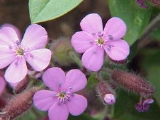
Saponaria

Encyclopedia
Saponaria, also known as soapworts, is a genus of about 20 species of perennial
herb
s in the Caryophyllaceae
, native to southern Europe
and southwest Asia
. The most familiar species in Europe is the Common Soapwort (S. officinalis), locally simply known as "the Soapwort". They grow to a height of 10-60 cm, with opposite leaves
1-6 cm long. The flower
s are produced in tight clusters on the stem, 4-25 mm diameter, with five white, yellow, pink, or pale purple petals.
The genus is closely related to Lychnis
and Silene
, being distinguished from these by having only two (not three or five) styles in the flower.
Saponaria species are used as food plants by the larva
e of some Lepidoptera
species including the Lychnis
and Coleophora saponariella
(which feeds exclusively on Saponaria spp).
conservators still use the soap made from its leaves and roots for cleaning delicate fabrics and it also makes a fine shampoo.
Soapworts are also used in the food industry, especially in the making of halva
(a sweet made using tahini and sugar or honey).
Perennial plant
A perennial plant or simply perennial is a plant that lives for more than two years. The term is often used to differentiate a plant from shorter lived annuals and biennials. The term is sometimes misused by commercial gardeners or horticulturalists to describe only herbaceous perennials...
herb
Herb
Except in botanical usage, an herb is "any plant with leaves, seeds, or flowers used for flavoring, food, medicine, or perfume" or "a part of such a plant as used in cooking"...
s in the Caryophyllaceae
Caryophyllaceae
The Caryophyllaceae, commonly called the pink family or carnation family, is a family of flowering plants. It is included in the dicotyledon order Caryophyllales in the APG III system, alongside 33 other families, including Amaranthaceae, Cactaceae and Polygonaceae...
, native to southern Europe
Europe
Europe is, by convention, one of the world's seven continents. Comprising the westernmost peninsula of Eurasia, Europe is generally 'divided' from Asia to its east by the watershed divides of the Ural and Caucasus Mountains, the Ural River, the Caspian and Black Seas, and the waterways connecting...
and southwest Asia
Asia
Asia is the world's largest and most populous continent, located primarily in the eastern and northern hemispheres. It covers 8.7% of the Earth's total surface area and with approximately 3.879 billion people, it hosts 60% of the world's current human population...
. The most familiar species in Europe is the Common Soapwort (S. officinalis), locally simply known as "the Soapwort". They grow to a height of 10-60 cm, with opposite leaves
Leaf
A leaf is an organ of a vascular plant, as defined in botanical terms, and in particular in plant morphology. Foliage is a mass noun that refers to leaves as a feature of plants....
1-6 cm long. The flower
Flower
A flower, sometimes known as a bloom or blossom, is the reproductive structure found in flowering plants . The biological function of a flower is to effect reproduction, usually by providing a mechanism for the union of sperm with eggs...
s are produced in tight clusters on the stem, 4-25 mm diameter, with five white, yellow, pink, or pale purple petals.
The genus is closely related to Lychnis
Lychnis
Lychnis is a genus of 15-25 species of flowering plants in the family Caryophyllaceae, native to Europe, Asia and north Africa. The genus is closely related to Silene, differing in the flowers having five styles , the seed capsule having five teeth , and in the sticky stems of Lychnis...
and Silene
Silene
Silene is a genus of flowering plants in the family Caryophyllaceae. Common names include campion and catchfly....
, being distinguished from these by having only two (not three or five) styles in the flower.
Saponaria species are used as food plants by the larva
Larva
A larva is a distinct juvenile form many animals undergo before metamorphosis into adults. Animals with indirect development such as insects, amphibians, or cnidarians typically have a larval phase of their life cycle...
e of some Lepidoptera
Lepidoptera
Lepidoptera is a large order of insects that includes moths and butterflies . It is one of the most widespread and widely recognizable insect orders in the world, encompassing moths and the three superfamilies of butterflies, skipper butterflies, and moth-butterflies...
species including the Lychnis
Lychnis (moth)
The Lychnis is a moth of the family Noctuidae. It is found in northern and western Europe.This species has dark brown forewings marked with two prominent white-bordered stigmata and a white subterminal line. The hindwings are buffish, darkening to brown towards the margin but with a prominent...
and Coleophora saponariella
Coleophora
Coleophora is a very large genus of moths of the family Coleophoridae. It contains some 1,350 described species. The genus is represented on all continents, but the majority are found in the Nearctic and Palaearctic regions...
(which feeds exclusively on Saponaria spp).
Cultivation and uses
Soapworts are cultivated for their attractive flowers; they grow freely in any soil and under most conditions. The crushed leaves or roots of S. officinalis have been used as a soap since the Renaissance. MuseumMuseum
A museum is an institution that cares for a collection of artifacts and other objects of scientific, artistic, cultural, or historical importance and makes them available for public viewing through exhibits that may be permanent or temporary. Most large museums are located in major cities...
conservators still use the soap made from its leaves and roots for cleaning delicate fabrics and it also makes a fine shampoo.
Soapworts are also used in the food industry, especially in the making of halva
Halva
Halva refers to many types of dense, sweet confections, served across the Middle East, South Asia, Central Asia, West Asia, North Africa, the Horn of Africa, the Balkans, Eastern Europe, Malta and the Jewish world.The term halva ,...
(a sweet made using tahini and sugar or honey).