


SPYDER

Encyclopedia
The SPYDER is an anti-aircraft missile system developed by the Israel
i company Rafael Advanced Defense Systems, which is fitted atop a Czech
Tatra truck. It implements surface-to-air versions of the Python-5 and Derby missiles of the same company.
SPYDER is a quick reaction medium range missile system that can engage
aircraft, helicopters, unmanned air vehicles, drones and precision-guided munitions. It provides air defence for fixed assets and for point and area mobile forces in combat areas. Technological research that was used to develop the SPYDER was later used to develop the Iron Dome
.
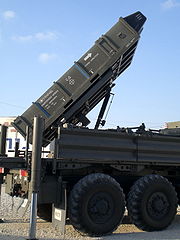 The SPYDER-SR system has 360° engagement ability and missiles can be launched from the full-readiness state in less than five seconds after target confirmation. The kill range is up to 20 miles and at altitudes from a minimum of 50 ft to a maximum of 120,000 ft. The system can perform multi-target simultaneous engagement and single, multiple and ripple firing, by day and night, in all weather.
The command and control unit is developed by Israel Aerospace Industries. It is housed in a truck-mounted shelter with a mounted Elta
EL/M-2106 ATAR radar, identification friend or foe
(IFF) interrogator and communication equipment. The VHF/UHF communication system is for internal squadron communication and to upper tier command. The Elta EL/M-2106 ATAR 3D surveillance radar can track up to 500 targets simultaneously. The radar has 360° operation and all-weather day and night ability. The radar includes advanced electronic counter-countermeasures
(ECCM) to operate in dense hostile electronic warfare
environments.
plans to acquire
18 systems at a cost of $415 million (Rs. 1800 crore) for its air force, but the deal is to be reviewed by the Central Vigilance Commission, the government’s anti-corruption agency. The deal was cleared by the Defence Acquisition Council in August, 2009.
Israel
The State of Israel is a parliamentary republic located in the Middle East, along the eastern shore of the Mediterranean Sea...
i company Rafael Advanced Defense Systems, which is fitted atop a Czech
Czech Republic
The Czech Republic is a landlocked country in Central Europe. The country is bordered by Poland to the northeast, Slovakia to the east, Austria to the south, and Germany to the west and northwest....
Tatra truck. It implements surface-to-air versions of the Python-5 and Derby missiles of the same company.
SPYDER is a quick reaction medium range missile system that can engage
Engagement (military)
A military engagement is a combat between two forces, neither larger than a division and not smaller than a company, in which each has an assigned or perceived mission...
aircraft, helicopters, unmanned air vehicles, drones and precision-guided munitions. It provides air defence for fixed assets and for point and area mobile forces in combat areas. Technological research that was used to develop the SPYDER was later used to develop the Iron Dome
Iron Dome
Iron Dome is a mobile air defense system in development by Rafael Advanced Defense Systems designed to intercept short-range rockets and artillery shells. The system was created as a defensive countermeasure to the rocket threat against Israel's civilian population on its northern and southern...
.
Description
The command and control unit is developed by Israel Aerospace Industries. It is housed in a truck-mounted shelter with a mounted Elta
Elta
ELTA Systems LTD is an Israeli provider of defense products and services specializing in radar, C4ISTAR, RF, SIGINT and EW products.Elta, a group and subsidiary of Israel Aerospace Industries, is one of Israel's major defence electronics companies specializing in a variety of fields...
EL/M-2106 ATAR radar, identification friend or foe
Identification friend or foe
In telecommunications, identification, friend or foe is an identification system designed for command and control. It is a system that enables military and national interrogation systems to identify aircraft, vehicles, or forces as friendly and to determine their bearing and range from the...
(IFF) interrogator and communication equipment. The VHF/UHF communication system is for internal squadron communication and to upper tier command. The Elta EL/M-2106 ATAR 3D surveillance radar can track up to 500 targets simultaneously. The radar has 360° operation and all-weather day and night ability. The radar includes advanced electronic counter-countermeasures
Electronic counter-countermeasures
Electronic counter-countermeasures is a part of electronic warfare which includes a variety of practices which attempt to reduce or eliminate the effect of electronic countermeasures on electronic sensors aboard vehicles, ships and aircraft and weapons such as missiles. ECCM is also known as...
(ECCM) to operate in dense hostile electronic warfare
Electronic warfare
Electronic warfare refers to any action involving the use of the electromagnetic spectrum or directed energy to control the spectrum, attack an enemy, or impede enemy assaults via the spectrum. The purpose of electronic warfare is to deny the opponent the advantage of, and ensure friendly...
environments.
Export
IndiaIndia
India , officially the Republic of India , is a country in South Asia. It is the seventh-largest country by geographical area, the second-most populous country with over 1.2 billion people, and the most populous democracy in the world...
plans to acquire
Military acquisition
Military acquisition is the bureaucratic management and procurement process dealing with a nation's investments in the technologies, programs, and product support necessary to achieve its national security strategy and support its armed forces...
18 systems at a cost of $415 million (Rs. 1800 crore) for its air force, but the deal is to be reviewed by the Central Vigilance Commission, the government’s anti-corruption agency. The deal was cleared by the Defence Acquisition Council in August, 2009.
Operators
- Georgian Air ForceGeorgian Air ForceThe Georgian Air Force is the air arm of the Georgian Armed Forces. Currently, it has 2,971 military and civilian personnel, fixed wing aircraft , helicopters of different types and air defense missiles of the "surface-to-air" class. The Air Force was founded in 1991 in the wake of the break-up...
- Indian Air ForceIndian Air ForceThe Indian Air Force is the air arm of the Indian armed forces. Its primary responsibility is to secure Indian airspace and to conduct aerial warfare during a conflict...
- 18 systems.
- Republic of Singapore Air ForceRepublic of Singapore Air ForceThe Republic of Singapore Air Force is the air arm of the Singapore Armed Forces. It was first established in 1968 as the Singapore Air Defence Command...
- 165 Squadron165 Squadron, Republic of Singapore Air ForceThe 165 Squadron is an Air Defence Group squadron of the Air Defence Operations Command, Republic of Singapore Air Force. It operates the Rapier missile purchased from British Aerospace since 1983, providing air defence cover against low-flying aircraft....
.
External links
- SPYDER ADS-SR Rafael's official Site
- SPYDER ADS-MR Rafael's official Site