
All Topics  
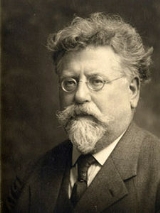
Rudolf Rocker


   Email Print
   Bookmark   Link


Rudolf Rocker


Johann Rudolf Rocker was an anarcho-syndicalistAnarcho-syndicalism

Anarcho-syndicalism is a branch of anarchism which focuses on the labour movement....
 writer and activist. A self-professed anarchist without adjectives, Rocker believed that anarchist schools of thoughtAnarchist schools of thought

Anarchism is a political philosophy with many heterogeneous and diverse schools of thought, united by a common opposit...
 represented "only different methods of economy" and that the first objective for anarchists was "to secure the personal and social freedom of men".
MainzEarly lifeRudolf Rocker was born to the lithographer Georg Philipp Rocker and his wife Anna Margaretha née Naumann as the second of three sons in MainzMainz Overview

Mainz is a city in Germany and the capital of the German federal state of Rhineland-Palatinate....
, HesseGrand Duchy of Hesse

The Grand Duchy of Hesse was a former state that existed in modern-day Germany....
 (now Rhineland-PalatinateRhineland-Palatinate

Rhineland-Palatinate is one of 16 Bundeslnder of Germany....
), GermanyGermany

Germany , officially the Federal Republic of Germany , is a country in central Europe....
 on March 25, 1873. This Catholic, yet not particularly devout, family had a democratic and anti-PrussianKingdom of Prussia Overview

The Kingdom of Prussia was a kingdom from 1701 to 1918 and, from 1871, was the leading state of the German Empire, comprisin...
 tradition dating back to Rocker's grandfather, who participated in the March Revolution of 1848. However, Georg Philipp died just four years after Rocker's birth.


Discussion
Ask a question about 'Rudolf Rocker'
Start a new discussion about 'Rudolf Rocker'
Answer questions from other users
Full Discussion Forum


Quotations


Ch. 2 The Proletariat and the Beginning of the Modern Labour Movement


Encyclopedia


Johann Rudolf Rocker was an anarcho-syndicalistAnarcho-syndicalism

Anarcho-syndicalism is a branch of anarchism which focuses on the labour movement....
 writer and activist. A self-professed anarchist without adjectives, Rocker believed that anarchist schools of thoughtAnarchist schools of thought

Anarchism is a political philosophy with many heterogeneous and diverse schools of thought, united by a common opposit...
 represented "only different methods of economy" and that the first objective for anarchists was "to secure the personal and social freedom of men".

Mainz

Early life

Rudolf Rocker was born to the lithographer Georg Philipp Rocker and his wife Anna Margaretha née Naumann as the second of three sons in MainzMainz Overview

Mainz is a city in Germany and the capital of the German federal state of Rhineland-Palatinate....
, HesseGrand Duchy of Hesse

The Grand Duchy of Hesse was a former state that existed in modern-day Germany....
 (now Rhineland-PalatinateRhineland-Palatinate

Rhineland-Palatinate is one of 16 Bundeslnder of Germany....
), GermanyGermany

Germany , officially the Federal Republic of Germany , is a country in central Europe....
 on March 25, 1873. This Catholic, yet not particularly devout, family had a democratic and anti-PrussianKingdom of Prussia Overview

The Kingdom of Prussia was a kingdom from 1701 to 1918 and, from 1871, was the leading state of the German Empire, comprisin...
 tradition dating back to Rocker's grandfather, who participated in the March Revolution of 1848. However, Georg Philipp died just four years after Rocker's birth. After that, the family managed to evade poverty, only through the massive support by his mother's family. Rocker's uncle and godfather Carl Rudolf Naumann, a long-time member of the Social Democratic PartySocial Democratic Party of Germany

The Social Democratic Party of Germany is the oldest political party of Germany and also one of the oldest and largest in...
 (SPD), became a substitute for his dead parents and a role model, who directed the boy's intellectual development. Rocker was disgusted by his schoolteacher's authoritarian methods calling the man a "heartless despot". He was, therefore, a poor student. When he was ten, the Rocker household was joined by his mother's new husband Ludwig Baumgartner. Rocker was shocked once again as his mother died in February 1877. After his stepfather re-married soon thereafter, Rocker was put into an orphanage.

Disgusted by the unconditional obedience demanded by the Catholic orphanage and drawn by the prospect of adventure, Rocker ran away from the orphanage twice. The first time he just wandered around in the woods around Mainz with occasional visits to the city to forage for food and was retrieved after three nights. The second time, which was at the age of fourteen and a reaction to the orphanage wanting him to be apprenticed as a tinsmithTinsmith

A tinsmith, or tinner, is a person who makes and repairs things made of light metal, such as tinware....
, he worked as a cabin-boy for Köln-Düsseldorfer Dampfschiffahrtsgesellschaft. He enjoyed leaving his hometown and traveling to places like RotterdamRotterdam

Rotterdam , located in the province of South Holland, is the second largest municipality in the Netherlands....
. After he returned, he started an apprenticeship to become a typographer like his uncle Carl.

Political activism

Carl also had a substantial library consisting of socialist literature of all colors. Rocker was particularly impressed by the writings of Constantin Franz, a federalistFederalist

The term federalist refers to a proponent of one of several different ideologies, depending on the locale or subject matter....
 and opponent of Bismarck's centralized German EmpireGerman Empire

The German Empire is the name conventionally given in English to the German state from the time of the proclamation of Will...
; Eugen DühringEugen Dühring

Eugen Karl D?hring was a German philosopher and economist, a socialist who was a strong critic of Marxism....
, an anti-Marxist socialist, whose theories had some anarchist aspects; novels like Victor HugoVictor Hugo

Victor-Marie Hugo was a poet, novelist, playwright, essayist, visual artist, statesman and human rights campaigner, recogni...
's Les MisérablesLes Misérables

Les Misrables is a novel by French author Victor Hugo....
and Edward BellamyEdward Bellamy

Edward Bellamy was an American author, most famous for his utopian novel set in the year 2000, Looking Backward, publis...
's Looking BackwardLooking Backward

Looking Backward: 2000-1887 is a utopian novel by Edward Bellamy, a lawyer and writer from western Massachusetts, and wa...
; as well as the traditional socialist literature such as Karl MarxKarl Marx

Karl Heinrich Marx was an immensely influential German philosopher, political economist, and socialist revolutionary....
's CapitalDas Kapital

Das Kapital is an extensive treatise on political economy written by Karl Marx in German....
and Ferdinand Lasalle and August Bebel's writings. Although Rocker is unlikely to have grasped all of the political and philosophical implications of what he read, he became a socialist and regularly discussed his ideas with others. His employer became the first person he converted to socialism.

Under the influence of his uncle, he joined the SPD and became active in the typographers' labor union in Mainz. He volunteered in the 1890 electoral campaign, which had to be organized in semi-clandestinity because of continuing government repression, helping the SPD candidate Franz Jöst retake the seat for the district Mainz-OppenheimOppenheim

Oppenheim is a small town on the Upper Rhine, between Mainz and Worms....
 in the ReichstagReichstag (institution) Summary

The Reichstag was the parliament of the Holy Roman Empire, the North German Confederation, and of Germany until 1945....
. Because the seat was heavily contested, important SPD figures like August Bebel, Wilhelm LiebknechtWilhelm Liebknecht

Wilhelm Liebknecht was a German social democrat, one of the founders of the SPD and father of Karl Liebknecht and Theodor Li...
, Georg von VollmarGeorg von Vollmar

Georg Heinrich von Vollmar was a Socialist politician in Bavaria....
, and Paul SingerPaul Singer

Paul Singer is the founder of hedge fund Elliott Associates....
 visited the town to help Jöst and Rocker had a chance to see them speak.
In 1890, there was a major debate in the SPD about the tactics it would choose after the lifting of the Anti-Socialist LawsAnti-Socialist Laws

The Anti-Socialist Laws or Socialist Laws were a series of acts, the first of which was passed on October 19 1878 by t...
. A radical oppositional wing known as Die Jungen (The Young Ones) developed. While the party leaders viewed the parliament as a means of social change, Die Jungen thought it could at best be used to spread the socialist message. They were unwilling to wait for the collapse of capitalist society, as predicted by MarxismMarxism

Marxism refers to the philosophy and social theory based on Karl Marx's work on one hand, and to the political practice base...
, rather they wanted to start a revolution as soon as possible. Although this wing was strongest in BerlinBerlin

Berlin is the capital city and a state of Germany....
, MagdeburgFacts About Magdeburg

Magdeburg, the capital city of the Bundesland of Saxony-Anhalt, Germany, lies on the Elbe river. ...
, and DresdenDresden

Dresden is the capital city of the German Federal State of Saxony and situated in a valley on the River Elbe....
, it also had a few adherents in Mainz, among them Rudolf Rocker. In May 1890, he started a reading circle, named Freiheit (Freedom), to study theoretical topics more intensively. After Rocker criticized Jöst and refused to retract his statements, he was expelled from the party. The same would happen to the rest of Die Jungen in October 1891. Nonetheless, he remained active and even gained influence in the socialist labor movement in Mainz. Although he had already encountered anarchist ideas as a result of his contacts to Die Jungen in Berlin, his conversion to anarchismAnarchism

Anarchism is the name of a political philosophy or a group of doctrines and attitudes that are centered on rejection of gove...
 did not take place until the International Socialist Congress in BrusselsFacts About Brussels

Brussels is the capital of Belgium, the French Community of Belgium, the Flemish Community, the Flemish Region and the main...
 in August 1891. He was heavily disappointed by the discussions at the congress, as it, especially the German delegates, refused to explicitly denounce militarismMilitarism

Militarism or militarist ideology is the doctrinal view of a society as being best served when it is governed or guide...
. He was rather impressed by the Dutch socialist and later anarchist Domela Nieuwenhuis, who attacked Liebknecht for his lack of militancy. Rocker got to know Karl Höfer, a German active in smuggling anarchist literature from BelgiumBelgium

The Kingdom of Belgium is a country in northwest Europe bordered by the Netherlands, Germany, Luxembourg and France and is...
 to Germany. Höfer gave him Bakunin's God and the StateGod and the State

God and the State is the best-known literary work of Russian anarchist, Mikhail Bakunin....
and KropotkinFacts About Kropotkin

Kropotkin may refer to:*Peter Kropotkin, a Russian anarchist...
's Anarchist Morality, two of the most influential anarchist works, as well as the newspaper Autonomie.

Rocker became convinced that the source of political institutions is an irrational belief in a higher authority, as Bakunin claimed in God and the State. However, Rocker rejected the Russian's rejection of theoretical propaganda and his claim that only revolutionRevolution

A revolution is a drastic change that usually occurs relatively quickly....
s can bring about change. Nevertheless, he was very much attracted by Bakunin's style, marked by pathosPathos

Pathos is one of the three modes of persuasion in rhetoric....
, emotion, and enthusiasm, designed to give the reader an impression of the heat of revolutionary moments. Rocker even attempted to emulate this style in his speeches, but was not very convincing. Kropotkin's anarcho-communist writings, on the other hand, were structured logically and contained an elaborate description of the future anarchist society. The work's basic premise, that an individual is entitled to receive the basic means of living from the community independently of his or her personal contributions, impressed Rocker.

In 1891, all Die Jungen were either expelled from the SPD or left voluntarily. They then founded the Union of Independent Socialists (VUS). Rocker became a member and founded a local section in Mainz, mostly active in distributing anarchist literature smuggled in from Belgium or the Netherlands in the city. He was a regular speaker at labor union meetings. On December 18, 1892, he spoke at a meeting of unemployed workers. Impressed by Rocker's speech, the speaker that followed Rocker, who was not from Mainz and therefore did not know at what point the police would intervene, advised the unemployed to take from the rich, rather to starve. The meeting was then dissolved by the police. The speaker was arrested, while Rocker barely escaped. He decided to flee Germany to Paris via FrankfurtFrankfurt

For the capital of the U.S. state of Kentucky, see Frankfort...
. He had, however, already been toying with the idea of leaving the country, in order to learn new languages, get to know anarchist groups abroad, and, above all, to escape conscriptionConscription in Germany

Germany has conscription for male citizens....
.

Paris

In Paris, he first came into contact with Jewish anarchismJewish anarchism

Jewish anarchism is a general term encompassing various expressions of anarchism within the Jewish community....
. In Spring 1893, he was invited to meeting of Jewish anarchists, which he attended and was impressed by. Though neither a Jew by birth nor by belief, he ended up frequenting the group's meeting, eventually holding lectures himself. Solomon Rappaport, later known as S. AnskyS. Ansky

Shloyme Zanvl Rappoport, better known by the pseudonym S....
, allowed Rocker to live with him, as they were both typographers and could share Rappaport's tools. During this period, Rocker also first came into contact with the blending of anarchist and syndicalist ideas represented by the General Confederation of LaborConfédération générale du travail

The General Confederation of Labour is one of the five major French confederations of trade unions....
 (CGT), which would influence him in the long term. In 1895, as a result of the anti-anarchist sentiment in France, Rocker traveled to London to visit the German consulate and examine the possibility of his returning to Germany but was told he would be imprisoned upon return.

London

Rocker's first years in London

Rocker decided to stay in London. He got a job as the librarian of the Communist Workers' Educational Union, where he got to know Louise MichelLouise Michel Overview

Louise Michel was a French anarchist, school teacher and medical worker....
 and Errico MalatestaErrico Malatesta

Errico Malatesta was an anarcho-communist with an unshakable belief, which he shared with his friend Peter Kropotkin, that t...
, two influential anarchists. Inspired to visit the quarter after reading John Henry MackayJohn Henry Mackay Overview

John Henry Mackay was an individualist anarchist, thinker, writer, and homosexual....
's Darkest London, he was appalled by the poverty he witnessed in the predominantly Jewish East EndEast End of London

The East End of London, known locally as the East End, is part of London in England....
. He joined the Jewish anarchist Arbeter Fraint group he had obtained information about from his French comrades, quickly becoming a regular lecturer at its meetings. There, he met his lifelong companion Milly WitkopMilly Witkop

Milly Witkop was a Ukrainian-born Jewish anarcho-syndicalist and feminist writer and activist....
, a Ukrainian-born Jew who had fled to London in 1894. In May 1897, having lost his job and with little chance of re-employment, Rocker was persuaded by a friend to move to New York. Witkop agreed to accompany him and they arrived on the 29th. They were, however, not admitted into the country, because they were not legally married. They refused to formalize their relationship. Rocker explained that their "bond is one of free agreement between my wife and myself. It is a purely private matter that only concerns ourselves, and it needs no confirmation from the law." Witkop added: "Love is always free. When love ceases to be free it is prostitution." The matter received front-page coverage in the national press. The Commissioner-General of Immigration, the former Knights of LaborKnights of Labor

The Knights of Labor was a labor union founded as a fraternal organization in December 1869, by a group of Philadelphia tail...
 President Terence V. PowderlyTerence V. Powderly

Terence Vincent Powderly was born in Carbondale, Pennsylvania, the son of Irish immigrants....
, advised the couple to get married to settle the matter, but they refused and were deported back to England on the same ship they had arrived on.

Unable to find employment upon return, Rocker decided to move to LiverpoolLiverpool

Liverpool is a city and metropolitan borough in North West England, along the eastern side of the Mersey Estuary....
. A former Whitechapel comrade of his persuaded him to become the editor of a recently founded Yiddish weekly newspaper called Dos Fraye VortDos Fraye Vort

Dos Fraye Vort was a short-lived Jewish anarchist newspaper from Liverpool in 1898 edited by Rudolf Rocker....
(The Free Word), even though he did not speak the language at the time. The newspaper only appeared for eight issues, but it led the Arbeter Fraint group to re-launch its eponymous newspaper and invite Rocker to return to the capital and take over as its editor.

Although it received some funds from Jews in New YorkNew York City

New York City is the largest city in the United States and the twelfth largest city in the world, making it a major global c...
, the journal's financial survival was precarious from the start. However, many volunteers helped by selling the paper on street corners and in workshops. During this time, Rocker was especially concerned with combating the influence of MarxismMarxism Summary

Marxism refers to the philosophy and social theory based on Karl Marx's work on one hand, and to the political practice base...
 and historical materialismHistorical materialism

Historical materialism is the methodological approach to the study of society, economics and history which was first articul...
 in London's Jewish labor movement. In all, the Arbeter Fraint published twenty-five essays by Rocker on the topic, the first ever critical examination of Marxism in Yiddish, according to William J. FishmanWilliam J. Fishman

William J. Fishman is the author of several books about the history of the East End of London....
. Arbeter Fraint's unsound financial footing also meant Rocker rarely received the small salary promised to him when he took over the journal and he depended financially on Witkop. Despite Rocker's sacrifices, however, the paper was forced to cease publication for lack of funds. In November 1899, the prominent American anarchist Emma GoldmanEmma Goldman

Emma Goldman aka 'Red Emma', was a Kaunas, Lithuania-born anarchist known for her anarchist writings and speeches....
 visited London and Rocker met her for the first time. After hearing of the Arbeter Fraint's situation she held three lectures to raise funds, but that was not enough.

Not wanting to be left without any means of propaganda, Rocker founded the GerminalGerminal (journal)

Germinal was a Yiddish-language anarchist journal in London edited by the German-born Rudolf Rocker....
in March 1900. Compared to Arbeter Fraint, it was more theoretical, applying anarchist thought to the analysis of literature and philosophy. It represented a maturation of Rocker's thinking towards KropotkinKropotkin

Kropotkin may refer to:*Peter Kropotkin, a Russian anarchist...
-ite anarchism and would survive until March 1903. 1902 saw the London Jews being targeted by a wave of anti-alien sentimentXenophobia

Xenophobia denotes a phobic attitude toward strangers or of the unknown....
, while Rocker was away for a year in LeedsLeeds

Leeds is a major city in the northern English county of Yorkshire and the urban core of the City of Leeds metropolitan borou...
. Upon return in September, he was happy to see the Jewish anarchists had kept the Arbeter Fraint organization alive. A conference of all Jewish anarchists of the city on December 26 decided for a re-launch of the Arbeter Fraint newspaper as the organ of all Jewish anarchists in Great Britain and Paris and made Rocker the editor. The first issue appeared on March 20, 1903. Following the Kishinev pogromKishinev pogrom

The Kishinev pogrom was a pogrom that took place in Kishinev, then part of the Bessarabia province of Imperial Russia on Apr...
 in the Russian EmpireRussian Empire Summary

The Russian Empire was a state that existed from 1721 until it was declared a republic in August 1917....
, Rocker led a demonstration in solidarity with the victims, the largest ever gathering of Jews in London. Afterwards he traveled to Leeds, GlasgowGlasgow

The city was formerly a royal burgh, and was known as the "Second City of the British Empire" in the Victorian era....
, and EdinburghEdinburgh

Edinburgh is the capital of Scotland and its second-largest city....
 to lecture on the topic.

Jewish anarchism's golden years

From 1904, the Jewish labor and anarchist movements in London reached their "golden years", according to William J. Fishman. In 1905, publication of Germinal resumed, it reached a circulation of 2,500 a year later, while Arbeter Fraint reached a demand of 5,000 copies. In 1906, the Arbeter Fraint group finally realized a long-time goal, the establishment of a club for both Jewish and gentile workers. The Workers' Friend Club was founded in a former Methodist church on Jubilee StreetJubilee Street

Jubilee Street is a street in Central, Hong Kong Island, Hong Kong....
. Rocker, by now a very eloquent speaker, became a regular speaker. As a result of the popularity of both the club and Germinal beyond the anarchist scene, Rocker befriended many prominent non-anarchist Jews in London, among them the Zionist philosopher Ber BorochovBer Borochov Overview

Ber Dov Berochov was a Marxist Zionist and one of the founders of the Labour Zionist movement....
.

From June 8, 1906, Rocker was involved in a garment workers' strike. Wages and working conditions in the East End were much lower than in the rest of London and tailoring was the most important industry. Rocker was asked by the union leading the strike to become part of the strike committee along with two other Arbeter Fraint members. He was a regular speaker at the strikers' gatherings. The strike failed, because the strike funds ran out. By July 1, all workers were back in their workshops.

Rocker represented the federation at the International Anarchist Congress in Amsterdam in 1907. Errico MalatestaErrico Malatesta

Errico Malatesta was an anarcho-communist with an unshakable belief, which he shared with his friend Peter Kropotkin, that t...
, Alexander Shapiro, and he became the secretaries of the new Anarchist International, but it only lasted until 1911. Also in 1907, his son FerminFermin Rocker

Fermin Rocker was a painter and book illustrator....
 was born. In 1909, while visiting France, Rocker denounced the assassination of the anarchist pedagogue Francisco Ferrer, leading him to be deported back to England.

In 1912, Rocker was once again an important figure in a strike by London's garment makers. In late April, 1,500 tailors from the West End, who were more highly skilled and better-paid than those in the East End, started striking. By May, the total number was between 7,000 and 8,000. Since much of the West Enders' work was now being performed in the East End, the tailors' union there, under the influence of the Arbeter Fraint group, decided to support the strike. Rudolf Rocker on the one hand saw this as a chance for the East End tailors to attack the sweatshop system, but on the other was afraid of an anti-Semitic backlash, should the Jewish workers remain idle. He called for a general strikeGeneral strike

A general strike is a strike action by an entire labour force in a city, region or country....
. His call was not followed, since over seventy percent of the East End tailors were engaged in the ready-made trade, which was not linked with the West End workers' strike. Nonetheless, 13,000 immigrant garment workers from the East End went on strike following a May 8 assembly at which Rocker spoke. Not one worker voted against a strike. Rocker became a member of the strike committee and chairman of the finance sub-committee. He was responsible for collecting money and other necessities for the striking workers. On the side he published the Arbeter Fraint newspaper on a daily basis to disseminate news about the strike. He was spoke at the workers' assemblies and demonstrations. On May 24 a mass meeting was held to discuss the question of whether to settle on a compromise proposed by the employers, which did not entail a closed union shopUnion shop

In the United States of America, a union shop is a place of employment where the employer may hire either labor union member...
. A speech by Rocker convinced the workers to continue the strike. By the next morning, all of the workers' demands were met.

World War I

Rocker opposed both sides in World War IFacts About World War I

World War I, also known as the First World War, the Great War and "The War to End All Wars" was a global m...
 on internationalistProletarian internationalism

Proletarian internationalism is a Marxist social class theory concept that members of the working class should act in solida...
 grounds. Although most in the United Kingdom and continental Europe expected a short war, Rocker predicted on August 7, 1914 "a period of mass murder such as the world has never known before" and attacked the Second InternationalSecond International

The Second International was an organization formed in 1889 by socialist and labour parties who wished to work together for ...
 for not opposing the conflict. Rocker with some other Arbeter Fraint members opened up a soup kitchen without fixed prices to alleviate the further impoverishment that came with the Great War. There was a debate between Kropotkin, who supported the Allies, and Rocker in Arbeter Fraint in October and November. He called the war "the contradiction of everything we had fought for".

Shortly after the publication of this statement, on December 2, Rocker was arrested and interned as an enemy alien. This was also the result of the anti-German sentimentAnti-German sentiment

Anti-German sentiment refers to the view of the German people or of Germany with suspicion or hostility....
 in the country. Arbeiter Fraynd was suppressed in 1915. The Jewish anarchist movement in Britain never fully recovered from these blows.

Back in Germany

FVdG

In March 1918, Rocker was taken to the NetherlandsNetherlands Summary

The Netherlands is the European part of the Kingdom of the Netherlands , which is formed by the Netherlands, the Neth...
 under an agreement to exchange prisoners through the Red Cross. In Holland, he stayed at the house of the socialist leader Domela Nieuwenhuis. There he recovered from the health problems he suffered from as a result of his internment in the UK and met up with his wife Milly WitkopMilly Witkop

Milly Witkop was a Ukrainian-born Jewish anarcho-syndicalist and feminist writer and activist....
 and his son FerminFermin Rocker

Fermin Rocker was a painter and book illustrator....
. He returned to Germany in November 1918 upon an invitation from Fritz KaterFritz Kater

Fritz Kater was a German trade unionist active in the Free Association of German Trade Unions and its successor organizat...
 to join him in BerlinBerlin

Berlin is the capital city and a state of Germany....
 to re-build the Free Association of German Trade UnionsFree Association of German Trade Unions

The Free Association of German Trade Unions was a trade union federation in Imperial and early Weimar Germany....
 (FVdG). The FVdG was a radical labor federation that quit the SPD in 1908 and became increasingly syndicalist and anarchist. During World War I, it had been unable to continue its activities for fear of government repression, but remained in existence as an underground organization.

Rocker was opposed to the FVdG's alliance with the communists during and immediately after the November Revolution, as he rejected Marxism, especially the concept of the dictatorship of the proletariatDictatorship of the proletariat

The "dictatorship of the proletariat" is a term employed by Karl Marx in his 1875 Critique of the Gotha Program that ref...
. Soon after arriving in Germany, however, he once again became seriously ill. He started giving public speeches in March 1919, including one at a congress of munitions workers in ErfurtErfurt

Erfurt is a city in central Germany....
, where he urged them to stop producing war material. During this period the FVdG grew rapidly and the coalition with the communists soon began to crumble. Eventually all syndicalist members of the Communist PartyFacts About Communist Party of Germany

The Communist Party of Germany was a major political party in Germany between 1918 and 1933, and a minor party in West Germa...
 were expelled. From December 27 to December 30, 1919, the twelfth national congress of the FVdG was held in Berlin. The organization decided to become the Free Workers' Union of GermanyFree Workers' Union of Germany

The Free Workers' Union of Germany was an anarcho-syndicalist trade union, which existed from the renaming of the Free Asso...
 (FAUD) under a new platform, which had been written by Rocker: the Prinzipienerklärung des Syndikalismus (Declaration of Syndicalist Principles). It rejected political parties and the dictatorship of the proletariat as bourgeois concepts. The program only recognized de-centralized, purely economic organizations. Although public ownership of land, means of production, and raw materials was advocated, nationalization and the idea of a communist state were rejected. Rocker decried nationalismNationalism

Nationalism is an ideology that holds that a nation is the fundamental unit for human social life, and takes precedence ove...
 as the religion of the modern state and opposed violence, championing instead direct actionDirect action

Direct action is a form of political activism which seeks immediate remedy for perceived ills, as opposed to indirect ac...
 and the education of the workers.

Heyday of syndicalism

On Gustav LandauerFacts About Gustav Landauer

Gustav Landauer was a German anarchist and revolutionary who was involved in establishing the short-lived Bayerische Rterepu...
's death during the Munich Soviet Republic uprising, Rocker took over the work of editing the German publications of Kropotkin's writings. In 1920, the social democratic Defense MinisterList of German defence ministers

This page contains a List of German defence ministers...
 Gustav NoskeGustav Noske Summary

Gustav Noske was a German administrator....
 started the suppression of the revolutionary left, which led to the imprisonment of Rocker and Fritz Kater. During their mutual detainment, Rocker convinced Kater, who had still held some social democratic ideals, completely of anarchism.

In the following years, Rocker became one of the most regular writers in the FAUD organ Der Syndikalist. In 1920, the FAUD hosted an international syndicalist conference, which ultimately led to the founding of the International Workers AssociationInternational Workers Association

The International Workers' Association is an international anarcho-syndicalist federation of various labour unions from diff...
 (IWA) in December 1922. Augustin Souchy, Alexander Schapiro, and Rocker became the organization's secretaries and Rocker wrote its platform. In 1921, he wrote the pamphlet Der Bankrott des russischen Staatskommunismus (The Bankruptcy of Russian State Communism) attacking the Soviet Union. He denounced what he considered a massive oppression of individual freedoms and the suppression of anarchists starting with the a purg on April 12, 1918. He supported instead the workers who took part in the Kronstadt uprising and the peasant movement led by the anarchist Nestor MakhnoNestor Makhno

Nestor Ivanovich Makhno was an anarcho-communist Ukrainian revolutionary who refused to align with the Bolsheviks after the ...
, whom he would meet in Berlin in 1923. In 1924, Rocker published a biography of Johann MostJohann Most Overview

Johann Most was a German-born emigrant to the United States, an anarchist and fiery orator, who in the late 19th century beg...
 called Das Leben eines Rebellen (The Life of a Rebel). There are great similarities between the men's vitas. It was Rocker who convinced the anarchist historian Max NettlauMax Nettlau

Max Heinrich Hermann Reinhardt Nettlau was a German anarchist and historian....
 to start publication of his anthology Geschichte der Anarchie (History of Anarchy) in 1925.

Decline of syndicalism

During the mid 1920s, the decline of Germany's syndicalist movement started. The FAUD had reached its peak of around 150,000 members in 1921, but then started losing members to both the Communist and the Social Democratic PartySocial Democratic Party of Germany

The Social Democratic Party of Germany is the oldest political party of Germany and also one of the oldest and largest in...
. Rocker attributed this loss of membership to the mentality of German workers accustomed to military discipline, accusing the communists of using similar tactics to the Nazis and thus attracting such workers. At first only planning a short book on nationalism, he started work on Nationalism and CultureNationalism and Culture

Nationalism and Culture is a nonfiction book by German anarcho-syndicalist writer Rudolf Rocker....
, which would be published in 1937 and become one of Rocker's best-known works, around 1925. 1925 also saw Rocker visit North America on a lecture tour with a total of 162 appearances. He was encouraged by the anarcho-syndicalist movement he found in the US and Canada.

Returning to Germany in May 1926, he became increasingly worried about the rise of nationalism and fascism. He wrote to Nettlau in 1927: "Every nationalism begins with a Mazzini, but in its shadow there lurks a Mussolini". In 1929, Rocker was a co-founder of the Gilde freiheitlicher Bücherfreunde (Guild of Libertarian Bibliophiles), a publishing house which would release works by Alexander BerkmanAlexander Berkman

Alexander Berkman was a Russian emigrant who became an American writer, radical anarchist, and would-be assassin....
, William GodwinWilliam Godwin

William Godwin was an English journalist, political philosopher and novelist....
, Erich MühsamErich Mühsam

Erich M?hsam was a German-Jewish anarchist, writer, poet, dramatist and cabaret performer....
, and John Henry MackayJohn Henry Mackay

John Henry Mackay was an individualist anarchist, thinker, writer, and homosexual....
. In the same year he went on a lecture tour in Scandinavia and was impressed by the anarcho-syndicalists there. Upon return, he wondered whether Germans were even capable of anarchist thought. In the 1930 electionsGerman election, 1930

The 6th German federal election of 1930, under the Weimar Republic....
, the Nazi Party received 18.3% of all votes, a total of 6 million. Rocker was worried: "Once the Nazis get to power, we'll all go the way of LandauerGustav Landauer

Gustav Landauer was a German anarchist and revolutionary who was involved in establishing the short-lived Bayerische Rterepu...
 and EisnerKurt Eisner

Kurt Eisner was a German and Bavarian politician. He is used as an example of charismatic authority by Max Weber. ...
" (who were killed by reactionaries in the course of the Munich Soviet Republic uprising).

In 1931, Rocker attended the IWA congress in Madrid and then the unveiling of the Nieuwenhuis memorial in Amsterdam. In 1933, the Nazis came to power. After the Reichstag fireReichstag fire

The Reichstag fire, a pivotal event in the establishment of Nazi Germany, began at 9:14 PM on the night of February 27, 1933...
 on February 27, Rocker and Witkop decided to leave Germany. As they left they received news of Erich MühsamErich Mühsam

Erich M?hsam was a German-Jewish anarchist, writer, poet, dramatist and cabaret performer....
's arrest. After his death in July 1934, Rocker would write a pamphlet called Der Leidensweg Erich Mühsams (The Life and Suffering of Erich Mühsam) about the anarchist's fate. Rocker reached Basel, Switzerland on March 8 by the last train to cross the border without being searched. Two weeks later, Rocker and his wife joined Emma Goldman in St. Tropez, France. There he wrote Der Weg ins Dritte Reich (The Path to the Third Reich) about the events in Germany, but it would only be published in Spanish.

In May, Rocker and Witkop moved back to London. There Rocker was welcomed by many of the Jewish anarchists he had lived and fought alongside for many years. He held lectures all over the city. In July, he attended an extraordinary IWA meeting in Paris, which decided to smuggle its organ Die Internationale into Nazi Germany.

United States

First years

On August 27, Rocker with his wife emigrated to New York. There they were reunited with Fermin who had stayed there after accompanying his father on his 1929 lecture tour in the US. The Rocker family moved to live with a sister of Witkop's in TowandaTowanda

Towanda may refer to:* Towanda, Pennsylvania...
, PennsylvaniaPennsylvania

The Commonwealth of Pennsylvania is a state in the northeastern part of the United States....
 where many families with progressive or libertarian socialist views lived. In October, Rocker toured the US and Canada speaking about racism, fascism, dictatorship, socialism in English, Yiddish, and German. He found many of his Jewish comrades from London, who had since emigrated to America, and became a regular writer for Freie Arbeiter StimmeFreie Arbeiter Stimme

The Freie Arbeiter Stimme was the longest-running anarchist periodical in the Yiddish language, founded initially as an ...
, a Jewish anarchist newspaper. Back in Towanda in the Summer of 1934, Rocker started work on an autobiography, but news of Erich Mühsam's death led him to halt his work. He was working on Nationalism and Culture, when the Spanish Civil WarSpanish Civil War

The Spanish Civil War, which lasted from July 17, 1936 to April 1, 1939, was a conflict in which the Nationalists, led by Ge...
 broke out in July 1936 instilling great optimism in Rocker. He published a pamphlet The Truth about Spain and contributed to The Spanish Revolution, a special fortnightly newspaper published by American anarchists to report on the events in Spain. In 1937, he wrote The Tragedy of Spain, which analyzed the events in greater detail. In September 1937, Rocker and Witkop moved to the libertarian commune MoheganLake Mohegan, New York Overview

Lake Mohegan is a census-designated place located in the town of Yorktown in Westchester County, New York....
 Colony about from New York City.

Nationalism and Culture and Anarcho-Syndicalism

In 1937, Nationalism and Culture, which he had started work on around 1925, was finally published with the help of anarchists from Chicago Rocker had met in 1933. A Spanish edition was released in three volumes in BarcelonaBarcelona

Barcelona – Greek: ; Latin: Barcino, Barcelo , and Barceno – is the second largest city in S...
, the stronghold of the Spanish anarchists. It would be his best-known work. In the book, Rocker traces the origins of the state back to religion claiming "that all politics is in the last instance religion": both enslave their very creator, man; both claim to be the source of cultural progress. He aims to prove the claim that culture and power are essentially antagonistic concepts. He applies this model to human history, analyzing the Middle AgesMiddle Ages

The Middle Ages formed the middle period in a traditional schematic division of European history into three "ages": the clas...
, the RenaissanceRenaissance

In the traditional view, the Renaissance was understood as a historical age in Europe that followed the Middle Ages and ...
, EnlightenmentAge of Enlightenment

The Age of Enlightenment refers to either the eighteenth century in European philosophy, or the longer period including the ...
, and modern capitalist society, and to the history of the socialist movement. He concludes by advocating a "new humanitarian socialism".

In 1938, Rocker published a history of anarchist thought, which he traced all the way back to ancient times, under the name Anarcho-Syndicalism. A modified version of the essay would be published in the Philosophical Library series European Ideologies under the name Anarchism and Anarcho-Syndicalism in 1949.

World War II, Pioneers of American Freedom, and final years

In 1939, Rocker had to undergo a serious operation and was forced to give up lecture tours. However, in the same year, the Rocker Publications Committee was formed by anarchists in Los Angeles to translate and publish Rockers writings. Many of his friends died around this time: Alexander Berkman in 1936, Emma Goldman in 1940, Max Nettlau in 1944; many more were imprisoned in Nazi concentration camps. Although Rocker had opposed his teacher Kropotkin for his support of the Allies during World War I, Rocker argued that the Allied effort in World War II was just, as it would ultimately lead to preservation of libertarian values. Although he viewed every state as a coercive apparatus designed to secure the economic exploitation of the masses, he defended democratic freedoms, which he considered a result of a desire for freedom of the enlightened public. This position was criticized by many American anarchists, who did not support any war.

After World War II, an appeal in the Fraye Arbeter Shtime detailing the plight of German anarchists and called for Americans to support them. By February 1946, the sending of aid parcels to anarchists in Germany was a large-scale operation. In 1947, Rocker published Zur Betrachting der Lage in Deutschland (Regarding the Portrayal of the Situation in Germany) about the impossibility of another anarchist movement in Germany. It became the first post-WWII anarchist writing to be distributed in Germany. Rocker thought young Germans were all either totally cynical or inclined to fascism and awaited a new generation to grow up before anarchism could bloom once again in the country. Nevertheless, the Federation of Libertarian Socialists (FFS) was founded in 1947 by former FAUD members. Rocker wrote for its organ, Die Freie Gesellschaft, which survived until 1953. In 1949, Rocker published another well-known work. In Pioneers of American FreedomPioneers of American Freedom

Pioneers of American Freedom: Origin of Liberal and Radical Thought in America is a book by the German anarcho-syndicali...
, a series of essays, he details the history of liberal and anarchist thought in the United States, seeking to debunk the idea that radical thought was foreign to American history and culture and had merely been imported by immigrants. On his eightieth birthday in 1953, a dinner was held in London to honor Rocker. Messages of gratitude were read by the likes of Thomas MannThomas Mann

Paul Thomas Mann was a German novelist, social critic, philanthropist, essayist, and Nobel Prize laureate, lauded principal...
, Albert EinsteinFacts About Albert Einstein

Albert Einstein was a German-born theoretical physicist....
, Herbert ReadHerbert Read

Sir Herbert Edward Read, MC, DSO was an English poet and critic of literature and art....
, and Bertrand RussellBertrand Russell

Bertrand Arthur William Russell, 3rd Earl Russell, OM, FRS , was a British philosopher, logician, and mathematician, working...
.

On September 10, 1958, Rocker died in the Mohigan Colony.

Bibliography


External links