


Rubin vase

Encyclopedia
Rubin's vase is a famous set of ambiguous or bi-stable (i.e., reversing) two-dimensional forms developed around 1915 by the Danish
psychologist
Edgar Rubin
. They were first introduced at large in Rubin's two-volume work, the Danish-language Synsoplevede Figurer ("Visual Figures"), which was very well received; Rubin included a number of examples, like a Maltese cross
figure in black and white, but the one that became the most famous was his vase example, perhaps because the Maltese cross one could also be easily interpreted as a black and white beachball.
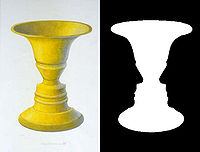
. Rubin's figure–ground distinction, since it involved higher-level cognitive pattern matching
, in which the overall picture determines its mental interpretation, rather than the net effect of the individual pieces, influenced the Gestalt psychologist
s, who discovered many similar illusions themselves.
Normally the brain classifies images by what surrounds what- establishing depth
and relationships. If something surrounds another thing, the surrounded object is seen as figure, and the presumably further away (and hence background) object is the ground, and vice versa. This makes sense, since if a piece of fruit is lying on the ground, one would want to pay attention to the "figure" and not the "ground". However, when the contours are not so unequal, ambiguity starts to creep into the previously simple inequality, and the brain must begin "shaping" what it sees; it can be shown that this shaping overrides and is at a higher level than feature recognition processes that pull together the face and the vase images- one can think of the lower levels putting together distinct regions of the picture (each region of which makes sense in isolation), but when the brain tries to make sense of it as a whole, contradictions ensue, and patterns must be discarded.
, whose contours match seamlessly the contours of another picture (sometimes the same picture; a practice M. C. Escher
used on occasion) or more often another picture. The picture should be "flat" and have little (if any) texture to it. The stereotypical example has a vase in the center, and a face matching its contour (since it is symmetrical, there is a matching face on the other side).
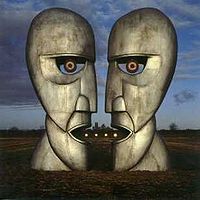 The album cover artwork for Pink Floyd
's The Division Bell
is an example of a Rubin-vase-like construction. The two metal heads in profile facing each other form the image of a third face looking directly at the viewer.
Denmark
Denmark is a Scandinavian country in Northern Europe. The countries of Denmark and Greenland, as well as the Faroe Islands, constitute the Kingdom of Denmark . It is the southernmost of the Nordic countries, southwest of Sweden and south of Norway, and bordered to the south by Germany. Denmark...
psychologist
Psychologist
Psychologist is a professional or academic title used by individuals who are either:* Clinical professionals who work with patients in a variety of therapeutic contexts .* Scientists conducting psychological research or teaching psychology in a college...
Edgar Rubin
Edgar Rubin
Edgar John Rubin was a Danish psychologist/phenomenologist, remembered for his work on figure-ground perception as seen in such optical illusions like the Rubin vase. He once worked as a research associate for Georg Elias Müller.-External links:*...
. They were first introduced at large in Rubin's two-volume work, the Danish-language Synsoplevede Figurer ("Visual Figures"), which was very well received; Rubin included a number of examples, like a Maltese cross
Maltese cross
The Maltese cross, also known as the Amalfi cross, is identified as the symbol of an order of Christian warriors known as the Knights Hospitaller or Knights of Malta and through them came to be identified with the Mediterranean island of Malta and is one of the National symbols of Malta...
figure in black and white, but the one that became the most famous was his vase example, perhaps because the Maltese cross one could also be easily interpreted as a black and white beachball.
The illusion
The visual effect generally presents the viewer with two shape interpretations, each of which is consistent with the retinal image, but only one of which can be maintained at a given moment. This is because the bounding contour will be seen as belonging to the figure shape, which appears interposed against a formless background. If the latter region is interpreted instead as the figure, then the same bounding contour will be seen as belonging to it.Explanation
The illusions are useful because they are an excellent and intuitive demonstration of the figure–ground distinction the brain makes during visual perceptionVisual perception
Visual perception is the ability to interpret information and surroundings from the effects of visible light reaching the eye. The resulting perception is also known as eyesight, sight, or vision...
. Rubin's figure–ground distinction, since it involved higher-level cognitive pattern matching
Pattern matching
In computer science, pattern matching is the act of checking some sequence of tokens for the presence of the constituents of some pattern. In contrast to pattern recognition, the match usually has to be exact. The patterns generally have the form of either sequences or tree structures...
, in which the overall picture determines its mental interpretation, rather than the net effect of the individual pieces, influenced the Gestalt psychologist
Gestalt psychology
Gestalt psychology or gestaltism is a theory of mind and brain of the Berlin School; the operational principle of gestalt psychology is that the brain is holistic, parallel, and analog, with self-organizing tendencies...
s, who discovered many similar illusions themselves.
Normally the brain classifies images by what surrounds what- establishing depth
Distance
Distance is a numerical description of how far apart objects are. In physics or everyday discussion, distance may refer to a physical length, or an estimation based on other criteria . In mathematics, a distance function or metric is a generalization of the concept of physical distance...
and relationships. If something surrounds another thing, the surrounded object is seen as figure, and the presumably further away (and hence background) object is the ground, and vice versa. This makes sense, since if a piece of fruit is lying on the ground, one would want to pay attention to the "figure" and not the "ground". However, when the contours are not so unequal, ambiguity starts to creep into the previously simple inequality, and the brain must begin "shaping" what it sees; it can be shown that this shaping overrides and is at a higher level than feature recognition processes that pull together the face and the vase images- one can think of the lower levels putting together distinct regions of the picture (each region of which makes sense in isolation), but when the brain tries to make sense of it as a whole, contradictions ensue, and patterns must be discarded.
Construction
The distinction is exploited by devising an ambiguous pictureImpossible object
An impossible object is a type of optical illusion consisting of a two-dimensional figure which is instantly and subconsciously interpreted by the visual system as representing a projection of a three-dimensional object although it is not actually possible for such an object to exist An impossible...
, whose contours match seamlessly the contours of another picture (sometimes the same picture; a practice M. C. Escher
M. C. Escher
Maurits Cornelis Escher , usually referred to as M. C. Escher , was a Dutch graphic artist. He is known for his often mathematically inspired woodcuts, lithographs, and mezzotints...
used on occasion) or more often another picture. The picture should be "flat" and have little (if any) texture to it. The stereotypical example has a vase in the center, and a face matching its contour (since it is symmetrical, there is a matching face on the other side).
Popular culture
Pink Floyd
Pink Floyd were an English rock band that achieved worldwide success with their progressive and psychedelic rock music. Their work is marked by the use of philosophical lyrics, sonic experimentation, innovative album art, and elaborate live shows. Pink Floyd are one of the most commercially...
's The Division Bell
The Division Bell
The Division Bell is the fourteenth and last studio album by English progressive rock group Pink Floyd. It was released in the United Kingdom by EMI Records on 28 March 1994, and in the United States by Columbia Records on 4 April....
is an example of a Rubin-vase-like construction. The two metal heads in profile facing each other form the image of a third face looking directly at the viewer.
Further reading
- A Psychology of Picture Perception, John M. Kennedy. 1974, Jossey-Bass Publishers, ISBN 0-87589-204-3
- The art and science of visual illusions, Nicholas Wade. 1982 Routledge & Kegan Paul Ltd. ISBN 0-7100-0868-6
- Visual Space Perception, William H. Ittelson. 1969, Springer Publishing Company, LOCCCN 60-15818
- "Vase or face? A neural correlates of shape-selective grouping processes in the human brain." Uri Hasson, Talma Hendler, Dafna Ben Bashat, Rafael Malach.
- Journal of Cognitive Neuroscience, Vol 13(6), Aug 2001. pp. 744–753. ISSN 0898-929X (Print)
External links
- Rubin's People Inside the Wall People trapped inside a Wall
- Illusionworks.com article
- Rubin has invented nothing The Rubin's vase before Rubin (fr)