

The Division Bell

Encyclopedia
The Division Bell is the fourteenth and last studio album
by English progressive rock
group Pink Floyd
. It was released in the United Kingdom by EMI Records
on 28 March 1994, and in the United States by Columbia Records
on 4 April.
Written mostly by guitarist David Gilmour
and keyboardist Richard Wright
, the album deals mostly with themes of communication. Recording took place in a number of locations, including the band's Britannia Row Studios
, and Gilmour's houseboat
, Astoria
. The production team included Pink Floyd stalwarts such as producer Bob Ezrin
, engineer Andy Jackson
, and saxophonist Dick Parry
. Gilmour's new wife, Polly Samson
, co-wrote many of the album's lyrics, and Wright performed his first lead vocal on a Pink Floyd album since 1973's The Dark Side of the Moon
.
The album went to number one in the UK and the US, but received lukewarm reviews. Its release was followed immediately by a tour of the US and Europe. The Division Bell was certified Gold, Platinum, and Double Platinum in the US in June 1994, and triple Platinum in January 1999. The album sold over 12 million copies worldwide.
and Pink Floyd, though Gilmour has denied that the album is an allegory
for the split. In 1994 he said: "People can invent and relate to a song in their personal ways, but it's a little late at this point for us to be conjuring Roger up." The general theme of communication is reflected in the choice of name for the album; The Division Bell was inspired by the division bell
rung in the British parliament
to indicate that a vote
is to take place. Drummer Nick Mason expanded on this in 1994, when he said "it does have some meaning. It's about people making choices, yeas or nays."
Produced only a few years after the collapse of the Eastern Bloc
, the song "A Great Day for Freedom" juxtaposes the general euphoria of, for instance, the fall of the Berlin Wall
, with the subsequent wars and ethnic cleansing
, particularly in Yugoslavia
. Audio samples of Professor Stephen Hawking
provide the spoken word portions of "Keep Talking". Gilmour had first heard the professor's words on a British television advertisement, and was so moved by Hawking's sentiment that he contacted the company which made the advertisement to get permission to use the recordings on the album. Emphasising the general theme of poor communication, at the end of the album Gilmour's stepson Charlie can be heard hanging up the telephone receiver on Pink Floyd manager Steve O'Rourke
, who had pleaded to be allowed to appear on a Pink Floyd album. In the Studio radio host Redbeard suggested that the album offered "the very real possibility of transcending it all, through shivering moments of grace".
(who had, since the end of the Momentary Lapse of Reason Tour, become an item with Wright's daughter, Gala Wright) was asked to contribute. According to Mason, "an interesting phenomenon occurred, which was that Guy's playing tended to change the mood of the music we had created on our own". Without the legal problems experienced during production of their 1987 album, A Momentary Lapse of Reason
, Gilmour was at ease; if he felt the band were "getting somewhere", he would press the record key of a two-track DAT recorder
. At one point Gilmour surreptitiously recorded Wright playing the keyboard, and captured material which later formed the basis for three pieces of music.
The improvisations the band recorded helped spur their creative process, and after about two weeks they had around 65 pieces of music. With engineer Andy Jackson
back on the team, and Bob Ezrin
employed as co-producer, production moved to Gilmour's houseboat and recording studio, Astoria. The band listened to and voted on each track, and whittled the material down to about 27 pieces of music. Eliminating some tracks, and merging others, they eventually arrived at a list about 15-strong, before cutting another 4 to produce a tracklist of 11 songs. Song selection was based upon a system of points, whereby all three members would award marks out of ten to each candidate song—a system skewed somewhat by Wright's decision to award his songs ten points each, and the other songs no points. The keyboardist was not contractually a full member of the band, a situation which clearly upset him; Wright later reflected: "It came very close to a point where I wasn't going to do the album, because I didn't feel that what we'd agreed was fair." Despite his frustration he chose to remain, and received his first song-writing credits on any Pink Floyd album since 1975's Wish You Were Here.
Gilmour's new wife, Polly Samson
, also received song-writing credits. Initially, her role was limited to providing encouragement for her husband, but she later helped Gilmour write "High Hopes
" (a song about Gilmour's childhood and early life in Cambridge
). Her role expanded to co-writing a further six songs, something which did not sit well with Ezrin. In an interview for Mojo magazine Gilmour admitted that Samson's contributions had "ruffled the management's [feathers]", but Ezrin later reflected that her presence was inspirational for Gilmour, and that she "pulled the whole album together". She also helped Gilmour, who, following his divorce, had developed a cocaine
habit.
Keyboard player Jon Carin, and Gary Wallis were brought in to complete the band, before recording began. Five backing vocalists were also hired, including Sam Brown, and Momentary Lapse tour singer Durga McBroom
. The band then moved to Olympia Studios, recorded most of the 'winning' tracks over the space of a week. After a summer break, they returned to Astoria to record more backing tracks. Ezrin worked on the various drum sounds, and previous collaborator and orchestral composer Michael Kamen
provided the album's string arrangements. Dick Parry
played saxophone on his first Pink Floyd album for almost twenty years, on "Wearing the Inside Out", and Chris Thomas
was booked to undertake the final mix. Between September and December recording and mixing sessions were held at Metropolis Studios in Chiswick
, and The Creek Recording Studios in London. In September, the band performed at a celebrity charity concert at Cowdray House
, in Midhurst
. The album was mastered at the Mastering Lab in Los Angeles, by Doug Sax and James Guthrie
.
organ. Some of the sounds sampled from these instruments were used on the tracks "Take It Back
", and "Marooned". Carin was joined on keyboards by Ezrin, Durga McBroom
supplied backing vocals alongside Sam Brown, Carol Kenyan, Jackie Sheridan, and Rebecca Leigh-White.
Gilmour used several styles on the album. "What Do You Want from Me" is heavily influenced by Chicago blues
, "Poles Apart" contains folksy overtones. Gilmour's heavily improvised guitar solos on "Marooned" used a DigiTech Whammy
pedal to pitch-shift the guitar notes over a full octave. On "Take It Back" he used an EBow (an electronic device which simulates the sound of a bow on the strings
), on a Gibson J-200
guitar through a Zoom effects unit.
, spurred on by the promise of a £5,000 payment to his favourite charity, the Environmental Investigation Agency, suggested The Division Bell (used in the lyrics for "High Hopes"), and the name stuck.
Long-time Floyd collaborator Storm Thorgerson provided the album artwork. He erected two large metal heads, each the height of a double-decker bus
, in a field near Ely
. The sculptures were positioned close together, and photographed in profile, to give the illusion that not only were they either facing or talking to each other, they also presented the viewer with a third face. The sculptures were devised by Keith Breeden, and constructed by John Robertson. Ely Cathedral
is visible on the horizon. The sculptures are now in the Rock and Roll Hall of Fame
in Cleveland, Ohio
.
The album was released in the UK and US on CD, vinyl, and Compact Cassette
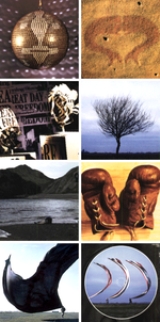
, each with its own format and label-specific design. Two 7.5 metres (24.6 ft) stone sculptures were made by Aden Hynes for the cassette releases, and photographed in the same style as the metal heads. The artwork inside the CD lyric booklet revolves around a similar theme, with the image of the two heads formed by various other objects, such as newspapers ("A Great Day for Freedom"), coloured glass ("Poles Apart"), and boxing gloves ("Lost for Words"). Pages two and three portray a picture from the Chile
an La Silla Observatory
. The CD case itself had the name of Pink Floyd printed in Braille
on the left front side.
in North Carolina
, in the US. A purpose-built Skyship 600
airship
, manufactured in the UK, toured the US until it returned to Weeksville, and was destroyed by a thunderstorm on 27 June. Pieces of the aircraft were sold as souvenirs. The band held another reception, in the UK, on 21 March. This time they used an A60 airship, translucent, and painted to look like a fish, which took journalists on a tour of London. The airship, which was lit internally so it glowed in the night sky, was also flown in northern Europe.
The album was released in the UK by EMI Records
on 28 March 1994, and in the US on 4 April, and went straight to number one in both countries. The Division Bell was certified Silver and Gold in the UK on 1 April 1994, Platinum a month later, and 2* Platinum on 1 October. In the US it was certified Gold and 2* Platinum on 6 June 1994, and 3* Platinum on 29 January 1999.
Despite strong sales the album received poor reviews. Tom Sinclair of Entertainment Weekly
gave it a "D", writing that "avarice is the only conceivable explanation for this glib, vacuous cipher of an album, which is notable primarily for its stomach-turning merger of progressive-rock pomposity and New Age noodling". Rolling Stone
s Tom Graves criticised Gilmour's performance, stating that his guitar solos "were once the band's centrepieces, as articulate, melodic and well-defined as any in rock, [but] he now has settled into rambling, indistinct asides that are as forgettable as they used to be indelible", adding that "only on 'What Do You Want from Me' does Gilmour sound like he cares". Nevertheless, the album was nominated in the 1995 Brit awards
for the "Best album by a British artist", but lost to Blur
's Parklife
. In March the same year the band was awarded with a Grammy for the "Best Rock Instrumental Performance" on "Marooned".
began at Joe Robbie Stadium, in suburban Miami. The set list began with 1967's "Astronomy Domine
", before moving to tracks from 1987's A Momentary Lapse of Reason
, and The Division Bell. Songs from Wish You Were Here and The Dark Side of the Moon
featured, as well as The Wall
. Backing musicians included Sam Brown, Jon Carin, Claudia Fontaine, Durga McBroom
, Dick Parry
, Guy Pratt, Tim Renwick, and Gary Wallis. The tour continued in the US through April, May, and mid-June, before moving to Canada, and then returning to the US in July. As the tour reached Europe in late July, Waters was invited to join the band, but he declined, and later expressed his annoyance that some Floyd songs were being performed again in large venues. On the first night of the UK leg of the tour on 12 October, a 1,200 capacity stand collapsed, but with no serious injuries; the performance was rescheduled.
During the tour an anonymous person named Publius
posted a message on an internet newsgroup, inviting fans to solve a riddle supposedly concealed in the new album. The veracity of the message was demonstrated when white lights in front of the stage at a performance in East Rutherford
spelled out the words Enigma Publius. During a televised concert at Earls Court in October 1994, the word enigma was projected in large letters on to the backdrop of the stage. Mason later acknowledged that the Publius Enigma
did exist, and that it had been instigated by the record company rather than the band. As of 2011 the puzzle remains unsolved.
The tour ended at Earls Court
on 29 October 1994, and was the group's final concert performance until Live 8
. Estimates placed the total number of tickets sold at over 5.3 million, and gross income at about $100 million. A live album of the tour, named Pulse, and a concert video, also named Pulse, (which was shot on 20 October 1994) were released in June 1995.
except where noted.
Production
Additional musicians
Singles
Studio album
A studio album is an album made up of tracks recorded in the controlled environment of a recording studio. A studio album contains newly written and recorded or previously unreleased or remixed material, distinguishing itself from a compilation or reissue album of previously recorded material, or...
by English progressive rock
Progressive rock
Progressive rock is a subgenre of rock music that developed in the late 1960s and early 1970s as part of a "mostly British attempt to elevate rock music to new levels of artistic credibility." John Covach, in Contemporary Music Review, says that many thought it would not just "succeed the pop of...
group Pink Floyd
Pink Floyd
Pink Floyd were an English rock band that achieved worldwide success with their progressive and psychedelic rock music. Their work is marked by the use of philosophical lyrics, sonic experimentation, innovative album art, and elaborate live shows. Pink Floyd are one of the most commercially...
. It was released in the United Kingdom by EMI Records
EMI Records
EMI Records is the flagship record label founded by the EMI company in 1972 and launched in January 1973 as the successor to its Columbia label. The EMI label was launched worldwide...
on 28 March 1994, and in the United States by Columbia Records
Columbia Records
Columbia Records is an American record label, owned by Japan's Sony Music Entertainment, operating under the Columbia Music Group with Aware Records. It was founded in 1888, evolving from an earlier enterprise, the American Graphophone Company — successor to the Volta Graphophone Company...
on 4 April.
Written mostly by guitarist David Gilmour
David Gilmour
David Jon Gilmour, CBE, D.M. is an English rock musician and multi-instrumentalist who is best known as the guitarist, one of the lead singers and main songwriters in the progressive rock band Pink Floyd. In addition to his work with Pink Floyd, Gilmour has worked as a producer for a variety of...
and keyboardist Richard Wright
Richard Wright (musician)
Richard William Wright was an English pianist, keyboardist and songwriter, best known for his career with Pink Floyd. Wright's richly textured keyboard layers were a vital ingredient and a distinctive characteristic of Pink Floyd's sound...
, the album deals mostly with themes of communication. Recording took place in a number of locations, including the band's Britannia Row Studios
Britannia Row Studios
Britannia Row Studios is a recording studio in Fulham, London SW6, England.Pink Floyd built the original Britannia Row Studios, located in the street Britannia Row, Islington, London N1, after their 1975 album Wish You Were Here was released...
, and Gilmour's houseboat
Houseboat
A houseboat is a boat that has been designed or modified to be used primarily as a human dwelling. Some houseboats are not motorized, because they are usually moored, kept stationary at a fixed point and often tethered to land to provide utilities...
, Astoria
Astoria (recording studio)
Astoria is a grand houseboat, adapted as a recording studio by its owner, Pink Floyd guitarist David Gilmour. It is moored on the River Thames near Hampton Court...
. The production team included Pink Floyd stalwarts such as producer Bob Ezrin
Bob Ezrin
Robert Alan "Bob" Ezrin is a Canadian music producer and keyboardist, known for his work with artists including Alice Cooper, Kiss and Pink Floyd. He was inducted into the Canadian Music Hall of Fame in 2004.-Biography:...
, engineer Andy Jackson
Andrew Jackson (recording engineer)
Andrew Jackson is a British recording engineer famous for his work with the British band Pink Floyd. He first helped out on the film soundtrack to Pink Floyd The Wall in 1982...
, and saxophonist Dick Parry
Dick Parry
Richard 'Dick' Parry is an English saxophonist. He has appeared as a session musician on various albums by modern bands and artists, and is probably best known for his solo parts on the Pink Floyd songs "Money", "Us and Them", "Shine On You Crazy Diamond" and "Wearing the Inside Out"...
. Gilmour's new wife, Polly Samson
Polly Samson
Polly Samson is a journalist and writer.-Biography:Samson was born to a diplomatic correspondent father and a writer mother of Chinese descent, Esther Cheo Ying, who wrote a memoir, Black Country Girl in Red China, about her time serving as a Major in Mao Zedong's Red Army...
, co-wrote many of the album's lyrics, and Wright performed his first lead vocal on a Pink Floyd album since 1973's The Dark Side of the Moon
The Dark Side of the Moon
The Dark Side of the Moon is the eighth studio album by English progressive rock band Pink Floyd, released in March 1973. It built on ideas explored in the band's earlier recordings and live shows, but lacks the extended instrumental excursions that characterised their work following the departure...
.
The album went to number one in the UK and the US, but received lukewarm reviews. Its release was followed immediately by a tour of the US and Europe. The Division Bell was certified Gold, Platinum, and Double Platinum in the US in June 1994, and triple Platinum in January 1999. The album sold over 12 million copies worldwide.
Concept
Much of the album deals with themes of communication—the idea that talking can solve more of life's problems. Songs such as "Poles Apart", "Lost for Words", and particularly the reference to "The day the wall came down" in "A Great Day For Freedom" are occasionally interpreted as references to the long-standing estrangement between former band-member Roger WatersRoger Waters
George Roger Waters is an English musician, singer-songwriter and composer. He was a founding member of the progressive rock band Pink Floyd, serving as bassist and co-lead vocalist. Following the departure of bandmate Syd Barrett in 1968, Waters became the band's lyricist, principal songwriter...
and Pink Floyd, though Gilmour has denied that the album is an allegory
Allegory
Allegory is a demonstrative form of representation explaining meaning other than the words that are spoken. Allegory communicates its message by means of symbolic figures, actions or symbolic representation...
for the split. In 1994 he said: "People can invent and relate to a song in their personal ways, but it's a little late at this point for us to be conjuring Roger up." The general theme of communication is reflected in the choice of name for the album; The Division Bell was inspired by the division bell
Division bell
A division bell is a bell rung in or around a parliament to signal a division and thus call all members of the chamber so affected to vote in it.- In the United Kingdom :...
rung in the British parliament
Parliament of the United Kingdom
The Parliament of the United Kingdom of Great Britain and Northern Ireland is the supreme legislative body in the United Kingdom, British Crown dependencies and British overseas territories, located in London...
to indicate that a vote
Division (vote)
In parliamentary procedure, a division of the assembly is a voting method in which the members of the assembly take a rising vote or go to different parts of the chamber, literally dividing into groups indicating a vote in favour of or in opposition to a motion on the floor...
is to take place. Drummer Nick Mason expanded on this in 1994, when he said "it does have some meaning. It's about people making choices, yeas or nays."
Produced only a few years after the collapse of the Eastern Bloc
Eastern bloc
The term Eastern Bloc or Communist Bloc refers to the former communist states of Eastern and Central Europe, generally the Soviet Union and the countries of the Warsaw Pact...
, the song "A Great Day for Freedom" juxtaposes the general euphoria of, for instance, the fall of the Berlin Wall
Berlin Wall
The Berlin Wall was a barrier constructed by the German Democratic Republic starting on 13 August 1961, that completely cut off West Berlin from surrounding East Germany and from East Berlin...
, with the subsequent wars and ethnic cleansing
Ethnic cleansing
Ethnic cleansing is a purposeful policy designed by one ethnic or religious group to remove by violent and terror-inspiring means the civilian population of another ethnic orreligious group from certain geographic areas....
, particularly in Yugoslavia
Yugoslav wars
The Yugoslav Wars were a series of wars, fought throughout the former Yugoslavia between 1991 and 1995. The wars were complex: characterized by bitter ethnic conflicts among the peoples of the former Yugoslavia, mostly between Serbs on the one side and Croats and Bosniaks on the other; but also...
. Audio samples of Professor Stephen Hawking
Stephen Hawking
Stephen William Hawking, CH, CBE, FRS, FRSA is an English theoretical physicist and cosmologist, whose scientific books and public appearances have made him an academic celebrity...
provide the spoken word portions of "Keep Talking". Gilmour had first heard the professor's words on a British television advertisement, and was so moved by Hawking's sentiment that he contacted the company which made the advertisement to get permission to use the recordings on the album. Emphasising the general theme of poor communication, at the end of the album Gilmour's stepson Charlie can be heard hanging up the telephone receiver on Pink Floyd manager Steve O'Rourke
Steve O'Rourke
Steve O'Rourke was born in Willesden, London, England. He was well known for being manager of the highly influential rock band Pink Floyd after the departure of Syd Barrett in 1968 until his death. He also had to weather the band's falling-out with member Roger Waters.He first managed Pink Floyd...
, who had pleaded to be allowed to appear on a Pink Floyd album. In the Studio radio host Redbeard suggested that the album offered "the very real possibility of transcending it all, through shivering moments of grace".
Recording
In January 1993, Gilmour, Mason, and Wright began ad-libbing new material, in sessions at a remodelled Britannia Row Studios. Although the band were initially apprehensive about recording together, after the first day their confidence improved and soon, bassist Guy PrattGuy Pratt
Guy Pratt is a session bassist and also a songwriter, actor and comedian. He is the son of actor Mike Pratt. In Kensington and Chelsea, London, in 1996, Pratt married Gala Wright, the daughter of Pink Floyd keyboardist Richard Wright...
(who had, since the end of the Momentary Lapse of Reason Tour, become an item with Wright's daughter, Gala Wright) was asked to contribute. According to Mason, "an interesting phenomenon occurred, which was that Guy's playing tended to change the mood of the music we had created on our own". Without the legal problems experienced during production of their 1987 album, A Momentary Lapse of Reason
A Momentary Lapse of Reason
A Momentary Lapse of Reason is the thirteenth studio album by English progressive rock group Pink Floyd. It was released in the UK and US in September 1987. In 1985 guitarist David Gilmour began to assemble a group of musicians to work on his third solo album...
, Gilmour was at ease; if he felt the band were "getting somewhere", he would press the record key of a two-track DAT recorder
Digital Audio Tape
Digital Audio Tape is a signal recording and playback medium developed by Sony and introduced in 1987. In appearance it is similar to a compact audio cassette, using 4 mm magnetic tape enclosed in a protective shell, but is roughly half the size at 73 mm × 54 mm × 10.5 mm. As...
. At one point Gilmour surreptitiously recorded Wright playing the keyboard, and captured material which later formed the basis for three pieces of music.
The improvisations the band recorded helped spur their creative process, and after about two weeks they had around 65 pieces of music. With engineer Andy Jackson
Andrew Jackson (recording engineer)
Andrew Jackson is a British recording engineer famous for his work with the British band Pink Floyd. He first helped out on the film soundtrack to Pink Floyd The Wall in 1982...
back on the team, and Bob Ezrin
Bob Ezrin
Robert Alan "Bob" Ezrin is a Canadian music producer and keyboardist, known for his work with artists including Alice Cooper, Kiss and Pink Floyd. He was inducted into the Canadian Music Hall of Fame in 2004.-Biography:...
employed as co-producer, production moved to Gilmour's houseboat and recording studio, Astoria. The band listened to and voted on each track, and whittled the material down to about 27 pieces of music. Eliminating some tracks, and merging others, they eventually arrived at a list about 15-strong, before cutting another 4 to produce a tracklist of 11 songs. Song selection was based upon a system of points, whereby all three members would award marks out of ten to each candidate song—a system skewed somewhat by Wright's decision to award his songs ten points each, and the other songs no points. The keyboardist was not contractually a full member of the band, a situation which clearly upset him; Wright later reflected: "It came very close to a point where I wasn't going to do the album, because I didn't feel that what we'd agreed was fair." Despite his frustration he chose to remain, and received his first song-writing credits on any Pink Floyd album since 1975's Wish You Were Here.
Gilmour's new wife, Polly Samson
Polly Samson
Polly Samson is a journalist and writer.-Biography:Samson was born to a diplomatic correspondent father and a writer mother of Chinese descent, Esther Cheo Ying, who wrote a memoir, Black Country Girl in Red China, about her time serving as a Major in Mao Zedong's Red Army...
, also received song-writing credits. Initially, her role was limited to providing encouragement for her husband, but she later helped Gilmour write "High Hopes
High Hopes (Pink Floyd song)
"High Hopes" is a song from the 1994 Pink Floyd album, The Division Bell, composed by David Gilmour with lyrics by Gilmour and Polly Samson...
" (a song about Gilmour's childhood and early life in Cambridge
Cambridge
The city of Cambridge is a university town and the administrative centre of the county of Cambridgeshire, England. It lies in East Anglia about north of London. Cambridge is at the heart of the high-technology centre known as Silicon Fen – a play on Silicon Valley and the fens surrounding the...
). Her role expanded to co-writing a further six songs, something which did not sit well with Ezrin. In an interview for Mojo magazine Gilmour admitted that Samson's contributions had "ruffled the management's [feathers]", but Ezrin later reflected that her presence was inspirational for Gilmour, and that she "pulled the whole album together". She also helped Gilmour, who, following his divorce, had developed a cocaine
Cocaine
Cocaine is a crystalline tropane alkaloid that is obtained from the leaves of the coca plant. The name comes from "coca" in addition to the alkaloid suffix -ine, forming cocaine. It is a stimulant of the central nervous system, an appetite suppressant, and a topical anesthetic...
habit.
Keyboard player Jon Carin, and Gary Wallis were brought in to complete the band, before recording began. Five backing vocalists were also hired, including Sam Brown, and Momentary Lapse tour singer Durga McBroom
Durga McBroom
Durga McBroom is a singer and actress, born October 16, 1962 in California, who has performed backing vocals for Pink Floyd and was a member of Blue Pearl.-Biography:...
. The band then moved to Olympia Studios, recorded most of the 'winning' tracks over the space of a week. After a summer break, they returned to Astoria to record more backing tracks. Ezrin worked on the various drum sounds, and previous collaborator and orchestral composer Michael Kamen
Michael Kamen
Michael Arnold Kamen was an American composer , orchestral arranger, orchestral conductor, song writer, and session musician.-Background:...
provided the album's string arrangements. Dick Parry
Dick Parry
Richard 'Dick' Parry is an English saxophonist. He has appeared as a session musician on various albums by modern bands and artists, and is probably best known for his solo parts on the Pink Floyd songs "Money", "Us and Them", "Shine On You Crazy Diamond" and "Wearing the Inside Out"...
played saxophone on his first Pink Floyd album for almost twenty years, on "Wearing the Inside Out", and Chris Thomas
Chris Thomas (record producer)
Chris Thomas is an English record producer who has worked extensively with The Beatles, Pink Floyd, Roxy Music, Badfinger, Elton John, Paul McCartney, Pulp and The Pretenders. He has also produced breakthrough albums for The Sex Pistols and INXS.Thomas is quoted as saying -Early life:Thomas was...
was booked to undertake the final mix. Between September and December recording and mixing sessions were held at Metropolis Studios in Chiswick
Chiswick
Chiswick is a large suburb of west London, England and part of the London Borough of Hounslow. It is located on a meander of the River Thames, west of Charing Cross and is one of 35 major centres identified in the London Plan. It was historically an ancient parish in the county of Middlesex, with...
, and The Creek Recording Studios in London. In September, the band performed at a celebrity charity concert at Cowdray House
Cowdray House
Cowdray House consists of the ruins of one of England's great Tudor houses, architecturally comparable to many of the great palaces and country houses of that time. It is situated just east of Midhurst, West Sussex standing on the north bank of the River Rother...
, in Midhurst
Midhurst
Midhurst is a market town and civil parish in the Chichester district of West Sussex, England, with a population of 4,889 in 2001. The town is situated on the River Rother and is home to the ruin of the Tudor Cowdray House and the stately Victorian Cowdray Park...
. The album was mastered at the Mastering Lab in Los Angeles, by Doug Sax and James Guthrie
James Guthrie (record producer)
James K.A. Guthrie is a British recording engineer and record producer best known for his work with the progressive rock band Pink Floyd, having served as a producer and engineer for the band since 1978...
.
Instrumentation
With the aid of Gilmour's guitar technician, Phil Taylor, Carin managed to locate some of the band's older keyboards from the warehouse in which they had been stored, including a FarfisaFarfisa
Farfisa is a manufacturer of electronics based in Osimo, Italy.The Farfisa brand name is commonly associated with a series of compact electronic organs, and later, a series of multi-timbral synthesizers. At the height of its production, Farfisa operated three factories to produce instruments, in...
organ. Some of the sounds sampled from these instruments were used on the tracks "Take It Back
Take It Back
"Take It Back" is a song from Pink Floyd's 1994 album, The Division Bell.-Equipment:Guitarist David Gilmour used an E-bow on a Gibson J-200 acoustic guitar that is processed through a Zoom effects box, then directly injected into the board.-Personnel:...
", and "Marooned". Carin was joined on keyboards by Ezrin, Durga McBroom
Durga McBroom
Durga McBroom is a singer and actress, born October 16, 1962 in California, who has performed backing vocals for Pink Floyd and was a member of Blue Pearl.-Biography:...
supplied backing vocals alongside Sam Brown, Carol Kenyan, Jackie Sheridan, and Rebecca Leigh-White.
Gilmour used several styles on the album. "What Do You Want from Me" is heavily influenced by Chicago blues
Chicago blues
The Chicago blues is a form of blues music that developed in Chicago, Illinois, by taking the basic acoustic guitar and harmonica-based Delta blues, making the harmonica louder with a microphone and an instrument amplifier, and adding electrically amplified guitar, amplified bass guitar, drums,...
, "Poles Apart" contains folksy overtones. Gilmour's heavily improvised guitar solos on "Marooned" used a DigiTech Whammy
Digitech Whammy
-Overview:The WH-1 Whammy pedal, the original whammy, first engineered and manufactured in 1989 by IVL Technologies and discontinued in 1993, remains the most sought-after.-Controls:...
pedal to pitch-shift the guitar notes over a full octave. On "Take It Back" he used an EBow (an electronic device which simulates the sound of a bow on the strings
Bowed guitar
Bowed guitar is a method of playing a guitar, acoustic or electric, in which the guitarist uses a bow to play the instrument, similar to playing a cello or a viola da gamba. Unlike other bowed instruments, the guitar has a flat bridge, making it difficult to bow individual notes on the middle strings...
), on a Gibson J-200
Gibson J-200
Gibson J-200 is an acoustic guitar model produced by the Gibson Guitar Corporation.Gibson entered into production of this model in 1938 as its top-of-the-line flat top guitar, initially called the Super Jumbo, changing the name in 1939 to the Super Jumbo 200. It was made at the Gibson Factory in...
guitar through a Zoom effects unit.
Packaging
To avoid competing against other album releases (as had happened with A Momentary Lapse) Pink Floyd set a deadline of April 1994, at which point they would begin a new tour. By January of that year however, the band still had not decided on a title for the album. The list of names being considered included Pow Wow and Down to Earth. At a dinner one night, writer Douglas AdamsDouglas Adams
Douglas Noel Adams was an English writer and dramatist. He is best known as the author of The Hitchhiker's Guide to the Galaxy, which started life in 1978 as a BBC radio comedy before developing into a "trilogy" of five books that sold over 15 million copies in his lifetime, a television...
, spurred on by the promise of a £5,000 payment to his favourite charity, the Environmental Investigation Agency, suggested The Division Bell (used in the lyrics for "High Hopes"), and the name stuck.
Long-time Floyd collaborator Storm Thorgerson provided the album artwork. He erected two large metal heads, each the height of a double-decker bus
Double-decker bus
A double-decker bus is a bus that has two storeys or 'decks'. Global usage of this type of bus is more common in outer touring than in its intra-urban transportion role. Double-decker buses are also commonly found in certain parts of Europe, Asia, and former British colonies and protectorates...
, in a field near Ely
Ely, Cambridgeshire
Ely is a cathedral city in Cambridgeshire, England, 14 miles north-northeast of Cambridge and about by road from London. It is built on a Lower Greensand island, which at a maximum elevation of is the highest land in the Fens...
. The sculptures were positioned close together, and photographed in profile, to give the illusion that not only were they either facing or talking to each other, they also presented the viewer with a third face. The sculptures were devised by Keith Breeden, and constructed by John Robertson. Ely Cathedral
Ely Cathedral
Ely Cathedral is the principal church of the Diocese of Ely, in Cambridgeshire, England, and is the seat of the Bishop of Ely and a suffragan bishop, the Bishop of Huntingdon...
is visible on the horizon. The sculptures are now in the Rock and Roll Hall of Fame
Rock and Roll Hall of Fame
The Rock and Roll Hall of Fame and Museum is a museum located on the shore of Lake Erie in downtown Cleveland, Ohio, United States. It is dedicated to archiving the history of some of the best-known and most influential artists, producers, engineers and others who have, in some major way,...
in Cleveland, Ohio
Ohio
Ohio is a Midwestern state in the United States. The 34th largest state by area in the U.S.,it is the 7th‑most populous with over 11.5 million residents, containing several major American cities and seven metropolitan areas with populations of 500,000 or more.The state's capital is Columbus...
.
The album was released in the UK and US on CD, vinyl, and Compact Cassette
Compact Cassette
The Compact Cassette, often referred to as audio cassette, cassette tape, cassette, or simply tape, is a magnetic tape sound recording format. It was designed originally for dictation, but improvements in fidelity led the Compact Cassette to supplant the Stereo 8-track cartridge and reel-to-reel...
, each with its own format and label-specific design. Two 7.5 metres (24.6 ft) stone sculptures were made by Aden Hynes for the cassette releases, and photographed in the same style as the metal heads. The artwork inside the CD lyric booklet revolves around a similar theme, with the image of the two heads formed by various other objects, such as newspapers ("A Great Day for Freedom"), coloured glass ("Poles Apart"), and boxing gloves ("Lost for Words"). Pages two and three portray a picture from the Chile
Chile
Chile ,officially the Republic of Chile , is a country in South America occupying a long, narrow coastal strip between the Andes mountains to the east and the Pacific Ocean to the west. It borders Peru to the north, Bolivia to the northeast, Argentina to the east, and the Drake Passage in the far...
an La Silla Observatory
La Silla Observatory
La Silla Observatory is an astronomical observatory in Chile with three telescopes built and operated by the European Southern Observatory organisation, and several others are partly maintained by ESO...
. The CD case itself had the name of Pink Floyd printed in Braille
Braille
The Braille system is a method that is widely used by blind people to read and write, and was the first digital form of writing.Braille was devised in 1825 by Louis Braille, a blind Frenchman. Each Braille character, or cell, is made up of six dot positions, arranged in a rectangle containing two...
on the left front side.
Release and reception
On 10 January 1994 a press reception to announce the new album and world tour was held at a former US Naval Air StationCoast Guard Air Station Elizabeth City
Coast Guard Air Station Elizabeth City is a United States Coast Guard air station located at Elizabeth City Regional Airport in Elizabeth City, North Carolina, along the Pasquotank River near the opening of the Albemarle Sound...
in North Carolina
North Carolina
North Carolina is a state located in the southeastern United States. The state borders South Carolina and Georgia to the south, Tennessee to the west and Virginia to the north. North Carolina contains 100 counties. Its capital is Raleigh, and its largest city is Charlotte...
, in the US. A purpose-built Skyship 600
Skyship 600
The Skyship 600 is a modern airship, originally designed by British company Airship Industries, and now owned and operated by Airship Management Services and Skycruise Switzerland AG.The first Skyship 600 made its maiden flight on 6 March 1984....
airship
Airship
An airship or dirigible is a type of aerostat or "lighter-than-air aircraft" that can be steered and propelled through the air using rudders and propellers or other thrust mechanisms...
, manufactured in the UK, toured the US until it returned to Weeksville, and was destroyed by a thunderstorm on 27 June. Pieces of the aircraft were sold as souvenirs. The band held another reception, in the UK, on 21 March. This time they used an A60 airship, translucent, and painted to look like a fish, which took journalists on a tour of London. The airship, which was lit internally so it glowed in the night sky, was also flown in northern Europe.
The album was released in the UK by EMI Records
EMI Records
EMI Records is the flagship record label founded by the EMI company in 1972 and launched in January 1973 as the successor to its Columbia label. The EMI label was launched worldwide...
on 28 March 1994, and in the US on 4 April, and went straight to number one in both countries. The Division Bell was certified Silver and Gold in the UK on 1 April 1994, Platinum a month later, and 2* Platinum on 1 October. In the US it was certified Gold and 2* Platinum on 6 June 1994, and 3* Platinum on 29 January 1999.
Despite strong sales the album received poor reviews. Tom Sinclair of Entertainment Weekly
Entertainment Weekly
Entertainment Weekly is an American magazine, published by the Time division of Time Warner, that covers film, television, music, broadway theatre, books and popular culture...
gave it a "D", writing that "avarice is the only conceivable explanation for this glib, vacuous cipher of an album, which is notable primarily for its stomach-turning merger of progressive-rock pomposity and New Age noodling". Rolling Stone
Rolling Stone
Rolling Stone is a US-based magazine devoted to music, liberal politics, and popular culture that is published every two weeks. Rolling Stone was founded in San Francisco in 1967 by Jann Wenner and music critic Ralph J...
s Tom Graves criticised Gilmour's performance, stating that his guitar solos "were once the band's centrepieces, as articulate, melodic and well-defined as any in rock, [but] he now has settled into rambling, indistinct asides that are as forgettable as they used to be indelible", adding that "only on 'What Do You Want from Me' does Gilmour sound like he cares". Nevertheless, the album was nominated in the 1995 Brit awards
Brit Awards
The Brit Awards are the British Phonographic Industry's annual pop music awards. The name was originally a shortened form of "British", "Britain" or "Britannia", but subsequently became a backronym for British Record Industry Trust...
for the "Best album by a British artist", but lost to Blur
Blur (band)
Blur is an English alternative rock band. Formed in London in 1989 as Seymour, the group consists of singer Damon Albarn, guitarist Graham Coxon, bassist Alex James and drummer Dave Rowntree. Blur's debut album Leisure incorporated the sounds of Madchester and shoegazing...
's Parklife
Parklife
Parklife is the third studio album by the English alternative rock band Blur, released in April 1994 on Food Records. After disappointing sales for their previous album Modern Life Is Rubbish , Parklife returned Blur to prominence in the UK, helped by its four hit singles: "Girls & Boys", "End of a...
. In March the same year the band was awarded with a Grammy for the "Best Rock Instrumental Performance" on "Marooned".
Tour
Two days after the album's release, the band's Division Bell TourThe Division Bell tour
The Division Bell Tour was a concert tour by British rock band Pink Floyd in 1994 to support their album The Division Bell. In 1995 the band released the live album Pulse to commemorate the tour, which would turn out to be the final Pink Floyd tour, although members of the band have continued to...
began at Joe Robbie Stadium, in suburban Miami. The set list began with 1967's "Astronomy Domine
Astronomy Domine
"Astronomy Domine" is a song by British psychedelic rock band Pink Floyd. The song, written and composed by original vocalist/guitarist Syd Barrett, was the first track featured on their debut album, The Piper at the Gates of Dawn . The lead vocal was sung by Barrett and keyboard player Richard...
", before moving to tracks from 1987's A Momentary Lapse of Reason
A Momentary Lapse of Reason
A Momentary Lapse of Reason is the thirteenth studio album by English progressive rock group Pink Floyd. It was released in the UK and US in September 1987. In 1985 guitarist David Gilmour began to assemble a group of musicians to work on his third solo album...
, and The Division Bell. Songs from Wish You Were Here and The Dark Side of the Moon
The Dark Side of the Moon
The Dark Side of the Moon is the eighth studio album by English progressive rock band Pink Floyd, released in March 1973. It built on ideas explored in the band's earlier recordings and live shows, but lacks the extended instrumental excursions that characterised their work following the departure...
featured, as well as The Wall
The Wall
The Wall is the eleventh studio album by English progressive rock group Pink Floyd. Released as a double album on 30 November 1979, it was subsequently performed live with elaborate theatrical effects, and adapted into a feature film, Pink Floyd—The Wall.As with the band's previous three...
. Backing musicians included Sam Brown, Jon Carin, Claudia Fontaine, Durga McBroom
Durga McBroom
Durga McBroom is a singer and actress, born October 16, 1962 in California, who has performed backing vocals for Pink Floyd and was a member of Blue Pearl.-Biography:...
, Dick Parry
Dick Parry
Richard 'Dick' Parry is an English saxophonist. He has appeared as a session musician on various albums by modern bands and artists, and is probably best known for his solo parts on the Pink Floyd songs "Money", "Us and Them", "Shine On You Crazy Diamond" and "Wearing the Inside Out"...
, Guy Pratt, Tim Renwick, and Gary Wallis. The tour continued in the US through April, May, and mid-June, before moving to Canada, and then returning to the US in July. As the tour reached Europe in late July, Waters was invited to join the band, but he declined, and later expressed his annoyance that some Floyd songs were being performed again in large venues. On the first night of the UK leg of the tour on 12 October, a 1,200 capacity stand collapsed, but with no serious injuries; the performance was rescheduled.
During the tour an anonymous person named Publius
Publius Enigma
The Publius Enigma is a mystery involving a riddle proposed in connection with the 1994 Pink Floyd album The Division Bell. It originated on the Internet as a Web-based contest implemented to promote the album and its tour, possibly an early example of viral marketing...
posted a message on an internet newsgroup, inviting fans to solve a riddle supposedly concealed in the new album. The veracity of the message was demonstrated when white lights in front of the stage at a performance in East Rutherford
Giants Stadium
Giants Stadium was a multi-purpose stadium, located in East Rutherford, New Jersey, USA, in the Meadowlands Sports Complex. Maximum seating capacity was 80,242. The building itself was 230.5 m long, 180.5 m wide and 44 m high from service level to the top of the seating bowl and 54 m high to...
spelled out the words Enigma Publius. During a televised concert at Earls Court in October 1994, the word enigma was projected in large letters on to the backdrop of the stage. Mason later acknowledged that the Publius Enigma
Publius Enigma
The Publius Enigma is a mystery involving a riddle proposed in connection with the 1994 Pink Floyd album The Division Bell. It originated on the Internet as a Web-based contest implemented to promote the album and its tour, possibly an early example of viral marketing...
did exist, and that it had been instigated by the record company rather than the band. As of 2011 the puzzle remains unsolved.
The tour ended at Earls Court
Earls Court Exhibition Centre
The Earls Court Exhibition Centre is an exhibition centre, conference and event venue located in west London, United Kingdom in the Royal Borough of Kensington and Chelsea . It is the largest exhibition venue in central London. It is served by two underground stations, Earl's Court and West...
on 29 October 1994, and was the group's final concert performance until Live 8
Live 8
Live 8 was a string of benefit concerts that took place on 2 July 2005, in the G8 states and in South Africa. They were timed to precede the G8 Conference and summit held at the Gleneagles Hotel in Auchterarder, Scotland from 6–8 July 2005; they also coincided with the 20th anniversary of Live Aid...
. Estimates placed the total number of tickets sold at over 5.3 million, and gross income at about $100 million. A live album of the tour, named Pulse, and a concert video, also named Pulse, (which was shot on 20 October 1994) were released in June 1995.
Track listing
All lead vocals performed by David GilmourDavid Gilmour
David Jon Gilmour, CBE, D.M. is an English rock musician and multi-instrumentalist who is best known as the guitarist, one of the lead singers and main songwriters in the progressive rock band Pink Floyd. In addition to his work with Pink Floyd, Gilmour has worked as a producer for a variety of...
except where noted.
Personnel
Pink Floyd- David GilmourDavid GilmourDavid Jon Gilmour, CBE, D.M. is an English rock musician and multi-instrumentalist who is best known as the guitarist, one of the lead singers and main songwriters in the progressive rock band Pink Floyd. In addition to his work with Pink Floyd, Gilmour has worked as a producer for a variety of...
– lead vocalsSingingSinging is the act of producing musical sounds with the voice, and augments regular speech by the use of both tonality and rhythm. One who sings is called a singer or vocalist. Singers perform music known as songs that can be sung either with or without accompaniment by musical instruments...
, guitarGuitarThe guitar is a plucked string instrument, usually played with fingers or a pick. The guitar consists of a body with a rigid neck to which the strings, generally six in number, are attached. Guitars are traditionally constructed of various woods and strung with animal gut or, more recently, with...
s, bass guitarBass guitarThe bass guitar is a stringed instrument played primarily with the fingers or thumb , or by using a pick....
, acoustic guitarAcoustic guitarAn acoustic guitar is a guitar that uses only an acoustic sound board. The air in this cavity resonates with the vibrational modes of the string and at low frequencies, which depend on the size of the box, the chamber acts like a Helmholtz resonator, increasing or decreasing the volume of the sound...
, keyboardsKeyboard instrumentA keyboard instrument is a musical instrument which is played using a musical keyboard. The most common of these is the piano. Other widely used keyboard instruments include organs of various types as well as other mechanical, electromechanical and electronic instruments...
, productionRecord producerA record producer is an individual working within the music industry, whose job is to oversee and manage the recording of an artist's music...
, mixingAudio mixing (recorded music)In audio recording, audio mixing is the process by which multiple recorded sounds are combined into one or more channels, most commonly two-channel stereo. In the process, the source signals' level, frequency content, dynamics, and panoramic position are manipulated and effects such as reverb may...
, programmingProgramming (music)Programming is a form of music production and performance using electronic devices, often sequencers or computer programs, to generate music. Programming is used in nearly all forms of electronic music and in most hip hop music since the 1990s. It is also frequently used in modern pop and rock... - Nick MasonNick MasonNicholas Berkeley "Nick" Mason is an English drummer and songwriter, best known for his work with Pink Floyd. He was the only constant member of the band since its formation in 1965...
– drumsDrum kitA drum kit is a collection of drums, cymbals and often other percussion instruments, such as cowbells, wood blocks, triangles, chimes, or tambourines, arranged for convenient playing by a single person ....
, percussionPercussion instrumentA percussion instrument is any object which produces a sound when hit with an implement or when it is shaken, rubbed, scraped, or otherwise acted upon in a way that sets the object into vibration...
, programming - Richard WrightRichard Wright (musician)Richard William Wright was an English pianist, keyboardist and songwriter, best known for his career with Pink Floyd. Wright's richly textured keyboard layers were a vital ingredient and a distinctive characteristic of Pink Floyd's sound...
– keyboards, pianoPianoThe piano is a musical instrument played by means of a keyboard. It is one of the most popular instruments in the world. Widely used in classical and jazz music for solo performances, ensemble use, chamber music and accompaniment, the piano is also very popular as an aid to composing and rehearsal...
, vocals
Production
- Bob EzrinBob EzrinRobert Alan "Bob" Ezrin is a Canadian music producer and keyboardist, known for his work with artists including Alice Cooper, Kiss and Pink Floyd. He was inducted into the Canadian Music Hall of Fame in 2004.-Biography:...
– productionRecord producerA record producer is an individual working within the music industry, whose job is to oversee and manage the recording of an artist's music... - Andrew JacksonAndrew Jackson (recording engineer)Andrew Jackson is a British recording engineer famous for his work with the British band Pink Floyd. He first helped out on the film soundtrack to Pink Floyd The Wall in 1982...
– engineeringAudio engineeringAn audio engineer, also called audio technician, audio technologist or sound technician, is a specialist in a skilled trade that deals with the use of machinery and equipment for the recording, mixing and reproduction of sounds. The field draws on many artistic and vocational areas, including... - Michael KamenMichael KamenMichael Arnold Kamen was an American composer , orchestral arranger, orchestral conductor, song writer, and session musician.-Background:...
– orchestraOrchestraAn orchestra is a sizable instrumental ensemble that contains sections of string, brass, woodwind, and percussion instruments. The term orchestra derives from the Greek ορχήστρα, the name for the area in front of an ancient Greek stage reserved for the Greek chorus...
l arrangementArrangementThe American Federation of Musicians defines arranging as "the art of preparing and adapting an already written composition for presentation in other than its original form. An arrangement may include reharmonization, paraphrasing, and/or development of a composition, so that it fully represents...
s - Edward Shearmur – orchestrations
- Steve McLoughlin – orchestra recording
- Chris ThomasChris Thomas (record producer)Chris Thomas is an English record producer who has worked extensively with The Beatles, Pink Floyd, Roxy Music, Badfinger, Elton John, Paul McCartney, Pulp and The Pretenders. He has also produced breakthrough albums for The Sex Pistols and INXS.Thomas is quoted as saying -Early life:Thomas was...
– mixing - Tony May, Rupert Truman, Stephen Piotrowski – photography
- Peter Curzon, Ian Wright – graphics
Additional musicians
- Jon CarinJon CarinJon Carin is a producer, artist and musician best known for his association with Pink Floyd, and more specifically its guitarist David Gilmour and former member Roger Waters over the last twenty five years. In the early eighties, he gained fame as the front-man for the band Industry...
– programming and additional keyboards - Guy PrattGuy PrattGuy Pratt is a session bassist and also a songwriter, actor and comedian. He is the son of actor Mike Pratt. In Kensington and Chelsea, London, in 1996, Pratt married Gala Wright, the daughter of Pink Floyd keyboardist Richard Wright...
– bass guitar - Gary WallisGary WallisGary Wallis is a drummer/percussionist trained at the London Symphony School of Music. He is known for having a massive percussion kit featuring many electronic drums and percussion. He is best known as the secondary percussionist for Pink Floyd in the post-Waters era for live performances...
– percussion - Tim RenwickTim RenwickTimothy John Pearson 'Tim' Renwick is an English guitarist.-Career:Renwick started playing guitar in the 1960s. He performed with many bands, including Little Women, Wages of Sin, Junior's Eyes, The Hype, Quiver and Lazy Racer...
– guitars - Dick ParryDick ParryRichard 'Dick' Parry is an English saxophonist. He has appeared as a session musician on various albums by modern bands and artists, and is probably best known for his solo parts on the Pink Floyd songs "Money", "Us and Them", "Shine On You Crazy Diamond" and "Wearing the Inside Out"...
– Tenor saxophoneTenor saxophoneThe tenor saxophone is a medium-sized member of the saxophone family, a group of instruments invented by Adolphe Sax in the 1840s. The tenor, with the alto, are the two most common types of saxophones. The tenor is pitched in the key of B, and written as a transposing instrument in the treble... - Bob EzrinBob EzrinRobert Alan "Bob" Ezrin is a Canadian music producer and keyboardist, known for his work with artists including Alice Cooper, Kiss and Pink Floyd. He was inducted into the Canadian Music Hall of Fame in 2004.-Biography:...
– keyboards and percussion - Sam Brown – backing vocals
- Durga McBroomDurga McBroomDurga McBroom is a singer and actress, born October 16, 1962 in California, who has performed backing vocals for Pink Floyd and was a member of Blue Pearl.-Biography:...
– backing vocals - Carol KenyonCarol KenyonCarol Kenyon , is a British singer. She was born c. 1959.Although primarily known as a session vocalist on many albums and singles by a variety of prominent artists, as well as in many concerts, Kenyon has also released several singles as a solo artist...
– backing vocals - Jackie Sheridan – backing vocals
- Rebecca Leigh-White – backing vocals
Sales chart positions
Album| Year | Chart | Position |
|---|---|---|
| 1994 | UK Albums Chart UK Albums Chart The UK Albums Chart is a list of albums ranked by physical and digital sales in the United Kingdom. It is compiled every week by The Official Charts Company and broadcast on a Sunday on BBC Radio 1 , and published in Music Week magazine and on the OCC website .To qualify for the UK albums chart... |
1 |
| US Billboard 200 Billboard 200 The Billboard 200 is a ranking of the 200 highest-selling music albums and EPs in the United States, published weekly by Billboard magazine. It is frequently used to convey the popularity of an artist or groups of artists... |
1 | |
| Chile (APF) | 1 | |
| Norwegian Record Charts | 1 | |
| Australian Albums Chart ARIA Charts The ARIA charts are the main Australian music sales charts, issued weekly by the Australian Recording Industry Association. The charts are a record of the highest selling singles and albums in various genres in Australia. ARIA commenced compiling its own charts in-house from the week ending 26 June... |
1 | |
| Swiss Charts | 1 |
Singles
| Year | Title | Position | Chart | Source(s) |
|---|---|---|---|---|
| 1994 | "Take it Back" (edit)/"Astronomy Domine (live)" | 73 | US | |
| "Take It Back" | 23 | UK Singles Chart | ||
| "High Hopes" (album version)/"Keep Talking" (album version)/"One of These Days" (live) | 26 | UK Singles Chart |