
All Topics  
Rotating magnetic field


   Email Print
   Bookmark   Link


Rotating magnetic field


A rotating magnetic field is a magnetic field
Magnetic field

A magnetism field is a vector field which can exert a magnetic force on moving electric charges and on magnetic dipoles . When placed in a magnetic field, magnetic dipoles tend to align their axes parallel to the magnetic field....
 which changes direction at (ideally) a constant angular rate. This is a key principle in the operation of the alternating-current motor
Alternator

An alternator is an generator that converts mechanical energy to alternating current electrical energy. Most alternators use a rotating magnetic field but linear alternators are occasionally used....
. In 1882, Nikola Tesla
Nikola Tesla

Nikola Tesla was an inventor and a mechanical engineer and electrical engineer. Tesla was born in the village of Smiljan near the town of Gospic, in Croatia ....
 identified the concept of the rotating magnetic field. In 1885, Galileo Ferraris
Galileo Ferraris

Galileo Ferraris was an Italian physicist and electrical engineer, noted mostly for his studies of alternating current....
 independently researched the concept. In 1888, Tesla gained for his work. Also in 1888, Ferraris published his research in a paper to the Royal Academy of Sciences in Turin
Turín

Tur?n is a municipality in the Ahuachap?n Department Departments of El Salvador of El Salvador....
.

Description
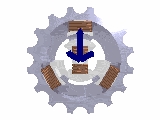
A symmetric rotating magnetic field can be produced with as few as three coils.


Discussion
Ask a question about 'Rotating magnetic field'
Start a new discussion about 'Rotating magnetic field'
Answer questions from other users
Full Discussion Forum


Encyclopedia


A rotating magnetic field is a magnetic field
Magnetic field

A magnetism field is a vector field which can exert a magnetic force on moving electric charges and on magnetic dipoles . When placed in a magnetic field, magnetic dipoles tend to align their axes parallel to the magnetic field....
 which changes direction at (ideally) a constant angular rate. This is a key principle in the operation of the alternating-current motor
Alternator

An alternator is an generator that converts mechanical energy to alternating current electrical energy. Most alternators use a rotating magnetic field but linear alternators are occasionally used....
. In 1882, Nikola Tesla
Nikola Tesla

Nikola Tesla was an inventor and a mechanical engineer and electrical engineer. Tesla was born in the village of Smiljan near the town of Gospic, in Croatia ....
 identified the concept of the rotating magnetic field. In 1885, Galileo Ferraris
Galileo Ferraris

Galileo Ferraris was an Italian physicist and electrical engineer, noted mostly for his studies of alternating current....
 independently researched the concept. In 1888, Tesla gained for his work. Also in 1888, Ferraris published his research in a paper to the Royal Academy of Sciences in Turin
Turín

Tur?n is a municipality in the Ahuachap?n Department Departments of El Salvador of El Salvador....
.

Description


A symmetric rotating magnetic field can be produced with as few as three coils. The three coils will have to be driven by a symmetric 3-phase AC sine current system, thus each phase will be shifted 120 degrees in phase from the others. For the purpose of this example, the magnetic field is taken to be the linear function
Linear function

In mathematics, the term linear function can refer to either of two different but related concepts: a first-degree polynomial function of one variable; or a map between two vector spaces that preserves vector addition and scalar multiplication....
 of the coil's current.

3phase Rmf Noadd 60f Airopt
3phase Rmf 60fv2 Airopt


The result of adding three 120-degrees phased sine waves on the axis of the motor is a single rotating vector. The rotor has a constant magnetic field. The N pole of the rotor will move toward the S pole of the magnetic field of the stator, and vice versa. This magneto-mechanical attraction creates a force which will drive rotor to follow the rotating magnetic field in a synchronous manner.

Rmfpatent
A permanent magnet in such a field will rotate so as to maintain its alignment with the external field. This effect was utilized in early alternating current electric motor
Electric motor

An electric motor uses electrical energy to produce mechanical energy, nearly always by the interaction of magnetic fields and current-carrying conductors....
s. A rotating magnetic field can be constructed using two orthogonal coils with a 90 degree phase difference in their AC currents. However, in practice such a system would be supplied through a three-wire arrangement with unequal currents. This inequality would cause serious problems in the standardization of the conductor size. In order to overcome this, three-phase systems are used where the three currents are equal in magnitude and have a 120 degree phase difference. Three similar coils having mutual geometrical angles of 120 degrees will create the rotating magnetic field in this case. The ability of the three phase system to create the rotating field utilized in electric motors is one of the main reasons why three phase systems dominate in the world electric power supply systems.

Rotating magnetic fields are also used in induction motor
Induction motor

An induction motor is a type of asynchronous AC motor where power is supplied to the rotating device by means of Electromagnetic induction. Other commonly used name is squirrel cage motor due to the fact that the rotor bars with short circuit rings resemble a squirrel cage ....
s. Because magnets degrade with time, induction motors use short-circuited rotor
Rotor

Rotor may refer to:*Rotor , a rotating part of a mechanical device, for example Rotor , generator, alternator or pump.In engineering:...
s (instead of a magnet) which follow the rotating magnetic field of a multicoiled stator
Stator

The stator is the stationary part of a rotordynamics system, such as in an electric generator or electric motorDepending on the configuration of a spinning electromotive device the stator may act as the field magnet, interacting with the armature to create motion, or it may act as the armature, receiving its influence from moving...
. In these motors, the short circuited turns of the rotor develop eddy current
Eddy current

An eddy current is an Electricity phenomenon discovered by France physics L?on Foucault in 1851. It is caused when a conductor is exposed to a changing magnetic field due to relative motion of the field source and conductor; or due to variations of the field with time....
s in the rotating field of stator which in turn move the rotor by Lorentz force
Lorentz force

In physics, the Hendrik Lorentz force is the force on a point charge due to electromagnetic fields. It is given by the following equation in terms of the electric field and magnetic fields:...
. These types of motors are not usually synchronous, but instead necessarily involve a degree of 'slip' in order that the current may be produced due to the relative movement of the field and the rotor.

NOTE: The rotating magnetic field can actually be produced by two coils, with phases shifted about 90 degrees, but such a field would not be symmetric due to the difference between the magnetic susceptibility
Magnetic susceptibility

In electromagnetism the magnetic susceptibility is the degree of magnetization of a material in response to an applied magnetic field....
 of the ferromagnetic materials of pole and of air. In the case where only two phases of sine current are available, four poles are commonly used.

See also

  • 1882 in science
    1882 in science

    The year 1882 in science and technology involved some significant events, listed below....
  • Alternator
    Alternator

    An alternator is an generator that converts mechanical energy to alternating current electrical energy. Most alternators use a rotating magnetic field but linear alternators are occasionally used....
  • Dynamo theory
    Dynamo theory

    The dynamo theory proposes a mechanism by which a celestial body such as the Earth generates a magnetic field....
  • Halbach array
    Halbach array

    A Halbach array is a special arrangement of permanent magnets that augments the magnetic field on one side of the array while cancelling the field to near zero on the other side....
     a magnetic field that rotates spatially
  • Tesla's Egg of Columbus
    Tesla's Egg of Columbus

    Nikola Tesla, at the 1893 World's Columbian Exposition, demonstrated a device he constructed known as the "Egg of Columbus." It was used to demonstrate and explain the principles of the rotating magnetic field model and the induction motor....
  • Magnetic stirrer
    Magnetic stirrer

    A magnetic stirrer is a type of laboratory equipment consisting of a rotating magnet or stationary electomagnets creating a rotating magnetic field....
  • Shaded-pole motor
    Shaded-pole motor

    A shaded-pole motor is a type of alternating current single-phase electric power induction electric motor. As in other induction motors the rotating part is a squirrel-cage rotor....
  • Squirrel cage rotor
    Squirrel cage rotor

    A squirrel cage rotor is the rotating part often used in an AC induction motor. An electric motor with a squirrel cage rotor is sometimes called a squirrel cage motor....
  • Synchronous motor
    Synchronous motor

    A synchronous electric motor is an AC motor distinguished by a Rotor spinning with coils passing magnets at the same rate as the alternating current and resulting magnetic field which drives it....
  • Timeline of motor and engine technology
    Timeline of motor and engine technology

    Timeline of Electric motor and engine technology* - Hero of Alexandria builds the first documented steam-powered device, the aeolipile.* 1698 - Thomas Savery builds a steam-powered water pump for pumping water out of mines...
  • War of Currents
    War of Currents

    In the "War of Currents" era in the late 1880s, George Westinghouse and Thomas Edison became adversaries due to Edison's promotion of direct current for electric power distribution over alternating current advocated by Westinghouse and Nikola Tesla....


Further reading

  • C Mackechnie Jarvis, "Nikola Tesla and the induction motor". 1970, Phys. Educ. 5 280-287 doi:10.1088/0031-9120/5/5/306
  • Owen, E.L., "The induction motor's historical past". IEEE Potentials, Oct 1988, Volume 7, Issue 3, pg. 27-30, ISSN 0278-6648
  • Beckhard, Arthur J., "Electrical genius Nikola Tesla". New York, Messner, 1959. LCCN 59007009 /L/AC/r85 (ed. 192 p.; 22 cm.; biography with notes on the inventions of the rotating magnetic field motors for alternating current.)
  • Kline, R., "Science and Engineering Theory in the Invention and Development of the Induction Motor, 1880-1900". Technology and Culture, 1987.
  • Cebers, A., "Dynamics of an elongated magnetic droplet in a rotating field". Phys. Rev. E 66, 061402, Issue 6, December 13, 2002.
  • Cebers, A., and I. Javaitis, "Dynamics of a flexible magnetic chain in a rotating magnetic field". Phys. Rev. E 69, 021404 2004.
  • Cebers, A., and M. Ozols, "Dynamics of an active magnetic particle in a rotating magnetic field". Phys. Rev. E 73, 021505, 2006.
  • Tao Song, et. al., "Rotating permanent magnetic fields exposure system for in vitro study". IEEE Transactions on Applied Superconductivity, June 2004, Volume 14, Issue 2, pg 1643-1646. ISSN 1051-8223
  • Labzovskii, L.N. , A.O. Mitrushchenkov, and A.I. Frenkel, "". 6 July 1987. (ed., Shows that the continuous current arises under the influence of the rotating magnetic field.)


Patents


External articles


  • Naval Electrical Engineering Training Series, Module 05 - Introduction to Generators and Motors, Chapter 4 Alternating Current Motors, (ed. different copy of the NEETS book is available, )
  • , eng.ox.ac.uk
  • Tesla's Autobiography, III. My Later Endeavors;
  • , Inventor of the Week Archive.
  • H.Y. Guo, A.L. Hoffman, D. Lotz, S.J. Tobin, W.A. Reass, L.S. Schrank and G.A. Wurden, , March 22, 2001.
  • Putko, V. F., and V. S. Sobolev, .