Rongo

Encyclopedia
Maori mythology
Māori mythology and Māori traditions are the two major categories into which the legends of the Māori of New Zealand may usefully be divided...
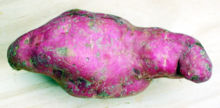
, Rongo is a major god, the god of cultivated food, especially the kūmara
Sweet potato
The sweet potato is a dicotyledonous plant that belongs to the family Convolvulaceae. Its large, starchy, sweet-tasting, tuberous roots are an important root vegetable. The young leaves and shoots are sometimes eaten as greens. Of the approximately 50 genera and more than 1,000 species of...
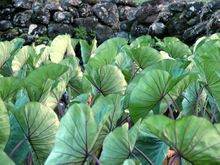
, a vital food crop. Other food crops cultivated by Māori in traditional times include taro
Taro
Taro is a common name for the corms and tubers of several plants in the family Araceae . Of these, Colocasia esculenta is the most widely cultivated, and is the subject of this article. More specifically, this article describes the 'dasheen' form of taro; another variety is called eddoe.Taro is...
, yams (uwhi), cordyline
Cordyline
Cordyline is a genus of about 15 species of woody monocotyledonous flowering plants in family Asparagaceae, subfamily Lomandroideae. The subfamily has previously been treated as a separate family Laxmanniaceae, or Lomandraceae. Other authors have placed the genus in the Agavaceae...
(tī), and gourds (hue). Because of their tropical origin, most of these crops were difficult to grow except in the far north of New Zealand
New Zealand
New Zealand is an island country in the south-western Pacific Ocean comprising two main landmasses and numerous smaller islands. The country is situated some east of Australia across the Tasman Sea, and roughly south of the Pacific island nations of New Caledonia, Fiji, and Tonga...
. Hence the importance of Rongo.
Origin
Rongo, with his brothers TūTumatauenga
In Māori mythology, Tū or Tūmatauenga is one of the great gods, and the origin of war. All war-parties were dedicated to him, and he was treated with the greatest respect and awe. He is usually a son of the primordial parent, sky and earth...
, Tāne
Tane
In Māori mythology, Tāne is the god of forests and of birds, and the son of Ranginui and Papatuanuku, the sky father and the earth mother, who lie in a tight embrace...
, Tāwhirimātea
Tawhirimatea
In Māori mythology, Tāwhirimātea is the god of weather, including thunder and lightning, wind, clouds and storms. He is a son of Papatūānuku and Ranginui...
, Tangaroa
Tangaroa
In Māori mythology, Tangaroa is one of the great gods, the god of the sea. He is a son of Ranginui and Papatuanuku, Sky and Earth. After he joins his brothers Rongo, Tūmatauenga, Haumia, and Tane in the forcible separation of their parents, he is attacked by his brother Tawhirimatea, the god of...
and Haumia-tiketike
Haumia-tiketike
In Māori mythology, Haumia-tiketike is the god of wild or uncultivated foods. Haumia was a son of Rangi and Papa, and agreed to the forced separation of his parents. Because of this he was subjected to the fury of his brother Tāwhirimātea, god of winds and storms, who would have killed him if...
, separated the primordial parents Rangi and Papa
Rangi and Papa
In Māori mythology the primal couple Rangi and Papa appear in a creation myth explaining the origin of the world. In some South Island dialects, Rangi is called Raki or Rakinui.-Union and separation:...
to allow daylight into the world. Tāwhirimātea, the god of storms, did not consent to this plan and afterwards attacked his brothers with unrelenting fury. Rongo and Haumia, the god of wild food, took refuge in the body of Papa, mother earth, who hid them until the storm passed (Grey 1956:7, Tregear 1891:424,Orbell 1998:121).
Kūmara
In the Māori language, ‘rongo’ means peace. Rongo is generally portrayed as the creator of the kūmara, a plant associated with peace (probably because the intense cultivation it needed was best performed in times of peace). In Ngāti AwaNgati Awa
Ngāti Awa is a Māori iwi centred in the eastern Bay of Plenty Region of New Zealand.Ngāti Awa comprises 22 hapu , with 15,258 people claiming affiliation to the iwi in 2006. The Ngāti Awa people are primarily located in towns on the Rangitaiki Plain, including Whakatane, Kawerau, Edgecumbe, Te...
traditions, Rongo is a son of Tāne and father of the kūmara, but a man named Rongo-māui travels to the star Whānui, obtains the kūmara and returns to Earth with it.
Small statues representing Rongo were once placed alongside kumara fields.
Other names and epithets
- Rongo-mā-tāne