

Rigid-hulled inflatable boat

Encyclopedia
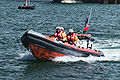
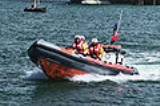
A rigid-hulled inflatable boat, (RHIB) or rigid-inflatable boat (RIB) is a light-weight but high-performance and high-capacity boat
Boat
A boat is a watercraft of any size designed to float or plane, to provide passage across water. Usually this water will be inland or in protected coastal areas. However, boats such as the whaleboat were designed to be operated from a ship in an offshore environment. In naval terms, a boat is a...
constructed with a solid, shaped hull and flexible tubes at the gunwale
Gunwale
The gunwale is a nautical term describing the top edge of the side of a boat.Wale is the same word as the skin injury, a wheal, which, too, forms a ridge. Originally the gunwale was the "Gun ridge" on a sailing warship. This represented the strengthening wale or structural band added to the design...
. The design is stable and seaworthy. The inflatable collar allows the vessel to maintain buoyancy
Buoyancy
In physics, buoyancy is a force exerted by a fluid that opposes an object's weight. In a column of fluid, pressure increases with depth as a result of the weight of the overlying fluid. Thus a column of fluid, or an object submerged in the fluid, experiences greater pressure at the bottom of the...
even if a large quantity of water is shipped aboard due to bad sea conditions. The RIB is a development of the inflatable boat
Inflatable boat
An inflatable boat is a lightweight boat constructed with its sides and bow made of flexible tubes containing pressurised gas. For smaller boats, the floor and hull beneath it is often flexible. On boats longer than , the floor often consists of three to five rigid plywood or aluminium sheets fixed...
.
Uses include work boats (supporting shore facilities or larger ships) in trades that operate on the water, as well as use as lifeboats and military craft, where they are used in patrol roles and to transport troops between vessels or ashore.
Origins in Britain
The combination of rigid hull and large inflatable buoyancy tubes seems to have been first introduced in 1967 by Tony and Edward Lee-Elliott, and patented by Admiral Desmond Hoare in 1969 after research and development at Atlantic CollegeAtlantic College
The United World College of the Atlantic, also known as Atlantic College, is an international IB Diploma Programme boarding school in the United Kingdom. Founded in 1962, the school was the first of the United World Colleges and was among the first schools in the world to follow an international...
in Wales
Wales
Wales is a country that is part of the United Kingdom and the island of Great Britain, bordered by England to its east and the Atlantic Ocean and Irish Sea to its west. It has a population of three million, and a total area of 20,779 km²...
.
In 1964, Rear-Admiral Desmond J. Hoare and his students at Atlantic College
Atlantic College
The United World College of the Atlantic, also known as Atlantic College, is an international IB Diploma Programme boarding school in the United Kingdom. Founded in 1962, the school was the first of the United World Colleges and was among the first schools in the world to follow an international...
in South Wales
Wales
Wales is a country that is part of the United Kingdom and the island of Great Britain, bordered by England to its east and the Atlantic Ocean and Irish Sea to its west. It has a population of three million, and a total area of 20,779 km²...
replaced the torn bottom of their 12 feet (3.7 m) sailing club rescue inflatable boat
Inflatable boat
An inflatable boat is a lightweight boat constructed with its sides and bow made of flexible tubes containing pressurised gas. For smaller boats, the floor and hull beneath it is often flexible. On boats longer than , the floor often consists of three to five rigid plywood or aluminium sheets fixed...
by a plywood
Plywood
Plywood is a type of manufactured timber made from thin sheets of wood veneer. It is one of the most widely used wood products. It is flexible, inexpensive, workable, re-usable, and can usually be locally manufactured...
sheet glued to the inflatable tubes. This proved a successful modification but was rather uncomfortable at speed offshore and so the floor was rebuilt with a deep-vee bow blending to a nearly flat section stern. This boat was named Atlanta and later that year an Atlantic College RIB was displayed at the London Boat Show.
By 1966 the students had built a further five rigid inflatable boats – Aphrodite (15 ft), Triton (16 ft) and X1–X3. Aphrodite and Triton were for the College’s own use. X1 (16 ft) and X2 (22 ft) were launched in 1965 by Queen Elizabeth II and made under a development agreement with the UK Royal National Lifeboat Institution
Royal National Lifeboat Institution
The Royal National Lifeboat Institution is a charity that saves lives at sea around the coasts of Great Britain, Ireland, the Channel Islands and the Isle of Man, as well as on selected inland waterways....
(RNLI). They were taken by the RNLI for trials at Gorleston
Gorleston
Gorleston-On-Sea, also known colloquially as Gorleston, is a settlement in Norfolk in the United Kingdom, forming part of the larger town of Great Yarmouth. Situated at the mouth of the River Yare it was a port town at the time of the Domesday Book. The port then became a centre of fishing for...
(X1) and Great Yarmouth
Great Yarmouth
Great Yarmouth, often known to locals as Yarmouth, is a coastal town in Norfolk, England. It is at the mouth of the River Yare, east of Norwich.It has been a seaside resort since 1760, and is the gateway from the Norfolk Broads to the sea...
(X2) from which they returned to Atlantic College in spring 1967. X3 was an experimental vortex-lift hull funded by a private developer and was not greatly successful.
By that time Des Hoare had concluded that for the conditions under which they operated a boat of around 18 feet long was optimum which led to X4 (launched 1966), X5 and X6 (launched 1967), and X5 to X8 (launched 1968). These boats were used to support the college's sailing activities and also to fulfil the college's responsibility as an inshore lifeboat station for the RNLI – a responsibility it still discharges to this day. At the same time work started on a smaller series of beach-launchable boats (10 – 12 ft long, designated MX1 – MX6) to support lifeguard
Lifeguard
A lifeguard supervises the safety and rescue of swimmers, surfers, and other water sports participants such as in a swimming pool, water park, or beach. Lifeguards are strong swimmers and trained in first aid, certified in water rescue using a variety of aids and equipment depending on...
s on local beaches.
All the above boats’ hulls were built from plywood. In summer 1968, student Paul Jefferies designed and constructed a hull (X10) from fiberglass
Fiberglass
Glass fiber is a material consisting of numerous extremely fine fibers of glass.Glassmakers throughout history have experimented with glass fibers, but mass manufacture of glass fiber was only made possible with the invention of finer machine tooling...
, which was not a success due to lack of strength. However that development led to the building of Psychedelic Surfer, a twin-engined 21 ft RIB, for John Caulcott, Graeme Dillon and Simon de’Ath to race in the 1969 Round Britain Powerboat Race, in which it was one of the few boats to finish.
From that time, the RNLI transferred development to its research centre in Cowes
Cowes
Cowes is an English seaport town and civil parish on the Isle of Wight. Cowes is located on the west bank of the estuary of the River Medina facing the smaller town of East Cowes on the east Bank...
, who took the Atlantic College designs and developed from them the 21 ft Atlantic 21 class of inshore lifeboats which entered service in 1972 and continued for the next 30 years or so.
The first commercial RIB is believed to be the Avon Rubber Co Searider which was launched at the January 1969 London Boat Show.
Introduction to North America
In the mid-1970s a hull mold and tubes for 21-foot R-HIBs were sent from Atlantic CollegeAtlantic College
The United World College of the Atlantic, also known as Atlantic College, is an international IB Diploma Programme boarding school in the United Kingdom. Founded in 1962, the school was the first of the United World Colleges and was among the first schools in the world to follow an international...
to their new sister school being established on the west coast of Canada, the Lester B. Pearson College
Lester B. Pearson College
Lester B. Pearson United World College of the Pacific is one of thirteen United World Colleges around the world. It is named after the late Canadian Prime Minister Lester Bowles Pearson, winner of the 1957 Nobel Peace Prize and originator of the United Nations Peace Keeping program...
of the Pacific, at Pedder Bay, British Columbia. 3 graduates of the Atlantic College who were also trained as RNLI inshore lifeboat coxswains worked at the school during its inaugural year and coached some Pacific College students to build a pair of boats, designated X-27, propelled by twin outboard engines and X-28, propelled by inboard-outboard stern drive. These students were also trained by the graduates to operate these craft as safety boats in support of the college's coastal sailing and diving programs.
During summer, the college loaned their fast rescue craft to the Canadian Coast Guard
Canadian Coast Guard
The Canadian Coast Guard is the coast guard of Canada. It is a federal agency responsible for providing maritime search and rescue , aids to navigation, marine pollution response, marine radio, and icebreaking...
(CCG), which was introducing rigid-hull inflatables into its new summer seasonal inshore rescue boat service operation. Meanwhile, the Great Lakes
Great Lakes
The Great Lakes are a collection of freshwater lakes located in northeastern North America, on the Canada – United States border. Consisting of Lakes Superior, Michigan, Huron, Erie, and Ontario, they form the largest group of freshwater lakes on Earth by total surface, coming in second by volume...
branch of the CCG introduced 5.4 metre Avon Seariders into its regional inshore rescue boat service in the late 1970s. Both branches hired university students to serve as crew, in part due to the success of the student crews operating these ever-buoyant rescue craft at Atlantic and at Pearson College.
General characteristics
RIBs are commonly 4 to 9 metres (13 to 28 ft) long, although they can range in length between 2.5 and 18 metres (7.5 and 55 ft). A RIB is often propelled by one or more outboard motorOutboard motor
An outboard motor is a propulsion system for boats, consisting of a self-contained unit that includes engine, gearbox and propeller or jet drive, designed to be affixed to the outside of the transom and are the most common motorized method of propelling small watercraft...
s or an inboard motor
Internal combustion engine
The internal combustion engine is an engine in which the combustion of a fuel occurs with an oxidizer in a combustion chamber. In an internal combustion engine, the expansion of the high-temperature and high -pressure gases produced by combustion apply direct force to some component of the engine...
turning a water jet
Pump-jet
A pump-jet, hydrojet, or water jet, is a marine system that creates a jet of water for propulsion. The mechanical arrangement may be a ducted propeller with nozzle, or a centrifugal pump and nozzle...
or stern drive. Generally the power of the motors is in the range of 5 to 300 horse power (4 to 220 kW).
RIBs are used as rescue craft
Rescue craft
A rescue craft is a boat, ship or aircraft used in rescuing.The most common are Lifeboat for Inshore and closer to shore rescues. For operations further out from shore helicopters & ships are mainly used....
, safety boats for sailing, dive boat
Dive boat
A dive boat is a boat that scuba divers use to reach a diving site which they could not reach by swimming from land.-Dive boat features:Features that make a boat suitable for use by divers are:* marine VHF radio* oxygen first aid* diving shot...
s or tenders
Ship's tender
A ship's tender, usually referred to as a tender, is a boat, or a larger ship used to service a ship, generally by transporting people and/or supplies to and from shore or another ship...
for larger boats and ships. Their shallow draught, high maneuverability, speed and relative immunity to damage in low-speed collisions are advantages in these applications.
RIBs up to about 7 metres in length can be towed on trailers
Trailer (vehicle)
A trailer is generally an unpowered vehicle pulled by a powered vehicle. Commonly, the term trailer refers to such vehicles used for transport of goods and materials....
on the road; this, coupled with their other properties, is making them increasingly attractive as leisure craft.
Performance
Planing (sailing)
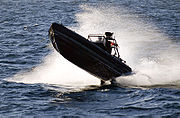
Planing is the mode of operation for a waterborne craft in which its weight is predominantly supported by hydrodynamic lift, rather than hydrostatic lift .-History:...
hulls. Due to their low weight, RIBs often outperform some types of similarly sized and powered boats, although a pure fibreglass speedboat with similar dimensions is typically faster, due to its lighter weight and more arrowlike-shape.
RIBs can also generally cope better with rougher seas, although this may be partially due to an increased level of confidence, in knowing that a RIB is hard to sink, and better absorption of heavy loads by the flexible tubes, which therefore make heavy seas less unpleasant.
The maximum speed of the RIB depends on its gross weight, power, length and profile of hull, and sea conditions. A typical seaborne 6 metre RIB, with six passengers, 110 hp engines, in Beaufort
Beaufort scale
The Beaufort Scale is an empirical measure that relates wind speed to observed conditions at sea or on land. Its full name is the Beaufort Wind Force Scale.-History:...
force 2 is very likely to have a top speed of around 30 knots (58.8 km/h). High-Performance RIBs may operate with a speed between 40 and 70 kn (78.4 and 137.2 km/h), depending on the size and weight.
Hull
The hull is made of steelSteel
Steel is an alloy that consists mostly of iron and has a carbon content between 0.2% and 2.1% by weight, depending on the grade. Carbon is the most common alloying material for iron, but various other alloying elements are used, such as manganese, chromium, vanadium, and tungsten...
, wood
Wood
Wood is a hard, fibrous tissue found in many trees. It has been used for hundreds of thousands of years for both fuel and as a construction material. It is an organic material, a natural composite of cellulose fibers embedded in a matrix of lignin which resists compression...
, aluminium
Aluminium
Aluminium or aluminum is a silvery white member of the boron group of chemical elements. It has the symbol Al, and its atomic number is 13. It is not soluble in water under normal circumstances....
, or more commonly, a combination of wood for the structure and glass-reinforced plastic
Glass-reinforced plastic
Fiberglass , is a fiber reinforced polymer made of a plastic matrix reinforced by fine fibers of glass. It is also known as GFK ....
(GRP) composite for the shaped and smooth surface. Some manufacturers also weave Kevlar into the GRP sheets for extra strength. The hull of a RIB is shaped to increase the performance of the boat in the water by optimising its hydroplaning
Planing (sailing)
Planing is the mode of operation for a waterborne craft in which its weight is predominantly supported by hydrodynamic lift, rather than hydrostatic lift .-History:...
characteristics. "Deep-V" hulls cut through waves easily but require greater engine power to start planing than "shallow-V" hulls, which plane at lower speed but with a more uncomfortable ride. As with the design of most boat hulls they represent a compromise of different design characteristics. Modern "all round" RIB hulls combine a deep v hull at the bow which flattens out to present a broad planing pad. This is a flat area on the rear of the hull designed to allow the boat to have a stable surface to plane on.
Tubes
The tubes are usually constructed in separate sections to reduce the effect of a puncture, each with a valveValve
A valve is a device that regulates, directs or controls the flow of a fluid by opening, closing, or partially obstructing various passageways. Valves are technically pipe fittings, but are usually discussed as a separate category...
to add or remove air. Larger boats (7m+) have 6 or more chambers with a valve for each chamber. The more chambers a boat has the more redundancy the boat is considered to have. This is because if only one chamber is damaged then the impact the damage has on the boat is much less. Dark tubes often have pressure relief valves as the air inside them expands when exposed to sunlight. This prevents the tubes bursting from over pressure. Common materials for the tubes are Hypalon and uPVC (Polyvinyl chloride), though some manufacturers use PU (Polyurethane).
Hypalon
Tubes made of HypalonHypalon
Hypalon is a trademark for chlorosulfonated polyethylene synthetic rubber noted for its resistance to chemicals, temperature extremes, and ultraviolet light. It was a product of DuPont Performance Elastomers, a subsidiary of DuPont....
are easy to manufacture and can be repaired with simple puncture repair kits. Hypalon is not airtight and so must be combined with Neoprene
Neoprene
Neoprene or polychloroprene is a family of synthetic rubbers that are produced by polymerization of chloroprene. Neoprene in general has good chemical stability, and maintains flexibility over a wide temperature range...
when used to build tubes. Tubes made with Hypalon and Neoprene layers can last 20+ years.
Although early in its life a PU tube will be stronger than a Hypalon/Neoprene tube, by the age of five years they have similar levels of durability, which is why Hypalon/Neoprene tubes are often to be found on RIBs that are owned by commercial and high-value leisure users. Hypalon is probably the most popular material used for the construction of RIBs manufactured in the UK.
uPVC (Polyvinyl chloride)
As a material for building tubes, polyvinylchloride (PVC) has the disadvantage of lacking flexibility. To make it supple, an additivePlasticizer
Plasticizers or dispersants are additives that increase the plasticity or fluidity of the material to which they are added; these include plastics, cement, concrete, wallboard, and clay. Although the same compounds are often used for both plastics and concretes the desired effects and results are...
is used with the polymer
Polymer
A polymer is a large molecule composed of repeating structural units. These subunits are typically connected by covalent chemical bonds...
. This additive vaporises as the material ages, making the PVC brittle and allowing it to crack. A PVC tube is the cheapest option and can last approximately 10–15 years.
PU (Polyurethane)
Tubes made of polyurethanePolyurethane
A polyurethane is any polymer composed of a chain of organic units joined by carbamate links. Polyurethane polymers are formed through step-growth polymerization, by reacting a monomer with another monomer in the presence of a catalyst.Polyurethanes are...
(PU) are difficult to manufacture and hard to repair and are consequently not often used for RHIB construction. PU has an advantage of being very tough, it can be made knife-proof or bulletproof
Bulletproof
Bulletproofing is the process of making something capable of stopping a bullet or similar high velocity projectiles e.g. shrapnel. The term bullet resistance is often preferred because few, if any, practical materials provide complete protection against all types of bullets, or multiple hits in the...
. Unfortunately to make PU airtight it has to be used in layers combined with neoprene
Neoprene
Neoprene or polychloroprene is a family of synthetic rubbers that are produced by polymerization of chloroprene. Neoprene in general has good chemical stability, and maintains flexibility over a wide temperature range...
. The biggest disadvantage with PU is that it ages quickly: thermal and mechanical wear-and-tear and exposure to ultraviolet
Ultraviolet
Ultraviolet light is electromagnetic radiation with a wavelength shorter than that of visible light, but longer than X-rays, in the range 10 nm to 400 nm, and energies from 3 eV to 124 eV...
-light are problems. A high-quality PU-made tube lasts 10 to 15 years.
Wheelhouse/cabins
Larger RIBs can have hard-tops or wheelhouses made of GRP or aluminiumAluminium
Aluminium or aluminum is a silvery white member of the boron group of chemical elements. It has the symbol Al, and its atomic number is 13. It is not soluble in water under normal circumstances....
. Wheelhouses offer protection from the elements to both the crew and passengers - and can also protect equipment such as suspension seats and navigation equipment. Some RIB manufacturers, particularly those popular in Ireland and the West Coast of Scotland provide optional canopies which form fabric and perspex wheelhouses but can be easily removed in good weather. Increasingly, RIBs are becoming available with small cabins (usually with accommodation for two people and in some cases sea toilets or chemical toilet
Chemical toilet
A chemical toilet is a toilet which uses chemicals to deodorize the waste instead of simply storing it in a hole, or piping it away to a sewage treatment plant. Common types include aircraft lavatory, some passenger train toilets and the portable toilets used on construction sites and at large...
s), widening the application of RIBs as cruising craft.
Flying inflatable boat
A flying inflatable boat or FIB is a RIB with microlight-type wings and air propeller.See also
- Inflatable boatInflatable boatAn inflatable boat is a lightweight boat constructed with its sides and bow made of flexible tubes containing pressurised gas. For smaller boats, the floor and hull beneath it is often flexible. On boats longer than , the floor often consists of three to five rigid plywood or aluminium sheets fixed...
- Luxury yacht tenderLuxury yacht tenderA luxury yacht tender is a transport used to service and to provide support and entertainment to a private or charter luxury yacht. Known commonly as the 'yacht's tender' a luxury yacht tender will often be a rigid-hulled inflatable boat which features cushioned inflatable rubber inner tubes...
- Outboard motorOutboard motorAn outboard motor is a propulsion system for boats, consisting of a self-contained unit that includes engine, gearbox and propeller or jet drive, designed to be affixed to the outside of the transom and are the most common motorized method of propelling small watercraft...
- SubskimmerSubskimmerThe Subskimmer is a Diver Propulsion Vehicle which is a form of RIB with an outboard petrol engine. It is equipped to inflate and deflate itself as it runs. When submerged it seals its motor and runs with battery-electric thrusters, which are on a rotatable cross-arm, and is deflated...
for a RIB that can transform into a submerged Diver Propulsion VehicleDiver Propulsion VehicleA diver propulsion vehicle is an item of diving equipment used by scuba and rebreather divers to increase range underwater...
and back. - LCRSLCRSThe LCRS was a small inflatable boat which was used by the USMC from 1938 to 1945. During World War II 8,150 LCRSs were made. It had a weight of 95 kg and could transport seven men.-External links and references:* at ibiblio...
- Rigid buoyant boatRigid buoyant boatThe rigid buoyant boat is a light-weight but high performance and high capacity boat. Based on the concept of a Rigid-hulled inflatable boat , it has a tube/sponson manufactured from a solid material such as moulded polyethylene or aluminium and therefore being much more robust than the fabrics...