
In
geometryGeometry arose as the field of knowledge dealing with spatial relationships. Geometry was one of the two fields of pre-modern mathematics, the other being the study of numbers ....
, the
rhombicuboctahedron, or
small rhombicuboctahedron, is an
Archimedean solidIn geometry an Archimedean solid is a highly symmetric, semi-regular convex polyhedron composed of two or more types of regular polygons meeting in identical vertices...
with eight
triangularA triangle is one of the basic shapes of geometry: a polygon with three corners or vertices and three sides or edges which are line segments. A triangle with vertices A, B, and C is denoted ....
and eighteen
squareIn geometry, a square is a regular quadrilateral. This means that it has four equal sides and four equal angles...
faces. There are 24 identical vertices, with one triangle and three squares meeting at each. Note that six of the squares only share vertices with the triangles while the other twelve share an edge. The
polyhedronIn elementary geometry a polyhedron is a geometric solid in three dimensions with flat faces and straight edges...
has
octahedral symmetry150px|thumb|right|The [[cube]] is the most common shape with octahedral symmetryA regular octahedron has 24 rotational symmetries, and a symmetry order of 48 including transformations that combine a reflection and a rotation...
, like the cube and
octahedronIn geometry, an octahedron is a polyhedron with eight faces. A regular octahedron is a Platonic solid composed of eight equilateral triangles, four of which meet at each vertex....
. Its
dualIn geometry, polyhedra are associated into pairs called duals, where the vertices of one correspond to the faces of the other. The dual of the dual is the original polyhedron. The dual of a polyhedron with equivalent vertices is one with equivalent faces, and of one with equivalent edges is another...
is called the
deltoidal icositetrahedronIn geometry, a deltoidal icositetrahedron is a Catalan solid which looks a bit like an overinflated cube. Its dual polyhedron is the rhombicuboctahedron....
or trapezoidal icositetrahedron, although its faces are not really true
trapezoidIn Euclidean geometry, a convex quadrilateral with one pair of parallel sides is referred to as a trapezoid in American English and as a trapezium in English outside North America. A trapezoid with vertices ABCD is denoted...
s.
The name rhombicuboctahedron refers to the fact that 12 of the square faces lie in the same planes as the 12 faces of the
rhombic dodecahedronIn geometry, the rhombic dodecahedron is a convex polyhedron with 12 rhombic faces. It is an Archimedean dual solid, or a Catalan solid. Its dual is the cuboctahedron.-Properties:...
which is dual to the
cuboctahedronIn geometry, a cuboctahedron is a polyhedron with eight triangular faces and six square faces. A cuboctahedron has 12 identical vertices, with two triangles and two squares meeting at each, and 24 identical edges, each separating a triangle from a square. As such it is a quasiregular polyhedron,...
. Great rhombicuboctahedron is an alternative name for a
truncated cuboctahedronIn geometry, the truncated cuboctahedron is an Archimedean solid. It has 12 square faces, 8 regular hexagonal faces, 6 regular octagonal faces, 48 vertices and 72 edges...
, whose faces are parallel to those of the (small) rhombicuboctahedron.
It can also be called an
expandedIn geometry, expansion is a polytope operation where facets are separated and moved radially apart, and new facets are formed at separated elements...
cube or
cantellatedIn geometry, a cantellation is an operation in any dimension that cuts a regular polytope at its edges and vertices, creating a new facet in place of each edge and vertex. The operation also applies to regular tilings and honeycombs...
cube or a cantellated octahedron from truncation operations of the
uniform polyhedronA uniform polyhedron is a polyhedron which has regular polygons as faces and is vertex-transitive...
.
If the original rhombicuboctahedron has unit edge length, its dual strombic icositetrahedron has edge lengths

and
Area and volume
The area A and the volume V of the rhombicuboctahedron of edge length a are:

Cartesian coordinates
Orthographic projectionOrthographic projection is a means of representing a three-dimensional object in two dimensions. It is a form of parallel projection, where all the projection lines are orthogonal to the projection plane, resulting in every plane of the scene appearing in affine transformation on the viewing surface...
s
|
|
Cartesian coordinates for the vertices of a rhombicuboctahedron centred at the origin, with edge length 2 units, are all permutations of
Geometric relations
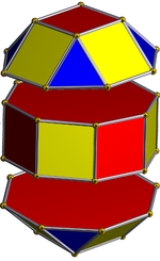
There are three pairs of parallel planes that each intersect the rhombicuboctahedron in a regular octagon. The rhombicuboctahedron may be divided along any of these to obtain an octagonal prism with regular faces and two additional polyhedra called square
cupolaeIn geometry, a cupola is a solid formed by joining two polygons, one with twice as many edges as the other, by an alternating band of triangles and rectangles...
, which count among the
Johnson solidIn geometry, a Johnson solid is a strictly convex polyhedron, each face of which is a regular polygon, but which is not uniform, i.e., not a Platonic solid, Archimedean solid, prism or antiprism. There is no requirement that each face must be the same polygon, or that the same polygons join around...
s; it is thus an elongated square orthobicupola. These pieces can be reassembled to give a new solid called the
elongated square gyrobicupolaIn geometry, the elongated square gyrobicupola or pseudorhombicuboctahedron is one of the Johnson solids . The 92 Johnson solids were named and described by Norman Johnson in 1966.- Relation to Rhombicuboctahedron :...
or pseudorhombicuboctahedron, with the symmetry of a square antiprism. In this the vertices are all locally the same as those of a rhombicuboctahedron, with one triangle and three squares meeting at each, but are not all identical with respect to the entire polyhedron, since some are closer to the symmetry axis than others.
 |
| Rhombicuboctahedron |
 |
| Pseudorhombicuboctahedron |
There are distortions of the rhombicuboctahedron that, while some of the faces are not regular polygons, are still vertex-uniform. Some of these can be made by taking a cube or octahedron and cutting off the edges, then trimming the corners, so the resulting polyhedron has six square and twelve rectangular faces. These have octahedral symmetry and form a continuous series between the cube and the octahedron, analogous to the distortions of the
rhombicosidodecahedronIn geometry, the rhombicosidodecahedron, or small rhombicosidodecahedron, is an Archimedean solid, one of thirteen convex isogonal nonprismatic solids constructed of two or more types of regular polygon faces....
or the tetrahedral distortions of the
cuboctahedronIn geometry, a cuboctahedron is a polyhedron with eight triangular faces and six square faces. A cuboctahedron has 12 identical vertices, with two triangles and two squares meeting at each, and 24 identical edges, each separating a triangle from a square. As such it is a quasiregular polyhedron,...
. However, the rhombicuboctahedron also has a second set of distortions with six rectangular and sixteen trapezoidal faces, which do not have octahedral symmetry but rather T
h symmetry, so they are invariant under the same rotations as the
tetrahedronIn geometry, a tetrahedron is a polyhedron composed of four triangular faces, three of which meet at each vertex. A regular tetrahedron is one in which the four triangles are regular, or "equilateral", and is one of the Platonic solids...
but different reflections.
The lines along which a
Rubik's CubeRubik's Cube is a 3-D mechanical puzzle invented in 1974 by Hungarian sculptor and professor of architecture Ernő Rubik.Originally called the "Magic Cube", the puzzle was licensed by Rubik to be sold by Ideal Toy Corp. in 1980 and won the German Game of the Year special award for Best Puzzle that...
can be turned are, projected onto a sphere, similar,
topologicallyTopology is a major area of mathematics concerned with properties that are preserved under continuous deformations of objects, such as deformations that involve stretching, but no tearing or gluing...
identical, to a rhombicuboctahedron's edges. In fact, variants using the Rubik's Cube mechanism have been produced which closely resemble the rhombicuboctahedron.
The rhombicuboctahedron is used in three
uniform space-filling tessellationsIn geometry, a honeycomb is a space filling or close packing of polyhedral or higher-dimensional cells, so that there are no gaps. It is an example of the more general mathematical tiling or tessellation in any number of dimensions....
: the
cantellated cubic honeycombThe cantellated cubic honeycomb is a uniform space-filling tessellation in Euclidean 3-space. It is composed of small rhombicuboctahedra, cuboctahedra, and cubes in a ratio of 1:1:3.- References :...
, the
runcitruncated cubic honeycombThe runcitruncated cubic honeycomb is a uniform space-filling tessellation in Euclidean 3-space. It is composed of small rhombicuboctahedra, truncated cubes, octagonal prisms, and cubes in a ratio of 1:1:3:3....
, and the
runcinated alternated cubic honeycombThe runcinated alternated cubic honeycomb is a uniform space-filling tessellation in Euclidean 3-space. It is composed of small rhombicuboctahedra, cubes, and tetrahedra in a ratio of 1:1:2.- References :...
.
It shares its vertex arrangement with three
nonconvex uniform polyhedraIn geometry, a uniform star polyhedron is a self-intersecting uniform polyhedron. They are also sometimes called nonconvex polyhedra to imply self-intersecting...
: the
stellated truncated hexahedron, the
small rhombihexahedronIn geometry, the small rhombihexahedron is a nonconvex uniform polyhedron, indexed as U18. It has 18 faces , 48 edges, and 24 vertices. Its vertex figure is an antiparallelogram.-Related polyhedra:...
(having the triangular faces and 6 square faces in common), and the
small cubicuboctahedronIn geometry, the small cubicuboctahedron is a uniform star polyhedron, indexed as U13. It has 20 faces , 48 edges, and 24 vertices. Its vertex figure is a crossed quadrilateral.- Related polyhedra :...
(having 12 square faces in common).
In the arts
The polyhedron in the portrait of
Luca PacioliFra Luca Bartolomeo de Pacioli was an Italian mathematician, Franciscan friar, collaborator with Leonardo da Vinci, and seminal contributor to the field now known as accounting...
is a glass rhombicuboctahedron half-filled with water.
A spherical 180x360° panorama can be projected onto any polyhedron; but the rhombicuboctahedron provides a good enough approximation of a sphere while being easy to build. This type of projection, called 'Philosphere', is possible from some panorama assembly software. It consists of two images that are printed separately and cut with scissors while leaving some flaps for assembly with glue.
Games and toys
The
Freescapethumb|The Freescape logo.The Freescape engine was an early 3D game engine used in games such as 1987's Driller.-History:Developed in-house by Incentive Software, Freescape is considered to be one of the first proprietary 3D engines to be used in computer games, although the engine was not used...
games Driller and Dark Side both had a game map in the form of a rhombicuboctahedron.
A level in the videogame
Super Mario Galaxyis a 3D platform game developed by Nintendo EAD Tokyo and published by Nintendo for the Wii. It was released in most regions in November 2007, and is the third 3D original platformer in the Mario series, after Super Mario 64 and Super Mario Sunshine. The game follows the protagonist, Mario, on a...
has a planet in the shape of a rhombicuboctahedron.
During the
Rubik's CubeRubik's Cube is a 3-D mechanical puzzle invented in 1974 by Hungarian sculptor and professor of architecture Ernő Rubik.Originally called the "Magic Cube", the puzzle was licensed by Rubik to be sold by Ideal Toy Corp. in 1980 and won the German Game of the Year special award for Best Puzzle that...
craze of the 1980s, one combinatorial puzzle sold had the form of a rhombicuboctahedron (the mechanism was of course that of a
Rubik's CubeRubik's Cube is a 3-D mechanical puzzle invented in 1974 by Hungarian sculptor and professor of architecture Ernő Rubik.Originally called the "Magic Cube", the puzzle was licensed by Rubik to be sold by Ideal Toy Corp. in 1980 and won the German Game of the Year special award for Best Puzzle that...
).
The
Rubik's SnakeA Rubik's Snake is a toy with twenty-four wedges identically shaped liked prisms, specifically right isosceles triangular prisms. The wedges are connected, by spring bolts, such that they can be twisted, but not separated...
toy was usually sold in the shape of a stretched rhombicuboctahedron (12 of the squares being replaced with 1:√2 rectangles).
External links