

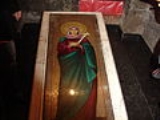
Rhipsime

Encyclopedia
Rhipsime, sometimes called Hripsime , Ripsime, Ripsima or Arsema (died c. 290) was an Armenia
n virgin and martyr
of Roman
origin. She and her companions in martyrdom are venerated as the first Christian martyrs of Armenia.
According to legend, Rhipsime was possibly of noble birth. She belonged to a community of virgins, numbering 35 and under the leadership of Gaiane, in Rome; she was known to be extremely beautiful, and attracted the notice of Diocletian
. To avoid his advances she, along with her community, fled the city, going first to Alexandria
before settling in Vagharshapat
. The varying accounts of her martyrdom diverge at this point. One story indicates that Rhipsime again was noticed for her beauty, this time by King Tiridates III
, who proceeded to pursue her. Upon being brought before him, she refused his advances and was punished by being roasted
alive. Gaiane was then put to death by Armenian soldiers, as were all members of her community except for Saint Nune
(or Marine), who was later a missionary
in Georgia
and is praised as the founders of the Georgian Orthodox Church being named as Saint Nino
.
Another version of the saint's Acts indicates that, upon discovering Rhipsime's whereabouts, Diocletian sent a letter to Tiridates insisting that he either send her back or take her for himself. The king's servants found her among her companions, here described as nun
s, and urged that she follow his wishes. She responded that she could not marry as she was betrothed to Jesus Christ, as were the others. At this, a voice from heaven was heard, saying, "Be brave and fear not, for I am with you". Upon this, Tiridates ordered that Rhipsime be tortured; her tongue was cut out, her stomach cut open, and she was blinded before being killed. Her body was then cut into pieces. Inspired by her example, Gaiane and two other nuns gave themselves over to similar treatment before being beheaded. The rest of the community was put to the sword, their bodies thrown to the beasts to be eaten. Supposedly, Tiridates and his soldiers were then punished by God for their actions; the soldiers were beset by devil
s, and began to act like wild animals, running through the forests, gnawing at themselves, and tearing their clothes. The legend states that the King was turned into a wild boar
for his actions, and had to be saved by the intervention of Gregory the Illuminator
. These accounts are likely highly fictionalized; about the only thing certain about Rhipsime's story is that she and her companions were, in fact, martyred in Armenia in about 290.
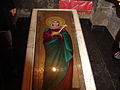 A church
dedicated to Rhipsime may still be seen in Echmiadzin; the current structure was consecrated in 618, and contains her tomb in the catacombs beneath the building. According to legend, Christ designated the spot for the shrine by descending from heaven in a shaft of light and smiting the ground with a golden hammer until the earth shook. Some of the saint's relics, along with items relating to Tiridates and Gregory the Illuminator, were pillaged by Persians
during an invasion in 1604, but were restored in 1638. In the Catholic tradition, Rhipsime and her companions are commemorated with a feast day of September 29; the Orthodox Church in America
commemorates them on September 30. The Armenian Apostolic Church
remembers Rhipsime and her companions on June 4; Gaiane and her companions are commemorated separately, on June 5.
Saint Rhipsime is known as "Arsema" to Ethiopian Orthodox Christians and currently there are three churches in her name found in Ethiopia. Among the churches, the oldest one which is found in one of the islands of Lake Tana
is known for its miracles. There are also many old paintings in the church portraying how she was killed by Tiridates III (named as Dirtados by Ethiopians) and how the cruel king was changed into a bear after killing her. There is annual pilgrimage by Ethiopian Christians to this church in January. There are also Christian songs that praise her name. The book entitled Gedle Arsema meaning "The Life of Arsema" is found almost in every spiritual bookshop throughout Ethiopia.
In honor of the saint, Hripisme remains a fairly common name in Armenia, as do its variants; likewise, Arsema is a very popular name among Ethiopian and Eritrean Christians.
Armenia
Armenia , officially the Republic of Armenia , is a landlocked mountainous country in the Caucasus region of Eurasia...
n virgin and martyr
Martyr
A martyr is somebody who suffers persecution and death for refusing to renounce, or accept, a belief or cause, usually religious.-Meaning:...
of Roman
Rome
Rome is the capital of Italy and the country's largest and most populated city and comune, with over 2.7 million residents in . The city is located in the central-western portion of the Italian Peninsula, on the Tiber River within the Lazio region of Italy.Rome's history spans two and a half...
origin. She and her companions in martyrdom are venerated as the first Christian martyrs of Armenia.
According to legend, Rhipsime was possibly of noble birth. She belonged to a community of virgins, numbering 35 and under the leadership of Gaiane, in Rome; she was known to be extremely beautiful, and attracted the notice of Diocletian
Diocletian
Diocletian |latinized]] upon his accession to Diocletian . c. 22 December 244 – 3 December 311), was a Roman Emperor from 284 to 305....
. To avoid his advances she, along with her community, fled the city, going first to Alexandria
Alexandria
Alexandria is the second-largest city of Egypt, with a population of 4.1 million, extending about along the coast of the Mediterranean Sea in the north central part of the country; it is also the largest city lying directly on the Mediterranean coast. It is Egypt's largest seaport, serving...
before settling in Vagharshapat
Echmiadzin
Mother Cathedral of Holy Etchmiadzin is a 4th century Armenian church in the town of Ejmiatsin, Armenia. It is also the central cathedral of the Mother See of Holy Etchmiadzin of the Armenian Apostolic Church....
. The varying accounts of her martyrdom diverge at this point. One story indicates that Rhipsime again was noticed for her beauty, this time by King Tiridates III
Tiridates III of Armenia
Tiridates III or Diritades III was the king of Arsacid Armenia , and is also known as Tiridates the Great ; some scholars incorrectly refer to him as Tiridates IV as a result of the fact that Tiridates I of Armenia reigned twice)...
, who proceeded to pursue her. Upon being brought before him, she refused his advances and was punished by being roasted
Roasting
Roasting is a cooking method that uses dry heat, whether an open flame, oven, or other heat source. Roasting usually causes caramelization or Maillard browning of the surface of the food, which is considered by some as a flavor enhancement. Roasting uses more indirect, diffused heat , and is...
alive. Gaiane was then put to death by Armenian soldiers, as were all members of her community except for Saint Nune
Saint Nino
Saint Nino , ), Equal to the Apostles in and the Enlightener of Georgia, was a woman who preached Christianity in Georgia....
(or Marine), who was later a missionary
Missionary
A missionary is a member of a religious group sent into an area to do evangelism or ministries of service, such as education, literacy, social justice, health care and economic development. The word "mission" originates from 1598 when the Jesuits sent members abroad, derived from the Latin...
in Georgia
Georgia (country)
Georgia is a sovereign state in the Caucasus region of Eurasia. Located at the crossroads of Western Asia and Eastern Europe, it is bounded to the west by the Black Sea, to the north by Russia, to the southwest by Turkey, to the south by Armenia, and to the southeast by Azerbaijan. The capital of...
and is praised as the founders of the Georgian Orthodox Church being named as Saint Nino
Saint Nino
Saint Nino , ), Equal to the Apostles in and the Enlightener of Georgia, was a woman who preached Christianity in Georgia....
.
Another version of the saint's Acts indicates that, upon discovering Rhipsime's whereabouts, Diocletian sent a letter to Tiridates insisting that he either send her back or take her for himself. The king's servants found her among her companions, here described as nun
Nun
A nun is a woman who has taken vows committing her to live a spiritual life. She may be an ascetic who voluntarily chooses to leave mainstream society and live her life in prayer and contemplation in a monastery or convent...
s, and urged that she follow his wishes. She responded that she could not marry as she was betrothed to Jesus Christ, as were the others. At this, a voice from heaven was heard, saying, "Be brave and fear not, for I am with you". Upon this, Tiridates ordered that Rhipsime be tortured; her tongue was cut out, her stomach cut open, and she was blinded before being killed. Her body was then cut into pieces. Inspired by her example, Gaiane and two other nuns gave themselves over to similar treatment before being beheaded. The rest of the community was put to the sword, their bodies thrown to the beasts to be eaten. Supposedly, Tiridates and his soldiers were then punished by God for their actions; the soldiers were beset by devil
Devil
The Devil is believed in many religions and cultures to be a powerful, supernatural entity that is the personification of evil and the enemy of God and humankind. The nature of the role varies greatly...
s, and began to act like wild animals, running through the forests, gnawing at themselves, and tearing their clothes. The legend states that the King was turned into a wild boar
Boar
Wild boar, also wild pig, is a species of the pig genus Sus, part of the biological family Suidae. The species includes many subspecies. It is the wild ancestor of the domestic pig, an animal with which it freely hybridises...
for his actions, and had to be saved by the intervention of Gregory the Illuminator
Gregory the Illuminator
Saint Gregory the Illuminator or Saint Gregory the Enlightener is the patron saint and first official head of the Armenian Apostolic Church...
. These accounts are likely highly fictionalized; about the only thing certain about Rhipsime's story is that she and her companions were, in fact, martyred in Armenia in about 290.
St. Hripsime Church, Echmiadzin
Saint Hripsimé Church is one of the oldest surviving churches in Armenia. The church was erected by Catholicos Komitas atop the original mausoleum built by Catholicos Sahak the Great in the year 395 AD that contained the remains of the martyred Saint Hripsimé to whom the church was dedicated. The...
dedicated to Rhipsime may still be seen in Echmiadzin; the current structure was consecrated in 618, and contains her tomb in the catacombs beneath the building. According to legend, Christ designated the spot for the shrine by descending from heaven in a shaft of light and smiting the ground with a golden hammer until the earth shook. Some of the saint's relics, along with items relating to Tiridates and Gregory the Illuminator, were pillaged by Persians
Persian people
The Persian people are part of the Iranian peoples who speak the modern Persian language and closely akin Iranian dialects and languages. The origin of the ethnic Iranian/Persian peoples are traced to the Ancient Iranian peoples, who were part of the ancient Indo-Iranians and themselves part of...
during an invasion in 1604, but were restored in 1638. In the Catholic tradition, Rhipsime and her companions are commemorated with a feast day of September 29; the Orthodox Church in America
Orthodox Church in America
The Orthodox Church in America is an autocephalous Eastern Orthodox church in North America. Its primate is Metropolitan Jonah , who was elected on November 12, 2008, and was formally installed on December 28, 2008...
commemorates them on September 30. The Armenian Apostolic Church
Armenian Apostolic Church
The Armenian Apostolic Church is the world's oldest National Church, is part of Oriental Orthodoxy, and is one of the most ancient Christian communities. Armenia was the first country to adopt Christianity as its official religion in 301 AD, in establishing this church...
remembers Rhipsime and her companions on June 4; Gaiane and her companions are commemorated separately, on June 5.
Saint Rhipsime is known as "Arsema" to Ethiopian Orthodox Christians and currently there are three churches in her name found in Ethiopia. Among the churches, the oldest one which is found in one of the islands of Lake Tana
Lake Tana
Lake Tana is the source of the Blue Nile and is the largest lake in Ethiopia...
is known for its miracles. There are also many old paintings in the church portraying how she was killed by Tiridates III (named as Dirtados by Ethiopians) and how the cruel king was changed into a bear after killing her. There is annual pilgrimage by Ethiopian Christians to this church in January. There are also Christian songs that praise her name. The book entitled Gedle Arsema meaning "The Life of Arsema" is found almost in every spiritual bookshop throughout Ethiopia.
In honor of the saint, Hripisme remains a fairly common name in Armenia, as do its variants; likewise, Arsema is a very popular name among Ethiopian and Eritrean Christians.