


Renewable heat

Encyclopedia
Renewable heat is an application of renewable energy
and it refers to the renewable generation of heat, rather than electrical power (e.g. replacing a fossil fuel boiler using concentrating solar thermal to feed radiators).
Many colder countries consume more energy for heating than electrical power. For example, in 2005 the United Kingdom consumed 354 TWh of electric power, but had a heat requirement of 907 TWh, the majority of which (81%) was met using gas. The residential sector alone consumed a massive 550 TWh of energy for heating, mainly in the form of gas. Almost half of the final energy consumed in the UK (49%) was in the form of heat, of which 70% was used by households and in commercial and public buildings. Households used heat for mainly for space heating (69%) and heating water.
Renewable electric power is becoming cheap and convenient enough to place it, in many cases, within reach of the average consumer. By contrast, the market for renewable heat is mostly inaccessible to domestic consumers due to inconvenience of supply, and high capital costs. Heating accounts for a large proportion of energy consumption, however a universally accessible market is still in its early stages.
and water heating
(see solar hot water
). Solar heating design is divided into two groups:
Solar heating systems usually require a small supplementary backup heating system, either conventional or renewable.
 Heat from the Earth, or geothermal - Geo (Earth) + thermal (heat) - energy can be and already is accessed by drilling water or steam wells in a process similar to drilling for oil. Geothermal energy is an enormous, underused heat and power resource that is clean (emits little or no greenhouse gases), reliable (average system availability of 95%), and homegrown (making populations less dependent on oil).
The earth absorbs the sun’s energy and stores it as heat underground. The temperature remains constant at a point of 42 °F to 100 °F all year round depending on where you live on earth. A geothermal heating system takes advantage of the consistent temperature found below the Earth's surface and uses it to heat and cool buildings. The system is made up of a series of pipes installed underground, connected to pipes in a building. A pump circulates liquid through the circuit. In the winter the fluid in the pipe absorbs the heat of the earth and uses it to heat the building. In the summer the fluid absorbs heat from the building and disposes of it in the earth.
s use work to move heat from one place to another, and can be used for both heating and air conditioning. Though capital intensive, heat pumps are economical to run and can be powered by renewable electricity. Two common types of heat pump are air-source heat pumps (ASHP) and ground-source heat pumps (GSHP), depending on whether heat is transferred from the air or from the ground. Air source heat pumps are not effective when the outside air temperature is lower than about -15 °C, while ground-source heat pumps are not affected. The efficiency of a heat pump is measured by the coefficient of performance (CoP): For every unit of electricity used to pump the heat, an air source heat pump generates 2.5 to 3 units of heat (i.e. it has a CoP of 2.5 to 3), whereas a GSHP generates 3 to 3.5 units of heat. Based on current fuel prices for the United Kingdom, assuming a CoP of 3-4, a GSHP is sometimes a cheaper form of space heating than electric, oil, and solid fuel heating. Heat pumps can be linked to interseasonal thermal stores, doubling the CoP from 4 to 8 by extracting heat from warmer ground.
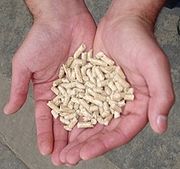 Wood-pellet heating and other types of wood heating systems have achieved their greatest success in heating premises that are off the gas grid, typically being previously heated using heating oil or coal. Solid wood fuel requires a large amount of dedicated storage space, and the specialized heating systems can be expensive (though grant schemes are available in many European countries to offset this capital cost.) Low fuel costs mean that wood fuelled heating in Europe is frequently able to achieve a payback period of less than 3 to 5 years. Because of the large fuel storage requirement wood fuel can be less attractive in urban residential scenarios, or for premises connected to the gas grid (though rising gas prices and uncertainty of supply mean that wood fuel is becoming more competitive.) There is also growing concern over the air pollution from wood heating versus oil or gas heat, especially the fine particulates.
in an open fire is both extremely inefficient (0-20%) and polluting due to low temperature partial combustion. In the same way that a drafty building loses heat through loss of warm air through poor sealing, an open fire is responsible for large heat losses by drawing very large volumes of warm air out of the building.
Modern wood stove
designs allow for more efficient combustion and then heat extraction. In the United States, new wood stoves are certified by the U.S. Environmental Protection Agency (EPA) and burn cleaner and more efficiently (the overall efficiency is 60-80%) and draw only small volumes of warm air from the building.
"Cleaner" should not, however, be confused with clean. An Australian study of real-life emissions from woodheaters satifying the current Australian standard , found that particle emissions averaged 9.4 g/kg wood burned (range 2.6 to 21.7). A heater with average wood consumption of 4 tonnes per year therefore emits 37.6 kg of PM2.5, i.e. particles less than 2.5 microns (millionths of a metre). This can be compared with a passenger car satisfying the current Euro 5 standards (introduced September 2009) of 0.005 g/km. So one new woodheater emits as many PM2.5 per year as 367 passenger cars each driving 20,000 km a year. A recent European study identified PM2.5 as the most health-hazardous air pollutant, causing an estimated 492,000 premature deaths. The next worst pollutant, ozone, is responsible for 21,000 premature deaths.
Because of the problems with pollution, the Australian Lung Foundation recommends using alternative means for climate control . The American Lung Association "strongly recommends using cleaner, less toxic sources of heat. Converting a wood-burning fireplace or stove to use either natural gas or propane will eliminate exposure to the dangerous toxins wood burning generates including dioxin, arsenic and formaldehyde
"Renewable" should not be confused with "greenhouse neutral". A recent peer-reviewed paper found that, even if burning firewood from a sustainable supply, methane emissions from a typical Australian wood heater satisfying the current standard cause more global warming than heating the same house with gas. However, because a large proportion of firewood sold in the Australia is not from suststainable supplies, Australian households that use wood heating often cause more global warming that heating 3 similar homes with gas.
High efficiency stoves should meet the following design criteria:
is defined as gas obtained from biomass
which is upgraded to a quality similar to natural gas
. By upgrading the quality to that of natural gas, it becomes possible to distribute the gas to customers via the existing gas grid. According to the Energy research Centre of the Netherlands, renewable natural gas is 'cheaper than alternatives where biomass is used in a combined heat and power plant or local combustion plant'. Energy unit costs are lowered through 'favourable scale and operating hours', and end-user capital costs eliminated through distribution via the existing gas grid.
Two main types of improvement can be made to a building's energy efficiency:
. Older buildings can benefit from several kinds of improvement:
may sometimes be more energy efficient than traditional methods of heating:
 It is possible to recover significant amounts of heat from waste hot water via hot water heat recycling
. On average 90% of a property's domestic hot water is used for showering. Incoming fresh water is typically of a far lower temperature than the waste water from a shower. An inexpensive heat exchanger recovers up on average 40% of the heat that would normally be wasted, by warming incoming cold fresh water with heat from outgoing waste water.
Renewable energy
Renewable energy is energy which comes from natural resources such as sunlight, wind, rain, tides, and geothermal heat, which are renewable . About 16% of global final energy consumption comes from renewables, with 10% coming from traditional biomass, which is mainly used for heating, and 3.4% from...
and it refers to the renewable generation of heat, rather than electrical power (e.g. replacing a fossil fuel boiler using concentrating solar thermal to feed radiators).
Many colder countries consume more energy for heating than electrical power. For example, in 2005 the United Kingdom consumed 354 TWh of electric power, but had a heat requirement of 907 TWh, the majority of which (81%) was met using gas. The residential sector alone consumed a massive 550 TWh of energy for heating, mainly in the form of gas. Almost half of the final energy consumed in the UK (49%) was in the form of heat, of which 70% was used by households and in commercial and public buildings. Households used heat for mainly for space heating (69%) and heating water.
Renewable electric power is becoming cheap and convenient enough to place it, in many cases, within reach of the average consumer. By contrast, the market for renewable heat is mostly inaccessible to domestic consumers due to inconvenience of supply, and high capital costs. Heating accounts for a large proportion of energy consumption, however a universally accessible market is still in its early stages.
Solar heating
Solar heating is a style of building construction which uses the energy of summer or winter sunshine to provide an economic supply of primary or supplementary heat to a structure. The heat can be used for both space heatingSpace heating
A space heater is a self-contained device for heating an enclosed area. Space heating is generally employed to warm a small space, and is usually held in contrast with central heating, which warms many connected spaces at once...
and water heating
Water heating
Water heating is a thermodynamic process using an energy source to heat water above its initial temperature. Typical domestic uses of hot water are for cooking, cleaning, bathing, and space heating...
(see solar hot water
Solar hot water
Solar water heating or solar hot water systems comprise several innovations and many mature renewable energy technologies that have been well established for many years...
). Solar heating design is divided into two groups:
- Passive solar heating relies on the design and structure of the house to collect heat. Passive solar building designPassive solar building designIn passive solar building design, windows, walls, and floors are made to collect, store, and distribute solar energy in the form of heat in the winter and reject solar heat in the summer...
must also consider the storage and distribution of heat, which may be accomplished passively, or use air ducting to draw heat actively to the foundation of the building for storage. One such design was measured lifting the temperature of a house to 24 °C (74 °F) on a partially sunny winter day (-7 °C or 19 °F), and it is claimed that the system provides passively for the bulk of the building's heating. The 4000 square feet (371.6 m²) home cost $125 per square foot (or 370 m2 at $1,351/m2), similar to the cost of a traditional new home. - Active solarActive solarActive solar technologies are employed to convert solar energy into another more useful form of energy. This would normally be a conversion to heat or electrical energy. Inside a building this energy would be used for heating, cooling, or off-setting other energy use or costs. Active solar uses...
heating uses pumpPumpA pump is a device used to move fluids, such as liquids, gases or slurries.A pump displaces a volume by physical or mechanical action. Pumps fall into three major groups: direct lift, displacement, and gravity pumps...
s to move air or a liquid from the solar collectorSolar collector-See also:*Solar thermal collector*Solar water heating*Solar air heating*Photovoltaic module*Renewable heat*Concentrating solar power...
into the building or storage area. Applications such as solar air heatingSolar air heatSolar air heating is a solar thermal technology in which the energy from the sun, solar insolation, is captured by an absorbing medium and used to heat air. Solar air heating is a renewable energy heating technology used to heat or condition air for buildings or process heat applications...
and solar water heatingSolar water heatingSolar water heating or solar hot water systems comprise several innovations and many mature renewable energy technologies that have been well established for many years...
typically capture solar heat in panels which can then be used for applications such as space heating and supplementation of residential water heaters. In contrast to photovoltaic panels, which are used to generate electricity, solar heating panels are less expensive and capture a much higher proportion of the sun's energy.
Solar heating systems usually require a small supplementary backup heating system, either conventional or renewable.
Geothermal heating
The earth absorbs the sun’s energy and stores it as heat underground. The temperature remains constant at a point of 42 °F to 100 °F all year round depending on where you live on earth. A geothermal heating system takes advantage of the consistent temperature found below the Earth's surface and uses it to heat and cool buildings. The system is made up of a series of pipes installed underground, connected to pipes in a building. A pump circulates liquid through the circuit. In the winter the fluid in the pipe absorbs the heat of the earth and uses it to heat the building. In the summer the fluid absorbs heat from the building and disposes of it in the earth.
Heat Pump
Heat pumpHeat pump
A heat pump is a machine or device that effectively "moves" thermal energy from one location called the "source," which is at a lower temperature, to another location called the "sink" or "heat sink", which is at a higher temperature. An air conditioner is a particular type of heat pump, but the...
s use work to move heat from one place to another, and can be used for both heating and air conditioning. Though capital intensive, heat pumps are economical to run and can be powered by renewable electricity. Two common types of heat pump are air-source heat pumps (ASHP) and ground-source heat pumps (GSHP), depending on whether heat is transferred from the air or from the ground. Air source heat pumps are not effective when the outside air temperature is lower than about -15 °C, while ground-source heat pumps are not affected. The efficiency of a heat pump is measured by the coefficient of performance (CoP): For every unit of electricity used to pump the heat, an air source heat pump generates 2.5 to 3 units of heat (i.e. it has a CoP of 2.5 to 3), whereas a GSHP generates 3 to 3.5 units of heat. Based on current fuel prices for the United Kingdom, assuming a CoP of 3-4, a GSHP is sometimes a cheaper form of space heating than electric, oil, and solid fuel heating. Heat pumps can be linked to interseasonal thermal stores, doubling the CoP from 4 to 8 by extracting heat from warmer ground.
Interseasonal heat transfer
Interseasonal Heat Transfer combines active solar collection to store surplus summer heat in thermal banks with GSHPs to extract it for space heating in winter. This reduces the "Lift" needed and doubles the CoP of the heat pump because the pump starts with warmth from the thermal bank in place of cold from the ground.CoP and lift
The CoP increases as the temperature difference, or "Lift", decreases between heat source and destination. The CoP can be maximized at design time by choosing a heating system requiring only a low final water temperature (e.g., underfloor heating), and by choosing a heat source with a high average temperature (e.g., the ground). Domestic hot water (DHW) and conventional radiators require high water temperatures, affecting the choice of heat pump technology. Low temperature radiators provide an alternative to conventional radiators.| Pump type and source | Typical use case | CoP variation with Output Temperature | |||||
|---|---|---|---|---|---|---|---|
| 35 °C (e.g. heated screed floor) |
45 °C (e.g. low temp. radiator or heated screed floor) |
55 °C (e.g. low temp. radiator or heated timber floor) |
65 °C (e.g. std. radiator or DHW) |
75 °C (e.g. std. radiator & DHW) |
85 °C (e.g. std. radiator & DHW) |
||
| High Efficiency ASHP air at -20 °C | 2.2 | 2.0 | - | - | - | - | |
| Two Stage ASHP air at -20 °C | Low source temp. | 2.4 | 2.2 | 1.9 | - | - | - |
| High Efficiency ASHP air at 0 °C | Low output temp. | 3.8 | 2.8 | 2.2 | 2.0 | - | - |
| Prototype Transcritical (R744) Heat Pump with Tripartite Gas Cooler, source at 0 °C | High output temp. | 3.3 | - | - | 4.2 | - | 3.0 |
| GSHP water at 0 °C | 5.0 | 3.7 | 2.9 | 2.4 | - | - | |
| GSHP ground at 10 °C | Low output temp. | 7.2 | 5.0 | 3.7 | 2.9 | 2.4 | - |
| Theoretical Carnot cycle limit, source -20 °C | 5.6 | 4.9 | 4.4 | 4.0 | 3.7 | 3.4 | |
| Theoretical Carnot cycle limit, source 0 °C | 8.8 | 7.1 | 6.0 | 5.2 | 4.6 | 4.2 | |
| Theoretical Lorentz Cycle limit ( pump), return fluid 25 °C, source 0 °C | 10.1 | 8.8 | 7.9 | 7.1 | 6.5 | 6.1 | |
| Theoretical Carnot cycle limit, source 10 °C | 12.3 | 9.1 | 7.3 | 6.1 | 5.4 | 4.8 | |
Wood-pellet heating
Wood-stove heating
Burning wood fuelWood fuel
Wood fuel is wood used as fuel. The burning of wood is currently the largest use of energy derived from a solid fuel biomass. Wood fuel can be used for cooking and heating, and occasionally for fueling steam engines and steam turbines that generate electricity. Wood fuel may be available as...
in an open fire is both extremely inefficient (0-20%) and polluting due to low temperature partial combustion. In the same way that a drafty building loses heat through loss of warm air through poor sealing, an open fire is responsible for large heat losses by drawing very large volumes of warm air out of the building.
Modern wood stove
Stove
A stove is an enclosed heated space. The term is commonly taken to mean an enclosed space in which fuel is burned to provide heating, either to heat the space in which the stove is situated or to heat the stove itself, and items placed on it...
designs allow for more efficient combustion and then heat extraction. In the United States, new wood stoves are certified by the U.S. Environmental Protection Agency (EPA) and burn cleaner and more efficiently (the overall efficiency is 60-80%) and draw only small volumes of warm air from the building.
"Cleaner" should not, however, be confused with clean. An Australian study of real-life emissions from woodheaters satifying the current Australian standard , found that particle emissions averaged 9.4 g/kg wood burned (range 2.6 to 21.7). A heater with average wood consumption of 4 tonnes per year therefore emits 37.6 kg of PM2.5, i.e. particles less than 2.5 microns (millionths of a metre). This can be compared with a passenger car satisfying the current Euro 5 standards (introduced September 2009) of 0.005 g/km. So one new woodheater emits as many PM2.5 per year as 367 passenger cars each driving 20,000 km a year. A recent European study identified PM2.5 as the most health-hazardous air pollutant, causing an estimated 492,000 premature deaths. The next worst pollutant, ozone, is responsible for 21,000 premature deaths.
Because of the problems with pollution, the Australian Lung Foundation recommends using alternative means for climate control . The American Lung Association "strongly recommends using cleaner, less toxic sources of heat. Converting a wood-burning fireplace or stove to use either natural gas or propane will eliminate exposure to the dangerous toxins wood burning generates including dioxin, arsenic and formaldehyde
"Renewable" should not be confused with "greenhouse neutral". A recent peer-reviewed paper found that, even if burning firewood from a sustainable supply, methane emissions from a typical Australian wood heater satisfying the current standard cause more global warming than heating the same house with gas. However, because a large proportion of firewood sold in the Australia is not from suststainable supplies, Australian households that use wood heating often cause more global warming that heating 3 similar homes with gas.
High efficiency stoves should meet the following design criteria:
- Well sealed and precisely calibrated to draw a low yet sufficient volume of air. Air-flow restriction is critical; a lower inflow of cold air cools the furnace less (a higher temperature is thus achieved). It also allows greater time for extraction of heat from the exhaust gas, and draws less heat from the building.
- The furnace must be well insulated to increase combustion temperature, and thus completeness.
- A well insulated furnace radiates little heat. Thus heat must be extracted instead from the exhaust gas duct. Heat absorption efficiencies are higher when the heat-exchange duct is longer, and when the flow of exhaust gas is slower.
- In many designs, the heat-exchange duct is built of a very large mass of heat-absorbing brick or stone. This design causes the absorbed heat to be emitted over a longer period - typically a day.
Renewable natural gas
Renewable natural gasRenewable natural gas
Renewable natural gas, also known as sustainable natural gas, is a biogas which has been upgraded to a quality similar to fossil natural gas. A biogas is a gas methane obtained from biomass. By upgrading the quality to that of natural gas, it becomes possible to distribute the gas to customers via...
is defined as gas obtained from biomass
Biomass
Biomass, as a renewable energy source, is biological material from living, or recently living organisms. As an energy source, biomass can either be used directly, or converted into other energy products such as biofuel....
which is upgraded to a quality similar to natural gas
Natural gas
Natural gas is a naturally occurring gas mixture consisting primarily of methane, typically with 0–20% higher hydrocarbons . It is found associated with other hydrocarbon fuel, in coal beds, as methane clathrates, and is an important fuel source and a major feedstock for fertilizers.Most natural...
. By upgrading the quality to that of natural gas, it becomes possible to distribute the gas to customers via the existing gas grid. According to the Energy research Centre of the Netherlands, renewable natural gas is 'cheaper than alternatives where biomass is used in a combined heat and power plant or local combustion plant'. Energy unit costs are lowered through 'favourable scale and operating hours', and end-user capital costs eliminated through distribution via the existing gas grid.
Energy efficiency
Renewable heat goes hand in hand with energy efficiency. Indeed renewable heating projects depend heavily for their success on energy efficiency; in the case of solar heating to cut reliance on the requirement supplementary heating, in the case of wood fuel heating to cut the cost of wood purchased and volume stored, and in the case of heat pumps to reduce the size and investment in heat pump, heat sink and electricity costs.Two main types of improvement can be made to a building's energy efficiency:
Insulation
Improvements to insulation can cut energy consumption greatly, making a space cheaper to heat and to cool. However existing housing can often be difficult or expensive to improve. Newer buildings can benefit from many of the techniques of superinsulationSuperinsulation
Superinsulation is an approach to building design, construction, and retrofitting that dramatically reduces heat loss by using much higher levels of insulation and airtightness than normal...
. Older buildings can benefit from several kinds of improvement:
- Solid wall insulation: A building with solid walls can benefit from internal or external insulation. External wall insulation involves adding decorative weather-proof insulating panels or other treatment to the outside of the wall. Alternatively, internal wall insulation can be applied using ready-made insulation/plaster board laminates, or other methods. Thicknesses of internal or external insulation typically range between 50 and 100 mm.
- Cavity wall insulation: A building with cavity walls can benefit from insulation pumped into the cavity. This form of insulation is very cost effective.
- Programmable thermostatProgrammable thermostatA programmable thermostat is a thermostat which is designed to adjust the temperature according to a series of programmed settings that take effect at different times of the day...
s allow heating and cooling of a room to be switched off depending the time, day of the week, and temperature. A bedroom, for example, does not need to be heated during the day, but a living room does not need to be heated during the night. - Roof insulation
- Insulated windows and doors
- Draught proofing
Underfloor heating
Underfloor heatingUnderfloor heating
Underfloor heating and cooling is a form of central heating and cooling which achieves indoor climate control for thermal comfort using conduction, radiation and convection...
may sometimes be more energy efficient than traditional methods of heating:
- Water circulates within the system at low temperatures (35 °C - 50 °C) making gas boilers, wood fired boilers, and heat pumps significantly more efficient.
- Rooms with underfloor heating are cooler near the ceiling, where heat is not required, but warmer underfoot, where comfort is most required.
- Traditional radiators are frequently positioned underneath poorly insulated windows, heating them unnecessarily.
Waste-water heat recovery
Hot water heat recycling
Water heat recycling is the use of a heat exchanger to recover energy and reuse heat from drain water from various activities such as dish-washing, clothes washing and especially showers...
. On average 90% of a property's domestic hot water is used for showering. Incoming fresh water is typically of a far lower temperature than the waste water from a shower. An inexpensive heat exchanger recovers up on average 40% of the heat that would normally be wasted, by warming incoming cold fresh water with heat from outgoing waste water.
See also
- Air source heat pumpsAir source heat pumpsAn air source heat pump is a heating and cooling system that uses outside air as its heat source and heat sink. Under the principles of vapor compression refrigeration, an ASHP uses a refrigerant system involving a compressor and a condenser to absorb heat at one place and release it at another.In...
- Autonomous buildingAutonomous buildingAn autonomous building is a building designed to be operated independently from infrastructural support services such as the electric power grid, gas grid, municipal water systems, sewage treatment systems, storm drains, communication services, and in some cases, public roads.Advocates of...
- Architectural engineeringArchitectural engineeringArchitectural engineering, also known as building engineering, is the application of engineering principles and technology to building design and construction...
- BiogasBiogasBiogas typically refers to a gas produced by the biological breakdown of organic matter in the absence of oxygen. Organic waste such as dead plant and animal material, animal dung, and kitchen waste can be converted into a gaseous fuel called biogas...
- Energy conservationEnergy conservationEnergy conservation refers to efforts made to reduce energy consumption. Energy conservation can be achieved through increased efficient energy use, in conjunction with decreased energy consumption and/or reduced consumption from conventional energy sources...
- Ground source heat pump
- Green architecture
- Green buildingGreen buildingGreen building refers to a structure and using process that is environmentally responsible and resource-efficient throughout a building's life-cycle: from siting to design, construction, operation, maintenance, renovation, and demolition...
- Hot water heat recyclingHot water heat recyclingWater heat recycling is the use of a heat exchanger to recover energy and reuse heat from drain water from various activities such as dish-washing, clothes washing and especially showers...
- SuperinsulationSuperinsulationSuperinsulation is an approach to building design, construction, and retrofitting that dramatically reduces heat loss by using much higher levels of insulation and airtightness than normal...
- SustainabilitySustainabilitySustainability is the capacity to endure. For humans, sustainability is the long-term maintenance of well being, which has environmental, economic, and social dimensions, and encompasses the concept of union, an interdependent relationship and mutual responsible position with all living and non...
- Sustainable designSustainable designSustainable design is the philosophy of designing physical objects, the built environment, and services to comply with the principles of economic, social, and ecological sustainability.-Intentions:The intention of sustainable design is to "eliminate negative environmental...
- Mitigation of global warmingMitigation of global warmingClimate change mitigation is action to decrease the intensity of radiative forcing in order to reduce the potential effects of global warming. Mitigation is distinguished from adaptation to global warming, which involves acting to tolerate the effects of global warming...
- Natural buildingNatural buildingA natural building involves a range of building systems and materials that place major emphasis on sustainability. Ways of achieving sustainability through natural building focus on durability and the use of minimally processed, plentiful or renewable resources, as well as those that, while...
- Passive housePassive houseThe term passive house refers to the rigorous, voluntary, Passivhaus standard for energy efficiency in a building, reducing its ecological footprint. It results in ultra-low energy buildings that require little energy for space heating or cooling. A similar standard, MINERGIE-P, is used in...
- Passive solar
- Renewable energyRenewable energyRenewable energy is energy which comes from natural resources such as sunlight, wind, rain, tides, and geothermal heat, which are renewable . About 16% of global final energy consumption comes from renewables, with 10% coming from traditional biomass, which is mainly used for heating, and 3.4% from...
- Renewable energy development
- Seasonal thermal storeSeasonal thermal storeA seasonal thermal store is a store designed to retain heat deposited during the hot summer months for use during colder winter weather...
- Solar Air HeatSolar air heatSolar air heating is a solar thermal technology in which the energy from the sun, solar insolation, is captured by an absorbing medium and used to heat air. Solar air heating is a renewable energy heating technology used to heat or condition air for buildings or process heat applications...
- Solar combisystemSolar combisystemA solar combisystem provides both solar space heating and cooling as well as hot water from a common array of solar thermal collectors, usually backed up an auxiliary non-solar heat source....
- Solar hot waterSolar hot waterSolar water heating or solar hot water systems comprise several innovations and many mature renewable energy technologies that have been well established for many years...
- Solar powerSolar powerSolar energy, radiant light and heat from the sun, has been harnessed by humans since ancient times using a range of ever-evolving technologies. Solar radiation, along with secondary solar-powered resources such as wind and wave power, hydroelectricity and biomass, account for most of the available...
- Thermal insulationThermal insulationThermal insulation is the reduction of the effects of the various processes of heat transfer between objects in thermal contact or in range of radiative influence. Heat transfer is the transfer of thermal energy between objects of differing temperature...
- Underfloor heatingUnderfloor heatingUnderfloor heating and cooling is a form of central heating and cooling which achieves indoor climate control for thermal comfort using conduction, radiation and convection...
- Wood briquetteWood briquetteWood briquettes are made of dry, untreated wood chips . They are pressed with high pressure without any binder. By compacting the wood with this high pressure, it turns into a fuel like brown coal.-Advantages:...
s - Zero energy buildingZero energy buildingA zero-energy building, also known as a zero net energy building, Net-Zero Energy Building , or Net Zero Building, is a popular term to describe a building with zero net energy consumption and zero carbon emissions annually. Zero energy buildings can be independent from the energy grid supply...
External links
- Heat pumps based on R744 (CO2) FAQ
- Heat pumps Long Awaited Way out of the Global Warming - Information from Heat Pump & Thermal Storage Technology Center of Japan
- Department of Trade and Industry, 2005 study on Renewable Heat
- Renewable Heat combining asphalt solar collectors, thermal banks and ground source heat pumps.
- Energy Saving TrustEnergy Saving TrustEnergy Saving Trust is a non-profit organisation jointly funded by the British Government and the private sector in order to help fight climate change by promoting the sustainable use of energy, energy conservation and to cut carbon dioxide emissions in the United Kingdom.-Background:The Energy...
information on Home Insulation - Useful wood fuel information
- The Gill report on biomass in the UK - download
- Information and videos about non-conventional and renewable heating solutions
- Solid wall insulation
- Cavity wall insulation