


Religiosity

Encyclopedia
Belief
Belief is the psychological state in which an individual holds a proposition or premise to be true.-Belief, knowledge and epistemology:The terms belief and knowledge are used differently in philosophy....
(religious doctrine). Another term that would work equally well, though is less often used, is religiousness. In its narrowest sense, religiosity deals more with how religious a person is, and less with how a person is religious (in practicing certain ritual
Ritual
A ritual is a set of actions, performed mainly for their symbolic value. It may be prescribed by a religion or by the traditions of a community. The term usually excludes actions which are arbitrarily chosen by the performers....
s, retelling certain myths, revering certain symbols, or accepting certain doctrine
Doctrine
Doctrine is a codification of beliefs or a body of teachings or instructions, taught principles or positions, as the body of teachings in a branch of knowledge or belief system...
s about deities and afterlife
Afterlife
The afterlife is the belief that a part of, or essence of, or soul of an individual, which carries with it and confers personal identity, survives the death of the body of this world and this lifetime, by natural or supernatural means, in contrast to the belief in eternal...
).
Components
Numerous studies have explored the different components of human religiosity (Brink, 1993; Hill & Hood 1999). What most have found is that there are multiple dimensions (they often employ factor analysisFactor analysis
Factor analysis is a statistical method used to describe variability among observed, correlated variables in terms of a potentially lower number of unobserved, uncorrelated variables called factors. In other words, it is possible, for example, that variations in three or four observed variables...
). For instance, Cornwall, Albrecht, Cunningham and Pitcher (1986) identify six dimensions of religiosity based on the understanding that there are at least three components to religious behavior: knowing (cognition in the mind), feeling (affect to the spirit), and doing (behavior of the body). For each of these components of religiosity there were two cross classifications resulting in the six dimensions:
- Cognition
- traditional orthodoxyOrthodoxyThe word orthodox, from Greek orthos + doxa , is generally used to mean the adherence to accepted norms, more specifically to creeds, especially in religion...
- particularistic orthodoxy
- traditional orthodoxy
- Affect
- Palpable
- Tangible
- Behavior
- religious behavior
- religious participation
Other researchers have found different dimensions, ranging generally from four to twelve components. What most measures of religiosity find is that there is at least some distinction between religious doctrine, religious practice, and spirituality
Spirituality
Spirituality can refer to an ultimate or an alleged immaterial reality; an inner path enabling a person to discover the essence of his/her being; or the “deepest values and meanings by which people live.” Spiritual practices, including meditation, prayer and contemplation, are intended to develop...
.
For example, one can accept the truthfulness of the Bible
Bible
The Bible refers to any one of the collections of the primary religious texts of Judaism and Christianity. There is no common version of the Bible, as the individual books , their contents and their order vary among denominations...
(belief dimension), but never attend a church or even belong to an organized religion (practice dimension). Another example is an individual who does not hold orthodox Christian
Christian
A Christian is a person who adheres to Christianity, an Abrahamic, monotheistic religion based on the life and teachings of Jesus of Nazareth as recorded in the Canonical gospels and the letters of the New Testament...
doctrines (belief dimension), but does attend a charismatic
Charismatic movement
The term charismatic movement is used in varying senses to describe 20th century developments in various Christian denominations. It describes an ongoing international, cross-denominational/non-denominational Christian movement in which individual, historically mainstream congregations adopt...
worship
Worship
Worship is an act of religious devotion usually directed towards a deity. The word is derived from the Old English worthscipe, meaning worthiness or worth-ship — to give, at its simplest, worth to something, for example, Christian worship.Evelyn Underhill defines worship thus: "The absolute...
service (practice dimension) in order to develop his/her sense of oneness with the divine
Divinity
Divinity and divine are broadly applied but loosely defined terms, used variously within different faiths and belief systems — and even by different individuals within a given faith — to refer to some transcendent or transcendental power or deity, or its attributes or manifestations in...
(spirituality dimension).
An individual could disavow all doctrines associated with organized religions (belief dimension), not affiliate with an organized religion or attend religious services (practice dimension), and at the same time be strongly committed to a higher power and feel that the connection with that higher power is ultimately relevant (spirituality dimension). These are explanatory examples of the broadest dimensions of religiosity and that they may not be reflected in specific religiosity measures.
Most dimensions of religiosity are correlated, meaning people who often attend church services (practice dimension) are also likely to score highly on the belief and spirituality dimensions. But individuals do not have to score high on all dimensions or low on all dimensions; their scores can vary by dimension.
Genes and environment
The contributions of genesGênes
Gênes is the name of a département of the First French Empire in present Italy, named after the city of Genoa. It was formed in 1805, when Napoleon Bonaparte occupied the Republic of Genoa. Its capital was Genoa, and it was divided in the arrondissements of Genoa, Bobbio, Novi Ligure, Tortona and...
and environment
Natural environment
The natural environment encompasses all living and non-living things occurring naturally on Earth or some region thereof. It is an environment that encompasses the interaction of all living species....
to religiosity have been quantified in studies of twins
Twin study
Twin studies help disentangle the relative importance of environmental and genetic influences on individual traits and behaviors. Twin research is considered a key tool in behavioral genetics and related fields...
(Bouchard et al.', 1999; Kirk et al.', 1999) and sociological studies of welfare, availability, and legal regulations (state religions, etc).
Koenig et al. (2005) report that the contribution of genes to variation in religiosity (called heritability
Heritability
The Heritability of a population is the proportion of observable differences between individuals that is due to genetic differences. Factors including genetics, environment and random chance can all contribute to the variation between individuals in their observable characteristics...
) increases from 12% to 44% and the contribution of shared (family) effects decreases from 56% to 18% between adolescence
Adolescence
Adolescence is a transitional stage of physical and mental human development generally occurring between puberty and legal adulthood , but largely characterized as beginning and ending with the teenage stage...
and adulthood.
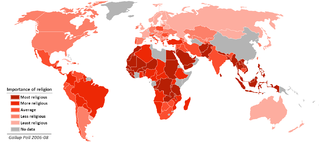
A market-based theory of religious choice and governmental regulation of religion have been the dominant theories used to explain variations of religiosity between societies. However, Gill and Lundsgaarde (2004) documented a much stronger correlation between welfare state spending and religiosity.
Just-world hypothesis
Studies have found belief in a just world to be correlated with aspects of religiousness.See also
- Demographics of atheismDemographics of atheismThe demographics of atheism are difficult to quantify. Different people interpret "atheist" and related terms differently, and it can be hard to draw boundaries between atheism, non-religious beliefs, and non-theistic religious and spiritual beliefs...
- MonasticismMonasticismMonasticism is a religious way of life characterized by the practice of renouncing worldly pursuits to fully devote one's self to spiritual work...
- Religiosity and intelligenceReligiosity and intelligenceThe topic of religiosity and intelligence pertains to relationships between intelligence and religiosity, the extent to which someone is religious...
- Spiritual But Not ReligiousSpiritual But Not ReligiousSpiritual But Not Religious is a popular phrase and acronym used to self-identify a life stance of spirituality that rejects traditional organized religion as the sole or most valuable means of furthering spiritual growth...