

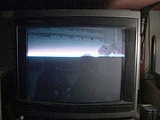
Refresh rate

Encyclopedia
The refresh rate is the number of times in a second that a display hardware draws the data. This is distinct from the measure of frame rate
in that the refresh rate includes the repeated drawing of identical frames, while frame rate measures how often a video source can feed an entire frame of new data to a display.
For example, most movie projector
s advance from one frame to the next one 24 times each second. But each frame is illuminated two or three times before the next frame is projected using a shutter in front of its lamp. As a result, the movie projector runs at 24 frames per second, but has a 48 or 72 Hz refresh rate.
On CRT displays, increasing the refresh rate decreases flicker
ing, thereby reducing eye strain. However, if a refresh rate is specified that is beyond what is recommended for the display, damage to the display can occur.
For computer programs or telemetry, the term is also applied to how frequently a datum is updated with a new external value from another source (for example; a shared public spreadsheet or hardware feed).
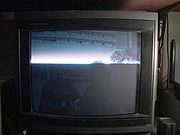 In a CRT, the scan rate is controlled by the vertical blanking
signal generated by the video controller, ordering the monitor to position the beam at the upper left corner of the raster
, ready to paint another frame. It is limited by the monitor's maximum horizontal scan rate
and the resolution, since higher resolution means more scan lines.
The refresh rate can be calculated from the horizontal scan rate by dividing the scanning frequency by the number of horizontal lines multiplied by 1.05 (since about 5% of the time it takes to scan the screen is spent moving the electron beam back to the top). For instance, a monitor with a horizontal scanning frequency of 96 kHz at a resolution of 1280 × 1024 results in a refresh rate of 96,000 / (1024 × 1.05) ≈ 89 Hz (rounded down).
CRT refresh rates have historically been an important factor in electronic game programming. Traditionally, one of the principles of video/computer game programming is to avoid altering the computer's video buffer except during the vertical retrace. This is necessary to prevent flickery graphics (caused by altering the picture in mid-frame) or screen tearing (caused by altering the graphics faster than the electronguns shut off). Unlike light pens, they are held at a distance from the screen.
Light pens and guns cannot be used on fixed-pixel displays because they have no electron beam to detect. Pen tablets and touchscreen LCDs are used as a substitute for them, but the latter require a specially-designed LCD panel and are mostly only found in point-of-service monitors. The Nintendo DS is an example of a vi
Refresh rate or the temporal resolution of an LCD is the number of times per second in which the display draws the data it is being given. Since activated LCD pixels do not flash on/off between frames, LCD monitors exhibit no refresh-induced flicker, no matter how low the refresh rate.[28]
Different operating systems set the default refresh rate differently. Microsoft Windows 95
and Windows 98
(First and Second Editions) set the refresh rate to the highest rate that they believe the display supports. Windows NT
-based operating systems, such as Windows 2000
and its descendants Windows XP
, Windows Vista
and Windows 7, set the default refresh rate to a "conservative" rate, usually 60 Hz. The many variations of Linux
usually set a refresh rate chosen by the user during setup of the display manager (although a default option is usually included with xfree86
). Some full-screen applications, including some games, allow the user to reconfigure the refresh rate before entering full-screen mode, but most default to a "conservative" resolution and refresh rate and let you increase the settings in the options.
Old monitors could be damaged if a user set the video card to a refresh rate higher than the highest rate supported by the monitor. Some models of monitors display a notice that the video signal uses an unsupported refresh rate.
displays, the effective refresh rate is halved, because each eye needs a separate picture. For this reason, it is usually recommended to use a display capable of at least 120 Hz, but 200 Hz is optimal. Unfortunately most monitors cannot handle this rate, especially at higher resolutions.
(60 Hz) and PAL
& SECAM
(50 Hz) sets used today. This accident of chance gave European sets higher resolution, in exchange for lower frame-rates. Compare NTSC (704x480 NTSC at 30i) and PAL/SECAM (704x576 at 25i). However, the lower refresh rate of PAL/SECAM introduces more flicker, so sets that use digital technology to double the refresh rate to 100 Hz are now very popular.
Another difference between 50 Hz and 60 Hz standards is the way motion pictures (film sources as opposed to video camera sources) are transferred or presented. 35 mm film is typically shot at 24 frame/s. For PAL 50 Hz this allows film sources to be easily transferred by accelerating the film by 4%. The resulting picture is therefore smooth, however, there is a small shift in the pitch of the audio. NTSC sets display both 24 frame/s and 25 frame/s material without any speed shifting by using a technique called 3:2 pulldown, but at the expense of introducing unsmooth playback in the form of telecine judder.
Unlike computer monitors, and some DVDs, analog television systems use interlace, which decreases the apparent flicker by painting first the odd lines and then the even lines (these are known as fields). This doubles the refresh rate, compared to a progressive scan image at the same frame rate. This works perfectly for video cameras, where each field results from a separate exposure - the effective frame rate doubles, there are now 50 rather than 25 exposures per second. The dynamics of a CRT are ideally suited to this approach, fast scenes will benefit from the 50 Hz refresh, the earlier field will have largely decayed away when the new field is written, and static images will benefit from improved resolution as both fields will be integrated by the eye. Modern CRT-based televisions may be made flicker-free
in the form of 100 Hz technology.
Many high-end LCD televisions now have a 120 or 240 Hz (current and former NTSC
countries) or 100 or 200 Hz (PAL
/SECAM
countries) refresh rate. The rate of 120 was chosen as the least common multiple
of 24 frame/s
(cinema) and 30 frame/s (NTSC TV), and allows for less distortion when movies are viewed due to the elimination of telecine
(3:2 pulldown). For PAL at 25 frame/s, 100 or 200 Hz is used as a fractional compromise of the least common multiple of 600 (24 x 25). These higher refresh rates are most effective from a 24p
-source video output (e.g. Blu-ray Disc
), and/or scenes of fast motion.
The combination of content production, playback device, and display device processing may also give artifacts that are unnecessary. A display device producing a fixed 60 frame/s rate cannot display a 24 frame/s movie at an even, judder-free rate. Usually, a 3:2 pulldown is used, giving a slight uneven movement.
While common multisync CRT computer monitors have been capable of running at even multiples of 24 Hz since the early 1990s, recent "120 Hz" LCD displays have been produced for the purpose of having smoother, more fluid motion, depending upon the source material, and any subsequent processing done to the signal. In the case of material shot on video, improvements in smoothness just from having a higher refresh rate may be barely noticeable.
In the case of filmed material, as 120 is an even multiple of 24, it is possible to present a 24 frame/s sequence without judder on a well-designed 120 Hz display (i.e., so-called 5-5 pulldown). If the 120 Hz rate is produced by frame-doubling a 60 frame/s 3:2 pulldown signal, the uneven motion could still be visible (i.e., so-called 6-4 pulldown).
Additionally, material may be displayed with synthetically created smoothness with the addition of motion interpolation
abilities to the display, which has an even larger effect on filmed material.
"50 Hz" tv sets (when fed with "50 Hz" content) usually get a movie that is slightly faster than normal, avoiding any problems with uneven pulldown.
Frame rate
Frame rate is the frequency at which an imaging device produces unique consecutive images called frames. The term applies equally well to computer graphics, video cameras, film cameras, and motion capture systems...
in that the refresh rate includes the repeated drawing of identical frames, while frame rate measures how often a video source can feed an entire frame of new data to a display.
For example, most movie projector
Movie projector
A movie projector is an opto-mechanical device for displaying moving pictures by projecting them on a projection screen. Most of the optical and mechanical elements, except for the illumination and sound devices, are present in movie cameras.-Physiology:...
s advance from one frame to the next one 24 times each second. But each frame is illuminated two or three times before the next frame is projected using a shutter in front of its lamp. As a result, the movie projector runs at 24 frames per second, but has a 48 or 72 Hz refresh rate.
On CRT displays, increasing the refresh rate decreases flicker
Flicker (screen)
Flicker is a visible fading between cycles displayed on video displays, especially the refresh interval on cathode ray tube based computer screens. Flicker occurs on CRTs when they are driven at a low refresh rate, allowing the brightness to drop for time intervals sufficiently long to be noticed...
ing, thereby reducing eye strain. However, if a refresh rate is specified that is beyond what is recommended for the display, damage to the display can occur.
For computer programs or telemetry, the term is also applied to how frequently a datum is updated with a new external value from another source (for example; a shared public spreadsheet or hardware feed).
Cathode ray tubes
Vertical blanking interval
The vertical blanking interval , also known as the vertical interval or VBLANK, is the time difference between the last line of one frame or field of a raster display, and the beginning of the first line of the next frame. It is present in analog television, VGA, DVI and other signals. During the...
signal generated by the video controller, ordering the monitor to position the beam at the upper left corner of the raster
Raster scan
A raster scan, or raster scanning, is the rectangular pattern of image capture and reconstruction in television. By analogy, the term is used for raster graphics, the pattern of image storage and transmission used in most computer bitmap image systems...
, ready to paint another frame. It is limited by the monitor's maximum horizontal scan rate
Horizontal scan rate
Horizontal scan rate, or horizontal frequency, usually expressed in kilohertz, is the frequency at which a CRT moves the electron beam from the left side of the display to the right and back, and therefore describes the number of horizontal lines displayed per second...
and the resolution, since higher resolution means more scan lines.
The refresh rate can be calculated from the horizontal scan rate by dividing the scanning frequency by the number of horizontal lines multiplied by 1.05 (since about 5% of the time it takes to scan the screen is spent moving the electron beam back to the top). For instance, a monitor with a horizontal scanning frequency of 96 kHz at a resolution of 1280 × 1024 results in a refresh rate of 96,000 / (1024 × 1.05) ≈ 89 Hz (rounded down).
CRT refresh rates have historically been an important factor in electronic game programming. Traditionally, one of the principles of video/computer game programming is to avoid altering the computer's video buffer except during the vertical retrace. This is necessary to prevent flickery graphics (caused by altering the picture in mid-frame) or screen tearing (caused by altering the graphics faster than the electronguns shut off). Unlike light pens, they are held at a distance from the screen.
Light pens and guns cannot be used on fixed-pixel displays because they have no electron beam to detect. Pen tablets and touchscreen LCDs are used as a substitute for them, but the latter require a specially-designed LCD panel and are mostly only found in point-of-service monitors. The Nintendo DS is an example of a vi
Refresh rate or the temporal resolution of an LCD is the number of times per second in which the display draws the data it is being given. Since activated LCD pixels do not flash on/off between frames, LCD monitors exhibit no refresh-induced flicker, no matter how low the refresh rate.[28]
Computer displays
On larger CRT monitors (17" or larger), most people experience mild discomfort unless the refresh is set to 72 Hz or higher. A rate of 100 Hz is comfortable at almost any size. However, this does not apply to LCD monitors. This is because the part of an LCD monitor that could produce CRT-like flicker—its backlight—typically operates at around 200&nbsDifferent operating systems set the default refresh rate differently. Microsoft Windows 95
Windows 95
Windows 95 is a consumer-oriented graphical user interface-based operating system. It was released on August 24, 1995 by Microsoft, and was a significant progression from the company's previous Windows products...
and Windows 98
Windows 98
Windows 98 is a graphical operating system by Microsoft. It is the second major release in the Windows 9x line of operating systems. It was released to manufacturing on 15 May 1998 and to retail on 25 June 1998. Windows 98 is the successor to Windows 95. Like its predecessor, it is a hybrid...
(First and Second Editions) set the refresh rate to the highest rate that they believe the display supports. Windows NT
Windows NT
Windows NT is a family of operating systems produced by Microsoft, the first version of which was released in July 1993. It was a powerful high-level-language-based, processor-independent, multiprocessing, multiuser operating system with features comparable to Unix. It was intended to complement...
-based operating systems, such as Windows 2000
Windows 2000
Windows 2000 is a line of operating systems produced by Microsoft for use on personal computers, business desktops, laptops, and servers. Windows 2000 was released to manufacturing on 15 December 1999 and launched to retail on 17 February 2000. It is the successor to Windows NT 4.0, and is the...
and its descendants Windows XP
Windows XP
Windows XP is an operating system produced by Microsoft for use on personal computers, including home and business desktops, laptops and media centers. First released to computer manufacturers on August 24, 2001, it is the second most popular version of Windows, based on installed user base...
, Windows Vista
Windows Vista
Windows Vista is an operating system released in several variations developed by Microsoft for use on personal computers, including home and business desktops, laptops, tablet PCs, and media center PCs...
and Windows 7, set the default refresh rate to a "conservative" rate, usually 60 Hz. The many variations of Linux
Linux
Linux is a Unix-like computer operating system assembled under the model of free and open source software development and distribution. The defining component of any Linux system is the Linux kernel, an operating system kernel first released October 5, 1991 by Linus Torvalds...
usually set a refresh rate chosen by the user during setup of the display manager (although a default option is usually included with xfree86
XFree86
XFree86 is an implementation of the X Window System. It was originally written for Unix-like operating systems on IBM PC compatibles and is now available for many other operating systems and platforms. It is free and open source software under the XFree86 License version 1.1. It is developed by the...
). Some full-screen applications, including some games, allow the user to reconfigure the refresh rate before entering full-screen mode, but most default to a "conservative" resolution and refresh rate and let you increase the settings in the options.
Old monitors could be damaged if a user set the video card to a refresh rate higher than the highest rate supported by the monitor. Some models of monitors display a notice that the video signal uses an unsupported refresh rate.
Stereo displays
When LCD shutter glasses are used for stereo 3D3D display
A 3D display is any display device capable of conveying a stereoscopic perception of 3-D depth to the viewer. The basic requirement is to present offset images that are displayed separately to the left and right eye. Both of these 2-D offset images are then combined in the brain to give the...
displays, the effective refresh rate is halved, because each eye needs a separate picture. For this reason, it is usually recommended to use a display capable of at least 120 Hz, but 200 Hz is optimal. Unfortunately most monitors cannot handle this rate, especially at higher resolutions.
Televisions
When the first televisions were developed in the 1920s and 1930s, the limitations of vacuum-tube electronics made it difficult to run them at anything other than a multiple of the AC line frequency used to power the set. Thus producers had little choice but to run sets at 60 Hz in America, and 50 Hz in Europe. Using the AC power frequency for the vertical sync rate also ensured that any residual power supply ripple (which would be visible as horizontal bands) was stationary. If a different frequency is used the "hum bars" move and thus are more distracting. These rates formed the basis for the NTSCNTSC
NTSC, named for the National Television System Committee, is the analog television system that is used in most of North America, most of South America , Burma, South Korea, Taiwan, Japan, the Philippines, and some Pacific island nations and territories .Most countries using the NTSC standard, as...
(60 Hz) and PAL
PAL
PAL, short for Phase Alternating Line, is an analogue television colour encoding system used in broadcast television systems in many countries. Other common analogue television systems are NTSC and SECAM. This page primarily discusses the PAL colour encoding system...
& SECAM
SECAM
SECAM, also written SÉCAM , is an analog color television system first used in France....
(50 Hz) sets used today. This accident of chance gave European sets higher resolution, in exchange for lower frame-rates. Compare NTSC (704x480 NTSC at 30i) and PAL/SECAM (704x576 at 25i). However, the lower refresh rate of PAL/SECAM introduces more flicker, so sets that use digital technology to double the refresh rate to 100 Hz are now very popular.
Another difference between 50 Hz and 60 Hz standards is the way motion pictures (film sources as opposed to video camera sources) are transferred or presented. 35 mm film is typically shot at 24 frame/s. For PAL 50 Hz this allows film sources to be easily transferred by accelerating the film by 4%. The resulting picture is therefore smooth, however, there is a small shift in the pitch of the audio. NTSC sets display both 24 frame/s and 25 frame/s material without any speed shifting by using a technique called 3:2 pulldown, but at the expense of introducing unsmooth playback in the form of telecine judder.
Unlike computer monitors, and some DVDs, analog television systems use interlace, which decreases the apparent flicker by painting first the odd lines and then the even lines (these are known as fields). This doubles the refresh rate, compared to a progressive scan image at the same frame rate. This works perfectly for video cameras, where each field results from a separate exposure - the effective frame rate doubles, there are now 50 rather than 25 exposures per second. The dynamics of a CRT are ideally suited to this approach, fast scenes will benefit from the 50 Hz refresh, the earlier field will have largely decayed away when the new field is written, and static images will benefit from improved resolution as both fields will be integrated by the eye. Modern CRT-based televisions may be made flicker-free
Flicker-free
Flicker-free is a term given to televisions that operate at a 100 or 120 hertz field rate to eliminate flicker, compared to standard televisions that operate at 50 Hz or 60 Hz...
in the form of 100 Hz technology.
Many high-end LCD televisions now have a 120 or 240 Hz (current and former NTSC
NTSC
NTSC, named for the National Television System Committee, is the analog television system that is used in most of North America, most of South America , Burma, South Korea, Taiwan, Japan, the Philippines, and some Pacific island nations and territories .Most countries using the NTSC standard, as...
countries) or 100 or 200 Hz (PAL
PAL
PAL, short for Phase Alternating Line, is an analogue television colour encoding system used in broadcast television systems in many countries. Other common analogue television systems are NTSC and SECAM. This page primarily discusses the PAL colour encoding system...
/SECAM
SECAM
SECAM, also written SÉCAM , is an analog color television system first used in France....
countries) refresh rate. The rate of 120 was chosen as the least common multiple
Least common multiple
In arithmetic and number theory, the least common multiple of two integers a and b, usually denoted by LCM, is the smallest positive integer that is a multiple of both a and b...
of 24 frame/s
Frame rate
Frame rate is the frequency at which an imaging device produces unique consecutive images called frames. The term applies equally well to computer graphics, video cameras, film cameras, and motion capture systems...
(cinema) and 30 frame/s (NTSC TV), and allows for less distortion when movies are viewed due to the elimination of telecine
Telecine
Telecine is transferring motion picture film into video and is performed in a color suite. The term is also used to refer to the equipment used in the post-production process....
(3:2 pulldown). For PAL at 25 frame/s, 100 or 200 Hz is used as a fractional compromise of the least common multiple of 600 (24 x 25). These higher refresh rates are most effective from a 24p
24p
In video technology, 24p refers to a video format that operates at 24 frames per second frame rate with progressive scanning . Originally, 24p was used in the non-linear editing of film-originated material...
-source video output (e.g. Blu-ray Disc
Blu-ray Disc
Blu-ray Disc is an optical disc storage medium designed to supersede the DVD format. The plastic disc is 120 mm in diameter and 1.2 mm thick, the same size as DVDs and CDs. Blu-ray Discs contain 25 GB per layer, with dual layer discs being the norm for feature-length video discs...
), and/or scenes of fast motion.
Displaying movie content on a TV
As movies are usually filmed at a rate of 24 frames per second, while television sets operate at different rates, some conversion is necessary. Different techniques exist to give the viewer an optimal experience.The combination of content production, playback device, and display device processing may also give artifacts that are unnecessary. A display device producing a fixed 60 frame/s rate cannot display a 24 frame/s movie at an even, judder-free rate. Usually, a 3:2 pulldown is used, giving a slight uneven movement.
While common multisync CRT computer monitors have been capable of running at even multiples of 24 Hz since the early 1990s, recent "120 Hz" LCD displays have been produced for the purpose of having smoother, more fluid motion, depending upon the source material, and any subsequent processing done to the signal. In the case of material shot on video, improvements in smoothness just from having a higher refresh rate may be barely noticeable.
In the case of filmed material, as 120 is an even multiple of 24, it is possible to present a 24 frame/s sequence without judder on a well-designed 120 Hz display (i.e., so-called 5-5 pulldown). If the 120 Hz rate is produced by frame-doubling a 60 frame/s 3:2 pulldown signal, the uneven motion could still be visible (i.e., so-called 6-4 pulldown).
Additionally, material may be displayed with synthetically created smoothness with the addition of motion interpolation
Motion interpolation
Motion interpolation is a form of video processing in which intermediate animation frames are generated between existing ones, in an attempt to make animation more fluid.-HDTV:...
abilities to the display, which has an even larger effect on filmed material.
"50 Hz" tv sets (when fed with "50 Hz" content) usually get a movie that is slightly faster than normal, avoiding any problems with uneven pulldown.
Computer data and telemetry
For computer data and telemetry, the term is also used to refer to the frequency of updates to a piece of data from an external source. This might be expressed in any unit of time.See also
- TelevisionTelevisionTelevision is a telecommunication medium for transmitting and receiving moving images that can be monochrome or colored, with accompanying sound...
- Cathode ray tubeCathode ray tubeThe cathode ray tube is a vacuum tube containing an electron gun and a fluorescent screen used to view images. It has a means to accelerate and deflect the electron beam onto the fluorescent screen to create the images. The image may represent electrical waveforms , pictures , radar targets and...
- Plasma displayPlasma displayA plasma display panel is a type of flat panel display common to large TV displays or larger. They are called "plasma" displays because the technology utilizes small cells containing electrically charged ionized gases, or what are in essence chambers more commonly known as fluorescent...
- Comparison of display technologyComparison of display technologyThis is a comparison of various properties of different display technologies.- General characteristics :- Temporal characteristics :Different display technologies have vastly different temporal characteristics, leading to claimed perceptual differences for motion, flicker, etc.The figure shows a...
- Frame rateFrame rateFrame rate is the frequency at which an imaging device produces unique consecutive images called frames. The term applies equally well to computer graphics, video cameras, film cameras, and motion capture systems...
- Temporal resolutionTemporal resolutionTemporal resolution refers to the precision of a measurement with respect to time. Often there is a tradeoff between temporal resolution of a measurement and its spatial resolution. This trade-off can be attributed to the finite speed of light and the fact that it takes a certain period of time...