


Family Compact

Encyclopedia
Fully developed after the War of 1812
, the Compact lasted until Upper and Lower Canada
were united in 1841. In Lower Canada, its equivalent was the Château Clique
. The influence of the Family Compact on the government administration at different levels lasted to the 1880s. The Family Compact controlled the government through the Executive Council
and Legislative Council, the advisers to the Lieutenant Governor, leaving the popularly elected Legislative Assembly
with little real power. Members ensured their conservative friends held the important positions in the colony through political patronage.
The centre of the Compact was Toronto, then called York. Its most important member was Bishop John Strachan
; many of the other members were his former students, or people who were related to him. The most prominent of Strachan's pupils was Sir John Beverley Robinson
who was from 1829 the Chief Justice of Upper Canada
for 34 years. The rest of the members were mostly descendants of United Empire Loyalists
or recent upper-class British
settlers.
The role of speculation in the vacant lands of Upper Canada ensured the development of group solidarity and cohesion of interest among the members of the Family Compact. Of the 26 largest landowners in Peel County between 1820 and 1840, 23 were absentee proprietors, of whom 17 were involved in the administration of the province; of these 17, 12 were part of the Family Compact. Society and politics in Upper Canada were dominated by interest and connection based on landed property, and only secondarily affected by ideologies and personalities.
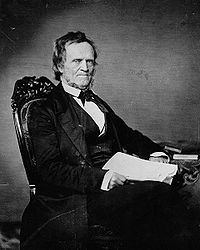 The influence of the Family Compact was of chief concern to liberal-minded citizens of Upper Canada. The radical reformer William Lyon Mackenzie
was the most vocal opponent of the Family Compact. At one point Mackenzie's opposition resulted in a group of fourteen led by Samuel Jarvis
, disguised as Indians, breaking into the offices of Mackenzie's newspaper Colonial Advocate on June 8, 1826, where they smashed his printing press and threw it into Toronto Harbour
. Mackenzie sued, won £
625 which was paid by donations from the Family Compact, and was able to set up a larger operation.
Mackenzie's frustration with Compact control of the government was a catalyst for the failed Upper Canada Rebellion
of 1837. Their hold on the government was reduced with the creation of the united Province of Canada
and later the installation of the system of Responsible Government
in Canada.
, was a federation united by geography in Goderich, Ontario
, Scottish heritage, time of immigration to Upper Canada, and an association with the Dunlop brothers William Tiger Dunlop and Robert Graham Dunlop
. Although their prime animosity was towards the Canada Company
, the Canada Company and the Family Compact were seen as one and the same thing causing the Colbornites to align themselves firmly against the Family Compact.
Many of the Colborne Clique had been employed by the Canada Company—John Galt and William Tiger Dunlop in particular—cutting their ties with the Canada Company just prior to the Rebellions of 1837-38. Anthony Van Egmond
and Thomas Mercer Jones
were late but important additions to the Clique from the Compact. Defections from the Company to the Clique, in part explains the failure of the Family Compact to continue into the era of responsible government. The defections left the Compact without local leadership in the Huron Tract
, a large and important area of immigration.
Amongst their grievances was the insistence of Bishop Strachan
that only Anglican priests perform a marriage. Most of these immigrants spoke Scottish Gaelic. Church of England priests typically spoke no Gaelic and Strachan prevented the Gaelic speaking Church of Scotland
from performing these rites. There were the grievances of distribution of land and the building of infrastructure for towns and settlements. Public protests were carried out in letter writing campaigns to Upper Canada officials, letters to the editor of various newspapers and public demonstrations during official visits.
Only those with Family Compact connections could access appropriate consideration from the Canada Company.
, a Toronto lawyer. Within a few years the Reform Party had a powerful leader in William Lyon Mackenzie
. His ability to agitate through his newspaper The Colonial Advocate and petitioning was effective. Speeches and petitions led directly to the redress of grievances in Upper Canada that otherwise had no means of redress.
One of the most notorious results of the Reform movement agitation is the Hamilton Outrage. The Legislative Assembly of Upper Canada
investigated the involvement of Sir Allan Napier MacNab in the hanging in effigy of Lieutenant Governor Lord Seaton
. Refusing to testify, MacNab was jailed for 10 days, cementing his position as a martyr for the Tory party. The Reform Party and Mackenzie in particular were responsible for the investigation and consequences for Napier.
lead by William Lyon Mackenzie
were unsuccessful. The Family Compact and the government of the day put down the rebellions, although that would be a hollow victory. The Family Compact as a social and political federation would fail to modify its extreme stance on the issues of the day, ultimately leading to its down-fall.
The Canada Company Commissioners in Canada were Thomas Mercer Jones
for Goderich 1829–1853 and Frederick Widder
for Toronto 1839–1864. Jones joined the Colborne Clique in 1853 leaving the 2 million square acre Huron Tract
with no representation on the board of the Company who were under specific obligations to provide schools, roads and fair access to purchase of that land.
's Report on the Affairs of British North America states that it is impossible
While irresponsible government was not enshrined by the Constitutional Act of 1791, vague wording had allowed it to become common practice. The Act of Union 1840
provided for responsible government and by 1848 ministerial responsibility was also enacted.
s were created by the Constitutional Act of 1791
as 1/7 of all land granted was to go to the Church. John Strachan, a Family Compact leader, lobbied successfully for years to keep the right to these lands for the Anglican Church only. Poor management and inequitable division between Christian sects resulted in the secularization of the lands in 1854.
With this Loyalist background and under the leadership of Strachan, they were strong royalists, and supported the Church of England
over the Catholic Church and other Protestant sects. They especially interpreted the Constitutional Act of 1791
, which gave land grants to build Protestant churches, to refer to Anglican churches alone. They were able to act on this interpretation through the creation of the Clergy Corporation
which oversaw the management of the reserves. These actions were opposed by the large numbers of Presbyterian Scottish
settlers, as well as smaller groups of Methodists
.
Crown reserves were parcels of uninhabited land designed as future revenue sources for the government. Without roads or infrastructure, these land parcels inhibited the growth of the provinces and decreased land values. Crown reserves were largely under the control of the Compact.
had two results for land distribution. First, with the borders restored to pre-War of 1812 placement, American citizens were prevented from buying land unless they had lived in Upper Canada for seven years before the war. Second, war veterans stationed in Canada were given free land grants. As the Canada Company controlled 2 million acres (8,093.7 km²) of the Huron Tract
, it came to the Company to enforce the policy. Establishing residence in Upper Canada or veteran status became a matter of knowing a well placed Canada Company and thereby Family Compact person.
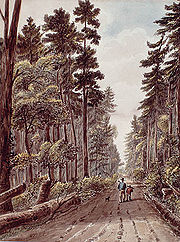 The most common complaint against the Company and the Compact was for bridges, roads and mills. The government spent monies available on canals more financially favourable to themselves, leaving the pioneers without basic services.
. The conservative values of the Family Compact was succeeded by the Upper Canada Tories
after 1841. The current Canadian establishment grew out of the Family Compact. Although the families and names changed, the basic template for power and control remained the same through to the end of World War II
. With greater immigration from a variety of nations and cultures came the meritocracy so desired during the early years of Upper Canada.
However, as John Porter
noted, a form of Family Compact in Canadian business and politics is to be expected.
War of 1812
The War of 1812 was a military conflict fought between the forces of the United States of America and those of the British Empire. The Americans declared war in 1812 for several reasons, including trade restrictions because of Britain's ongoing war with France, impressment of American merchant...
, the Compact lasted until Upper and Lower Canada
Lower Canada
The Province of Lower Canada was a British colony on the lower Saint Lawrence River and the shores of the Gulf of Saint Lawrence...
were united in 1841. In Lower Canada, its equivalent was the Château Clique
Château Clique
The Clique du Château or Château Clique was a group of wealthy families in Lower Canada in the early 19th century. They were the Lower Canadian equivalent of the Family Compact in Upper Canada...
. The influence of the Family Compact on the government administration at different levels lasted to the 1880s. The Family Compact controlled the government through the Executive Council
Executive Council of Upper Canada
The Executive Council of Upper Canada had a similar function to the Cabinet in England but was not responsible to the Legislative Assembly. Members of the Executive Council were not necessarily members of the Legislative Assembly but were usually members of the Legislative Council. Members were...
and Legislative Council, the advisers to the Lieutenant Governor, leaving the popularly elected Legislative Assembly
Legislative Assembly of Upper Canada
The Legislative Assembly of Upper Canada was created by the Constitutional Act of 1791. It was the elected legislature for the province of Upper Canada and functioned as the province's lower house in the Parliament of Upper Canada...
with little real power. Members ensured their conservative friends held the important positions in the colony through political patronage.
The centre of the Compact was Toronto, then called York. Its most important member was Bishop John Strachan
John Strachan
John Strachan was an influential figure in Upper Canada and the first Anglican Bishop of Toronto.-Early life:Strachan was the youngest of six children born to a quarry worker in Aberdeen, Scotland. He graduated from King's College, Aberdeen in 1797...
; many of the other members were his former students, or people who were related to him. The most prominent of Strachan's pupils was Sir John Beverley Robinson
John Beverley Robinson
John Beverley Robinson was elected mayor of Toronto in 1856. He was the fifth Lieutenant Governor of Ontario between the years 1880–1887....
who was from 1829 the Chief Justice of Upper Canada
Upper Canada
The Province of Upper Canada was a political division in British Canada established in 1791 by the British Empire to govern the central third of the lands in British North America and to accommodate Loyalist refugees from the United States of America after the American Revolution...
for 34 years. The rest of the members were mostly descendants of United Empire Loyalists
United Empire Loyalists
The name United Empire Loyalists is an honorific given after the fact to those American Loyalists who resettled in British North America and other British Colonies as an act of fealty to King George III after the British defeat in the American Revolutionary War and prior to the Treaty of Paris...
or recent upper-class British
United Kingdom
The United Kingdom of Great Britain and Northern IrelandIn the United Kingdom and Dependencies, other languages have been officially recognised as legitimate autochthonous languages under the European Charter for Regional or Minority Languages...
settlers.
The role of speculation in the vacant lands of Upper Canada ensured the development of group solidarity and cohesion of interest among the members of the Family Compact. Of the 26 largest landowners in Peel County between 1820 and 1840, 23 were absentee proprietors, of whom 17 were involved in the administration of the province; of these 17, 12 were part of the Family Compact. Society and politics in Upper Canada were dominated by interest and connection based on landed property, and only secondarily affected by ideologies and personalities.
Membership
In the early days of Upper Canada, providing for relatives and dependants was common. Those who could ease the transition from Britain to Canada did so with the approval of the social structure. The Family Compact was an informal organization that institutionalized this activity.William Lyon Mackenzie
William Lyon Mackenzie
William Lyon Mackenzie was a Scottish born American and Canadian journalist, politician, and rebellion leader. He served as the first mayor of Toronto, Upper Canada and was an important leader during the 1837 Upper Canada Rebellion.-Background and early years in Scotland, 1795–1820:Mackenzie was...
was the most vocal opponent of the Family Compact. At one point Mackenzie's opposition resulted in a group of fourteen led by Samuel Jarvis
Samuel Jarvis
Samuel Peters Jarvis was a Canadian government official in the nineteenth century. He was the Chief Superintendent of Indian Affairs for Upper Canada , and he was a member of the Family Compact....
, disguised as Indians, breaking into the offices of Mackenzie's newspaper Colonial Advocate on June 8, 1826, where they smashed his printing press and threw it into Toronto Harbour
Toronto Harbour
Toronto Harbour or Toronto Bay is a bay on the north shore of Lake Ontario, in Toronto, Ontario, Canada. It is a natural harbour, protected from Lake Ontario waves by the Toronto Islands. It is a commercial port on the Great Lakes as well as a recreational harbour...
. Mackenzie sued, won £
Pound sterling
The pound sterling , commonly called the pound, is the official currency of the United Kingdom, its Crown Dependencies and the British Overseas Territories of South Georgia and the South Sandwich Islands, British Antarctic Territory and Tristan da Cunha. It is subdivided into 100 pence...
625 which was paid by donations from the Family Compact, and was able to set up a larger operation.
Mackenzie's frustration with Compact control of the government was a catalyst for the failed Upper Canada Rebellion
Upper Canada Rebellion
The Upper Canada Rebellion was, along with the Lower Canada Rebellion in Lower Canada, a rebellion against the British colonial government in 1837 and 1838. Collectively they are also known as the Rebellions of 1837.-Issues:...
of 1837. Their hold on the government was reduced with the creation of the united Province of Canada
Province of Canada
The Province of Canada, United Province of Canada, or the United Canadas was a British colony in North America from 1841 to 1867. Its formation reflected recommendations made by John Lambton, 1st Earl of Durham in the Report on the Affairs of British North America following the Rebellions of...
and later the installation of the system of Responsible Government
Responsible government
Responsible government is a conception of a system of government that embodies the principle of parliamentary accountability which is the foundation of the Westminster system of parliamentary democracy...
in Canada.
Colborne Clique
The Colborne Clique, named for John Colborne, 1st Baron SeatonJohn Colborne, 1st Baron Seaton
Field Marshal John Colborne, 1st Baron Seaton, GCB, GCMG, GCH, PC was a British field marshal and colonial governor.-Early service:...
, was a federation united by geography in Goderich, Ontario
Goderich, Ontario
Goderich is a town in the Canadian province of Ontario and is the county seat of Huron County. The town was founded by William "Tiger" Dunlop in 1827. First laid out in 1828, the town is named after Frederick John Robinson, 1st Viscount Goderich, who was British prime minister at the time. The town...
, Scottish heritage, time of immigration to Upper Canada, and an association with the Dunlop brothers William Tiger Dunlop and Robert Graham Dunlop
Robert Graham Dunlop
Robert Graham Dunlop was a ship's captain and political figure in Upper Canada.He was born in Keppoch, Scotland in 1790 and joined the Royal Navy at the age of 13. He became a lieutenant while serving during the Napoleonic Wars; he later reached the rank of captain...
. Although their prime animosity was towards the Canada Company
Canada Company
The Canada Company was a large private chartered British land development company, incorporated by an act of British parliament on July 27, 1825, to aid the colonization of Upper Canada. Canada Company assisted emigrants by providing good ships, low fares, implements and tools,and inexpensive land....
, the Canada Company and the Family Compact were seen as one and the same thing causing the Colbornites to align themselves firmly against the Family Compact.
Many of the Colborne Clique had been employed by the Canada Company—John Galt and William Tiger Dunlop in particular—cutting their ties with the Canada Company just prior to the Rebellions of 1837-38. Anthony Van Egmond
Anthony Van Egmond
Anthony Van Egmond, born Antonij Jacobi Willem Gijben before coming to North America, was purportedly a Dutch Napoleonic War veteran...
and Thomas Mercer Jones
Thomas Mercer Jones
Thomas Mercer Jones was an English-born administrator who arrived in Upper Canada in the 1820s and was employed as a commissioner of the Canada Company based in Goderich. A series of internal conflicts led to his dismissal in 1852. He died in Toronto.- External links :*...
were late but important additions to the Clique from the Compact. Defections from the Company to the Clique, in part explains the failure of the Family Compact to continue into the era of responsible government. The defections left the Compact without local leadership in the Huron Tract
Huron Tract
The Huron Tract Purchase also known as the Huron Block, registered as Crown Treaty Number 29, is a large area of land in southwestern Ontario bordering on Lake Huron to the west and Lake Erie to the east...
, a large and important area of immigration.
Amongst their grievances was the insistence of Bishop Strachan
John Strachan
John Strachan was an influential figure in Upper Canada and the first Anglican Bishop of Toronto.-Early life:Strachan was the youngest of six children born to a quarry worker in Aberdeen, Scotland. He graduated from King's College, Aberdeen in 1797...
that only Anglican priests perform a marriage. Most of these immigrants spoke Scottish Gaelic. Church of England priests typically spoke no Gaelic and Strachan prevented the Gaelic speaking Church of Scotland
Church of Scotland
The Church of Scotland, known informally by its Scots language name, the Kirk, is a Presbyterian church, decisively shaped by the Scottish Reformation....
from performing these rites. There were the grievances of distribution of land and the building of infrastructure for towns and settlements. Public protests were carried out in letter writing campaigns to Upper Canada officials, letters to the editor of various newspapers and public demonstrations during official visits.
Only those with Family Compact connections could access appropriate consideration from the Canada Company.
Reform Party
The founder of the Reform movement in Upper Canada is Robert BaldwinRobert Baldwin
Robert Baldwin was born at York . He, along with his political partner Louis-Hippolyte Lafontaine, led the first responsible ministry in Canada, regarded by some as the first truly Canadian government....
, a Toronto lawyer. Within a few years the Reform Party had a powerful leader in William Lyon Mackenzie
William Lyon Mackenzie
William Lyon Mackenzie was a Scottish born American and Canadian journalist, politician, and rebellion leader. He served as the first mayor of Toronto, Upper Canada and was an important leader during the 1837 Upper Canada Rebellion.-Background and early years in Scotland, 1795–1820:Mackenzie was...
. His ability to agitate through his newspaper The Colonial Advocate and petitioning was effective. Speeches and petitions led directly to the redress of grievances in Upper Canada that otherwise had no means of redress.
One of the most notorious results of the Reform movement agitation is the Hamilton Outrage. The Legislative Assembly of Upper Canada
Legislative Assembly of Upper Canada
The Legislative Assembly of Upper Canada was created by the Constitutional Act of 1791. It was the elected legislature for the province of Upper Canada and functioned as the province's lower house in the Parliament of Upper Canada...
investigated the involvement of Sir Allan Napier MacNab in the hanging in effigy of Lieutenant Governor Lord Seaton
John Colborne, 1st Baron Seaton
Field Marshal John Colborne, 1st Baron Seaton, GCB, GCMG, GCH, PC was a British field marshal and colonial governor.-Early service:...
. Refusing to testify, MacNab was jailed for 10 days, cementing his position as a martyr for the Tory party. The Reform Party and Mackenzie in particular were responsible for the investigation and consequences for Napier.
Post-Rebellions of 1837-38
The Rebellions of 1837Rebellions of 1837
The Rebellions of 1837 were a pair of Canadian armed uprisings that occurred in 1837 and 1838 in response to frustrations in political reform. A key shared goal was the allowance of responsible government, which was eventually achieved in the incident's aftermath.-Rebellions:The rebellions started...
lead by William Lyon Mackenzie
William Lyon Mackenzie
William Lyon Mackenzie was a Scottish born American and Canadian journalist, politician, and rebellion leader. He served as the first mayor of Toronto, Upper Canada and was an important leader during the 1837 Upper Canada Rebellion.-Background and early years in Scotland, 1795–1820:Mackenzie was...
were unsuccessful. The Family Compact and the government of the day put down the rebellions, although that would be a hollow victory. The Family Compact as a social and political federation would fail to modify its extreme stance on the issues of the day, ultimately leading to its down-fall.
Decline
The Family Compact can take direct responsibility for the failure to carry out the social goals of representative government, constitutional reform and the clergy and crown reserves issue. The Compact is, however, only indirectly responsible for land reform, public education and roads; those issue being largely within the authority of the Canada Company. While the Canada Company and the Compact were seen as one and the same, the Compact shouldered any blame.The Canada Company Commissioners in Canada were Thomas Mercer Jones
Thomas Mercer Jones
Thomas Mercer Jones was an English-born administrator who arrived in Upper Canada in the 1820s and was employed as a commissioner of the Canada Company based in Goderich. A series of internal conflicts led to his dismissal in 1852. He died in Toronto.- External links :*...
for Goderich 1829–1853 and Frederick Widder
Frederick Widder
Frederick Widder was a Canada Company Commissioner, son of a Canada Company London director, with family connections to royalty and the right Anglican connections. His moderate approach and financial innovations for the Canada Company would give him good standing with the pioneers of the Huron...
for Toronto 1839–1864. Jones joined the Colborne Clique in 1853 leaving the 2 million square acre Huron Tract
Huron Tract
The Huron Tract Purchase also known as the Huron Block, registered as Crown Treaty Number 29, is a large area of land in southwestern Ontario bordering on Lake Huron to the west and Lake Erie to the east...
with no representation on the board of the Company who were under specific obligations to provide schools, roads and fair access to purchase of that land.
Representative and responsible government
The quest for responsible and representative government arguably begins in 1822, the year of a joint protest by Upper and Lower Canada against a proposed union of the two colonies. Representative government meant having a popularly elected legislative assembly with the authority to act, particularly in money bills, without reference to either of the executive councils. Responsible government as primarily the access to casual and territorial revenues had always been within the control of councils.Constitutional reform
To achieve representative and responsible government, constitutional reform was required. Lord DurhamEarl of Durham
Earl of Durham is a title in the Peerage of the United Kingdom. It was created in 1833 for the prominent Whig politician and colonial official John Lambton, 1st Baron Durham. Known as "Radical Jack", he played a leading role in the passing of the Great Reform Act of 1832...
's Report on the Affairs of British North America states that it is impossible
to understand how any English statesman could have ever imagined that representative and irresponsible government could be successfully combined.
While irresponsible government was not enshrined by the Constitutional Act of 1791, vague wording had allowed it to become common practice. The Act of Union 1840
Act of Union 1840
The Act of Union, formally the The British North America Act, 1840 , was enacted in July 1840 and proclaimed 10 February 1841. It abolished the legislatures of Lower Canada and Upper Canada and established a new political entity, the Province of Canada to replace them...
provided for responsible government and by 1848 ministerial responsibility was also enacted.
Clergy and Crown Reserves
The Clergy reserveClergy reserve
Clergy Reserves were tracts of land in Upper Canada reserved for the support of "Protestant clergy" by the Constitutional Act of 1791 which also established Upper and Lower Canada as distinct regions each with an elected assembly. One-seventh of all Crown lands were set aside...
s were created by the Constitutional Act of 1791
Constitutional Act of 1791
The Constitutional Act of 1791, formally The Clergy Endowments Act, 1791 , is an Act of the Parliament of Great Britain...
as 1/7 of all land granted was to go to the Church. John Strachan, a Family Compact leader, lobbied successfully for years to keep the right to these lands for the Anglican Church only. Poor management and inequitable division between Christian sects resulted in the secularization of the lands in 1854.
With this Loyalist background and under the leadership of Strachan, they were strong royalists, and supported the Church of England
Church of England
The Church of England is the officially established Christian church in England and the Mother Church of the worldwide Anglican Communion. The church considers itself within the tradition of Western Christianity and dates its formal establishment principally to the mission to England by St...
over the Catholic Church and other Protestant sects. They especially interpreted the Constitutional Act of 1791
Constitutional Act of 1791
The Constitutional Act of 1791, formally The Clergy Endowments Act, 1791 , is an Act of the Parliament of Great Britain...
, which gave land grants to build Protestant churches, to refer to Anglican churches alone. They were able to act on this interpretation through the creation of the Clergy Corporation
Clergy Corporation
The Clergy Corporation, or the Clergy Reserve Corporation of Upper Canada, existed to oversee, manage and lease the Clergy reserves of Upper Canada, a large amount of land in Upper Canada that had been put aside for the Anglican and later Protestant churches...
which oversaw the management of the reserves. These actions were opposed by the large numbers of Presbyterian Scottish
Scotland
Scotland is a country that is part of the United Kingdom. Occupying the northern third of the island of Great Britain, it shares a border with England to the south and is bounded by the North Sea to the east, the Atlantic Ocean to the north and west, and the North Channel and Irish Sea to the...
settlers, as well as smaller groups of Methodists
Methodism
Methodism is a movement of Protestant Christianity represented by a number of denominations and organizations, claiming a total of approximately seventy million adherents worldwide. The movement traces its roots to John Wesley's evangelistic revival movement within Anglicanism. His younger brother...
.
Crown reserves were parcels of uninhabited land designed as future revenue sources for the government. Without roads or infrastructure, these land parcels inhibited the growth of the provinces and decreased land values. Crown reserves were largely under the control of the Compact.
Land distribution
The War of 1812War of 1812
The War of 1812 was a military conflict fought between the forces of the United States of America and those of the British Empire. The Americans declared war in 1812 for several reasons, including trade restrictions because of Britain's ongoing war with France, impressment of American merchant...
had two results for land distribution. First, with the borders restored to pre-War of 1812 placement, American citizens were prevented from buying land unless they had lived in Upper Canada for seven years before the war. Second, war veterans stationed in Canada were given free land grants. As the Canada Company controlled 2 million acres (8,093.7 km²) of the Huron Tract
Huron Tract
The Huron Tract Purchase also known as the Huron Block, registered as Crown Treaty Number 29, is a large area of land in southwestern Ontario bordering on Lake Huron to the west and Lake Erie to the east...
, it came to the Company to enforce the policy. Establishing residence in Upper Canada or veteran status became a matter of knowing a well placed Canada Company and thereby Family Compact person.
Public education
William Tiger Dunlop, while in the employ of the Canada Company, wrote pamphlets and books to encourage settlement of Upper Canada. His descriptions of schools, roads, and other social infrastructure were not met with reality upon landing in Canada. Publicly-funded education was not readily available until after Confederation when the province took control of this responsibility.Roads
Current Status
The Family Compact began to reconfigure itself after 1841 as it was squeezed out of public life in the new Province of CanadaProvince of Canada
The Province of Canada, United Province of Canada, or the United Canadas was a British colony in North America from 1841 to 1867. Its formation reflected recommendations made by John Lambton, 1st Earl of Durham in the Report on the Affairs of British North America following the Rebellions of...
. The conservative values of the Family Compact was succeeded by the Upper Canada Tories
Upper Canada Tories
The Tory movement in Upper Canada was formed from the elements of the Family Compact following the War of 1812. It was an early political party, merely a group of like minded conservative elite in the early days of Canada...
after 1841. The current Canadian establishment grew out of the Family Compact. Although the families and names changed, the basic template for power and control remained the same through to the end of World War II
World War II
World War II, or the Second World War , was a global conflict lasting from 1939 to 1945, involving most of the world's nations—including all of the great powers—eventually forming two opposing military alliances: the Allies and the Axis...
. With greater immigration from a variety of nations and cultures came the meritocracy so desired during the early years of Upper Canada.
However, as John Porter
John Porter (sociologist)
John Arthur Porter was one of Canada's most important sociologists during the period from 1950 to the late 1970s. His work in the field of social stratification opened up new areas of inquiry for many sociologists in Canada.Porter was born in Vancouver and completed his education at the London...
noted, a form of Family Compact in Canadian business and politics is to be expected.
Canada is probably not unlike other western industrial nations in relying heavily on its elite groups to make major decisions and to determine the shape and direction of its development. The nineteenth-century notion of a liberal citizen-participating democracy is obviously not a satisfactory model by which to examine the processes of decision-making in either the economic of the political contexts. ... If power and decision-making must always rest with elite groups, there can at least be open recruitment from all classes into the elite.
External links
- Library and Archives Canada: Search Terms: Family Compact
- The Canadian Encyclopedia: Family Compact.
- Archives of Ontario, Canada Company Fonds.
- Historical Narratives of Early Canada by W.R. Wilson
- L’Encyclopédie de l’histoire du Québec: Family Compact
- of Canadian Biography Online.
Further reading
- George M. Wrong, Canada and the American Revolution: The Disruption of the First British Empire (1935)