

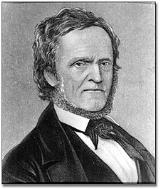
William Lyon Mackenzie

Encyclopedia
William Lyon Mackenzie (March 12, 1795 – August 28, 1861) was a Scottish born American and Canadian journalist
, politician
, and rebellion leader. He served as the first mayor of Toronto, Upper Canada and was an important leader during the 1837 Upper Canada Rebellion
.
, Scotland
. Both of Mackenzie's parents, Daniel Mackenzie, a weaver
, and Elizabeth Mackenzie, née Chambers, came from Kirkmichael. They married in May 1794: a widow
, Elizabeth was seventeen years older than Daniel. Daniel allegedly died three weeks after William Lyon Mackenzie's birth (though historians have been unable to find a record of his burial) and Mackenzie was raised by his mother. Elizabeth Mackenzie was a deeply religious woman, a proponent of the Secession
, a branch of Scottish Presbyterianism
deeply committed to the separation of church and state
. While William Lyon Mackenzie was not a religious man himself, he remained a proponent of separation of church and state for his entire life.
Mackenzie entered a parish grammar school at Dundee
at age 5, thanks to a bursary
, and then moved on to a Mr. Adie's school. Mackenzie early on adopted habits as a voracious reader, keeping a list detailing the 958 books he read between 1806 and 1820. By 1810, at age 15, he was writing for a local newspaper
. During this time he also joined a scientific society. It was there that he met Edward Lesslie and his sons James
and John, who would play a large role in Mackenzie's life.
Mackenzie's mother arranged for him to apprentice with several tradesmen in Dundee
, but in 1814, he was able to secure financial backing from Edward Lesslie to open a general store
and circulating library in Alyth
. During this period Mackenzie had a romantic relationship with one Isabel Reid, of whom nothing is known except that she gave birth to Mackenzie's illegitimate son on July 17, 1814. The boy was raised by Mackenzie's mother.
During the recession
which followed the ending of the Napoleonic Wars
in 1815, Mackenzie's store in Dundee went bankrupt and he had to travel to seek work, first returning to Dundee; then going to Wiltshire
in 1818 to work for a canal
company; travelled briefly to France
; and then worked briefly for a newspaper in London
.
Lacking stable employment, at age 25, Mackenzie decided to emigrate
to British North America
, along with his friend John Lesslie.
in Lower Canada
. He wrote for the Montreal Herald during this period. John Lesslie, on the other hand, had settled in York, Upper Canada
(now Toronto
) and Mackenzie soon became employed at Lesslie's bookselling
/drugstore
business. Mackenzie fell in love with Upper Canada
and began writing for the York Observer.
In 1822, Edward Lesslie and the rest of his family, along with Elizabeth Mackenzie, joined Mackenzie and John Lesslie in Upper Canada. Elizabeth brought along a young woman, Isabel Baxter (1805–73), whom she had chosen for William Lyon Mackenzie to marry, and the couple were married July 1, 1822 in Montreal
. Isabel would ultimately bear Mackenzie 14 children (including Isabel Grace Mackenzie, the mother of William Lyon Mackenzie King
).
Edward and John Lesslie now opened a branch store of their business in Dundas
, entering into a partnership
with Mackenzie on the understanding that Mackenzie would move to Dundas to be the store's manager; the store sold drugs
, hardware
, and general merchandise, and Mackenzie also operated a circulating library in Dundas. However, Mackenzie's relationship with the Lesslies soured and the partnership was dissolved in 1823. He moved to Queenston and established a business there. While there, he established a relationship with Robert Randal
, one of four members representing Lincoln County
in the Legislative Assembly of Upper Canada
.
. Mackenzie supported some characteristically British institutions, notably the British Empire
, primogeniture
and the clergy reserves, but he also praised American
institutions in the paper.
The Colonial Advocate had financial difficulties, and in November 1824, Mackenzie relocated the paper to York. There, he advocated in favour of the Reform
cause and became an outspoken critic of the "Family Compact
", an upper-class clique which dominated the government of Upper Canada. However, the newspaper continued to face financial pressures: the paper had only 825 subscribers by the beginning of 1825, and faced stiff competition from another Reform newspaper, the Canadian Freeman. As a result, Mackenzie had to suspend publishing the Colonial Advocate from July to December 1825. He purchased a new printing press
in fall 1825 and resumed publication in 1826, now engaging in even more scurrilous attacks on leading Tory politicians such as William Allan
, G. D'Arcy Boulton, Henry John Boulton
, and George Gurnett
. However, Mackenzie continued to amass debts, and in May 1826, he fled across the American border to Lewiston, New York
to evade his creditors.
A group of 15 young Tories, perhaps led by Samuel Peters Jarvis, took advantage of Mackenzie's absence to exact revenge for the attacks on the Tories printed in the Colonial Advocate. Thinly disguising themselves as "Indians
", they broke into the Colonial Advocates office in broad daylight, smashed the printing press, and threw the type into Lake Ontario
. The Tory magistrates did nothing to stop them and did not prosecute them afterwards.
Mackenzie took full advantage of the incident, returning to York and suing the perpetrators in a sensational trial, which propelled Mackenzie into the ranks of martyrs of Upper Canadian liberty, alongside Robert Thorpe
and Robert Fleming Gourlay
. Mackenzie refused a settlement of £200 (approximately the value of the damage) and insisted on trial. His legal team, which included Marshall Spring Bidwell
, argued effectively and the jury returned a verdict of £625, far more than the amount of damage done to the press.
Mackenzie took advantage of the money and fame which the trial had brought him to re-establish his business on sound financial footing.
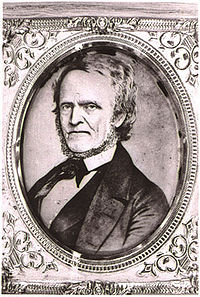 Mackenzie now aligned himself with John Rolph in arguing that American-born settlers in Upper Canada should have the full rights of British subjects. Mackenzie played a role in organizing a committee to present grievances to the British government: the committee selected Robert Randal to travel to London to advocate on behalf of the American-born settlers. In London, Randal allied himself with British Reformer Joseph Hume
in presenting the colonists' grievances to the Secretary of State for War and the Colonies
, Lord Goderich
. Goderich agreed that injustice was being done and instructed the Legislative Assembly of Upper Canada to redress the grievances. This incident taught Mackenzie the efficacy of appealing directly to Britain.
John Strachan
, who was then the rector
of York, as well as a member of the Executive Council of Upper Canada
and a prominent member of the Family Compact, also understood the efficacy of petitioning. He was in London the same year to seek a charter
for his proposed King's College (which would ultimately become the University of Toronto
) and to argue that the Church of England
should receive the proceeds of sales of the clergy reserves. Allying himself with Methodist minister Egerton Ryerson
, who felt that the Methodist Church should share in the proceeds of sale of the clergy reserves, Mackenzie declared himself opposed to Strachan's plans for Upper Canada.
Mackenzie declared his intentions to run in the elections for the 10th Parliament of Upper Canada
and entered into correspondence with Reformers like Joseph Hume in England and John Neilson
in Lower Canada. He ran in York County
, a riding dominated by colonists of American extraction. Mackenzie was one of four Reformers vying for York County's two seats – the others included two moderates (J. E. Small and Robert Baldwin
) and one radical Reformer, Jesse Ketchum
. During the campaign, Mackenzie published a "Black List" in the Colonial Advocate, a series of attacks on his opponents, leading to the rival Canadian Freeman and the Tories dubbing him "William Liar Mackenzie". Nevertheless, Mackenzie's tactics were successful and he and Ketchum won the seat as part of a landslide that saw the Reformers win a majority of the seats. However, given the undemocratic nature of Upper Canada at this time, this win did not give the Reformers the right to form a cabinet, with the cabinet (the Executive Council of Upper Canada
) still being chosen by the Lieutenant Governor of Upper Canada, Sir Peregrine Maitland
, who remained allied with the Family Compact.
The 10th Parliament of Upper Canada opened in January 1829. Although there was speculation that Mackenzie would be elected speaker
, that honour went to Mackenzie's former lawyer, Marshall Spring Bidwell. Nevertheless, Mackenzie now had a prominent position from which to advocate for further reforms in the colony. He organized committees on agriculture, commerce, and the post office (he denounced the post office because it was run to make a profit for British businessmen and he wanted it to come under local control). He was also critical of the Bank of Upper Canada
, which was a monopoly
and a limited liability company
(Mackenzie distrusted limited liability companies and favoured hard money
). Later in the session, he also spoke out against the Welland Canal
Company, denouncing its close links with the Executive Council and the financing methods of William Hamilton Merritt
.
In March 1829, Mackenzie traveled to the U.S. to study the new president
Andrew Jackson
. He admired the small size of the American government; the spoils system
(whereby a party that wins an election can distribute government jobs to its supporters – unlike in Upper Canada, where those jobs remained controlled by the lieutenant governor no matter who won the election to the Assembly); and Jackson's opposition to the Second Bank of the United States
, which corresponded to Mackenzie's feelings towards the Bank of Upper Canada. Mackenzie was also impressed with Jackson personally when he had the occasion to meet with the president. Following Mackenzie's 1829 trip to the U.S., his political attitudes became increasingly pro-American and anti-British.
The 10th Parliament of Upper Canada was dissolved in 1830 following the death of George IV
, and fresh elections were called. Unfortunately for Mackenzie and the Reformers, the mood of Upper Canada had changed somewhat from 1828 for a number of reasons: Sir John Colborne
, who replaced Sir Peregrine Maitland as lieutenant governor in 1828, was less allied with John Strachan and the Family Compact; Colborne had encouraged immigration to Upper Canada from the British Isles, and these new settlers felt more loyalty to the home country than Upper Canadians born in the New World; and the Reform party had seemed to accomplish little during the two years they had controlled the Assembly. Consequently, the 1830 election saw the Reformers win only 20 of the 51 seats in the 11th Parliament of Upper Canada
, though both Mackenzie and Ketchum were returned as members for York.
Disappointed at the setbacks to the Reform movement, Mackenzie became something of a troublemaker. He published vitriolic personal attacks on his political enemies in the Colonial Advocate. He refused to join an agricultural society organized by the Tories, but nevertheless turned up at their meetings and insisted on speaking. And he also caused a ruckus in church: as a member of the assembly, he had attended services at St. James's Cathedral
, the anchor congregation of the established Anglican church, as well as services in an independent Presbyterian church which opposed church-state connection. In summer, 1830, however, he joined St. Andrew's Presbyterian
, a congregation organized by Tories who supported the church-state connection. At St. Andrew's, he opposed the church-state connection, leading to a four-year battle within the congregation which ended with the departure of both Mackenzie and the congregation's minister, William Rintoul.
Meanwhile, the 11th Parliament of Upper Canada met in January 1831 and Mackenzie continued to denounce abuses in the province. Influenced by the burgeoning Reform movement
in England, he also began calling for a review of representation in Upper Canada. He chaired a committee which recommended increased representation for Upper Canadian towns (as opposed to rural areas), a single day's vote and voting by ballot
instead of voice.
Unfortunately for Mackenzie, the Assembly was now in the control of his Tory enemies: Archibald McLean
was speaker and Henry John Boulton
was solicitor general
as well as an important member of the House. The Tories, however, also felt threatened: Lieutenant Governor Colborne was reforming the Legislative Council
(traditionally dominated by the Family Compact) and paying less heed to John Strachan and the Executive Council. In the meantime, the British election of 1830
had brought the Reformer Earl Grey
to power in the United Kingdom, and Grey's government was suggesting giving power over certain revenues to the Legislative Assembly of Upper Canada in exchange for a permanent civil list
. Mackenzie supported giving control of revenues to the Legislative Assembly, but he opposed granting a permanent civil list, which he dubbed the "Everlasting Salary Bill".
Mackenzie spent 1831 traveling throughout Upper Canada collecting signatures for petitions to redress Upper Canadian grievances. He also met with Lower Canadian Reformers. New Irish immigrants and those of American descent were particularly supportive of Mackenzie.
In the legislative session that opened in November 1831, Mackenzie demanded investigations of the Bank of Upper Canada, the Welland Canal, King’s College, the revenues, and the chaplain’s salary. Taking his language even a step further, in the Colonial Advocate he denounced the Legislative Assembly as a sycophantic office. This was too much for the Assembly, and in December 1831, they voted to expel Mackenzie by a vote of 24 to 15.
Mackenzie's expulsion helped him to recreate his reputation as a martyr for Upper Canadian liberty. On the day the Assembly voted to expel him, a mob of several hundred stormed the Assembly, demanding that Colborne dissolve the Assembly and call fresh elections. Colborne refused, but on January 2, 1832, Mackenzie won the byelection called to replace him by a vote of 119 to 1. A parade of 134 sleighs down Yonge Street
, accompanied with bagpipes
, celebrated the occasion.
Nevertheless, on January 7, 1832, Henry John Boulton and Allan MacNab
again succeeded in getting through a motion expelling Mackenzie from the Assembly (on the basis of new attacks Mackenzie had published in the Colonial Advocate). A second byelection was called, and Mackenzie won by a landslide for a second time. When he was again expelled from the Assembly, Mackenzie appealed to London for redress; in response, the Tories organized the British Constitutional Society. 1832 was a time of great political turmoil in Upper Canada. When the Roman Catholic bishop
Alexander Macdonell
organized a rally in York to demonstrate Catholic support for the Tories, Mackenzie and his supporters disrupted the meeting. In Hamilton
, Tory magistrate William Johnson Kerr
arranged to have Mackenzie beaten by thugs. On March 23, Catholic Irish apprentices in York, furious at Mackenzie's attack on Bishop Macdonnell, pelted Mackenzie and Ketchum with garbage; riots broke out in York later that day and Mackenzie might have been killed by the crowd, but for the intervention of Tory magistrate James FitzGibbon
. Following the riots, Mackenzie went into hiding.
In April 1832, Mackenzie travelled to England to petition the British government for redress. In London, he met with reformers Joseph Hume and John Arthur Roebuck
and wrote in the Morning Chronicle
to influence British public opinion in his favour. Lord Goderich, serving as Secretary of State for War and the Colonies for a second time, received Mackenzie, along with Egerton Ryerson and Denis-Benjamin Viger
, a member of the Legislative Assembly of Lower Canada
, on July 2, 1832. Mackenzie felt that Goderich gave him a fair hearing (Goderich suggested that Mackenzie should send him a report on Upper Canada). Mackenzie remained in London for some time, and was present in the galleries for the debate on the Reform Act 1832
. He also wrote a book during this period, Sketches of Canada and the United States, designed to acquaint the British public with his grievances.
In Mackenzie's absence, the Legislative Assembly of Upper Canada voted to expel him a third time; on this occasion, he was re-elected by acclamation.
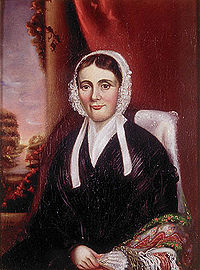 On November 8, 1832, Lord Goderich sent a dispatch to Lieutenant Governor Colborne, which arrived in January 1833, instructing him to make certain financial and political improvements in Upper Canada, and instructing him to rein in the Assembly's vendetta against Mackenzie. The House of Assembly and the Legislative Council were furious at this interference in Upper Canadian politics, and in February again deprived Mackenzie of his vote in the House and refused to call fresh elections. When news of this insubordination reached Lord Goderich, he dismissed Attorney General Boulton and Solicitor General Hagerman. Lieutenant Governor Colborne protested and Boulton and Hagerman travelled to London to make their case.
In April 1833, Lord Goderich was replaced as Secretary of State for War and the Colonies by the more conservative Lord Stanley
. Lord Stanley reappointed Hagerman as solicitor general and named Boulton chief justice
of Newfoundland.
This incident contributed to Mackenzie's decaying faith in Great Britain. Returning to Upper Canada, in December 1833 he renamed the Colonial Advocate simply The Advocate, a sign that he no longer valued the tie to Great Britain. On December 17, 1833, he was again expelled from the Legislative Assembly of Upper Canada, and later in the month was again re-elected: twice, he was refused admission to the House, and in the end it was only Lieutenant Governor Colborne's intervention which resulted in Mackenzie finally being able to take his seat.
Mackenzie broke with his old ally Egerton Ryerson in late 1833. In 1832, Ryerson had negotiated an agreement between the British and Canadian Methodists, and the Methodists agreed to take state aid. Ryerson began attacking British Reformer Joseph Hume in the pages of the Methodist newspaper, the Christian Guardian. Mackenzie disagreed with Ryerson's positions and broke with him at this point.
as a city (meaning it received local self-government) on March 6, 1834, taking the name of "the City of Toronto" to distinguish it from New York City
and the dozen other settlements named 'York' in Upper Canada. The Tories and the Reformers fielded candidates for Toronto's first municipal election, held on March 27, 1834, with the Reformers winning a majority on the Toronto City Council
. Mackenzie was elected as an alderman
. The City Council then met to decide who should become mayor. Mackenzie, after being nominated by Franklin Jackes
, defeated John Rolph in the vote and thereby became the first mayor of Toronto.
Mackenzie was largely ineffectual as a mayor. He got rid of Tory officials and replaced them with his supporters, but did not manage to deal with the city's excessive debt or institute much needed public works. Rather, Mackenzie's management style provoked frequent quarrels on the City Council, and by summer 1834, it was apparent that the Reformers would be able to accomplish nothing in the municipal government. It was therefore not surprising when the Tories won handily in the 1835 City Council elections and Robert Baldwin Sullivan
replaced Mackenzie as mayor.
In elections held in October 1834, the Reformers won a majority in the 12th Parliament of Upper Canada
and Mackenzie was again elected as member for York (though at this point he was still serving as mayor of Toronto). Determined to dedicate himself fulltime to his duties in the Legislative Assembly, in November 1834, he turned over the Advocate to fellow Reformer William John O’Grady
.
Upon meeting in January 1835, the 12th Parliament of Upper Canada voted to reverse all of Mackenzie's previous expulsions from the Legislative Assembly. Mackenzie chaired a special committee of the Legislative Assembly to detail the grievances of Upper Canada, which resulted in the production of the Seventh Report on Grievances, an extensive compilation of major and minor grievances with proposed solutions. The Assembly also appointed Mackenzie as a government director of the Welland Canal Company and Mackenzie produced an exhaustive report on the company's financial situation, though he stopped short of accusing the company's directors of full-blown dishonesty.
Mackenzie's reform proposals resulted in no action, however, since Sir Francis Bond Head
, who was appointed Lieutenant Governor of Upper Canada in 1836, received instructions from the Secretary of State for War and the Colonies, Lord Glenelg
, to disregard the Seventh Report on Grievances. Although Lieutenant Governor Head was initially seen as reform-minded (he appointed Robert Baldwin and John Rolph to the Executive Council), he soon quarrelled with the Reformers in the Legislative Assembly and dissolved the Assembly in May 1836.
In the run-up to the July 1836 election for the 13th Parliament of Upper Canada
, Head actively campaigned on behalf of the Tories against the Reformers, rallying the people behind the cause of loyalty to the British Empire. As a result, a large Tory majority was returned to the Assembly and Mackenzie lost his seat to Edward William Thomson
.
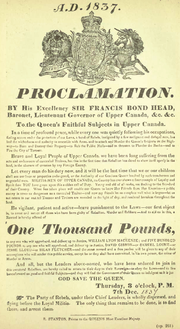
, 1836. In the pages of the Colonial Advocate, Mackenzie began advocating constitutional change for Upper Canada. He now believed that all of the colony's minor grievances could only be rectified through wholesale constitutional reform.
In spring 1837, Lord John Russell
, the British Whig
politician who was then Leader of the House of Commons
(the prime minister
was then Viscount Melbourne
), authored his "Ten Resolutions" on Upper and Lower Canada. The Resolutions removed the few means that the Legislative Assembly of Upper Canada had to control the Executive Council. The Ten Resolutions were the final straw for Mackenzie, and he now advocated severing Upper Canada's link to Great Britain and recommended armed resistance to the British oppression.
Mackenzie spent summer 1837 organizing vigilance and political unions throughout Upper Canada and holding large Reform meetings in the Home District
. These meetings passed resolutions indicating grave concern over how the colony was being governed and called for a convention with delegates from both Upper and Lower Canada to discuss the situation. Moving into fall 1837, Mackenzie attracted large crowds, but also began facing physical attacks from members of the Orange Order
. It was during this period that Mackenzie determined that violent rebellion would be necessary.
In early October, Sir John Colborne, who was now the acting Governor General of British North America, asked Lieutenant Governor Bond Head to despatch troops to Lower Canada, where the tensions which would lead to the outbreak of the Lower Canada Rebellion
in November under the leadership of Louis-Joseph Papineau
were high. In mid-October 1837, Mackenzie organized a meeting of ten of the most radical Reformers, arguing that in the absence of Bond Head's troops, Reformers should organize a coup d’état and seize control of the Upper Canadian government using the employees of two prominent Reformers in the colony. The meeting rejected Mackenzie's proposal and instead determined to organize the farmers of the colony to resist Head and the Family Compact.
Mackenzie now approached John Rolph and Thomas David Morrison
with false information that people outside Toronto were prepared to march on the city to organize a revolt. He also produced a letter from Thomas Storrow Brown
of Montreal which falsely claimed that the Reformers in Lower Canada were about to rise. Rolph and Morrison were still not entirely convinced and asked Mackenzie to canvass opinion north of the city. Instead, Mackenzie called a meeting of Reform leaders outside the city and convinced them that, together with support from Rolph, Morrison, and some disaffected members of the Family Compact, they would be able to take control of the government. He then returned to Toronto and informed Rolph and Morrison that the revolt would begin on December 7. Rolph and Morrison were angry that Mackenzie had deceived them, but ultimately decided to go along with Mackenzie's plan. On Rolph's suggestion, they now contacted Colonel
Anthony Van Egmond
to be the military leader of the rebellion. In the November 15, 1837 issue of The Constitution, Mackenzie published a draft constitution, mainly modelled on the United States Constitution
, but also incorporating English radical
Reform ideas and some aspects of utilitarianism
. If things had gone according to Mackenzie's plan, it appears that on November 29, he would have called for a provincial constitutional convention
, with a provisional government
headed by John Rolph administering the colony in the meantime.
On November 24, Mackenzie travelled north of Toronto to rally supporters. (There is no indication that this was coordinated with the outbreak of the Lower Canada Rebellion earlier in November.) At a meeting on December 2 in Stoufferville, Mackenzie set forth his plan for rebellion in greatest detail: British troops occupied in Lower Canada would be unable to do anything as Reformers from the country marched on Toronto; once there they would join up with Rolph, Morrison, and important men such as Peter Robinson
, George Herchmer Markland
, and John Henry Dunn
(who were not Reformers, but who had resigned from the Executive Council in protest of Lord John Russell's Ten Resolutions). Mackenzie felt that given an armed demonstration, the Tories would be overwhelmed and there would be no need to actually use violence. Instead, Lieutenant Governor Head could be seized and the reserve lands could be used to compensate everyone who marched on Toronto with 300 acres (1.2 km²) of land. The rebels were instructed to assemble at John Montgomery
's tavern
on Yonge Street on December 7, and then march into Toronto together. On December 1, Mackenzie wrote a Declaration of Independence
which was to be distributed to rebels immediately before the march on Toronto. On Sunday, December 3, Mackenzie returned to Toronto, where he learned that John Rolph, having heard a false rumour that the government was preparing to mount a defence, had sent a message to Samuel Lount
, instructing him to raise several hundred men and enter Toronto the next day. Mackenzie attempted to stop this action, but he could not reach Lount in time, and thus the Upper Canada Rebellion began ahead of Mackenzie's planned schedule, on December 4.
to determine Toronto's preparedness. On the way, he was met by Toronto Alderman John Powell
, who had been sent to investigate rumours of unrest north of the city. Powell managed to kill one of Mackenzie's men and then escape back to Toronto, where he warned the government of the impending rebellion.
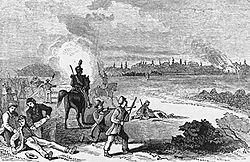 On Tuesday, December 5, Mackenzie grew increasingly erratic and spent the day attempting to punish the property or families of leading Tories instead of marching his men on Toronto. His secondary commanders, Lount and David Gibson, began to question Mackenzie's fitness to lead. Lieutenant Governor Head, unaware of John Rolph's role in planning the rebellion, sent him to attempt to convince Mackenzie to call off the rebellion – Rolph encouraged Mackenzie to enter Toronto immediately. Finally, that evening, Mackenzie began leading his troops to Toronto, but then turned around when troops led by Sheriff
William Botsford Jarvis
fired at them. Many of the men, who believed that they were participating in an armed demonstration, not an actual rebellion, now deserted in the face of actual violence.
On Wednesday, December 6, new arrivals replaced the men who had gone home, but Mackenzie did not attempt to march the men on Toronto and they simply sat around at Montgomery's Tavern. Mackenzie's only action that day was seizing the mail coach bound for Toronto.
On Thursday, December 7, the day initially set for the rebellion, 1000 troops quickly recruited from loyal areas of the province and led by Col. Allan MacNab
, marched on Montgomery's Tavern. Col. Van Egmond (who had just arrived) told Mackenzie that their position was impossible to defend, but Mackenzie put a pistol to Van Egmond's head. In the ensuing Battle of Montgomery's Tavern, Mackenzie's troops quickly surrendered after MacNabb opened artillery fire.
on December 11, 1837. On December 12, he delivered an address to the largest public meeting in the history of Buffalo, describing Upper Canada's desire for liberty and their oppression at the hands of the British, and asking for their help. The meeting ended with wild "cheers for Mackenzie, Papineau, and Rolph!" and Mackenzie thus began a recruiting campaign. On December 13, he declared himself the head of a provisional government, entitled the "Republic of Canada
". He convinced Rensselaer Van Rensselaer (nephew of Stephen Van Rensselaer III
, an American colonel during the War of 1812
) to join in a scheme whereby volunteers would invade Upper Canada from Navy Island
in the Niagara River
. Several hundred volunteers travelled to Navy Island in the next several weeks, as did shipments of food, arms, and cannon shot. Recruitment was hurt, however, when the American government, headed by President
Martin Van Buren
, instructed the volunteers that they would be prosecuted as criminals if they participated in the planned invasion, and many volunteers returned home.
On December 29, British troops led by Capt. Andrew Drew of the Royal Navy
and Canadian volunteers led by Col. Allan MacNab bombarded Navy Island, in the process destroying the SS Caroline
, an American ship that was supplying Mackenzie's and Rensselaer's forces. The action was undertaken based on information supplied by Alexander McLeod
.
While this was going on, Mackenzie had travelled to Buffalo, seeking medical attention for his sick wife. While there, he was arrested for violating American neutrality laws, but was released on bail and returned to Navy Island in January. Van Rensselaer had grown disillusioned, however, and on January 14, 1838, he and his volunteers withdrew from Navy Island.
in January 1838, with his family joining him in April. In May, he launched a new newspaper, Mackenzie's Gazette, which was initially successful because the Rebellions of 1837
had created American interest in Canadian affairs. In January 1839, he moved to Rochester, New York
, and spent several months trying to encourage Canadian exiles to launch a second invasion of Upper Canada, but had no success and eventually returned to New York City. Mackenzie was now determined to settle permanently in the United States, taking the first steps towards American citizenship. For the first time ever, Mackenzie now editorialized on internal American politics. He denounced Martin Van Buren
as a tool of British imperialism because his government had issued a neutrality proclamation.
The trial for Mackenzie's violation of American neutrality laws in January 1838 was finally held in June 1839. Mackenzie was sentenced to pay a $10 fine and spend 18 months in jail. Mackenzie attempted to continue to publish Mackenzie's Gazette from jail, but it appeared only erratically. Soon, the unhealthy conditions of the jail led to a deterioration in Mackenzie's health. Throughout 1839, he and his supporters now petitioned President Van Buren, Governor of New York
William H. Seward
, United States Attorney General
Felix Grundy
, and United States Secretary of State
John Forsyth
. Van Buren was initially reluctant to pardon Mackenzie because he did not want to offend the British, but he eventually acquiesced and Mackenzie was pardoned in May 1840, after he had served less than a year in jail.
Mackenzie's stint in prison seems to have soured him on the United States. He continued to attack Van Buren and the British in the pages of the Gazette, but his editorials now also frequently included denunciations of American life for not being what it claimed. Desiring to return to Canada, he asked influential Reformers such as Isaac Buchanan
to lobby for amnesty
for Mackenzie and the rebels. In the meantime, the Gazette was struggling, in spite of Mackenzie's friendship with prominent American newspapermen like Horace Greeley
, and Mackenzie was forced to shut down the paper in December 1840. In April 1841, he launched a newspaper in Rochester, The Rochester Volunteer. In it, he attempted to whip up fever for a war between the United States and Britain over the issue of Alexander McLeod, a Canadian who had been arrested in New York State in November 1840 for his role in the Caroline incident. The American public was not interested, however, and McLeod was acquitted. The Volunteer failed in September 1841, and in June 1842, Mackenzie moved back to New York City.
There, his money problems forced him to take a job as actuary
and librarian
at the Mechanics’ Institute. Mackenzie became an American citizen in May 1843. Throughout 1843, he worked on a biography of 500 Irish patriots, entitled, The Sons of the Emerald Isle (the first volume of which appeared in 1844) and in fall 1843 quit his job at the Mechanics' Institute to launch a new newspaper, the Examiner, which failed after just five issues. In July 1844, he managed to secure a patronage appointment as a customs
clerk in the New York Custom House
, but he resigned in June 1845 when Cornelius Van Wyck Lawrence
was appointed Collector of the Port of New York
and Mackenzie disagreed with his more conservative political views.
While Mackenzie was working at the Custom House, he copied out the papers of Jesse Hoyt
, a customs official associated with Van Buren and the Albany Regency
. Mackenzie published these papers, selling 50,000 copies, though Mackenzie himself did not make any money from the book, and he was criticized for publishing private papers solely to discredit his political enemies.
In 1846, Mackenzie published the second volume of The Sons of the Emerald Isle, as well as a highly critical biography of Martin Van Buren, whom Mackenzie despised.
In May 1846, Mackenzie's friend Horace Greeley asked him to travel to Albany
to report on the state constitutional convention for the New York Tribune
. The convention produced a radical constitution for New York State, establishing many new elected offices and resulting in the abolition of the Court of Chancery
. In his later years, Mackenzie was much influenced by what he saw at the 1846 New York constitutional convention. Mackenzie stayed in Albany, editing the Albany Patriot until spring 1847 when he returned to New York City to work for the Tribune and to edit almanacs for Horace Greeley.
(which had been formed out of Upper and Lower Canada in 1841 upon the recommendation of Lord Durham
) received responsible government
, with Lord Elgin
being the first Governor General of the Province of Canada
to accept the Legislative Assembly
's advice as to whom to appoint to the Executive Council
and hence the cabinet, instead of appointing the cabinet himself. In the elections for the 3rd Parliament of the Province of Canada
, the Reformers won, and Robert Baldwin
and Louis-Hippolyte Lafontaine
became Joint Premiers of the Province of Canada
. The Baldwin-Lafontaine ministry enacted sweeping reforms in the Province of Canada, which included an amnesty act for the rebels of 1837, which passed the Legislative Assembly in February 1849. Mackenzie wrote to his old friend James Leslie, who was now the Provincial Secretary
, asking to be included in the amnesty.
Mackenzie immediately went on a cross-country tour from Montreal
to Niagara Falls
, though he insisted at the time that he didn't want to move back to Canada and was happy to be allowed to visit. He even briefly accepted a position as the New York Daily Tribunes correspondent in Washington, D.C.
By April 1850, however, his desire to return to Canada was too great, and he moved back to Toronto in May 1850.
Mackenzie continued to write for the Tribune, and as for the Niagara Mail and the Toronto Examiner (owned by James Lesslie) and attempted to collect money that he believed he was owed for his public service in the 1830s.
In response to the Indian Mutiny, Mackenzie initially wrote supportive of the rebels. He argued that ‘the inhabitants of Hindostan’ who were as capable of civilisation as ‘the Celt or Anglo-Saxon’, but not the ‘woolyhaired African’. Later he became more even handed writing that ‘[t]here is cruelty on both sides’ and asked ‘Which has the most reason to be cruel? The strangers who seek to trample India for gain, or the natives whose home is there?’.
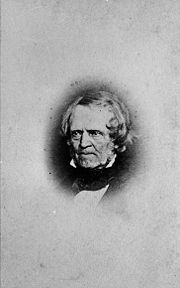 Mackenzie took advantage of his notoriety to resume a career in politics. He ran in a by-election
for the seat of Haldimand County
in the 3rd Parliament of the Province of Canada
. He won the election, defeating George Brown
, the owner of the Toronto Globe, partially because Brown's well-known anti-Catholic views did not play well in a riding with a large number of Catholics.
For the next seven years, Mackenzie was the loudest advocate in the Assembly for the cause of "true reform". This involved a resumption of several of his political stances from the 1830s, including opposition to the clergy reserves and to state funding of religious colleges, and calls for abolishing the Court of Chancery. He now also became an opponent of government overspending, and was especially critical of state aid for railways, especially when those railways were monopolies. He repeatedly introduced a simplified legal code
which he had drafted, but this never passed the Assembly.
As a "true reformer", Mackenzie was opposed to many of his Reform colleagues, whom Mackenzie labelled "sham reformers". One of the first victims of Mackenzie's ire was Robert Baldwin, who was forced to resign as Co-Premier in 1851, partially because of Mackenzie's report on the Court of Chancery in which he revealed that William Hume Blake
had used the 1849 reorganization of the Court of Chancery to line his own pockets. When Mackenzie and Lesslie subsequently campaigned against Baldwin in the October 1851 elections for the 4th Parliament of the Province of Canada
, they were thus largely responsible for Baldwin and several other Reformers losing their seats, and Sir Francis Hincks and Augustin-Norbert Morin
becoming co-premiers.
In 1852, Hincks asked Mackenzie to participate in his negotiations with George Brown's Clear Grits
, who Hincks hoped would rejoin the Reform Party, but Mackenzie refused out of a desire to maintain his freedom of action. Once Mackenzie's old friend John Rolph entered the Hincks-Morin ministry, he offered Mackenzie a plum job in Haldimand County, but Mackenzie refused, saying that he would not burden the Canadian taxpayers with an unnecessary post.
This period saw Mackenzie progressively alienate all of his old friends and allies. In late 1852, he had a falling-out with James Lesslie after Lesslie refused to publish an intemperate letter on crown lands policy in Lesslie's newspaper, the Toronto Examiner. In May 1853, Mackenzie turned his full wrath against Hincks when it was revealed that Hincks and John George Bowes
had stolen from the public in a railway debenture
scheme known as the "£10,000 Job". He even turned on John Rolph and his Lower Canadian ally Malcolm Cameron
, whom he now accused of selling out the cause of reform. His final break with Rolph came in April 1854, when he published a denunciation of Rolph in Mackenzie’s Weekly Message (which he had founded in 1852) in which he accused Rolph of treason
during the 1837 rebellion. Although Mackenzie would have appeared to be a natural ally of George Brown and the Clear Grits, who similarly denounced the Reform Party for "selling out" the cause of reform, Mackenzie despised the Clear Grits because of their "hypocrisy" and because of Brown's anti-Catholic prejudices. Several Reform politicians continued to attempt to reach out to Mackenzie, but he rebuffed all of them, to the point that by 1857, only David Christie
still attempted to include Mackenzie in Reform Party plans.
In the years 1854–1857, Mackenzie proposed an ambitious series of reforms in the Assembly, including a proposal to convert to decimal currency and to have mayors elected directly instead of by city councils. He also supported legislation with widespread support such as the abolition of the clergy reserves, the election of legislative councillors, privately financed railways, and reciprocity
.
In 1854, Mackenzie's old enemy, Allan MacNab (or Sir Allan MacNab, as he now was), became co-premier of the Province of Canada. As chairman of the finance committee during 1854–55, Mackenzie was able to expose financial mismanagement and misuse of patronage by MacNab and Attorney General John A. Macdonald
. Mackenzie now came to believe that the union of the two Canadas had been such a disaster that he thought it was no longer reformable.
As at many points in his life, Mackenzie continued to suffer from financial difficulties. James Lesslie, who had reconciled with Mackenzie, organized a fund to "reward" Mackenzie for his years of service to Canada, ultimately raising $7,500, which Mackenzie used to buy a house and to secure a loan for his newspaper.
His health failing, and his confidence in the reform movement gone, Mackenzie resigned his seat in the Legislative Assembly in August 1858.
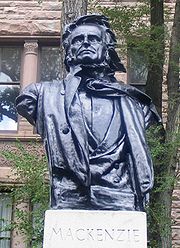 By 1858, Mackenzie advocated annexation of Canada by the United States and pushed this position regularly in the Message. The paper no longer even covered Canadian politics at all. By 1861, his mood had improved somewhat, and he now proposed some sort of federal union between Britain, Canada, the United States, and Ireland. He reconciled with George Brown and the two enjoyed friendly relations.
Mackenzie died on August 28, 1861, following an apoplectic seizure
. He died at his home in which he had lived since 1858 at 82 Bond Street
in Toronto, and was buried at Toronto Necropolis
. His house was recognized as a historic site in 1936 and became a museum. Toronto's William Lyon Mackenzie Collegiate Institute
was named after him.
Journalist
A journalist collects and distributes news and other information. A journalist's work is referred to as journalism.A reporter is a type of journalist who researchs, writes, and reports on information to be presented in mass media, including print media , electronic media , and digital media A...
, politician
Politician
A politician, political leader, or political figure is an individual who is involved in influencing public policy and decision making...
, and rebellion leader. He served as the first mayor of Toronto, Upper Canada and was an important leader during the 1837 Upper Canada Rebellion
Upper Canada Rebellion
The Upper Canada Rebellion was, along with the Lower Canada Rebellion in Lower Canada, a rebellion against the British colonial government in 1837 and 1838. Collectively they are also known as the Rebellions of 1837.-Issues:...
.
Background and early years in Scotland, 1795–1820
Mackenzie was born in DundeeDundee
Dundee is the fourth-largest city in Scotland and the 39th most populous settlement in the United Kingdom. It lies within the eastern central Lowlands on the north bank of the Firth of Tay, which feeds into the North Sea...
, Scotland
Scotland
Scotland is a country that is part of the United Kingdom. Occupying the northern third of the island of Great Britain, it shares a border with England to the south and is bounded by the North Sea to the east, the Atlantic Ocean to the north and west, and the North Channel and Irish Sea to the...
. Both of Mackenzie's parents, Daniel Mackenzie, a weaver
Weaving
Weaving is a method of fabric production in which two distinct sets of yarns or threads are interlaced at right angles to form a fabric or cloth. The other methods are knitting, lace making and felting. The longitudinal threads are called the warp and the lateral threads are the weft or filling...
, and Elizabeth Mackenzie, née Chambers, came from Kirkmichael. They married in May 1794: a widow
Widow
A widow is a woman whose spouse has died, while a widower is a man whose spouse has died. The state of having lost one's spouse to death is termed widowhood or occasionally viduity. The adjective form is widowed...
, Elizabeth was seventeen years older than Daniel. Daniel allegedly died three weeks after William Lyon Mackenzie's birth (though historians have been unable to find a record of his burial) and Mackenzie was raised by his mother. Elizabeth Mackenzie was a deeply religious woman, a proponent of the Secession
United Secession Church
The United Secession Church was a Scottish Presbyterian denomination. It was founded in 1820 by a union of various churches which had seceded from the established Church of Scotland and existed until 1847....
, a branch of Scottish Presbyterianism
Presbyterianism
Presbyterianism refers to a number of Christian churches adhering to the Calvinist theological tradition within Protestantism, which are organized according to a characteristic Presbyterian polity. Presbyterian theology typically emphasizes the sovereignty of God, the authority of the Scriptures,...
deeply committed to the separation of church and state
Separation of church and state
The concept of the separation of church and state refers to the distance in the relationship between organized religion and the nation state....
. While William Lyon Mackenzie was not a religious man himself, he remained a proponent of separation of church and state for his entire life.
Mackenzie entered a parish grammar school at Dundee
Dundee
Dundee is the fourth-largest city in Scotland and the 39th most populous settlement in the United Kingdom. It lies within the eastern central Lowlands on the north bank of the Firth of Tay, which feeds into the North Sea...
at age 5, thanks to a bursary
Bursary
A bursary is strictly an office for a bursar and his or her staff in a school or college.In modern English usage, the term has become synonymous with "bursary award", a monetary award made by an institution to an individual or a group to assist the development of their education.According to The...
, and then moved on to a Mr. Adie's school. Mackenzie early on adopted habits as a voracious reader, keeping a list detailing the 958 books he read between 1806 and 1820. By 1810, at age 15, he was writing for a local newspaper
Newspaper
A newspaper is a scheduled publication containing news of current events, informative articles, diverse features and advertising. It usually is printed on relatively inexpensive, low-grade paper such as newsprint. By 2007, there were 6580 daily newspapers in the world selling 395 million copies a...
. During this time he also joined a scientific society. It was there that he met Edward Lesslie and his sons James
James Lesslie (publisher)
James Lesslie was an Ontario businessman and publisher.He was born in Dundee, Scotland in 1802, the son of a bookseller, and came to Kingston, Upper Canada with a brother and sister in 1822 as part of a plan to relocate the family business to Canada. Lesslie and Sons operated stores in York ,...
and John, who would play a large role in Mackenzie's life.
Mackenzie's mother arranged for him to apprentice with several tradesmen in Dundee
Dundee
Dundee is the fourth-largest city in Scotland and the 39th most populous settlement in the United Kingdom. It lies within the eastern central Lowlands on the north bank of the Firth of Tay, which feeds into the North Sea...
, but in 1814, he was able to secure financial backing from Edward Lesslie to open a general store
General store
A general store, general merchandise store, or village shop is a rural or small town store that carries a general line of merchandise. It carries a broad selection of merchandise, sometimes in a small space, where people from the town and surrounding rural areas come to purchase all their general...
and circulating library in Alyth
Alyth
Alyth is a village in Perth and Kinross, Scotland, situated under the Hill of Alyth five miles northeast of Blairgowrie. The village has a population of 2,301...
. During this period Mackenzie had a romantic relationship with one Isabel Reid, of whom nothing is known except that she gave birth to Mackenzie's illegitimate son on July 17, 1814. The boy was raised by Mackenzie's mother.
During the recession
Recession
In economics, a recession is a business cycle contraction, a general slowdown in economic activity. During recessions, many macroeconomic indicators vary in a similar way...
which followed the ending of the Napoleonic Wars
Napoleonic Wars
The Napoleonic Wars were a series of wars declared against Napoleon's French Empire by opposing coalitions that ran from 1803 to 1815. As a continuation of the wars sparked by the French Revolution of 1789, they revolutionised European armies and played out on an unprecedented scale, mainly due to...
in 1815, Mackenzie's store in Dundee went bankrupt and he had to travel to seek work, first returning to Dundee; then going to Wiltshire
Wiltshire
Wiltshire is a ceremonial county in South West England. It is landlocked and borders the counties of Dorset, Somerset, Hampshire, Gloucestershire, Oxfordshire and Berkshire. It contains the unitary authority of Swindon and covers...
in 1818 to work for a canal
Canal
Canals are man-made channels for water. There are two types of canal:#Waterways: navigable transportation canals used for carrying ships and boats shipping goods and conveying people, further subdivided into two kinds:...
company; travelled briefly to France
France
The French Republic , The French Republic , The French Republic , (commonly known as France , is a unitary semi-presidential republic in Western Europe with several overseas territories and islands located on other continents and in the Indian, Pacific, and Atlantic oceans. Metropolitan France...
; and then worked briefly for a newspaper in London
London
London is the capital city of :England and the :United Kingdom, the largest metropolitan area in the United Kingdom, and the largest urban zone in the European Union by most measures. Located on the River Thames, London has been a major settlement for two millennia, its history going back to its...
.
Lacking stable employment, at age 25, Mackenzie decided to emigrate
Emigration
Emigration is the act of leaving one's country or region to settle in another. It is the same as immigration but from the perspective of the country of origin. Human movement before the establishment of political boundaries or within one state is termed migration. There are many reasons why people...
to British North America
British North America
British North America is a historical term. It consisted of the colonies and territories of the British Empire in continental North America after the end of the American Revolutionary War and the recognition of American independence in 1783.At the start of the Revolutionary War in 1775 the British...
, along with his friend John Lesslie.
Early years in Canada, 1820–1824
Mackenzie initially found a job working on the Lachine CanalLachine Canal
The Lachine Canal is a canal passing through the southwestern part of the Island of Montreal, Quebec, Canada, running 14.5 kilometres from the Old Port of Montreal to Lake Saint-Louis, through the boroughs of Lachine, Lasalle and Sud-Ouest.The canal gets its name from the French word for China...
in Lower Canada
Lower Canada
The Province of Lower Canada was a British colony on the lower Saint Lawrence River and the shores of the Gulf of Saint Lawrence...
. He wrote for the Montreal Herald during this period. John Lesslie, on the other hand, had settled in York, Upper Canada
York, Upper Canada
York was the name of Old Toronto between 1793 and 1834. It was the second capital of Upper Canada.- History :The town was established in 1793 by Governor John Graves Simcoe, with a new 'Fort York' on the site of the last French 'Fort Toronto'...
(now Toronto
Toronto
Toronto is the provincial capital of Ontario and the largest city in Canada. It is located in Southern Ontario on the northwestern shore of Lake Ontario. A relatively modern city, Toronto's history dates back to the late-18th century, when its land was first purchased by the British monarchy from...
) and Mackenzie soon became employed at Lesslie's bookselling
Bookselling
Bookselling is the commercial trading of books, the retail and distribution end of the publishing process. People who engage in bookselling are called booksellers or bookmen.-Bookstores today:...
/drugstore
Pharmacy
Pharmacy is the health profession that links the health sciences with the chemical sciences and it is charged with ensuring the safe and effective use of pharmaceutical drugs...
business. Mackenzie fell in love with Upper Canada
Upper Canada
The Province of Upper Canada was a political division in British Canada established in 1791 by the British Empire to govern the central third of the lands in British North America and to accommodate Loyalist refugees from the United States of America after the American Revolution...
and began writing for the York Observer.
In 1822, Edward Lesslie and the rest of his family, along with Elizabeth Mackenzie, joined Mackenzie and John Lesslie in Upper Canada. Elizabeth brought along a young woman, Isabel Baxter (1805–73), whom she had chosen for William Lyon Mackenzie to marry, and the couple were married July 1, 1822 in Montreal
Montreal
Montreal is a city in Canada. It is the largest city in the province of Quebec, the second-largest city in Canada and the seventh largest in North America...
. Isabel would ultimately bear Mackenzie 14 children (including Isabel Grace Mackenzie, the mother of William Lyon Mackenzie King
William Lyon Mackenzie King
William Lyon Mackenzie King, PC, OM, CMG was the dominant Canadian political leader from the 1920s through the 1940s. He served as the tenth Prime Minister of Canada from December 29, 1921 to June 28, 1926; from September 25, 1926 to August 7, 1930; and from October 23, 1935 to November 15, 1948...
).
Edward and John Lesslie now opened a branch store of their business in Dundas
Dundas, Ontario
Dundas is a formerly independent town and now constituent community in the city of Hamilton in Ontario, Canada. It's nickname is the Valley Town. The population has been stable for decades at about twenty thousand, largely because it has not annexed rural land from the protected Dundas Valley...
, entering into a partnership
Partnership
A partnership is an arrangement where parties agree to cooperate to advance their mutual interests.Since humans are social beings, partnerships between individuals, businesses, interest-based organizations, schools, governments, and varied combinations thereof, have always been and remain commonplace...
with Mackenzie on the understanding that Mackenzie would move to Dundas to be the store's manager; the store sold drugs
DRUGS
Destroy Rebuild Until God Shows are an American post-hardcore band formed in 2010. They released their debut self-titled album on February 22, 2011.- Formation :...
, hardware
Hardware
Hardware is a general term for equipment such as keys, locks, hinges, latches, handles, wire, chains, plumbing supplies, tools, utensils, cutlery and machine parts. Household hardware is typically sold in hardware stores....
, and general merchandise, and Mackenzie also operated a circulating library in Dundas. However, Mackenzie's relationship with the Lesslies soured and the partnership was dissolved in 1823. He moved to Queenston and established a business there. While there, he established a relationship with Robert Randal
Robert Randal
Robert Randal was a businessman and political figure in Upper Canada.He was born Robert Randall in Maryland around 1766; after 1809, he spelled his surname Randal. In 1795, he was part of a partnership which wished to buy the lower Michigan peninsula from the United States government...
, one of four members representing Lincoln County
Lincoln County, Ontario
Lincoln County is a historic county in the Canadian province of Ontario.The county was formed in 1792. In 1845, the southern portion of Lincoln County was separated to form Welland County....
in the Legislative Assembly of Upper Canada
Legislative Assembly of Upper Canada
The Legislative Assembly of Upper Canada was created by the Constitutional Act of 1791. It was the elected legislature for the province of Upper Canada and functioned as the province's lower house in the Parliament of Upper Canada...
.
Mackenzie's rise to prominence in Upper Canadian politics, 1824–26
In 1824, Mackenzie established his most famous newspaper, the Colonial Advocate. It was initially established for the purpose of influencing voters in the elections for the 9th Parliament of Upper Canada9th Parliament of Upper Canada
The 9th Parliament of Upper Canada was opened 11 January 1825. Elections in Upper Canada had been held in July 1824. All sessions were held at York, Upper Canada...
. Mackenzie supported some characteristically British institutions, notably the British Empire
British Empire
The British Empire comprised the dominions, colonies, protectorates, mandates and other territories ruled or administered by the United Kingdom. It originated with the overseas colonies and trading posts established by England in the late 16th and early 17th centuries. At its height, it was the...
, primogeniture
Primogeniture
Primogeniture is the right, by law or custom, of the firstborn to inherit the entire estate, to the exclusion of younger siblings . Historically, the term implied male primogeniture, to the exclusion of females...
and the clergy reserves, but he also praised American
United States
The United States of America is a federal constitutional republic comprising fifty states and a federal district...
institutions in the paper.
The Colonial Advocate had financial difficulties, and in November 1824, Mackenzie relocated the paper to York. There, he advocated in favour of the Reform
Reform Party (pre-Confederation)
The Reform movement, sometimes referred to as the Reform Party, began in the 1830s as the movement in the English speaking parts of British North America . It agitated for responsible government....
cause and became an outspoken critic of the "Family Compact
Family Compact
Fully developed after the War of 1812, the Compact lasted until Upper and Lower Canada were united in 1841. In Lower Canada, its equivalent was the Château Clique. The influence of the Family Compact on the government administration at different levels lasted to the 1880s...
", an upper-class clique which dominated the government of Upper Canada. However, the newspaper continued to face financial pressures: the paper had only 825 subscribers by the beginning of 1825, and faced stiff competition from another Reform newspaper, the Canadian Freeman. As a result, Mackenzie had to suspend publishing the Colonial Advocate from July to December 1825. He purchased a new printing press
Printing press
A printing press is a device for applying pressure to an inked surface resting upon a print medium , thereby transferring the ink...
in fall 1825 and resumed publication in 1826, now engaging in even more scurrilous attacks on leading Tory politicians such as William Allan
William Allan (banker)
William Allan JP was a Canadian banker, businessman and politician.Allan was born at Moss, near Huntly, Scotland around 1770. He came to Canada around 1787 to work with Forsyth, Richardson and Company and settled at Niagara a year later. In 1795, he moved to York...
, G. D'Arcy Boulton, Henry John Boulton
Henry John Boulton
Henry John Boulton, QC was a lawyer, judge and political figure in Upper Canada.He was born at Little Holland House, Kensington, England, the son of D’Arcy Boulton, in 1790. Some time later, the family settled in New York state and then moved to Upper Canada around 1800. He studied law at York ...
, and George Gurnett
George Gurnett
George Gurnett was a Canadian journalist and politician.Born in Sussex, England, he emigrated in the 1820s to Virginia and late moved to Ancaster in Upper Canada and finally to York in 1829. When York was incorporated in May 1834 as the city of Toronto, Gurnett was elected to the city council...
. However, Mackenzie continued to amass debts, and in May 1826, he fled across the American border to Lewiston, New York
Lewiston, New York
Lewiston is a village in Niagara County, New York, United States. The population was 2,781 at the 2000 census. The village is named after Morgan Lewis, an early 19th-century governor of New York. It is part of the Buffalo–Niagara Falls Metropolitan Statistical Area.The Village of Lewiston,...
to evade his creditors.
A group of 15 young Tories, perhaps led by Samuel Peters Jarvis, took advantage of Mackenzie's absence to exact revenge for the attacks on the Tories printed in the Colonial Advocate. Thinly disguising themselves as "Indians
Indigenous peoples of the Americas
The indigenous peoples of the Americas are the pre-Columbian inhabitants of North and South America, their descendants and other ethnic groups who are identified with those peoples. Indigenous peoples are known in Canada as Aboriginal peoples, and in the United States as Native Americans...
", they broke into the Colonial Advocates office in broad daylight, smashed the printing press, and threw the type into Lake Ontario
Lake Ontario
Lake Ontario is one of the five Great Lakes of North America. It is bounded on the north and southwest by the Canadian province of Ontario, and on the south by the American state of New York. Ontario, Canada's most populous province, was named for the lake. In the Wyandot language, ontarío means...
. The Tory magistrates did nothing to stop them and did not prosecute them afterwards.
Mackenzie took full advantage of the incident, returning to York and suing the perpetrators in a sensational trial, which propelled Mackenzie into the ranks of martyrs of Upper Canadian liberty, alongside Robert Thorpe
Robert Thorpe
Robert Thorpe was a judge and political figure in Upper Canada.He was born in Dublin, Ireland around 1764. He graduated with a degree in law from Trinity College, Dublin and was admitted to the bar in 1790....
and Robert Fleming Gourlay
Robert Fleming Gourlay
Robert Gourlay was a Scottish-Canadian writer, political reform activist, and agriculturalist.-Biography:...
. Mackenzie refused a settlement of £200 (approximately the value of the damage) and insisted on trial. His legal team, which included Marshall Spring Bidwell
Marshall Spring Bidwell
Marshall Spring Bidwell was a lawyer and political figure in Upper Canada.He was born in Stockbridge, Massachusetts in 1799, the son of Barnabas Bidwell. His family settled in Bath in Upper Canada before the War of 1812. He studied with a law firm in Kingston and was called to the Ontario Bar in...
, argued effectively and the jury returned a verdict of £625, far more than the amount of damage done to the press.
Mackenzie took advantage of the money and fame which the trial had brought him to re-establish his business on sound financial footing.
Career as a Reform advocate, 1827–1834
Joseph Hume
Joseph Hume FRS was a Scottish doctor and Radical MP, born in Montrose, Angus.-Medical career:He studied medicine at the University of Edinburgh and moved to India in 1797...
in presenting the colonists' grievances to the Secretary of State for War and the Colonies
Secretary of State for War and the Colonies
The Secretary of State for War and the Colonies was a British cabinet level position responsible for the army and the British colonies . The Department was created in 1801...
, Lord Goderich
Frederick John Robinson, 1st Viscount Goderich
Frederick John Robinson, 1st Earl of Ripon PC , styled The Honourable F. J. Robinson until 1827 and known as The Viscount Goderich between 1827 and 1833, the name by which he is best known to history, was a British statesman...
. Goderich agreed that injustice was being done and instructed the Legislative Assembly of Upper Canada to redress the grievances. This incident taught Mackenzie the efficacy of appealing directly to Britain.
John Strachan
John Strachan
John Strachan was an influential figure in Upper Canada and the first Anglican Bishop of Toronto.-Early life:Strachan was the youngest of six children born to a quarry worker in Aberdeen, Scotland. He graduated from King's College, Aberdeen in 1797...
, who was then the rector
Rector
The word rector has a number of different meanings; it is widely used to refer to an academic, religious or political administrator...
of York, as well as a member of the Executive Council of Upper Canada
Executive Council of Upper Canada
The Executive Council of Upper Canada had a similar function to the Cabinet in England but was not responsible to the Legislative Assembly. Members of the Executive Council were not necessarily members of the Legislative Assembly but were usually members of the Legislative Council. Members were...
and a prominent member of the Family Compact, also understood the efficacy of petitioning. He was in London the same year to seek a charter
Charter
A charter is the grant of authority or rights, stating that the granter formally recognizes the prerogative of the recipient to exercise the rights specified...
for his proposed King's College (which would ultimately become the University of Toronto
University of Toronto
The University of Toronto is a public research university in Toronto, Ontario, Canada, situated on the grounds that surround Queen's Park. It was founded by royal charter in 1827 as King's College, the first institution of higher learning in Upper Canada...
) and to argue that the Church of England
Church of England
The Church of England is the officially established Christian church in England and the Mother Church of the worldwide Anglican Communion. The church considers itself within the tradition of Western Christianity and dates its formal establishment principally to the mission to England by St...
should receive the proceeds of sales of the clergy reserves. Allying himself with Methodist minister Egerton Ryerson
Egerton Ryerson
Adolphus Egerton Ryerson was a Methodist minister, educator, politician, and public education advocate in early Ontario, Canada...
, who felt that the Methodist Church should share in the proceeds of sale of the clergy reserves, Mackenzie declared himself opposed to Strachan's plans for Upper Canada.
Mackenzie declared his intentions to run in the elections for the 10th Parliament of Upper Canada
10th Parliament of Upper Canada
The 10th Parliament of Upper Canada was opened 8 January 1829. Elections in Upper Canada had been held in July 1828. All sessions were held at York, Upper Canada...
and entered into correspondence with Reformers like Joseph Hume in England and John Neilson
John Neilson
John Neilson was a Scots-Quebecer editor of the newspaper La Gazette de Québec/The Quebec Gazette and a politician.- Biography :...
in Lower Canada. He ran in York County
York County, Ontario
York County is a historic county in Upper Canada, Canada West, and the Canadian province of Ontario.York County was created in 1792 and was part of the jurisdiction of Home District of Upper Canada...
, a riding dominated by colonists of American extraction. Mackenzie was one of four Reformers vying for York County's two seats – the others included two moderates (J. E. Small and Robert Baldwin
Robert Baldwin
Robert Baldwin was born at York . He, along with his political partner Louis-Hippolyte Lafontaine, led the first responsible ministry in Canada, regarded by some as the first truly Canadian government....
) and one radical Reformer, Jesse Ketchum
Jesse Ketchum
Jesse Ketchum was a tanner and political figure in Upper Canada.He was born in Spencertown, New York in 1782. After his mother died, he was taken into a foster home; his foster father was a tanner. He ran away from home in 1799 and joined his brother Seneca, who was farming north of York in Upper...
. During the campaign, Mackenzie published a "Black List" in the Colonial Advocate, a series of attacks on his opponents, leading to the rival Canadian Freeman and the Tories dubbing him "William Liar Mackenzie". Nevertheless, Mackenzie's tactics were successful and he and Ketchum won the seat as part of a landslide that saw the Reformers win a majority of the seats. However, given the undemocratic nature of Upper Canada at this time, this win did not give the Reformers the right to form a cabinet, with the cabinet (the Executive Council of Upper Canada
Executive Council of Upper Canada
The Executive Council of Upper Canada had a similar function to the Cabinet in England but was not responsible to the Legislative Assembly. Members of the Executive Council were not necessarily members of the Legislative Assembly but were usually members of the Legislative Council. Members were...
) still being chosen by the Lieutenant Governor of Upper Canada, Sir Peregrine Maitland
Peregrine Maitland
Sir Peregrine Maitland, KCB, GCB was a British soldier and colonial administrator who played first-class cricket from 1798 to 1808....
, who remained allied with the Family Compact.
The 10th Parliament of Upper Canada opened in January 1829. Although there was speculation that Mackenzie would be elected speaker
Speaker of the Canadian House of Commons
The Speaker of the House of Commons of Canada is the presiding officer of the lower house of the Parliament of Canada and is elected at the beginning of each new parliament by fellow Members of Parliament...
, that honour went to Mackenzie's former lawyer, Marshall Spring Bidwell. Nevertheless, Mackenzie now had a prominent position from which to advocate for further reforms in the colony. He organized committees on agriculture, commerce, and the post office (he denounced the post office because it was run to make a profit for British businessmen and he wanted it to come under local control). He was also critical of the Bank of Upper Canada
Bank of Upper Canada
The Bank of Upper Canada was a Canadian bank established in 1821 under a Charter granted by the colony of Upper Canada in 1819. The incorporators were William Allan, Robert C. Horne, John Scarlett, Francis Jackson, William W. Baldwin, Alexander Legge, Thomas Ridout, his son Samuel Ridout, D’Arcy...
, which was a monopoly
Monopoly
A monopoly exists when a specific person or enterprise is the only supplier of a particular commodity...
and a limited liability company
Limited liability company
A limited liability company is a flexible form of enterprise that blends elements of partnership and corporate structures. It is a legal form of company that provides limited liability to its owners in the vast majority of United States jurisdictions...
(Mackenzie distrusted limited liability companies and favoured hard money
Hard money (policy)
Hard money policies are those which are opposed to fiat currency and thus in support of a specie standard, usually gold or silver, typically implemented with representative money....
). Later in the session, he also spoke out against the Welland Canal
Welland Canal
The Welland Canal is a ship canal in Canada that extends from Port Weller, Ontario, on Lake Ontario, to Port Colborne, Ontario, on Lake Erie. As a part of the St...
Company, denouncing its close links with the Executive Council and the financing methods of William Hamilton Merritt
William Hamilton Merritt
William Hamilton Merritt was an influential figure in the Niagara Peninsula of Upper Canada in early 19th century and one of the fathers of the Welland Canal....
.
In March 1829, Mackenzie traveled to the U.S. to study the new president
President of the United States
The President of the United States of America is the head of state and head of government of the United States. The president leads the executive branch of the federal government and is the commander-in-chief of the United States Armed Forces....
Andrew Jackson
Andrew Jackson
Andrew Jackson was the seventh President of the United States . Based in frontier Tennessee, Jackson was a politician and army general who defeated the Creek Indians at the Battle of Horseshoe Bend , and the British at the Battle of New Orleans...
. He admired the small size of the American government; the spoils system
Spoils system
In the politics of the United States, a spoil system is a practice where a political party, after winning an election, gives government jobs to its voters as a reward for working toward victory, and as an incentive to keep working for the party—as opposed to a system of awarding offices on the...
(whereby a party that wins an election can distribute government jobs to its supporters – unlike in Upper Canada, where those jobs remained controlled by the lieutenant governor no matter who won the election to the Assembly); and Jackson's opposition to the Second Bank of the United States
Second Bank of the United States
The Second Bank of the United States was chartered in 1816, five years after the First Bank of the United States lost its own charter. The Second Bank of the United States was initially headquartered in Carpenters' Hall, Philadelphia, the same as the First Bank, and had branches throughout the...
, which corresponded to Mackenzie's feelings towards the Bank of Upper Canada. Mackenzie was also impressed with Jackson personally when he had the occasion to meet with the president. Following Mackenzie's 1829 trip to the U.S., his political attitudes became increasingly pro-American and anti-British.
The 10th Parliament of Upper Canada was dissolved in 1830 following the death of George IV
George IV of the United Kingdom
George IV was the King of the United Kingdom of Great Britain and Ireland and also of Hanover from the death of his father, George III, on 29 January 1820 until his own death ten years later...
, and fresh elections were called. Unfortunately for Mackenzie and the Reformers, the mood of Upper Canada had changed somewhat from 1828 for a number of reasons: Sir John Colborne
John Colborne, 1st Baron Seaton
Field Marshal John Colborne, 1st Baron Seaton, GCB, GCMG, GCH, PC was a British field marshal and colonial governor.-Early service:...
, who replaced Sir Peregrine Maitland as lieutenant governor in 1828, was less allied with John Strachan and the Family Compact; Colborne had encouraged immigration to Upper Canada from the British Isles, and these new settlers felt more loyalty to the home country than Upper Canadians born in the New World; and the Reform party had seemed to accomplish little during the two years they had controlled the Assembly. Consequently, the 1830 election saw the Reformers win only 20 of the 51 seats in the 11th Parliament of Upper Canada
11th Parliament of Upper Canada
The 11th Parliament of Upper Canada was opened 7 January 1831. Elections in Upper Canada had been held in October 1830. All sessions were held at York, later Toronto...
, though both Mackenzie and Ketchum were returned as members for York.
Disappointed at the setbacks to the Reform movement, Mackenzie became something of a troublemaker. He published vitriolic personal attacks on his political enemies in the Colonial Advocate. He refused to join an agricultural society organized by the Tories, but nevertheless turned up at their meetings and insisted on speaking. And he also caused a ruckus in church: as a member of the assembly, he had attended services at St. James's Cathedral
Cathedral Church of St. James (Toronto)
Cathedral Church of St. James in Toronto, Canada is the home of the oldest congregation in the city. The parish was established in 1797. The Cathedral was begun in 1850 and completed in 1853, was at the time one of the largest buildings in the city...
, the anchor congregation of the established Anglican church, as well as services in an independent Presbyterian church which opposed church-state connection. In summer, 1830, however, he joined St. Andrew's Presbyterian
St. Andrew's Church (Toronto)
St. Andrew's Church, 73 Simcoe Street, Toronto is a large and historic Romanesque Revival Presbyterian church in downtown Toronto, Canada.-History:...
, a congregation organized by Tories who supported the church-state connection. At St. Andrew's, he opposed the church-state connection, leading to a four-year battle within the congregation which ended with the departure of both Mackenzie and the congregation's minister, William Rintoul.
Meanwhile, the 11th Parliament of Upper Canada met in January 1831 and Mackenzie continued to denounce abuses in the province. Influenced by the burgeoning Reform movement
Reform movement
A reform movement is a kind of social movement that aims to make gradual change, or change in certain aspects of society, rather than rapid or fundamental changes...
in England, he also began calling for a review of representation in Upper Canada. He chaired a committee which recommended increased representation for Upper Canadian towns (as opposed to rural areas), a single day's vote and voting by ballot
Ballot
A ballot is a device used to record choices made by voters. Each voter uses one ballot, and ballots are not shared. In the simplest elections, a ballot may be a simple scrap of paper on which each voter writes in the name of a candidate, but governmental elections use pre-printed to protect the...
instead of voice.
Unfortunately for Mackenzie, the Assembly was now in the control of his Tory enemies: Archibald McLean
Archibald McLean (judge)
Chief Justice The Hon. Archibald McLean was a lawyer, judge and political figure in Upper Canada.-Early life:...
was speaker and Henry John Boulton
Henry John Boulton
Henry John Boulton, QC was a lawyer, judge and political figure in Upper Canada.He was born at Little Holland House, Kensington, England, the son of D’Arcy Boulton, in 1790. Some time later, the family settled in New York state and then moved to Upper Canada around 1800. He studied law at York ...
was solicitor general
Solicitor General of Canada
The Solicitor General of Canada was a position in the Canadian ministry from 1892 to 2005. The position was based on the Solicitor General in the British system and was originally designated as an officer to assist the Minister of Justice...
as well as an important member of the House. The Tories, however, also felt threatened: Lieutenant Governor Colborne was reforming the Legislative Council
Legislative Council of Upper Canada
The Legislative Council of Upper Canada was the upper house governing the province of Upper Canada. Modelled after the British House of Lords, it was created by the Constitutional Act of 1791. It was specified that the council should consist of at least seven members. Members were appointed for...
(traditionally dominated by the Family Compact) and paying less heed to John Strachan and the Executive Council. In the meantime, the British election of 1830
United Kingdom general election, 1830
The 1830 United Kingdom general election, was triggered by the death of King George IV and produced the first parliament of the reign of his successor, William IV. Fought in the aftermath of the Swing Riots, it saw electoral reform become a major election issue...
had brought the Reformer Earl Grey
Charles Grey, 2nd Earl Grey
Charles Grey, 2nd Earl Grey, KG, PC , known as Viscount Howick between 1806 and 1807, was Prime Minister of the United Kingdom of Great Britain and Ireland from 22 November 1830 to 16 July 1834. A member of the Whig Party, he backed significant reform of the British government and was among the...
to power in the United Kingdom, and Grey's government was suggesting giving power over certain revenues to the Legislative Assembly of Upper Canada in exchange for a permanent civil list
Civil list
-United Kingdom:In the United Kingdom, the Civil List is the name given to the annual grant that covers some expenses associated with the Sovereign performing their official duties, including those for staff salaries, State Visits, public engagements, ceremonial functions and the upkeep of the...
. Mackenzie supported giving control of revenues to the Legislative Assembly, but he opposed granting a permanent civil list, which he dubbed the "Everlasting Salary Bill".
Mackenzie spent 1831 traveling throughout Upper Canada collecting signatures for petitions to redress Upper Canadian grievances. He also met with Lower Canadian Reformers. New Irish immigrants and those of American descent were particularly supportive of Mackenzie.
In the legislative session that opened in November 1831, Mackenzie demanded investigations of the Bank of Upper Canada, the Welland Canal, King’s College, the revenues, and the chaplain’s salary. Taking his language even a step further, in the Colonial Advocate he denounced the Legislative Assembly as a sycophantic office. This was too much for the Assembly, and in December 1831, they voted to expel Mackenzie by a vote of 24 to 15.
Mackenzie's expulsion helped him to recreate his reputation as a martyr for Upper Canadian liberty. On the day the Assembly voted to expel him, a mob of several hundred stormed the Assembly, demanding that Colborne dissolve the Assembly and call fresh elections. Colborne refused, but on January 2, 1832, Mackenzie won the byelection called to replace him by a vote of 119 to 1. A parade of 134 sleighs down Yonge Street
Yonge Street
Yonge Street is a major arterial route connecting the shores of Lake Ontario in Toronto to Lake Simcoe, a gateway to the Upper Great Lakes. It was formerly listed in the Guinness Book of Records as the longest street in the world at , and the construction of Yonge Street is designated an "Event of...
, accompanied with bagpipes
Bagpipes
Bagpipes are a class of musical instrument, aerophones, using enclosed reeds fed from a constant reservoir of air in the form of a bag. Though the Scottish Great Highland Bagpipe and Irish uilleann pipes have the greatest international visibility, bagpipes of many different types come from...
, celebrated the occasion.
Nevertheless, on January 7, 1832, Henry John Boulton and Allan MacNab
Allan MacNab
Sir Allan Napier MacNab, 1st Baronet was a Canadian political leader and Premier of the Province of Canada before Canadian Confederation .-Biography:...
again succeeded in getting through a motion expelling Mackenzie from the Assembly (on the basis of new attacks Mackenzie had published in the Colonial Advocate). A second byelection was called, and Mackenzie won by a landslide for a second time. When he was again expelled from the Assembly, Mackenzie appealed to London for redress; in response, the Tories organized the British Constitutional Society. 1832 was a time of great political turmoil in Upper Canada. When the Roman Catholic bishop
Bishop
A bishop is an ordained or consecrated member of the Christian clergy who is generally entrusted with a position of authority and oversight. Within the Catholic Church, Eastern Orthodox, Oriental Orthodox Churches, in the Assyrian Church of the East, in the Independent Catholic Churches, and in the...
Alexander Macdonell
Alexander Macdonell (bishop)
Bishop Alexander Macdonell was the first Roman Catholic bishop of Kingston, Upper Canada.-Early years:...
organized a rally in York to demonstrate Catholic support for the Tories, Mackenzie and his supporters disrupted the meeting. In Hamilton
Hamilton, Ontario
Hamilton is a port city in the Canadian province of Ontario. Conceived by George Hamilton when he purchased the Durand farm shortly after the War of 1812, Hamilton has become the centre of a densely populated and industrialized region at the west end of Lake Ontario known as the Golden Horseshoe...
, Tory magistrate William Johnson Kerr
William Johnson Kerr
William Johnson Kerr was a political figure in Upper Canada.He was born in 1787, the son of Robert Kerr and grandson of Sir William Johnson. He was a captain in the Indian Department and with John Brant and John Norton, he led a group of Six Nations warriors at the Battle of Queenston Heights...
arranged to have Mackenzie beaten by thugs. On March 23, Catholic Irish apprentices in York, furious at Mackenzie's attack on Bishop Macdonnell, pelted Mackenzie and Ketchum with garbage; riots broke out in York later that day and Mackenzie might have been killed by the crowd, but for the intervention of Tory magistrate James FitzGibbon
James FitzGibbon
James FitzGibbon was a British soldier and hero of the War of 1812.Born to Garrett FitzGibbon and Mary Widenham in Glin, County Limerick, Ireland, he enlisted in the Knight of Glin's Yeomanry Corps at age 15...
. Following the riots, Mackenzie went into hiding.
In April 1832, Mackenzie travelled to England to petition the British government for redress. In London, he met with reformers Joseph Hume and John Arthur Roebuck
John Arthur Roebuck
John Arthur Roebuck , British politician, was born at Madras, in India.After the death of his father, a civil servant, his mother's second marriage transferred him to Canada, where he was chiefly brought-up. He came to England in 1824, was called to the bar John Arthur Roebuck (28 December 1802...
and wrote in the Morning Chronicle
Morning Chronicle
The Morning Chronicle was a newspaper founded in 1769 in London, England, and published under various owners until 1862. It was most notable for having been the first employer of Charles Dickens, and for publishing the articles by Henry Mayhew which were collected and published in book format in...
to influence British public opinion in his favour. Lord Goderich, serving as Secretary of State for War and the Colonies for a second time, received Mackenzie, along with Egerton Ryerson and Denis-Benjamin Viger
Denis-Benjamin Viger
Denis-Benjamin Viger was a 19th century Lower Canadian politician, lawyer, businessman, and Patriote movement member.Viger was part of the militia in the early 19th century and then a captain in the War of 1812...
, a member of the Legislative Assembly of Lower Canada
Legislative Assembly of Lower Canada
The Legislative Assembly of Lower Canada was the lower house of the bicameral structure of provincial government in Lower Canada until 1838. The legislative assembly was created by the Constitutional Act of 1791...
, on July 2, 1832. Mackenzie felt that Goderich gave him a fair hearing (Goderich suggested that Mackenzie should send him a report on Upper Canada). Mackenzie remained in London for some time, and was present in the galleries for the debate on the Reform Act 1832
Reform Act 1832
The Representation of the People Act 1832 was an Act of Parliament that introduced wide-ranging changes to the electoral system of England and Wales...
. He also wrote a book during this period, Sketches of Canada and the United States, designed to acquaint the British public with his grievances.
In Mackenzie's absence, the Legislative Assembly of Upper Canada voted to expel him a third time; on this occasion, he was re-elected by acclamation.
In April 1833, Lord Goderich was replaced as Secretary of State for War and the Colonies by the more conservative Lord Stanley
Edward Smith-Stanley, 14th Earl of Derby
Edward George Geoffrey Smith-Stanley, 14th Earl of Derby, KG, PC was an English statesman, three times Prime Minister of the United Kingdom, and to date the longest serving leader of the Conservative Party. He was known before 1834 as Edward Stanley, and from 1834 to 1851 as Lord Stanley...
. Lord Stanley reappointed Hagerman as solicitor general and named Boulton chief justice
Chief Justice
The Chief Justice in many countries is the name for the presiding member of a Supreme Court in Commonwealth or other countries with an Anglo-Saxon justice system based on English common law, such as the Supreme Court of Canada, the Constitutional Court of South Africa, the Court of Final Appeal of...
of Newfoundland.
This incident contributed to Mackenzie's decaying faith in Great Britain. Returning to Upper Canada, in December 1833 he renamed the Colonial Advocate simply The Advocate, a sign that he no longer valued the tie to Great Britain. On December 17, 1833, he was again expelled from the Legislative Assembly of Upper Canada, and later in the month was again re-elected: twice, he was refused admission to the House, and in the end it was only Lieutenant Governor Colborne's intervention which resulted in Mackenzie finally being able to take his seat.
Mackenzie broke with his old ally Egerton Ryerson in late 1833. In 1832, Ryerson had negotiated an agreement between the British and Canadian Methodists, and the Methodists agreed to take state aid. Ryerson began attacking British Reformer Joseph Hume in the pages of the Methodist newspaper, the Christian Guardian. Mackenzie disagreed with Ryerson's positions and broke with him at this point.
Mayor of Toronto, 1834
The township of York, which until 1793 had been known as "Toronto", incorporatedMunicipal corporation
A municipal corporation is the legal term for a local governing body, including cities, counties, towns, townships, charter townships, villages, and boroughs. Municipal incorporation occurs when such municipalities become self-governing entities under the laws of the state or province in which...
as a city (meaning it received local self-government) on March 6, 1834, taking the name of "the City of Toronto" to distinguish it from New York City
New York City
New York is the most populous city in the United States and the center of the New York Metropolitan Area, one of the most populous metropolitan areas in the world. New York exerts a significant impact upon global commerce, finance, media, art, fashion, research, technology, education, and...
and the dozen other settlements named 'York' in Upper Canada. The Tories and the Reformers fielded candidates for Toronto's first municipal election, held on March 27, 1834, with the Reformers winning a majority on the Toronto City Council
Toronto City Council
The Toronto City Council is the governing body of the city of Toronto, Ontario, Canada.Members represent wards throughout the city, and are known as councillors....
. Mackenzie was elected as an alderman
Alderman
An alderman is a member of a municipal assembly or council in many jurisdictions founded upon English law. The term may be titular, denoting a high-ranking member of a borough or county council, a council member chosen by the elected members themselves rather than by popular vote, or a council...
. The City Council then met to decide who should become mayor. Mackenzie, after being nominated by Franklin Jackes
Franklin Jackes
Franklin Jackes was an early Torontonian politician and revolutionary.- Early life :Franklin Jackes was born in London, England, the third child of William Jackes and Catharine Palmer. He had a twin brother who was named Napoleon, but who died in infancy...
, defeated John Rolph in the vote and thereby became the first mayor of Toronto.
Mackenzie was largely ineffectual as a mayor. He got rid of Tory officials and replaced them with his supporters, but did not manage to deal with the city's excessive debt or institute much needed public works. Rather, Mackenzie's management style provoked frequent quarrels on the City Council, and by summer 1834, it was apparent that the Reformers would be able to accomplish nothing in the municipal government. It was therefore not surprising when the Tories won handily in the 1835 City Council elections and Robert Baldwin Sullivan
Robert Baldwin Sullivan
Robert Baldwin Sullivan, QC , was a Canadian lawyer, judge, and politician who became the 2nd Mayor of Toronto....
replaced Mackenzie as mayor.
Upper Canadian politics 1835–1836
In May 1834, Mackenzie published a letter from British Reformer Joseph Hume in the pages of the Advocate in which Hume called for independence for the colonies, even by means of violent rebellion if necessary. Mackenzie was criticized for printing this letter (not only by Tories but also by some Reformers such as Egerton Ryerson) but it charted a course that Mackenzie would soon be travelling himself.In elections held in October 1834, the Reformers won a majority in the 12th Parliament of Upper Canada
12th Parliament of Upper Canada
The 12th Parliament of Upper Canada was opened 15 January 1835. Elections in Upper Canada had been held in October 1834. All sessions were held at York, Upper Canada. This parliament was dissolved 28 May 1836 by the new Lieutenant Governor, Sir Francis Bond Head. Head ordered a new election...
and Mackenzie was again elected as member for York (though at this point he was still serving as mayor of Toronto). Determined to dedicate himself fulltime to his duties in the Legislative Assembly, in November 1834, he turned over the Advocate to fellow Reformer William John O’Grady
William John O’Grady
William John O'Grady was an Irish Catholic priest and journalist in Upper Canada. He served as chaplain to Connell James Baldwin's soldiers in Brazil, and followed him to Toronto Gore Township in 1828. From January 1829 he was pastor of St. Paul's church in York.-References:*Curtis Fahey "" in...
.
Upon meeting in January 1835, the 12th Parliament of Upper Canada voted to reverse all of Mackenzie's previous expulsions from the Legislative Assembly. Mackenzie chaired a special committee of the Legislative Assembly to detail the grievances of Upper Canada, which resulted in the production of the Seventh Report on Grievances, an extensive compilation of major and minor grievances with proposed solutions. The Assembly also appointed Mackenzie as a government director of the Welland Canal Company and Mackenzie produced an exhaustive report on the company's financial situation, though he stopped short of accusing the company's directors of full-blown dishonesty.
Mackenzie's reform proposals resulted in no action, however, since Sir Francis Bond Head
Francis Bond Head
Sir Francis Bond Head, 1st Baronet KCH PC , known as "Galloping Head", was Lieutenant-Governor of Upper Canada during the rebellion of 1837.-Biography:...
, who was appointed Lieutenant Governor of Upper Canada in 1836, received instructions from the Secretary of State for War and the Colonies, Lord Glenelg
Charles Grant, 1st Baron Glenelg
Charles Grant, 1st Baron Glenelg PC FRS was a Scottish politician and colonial administrator.-Background and education:...
, to disregard the Seventh Report on Grievances. Although Lieutenant Governor Head was initially seen as reform-minded (he appointed Robert Baldwin and John Rolph to the Executive Council), he soon quarrelled with the Reformers in the Legislative Assembly and dissolved the Assembly in May 1836.
In the run-up to the July 1836 election for the 13th Parliament of Upper Canada
13th Parliament of Upper Canada
The 13th Parliament of Upper Canada was opened 8 November 1836. Elections in Upper Canada had been held 20 June 1836. All sessions were held at Toronto.The House of Assembly had five sessions 8 November 1836 to 10 February 1840....
, Head actively campaigned on behalf of the Tories against the Reformers, rallying the people behind the cause of loyalty to the British Empire. As a result, a large Tory majority was returned to the Assembly and Mackenzie lost his seat to Edward William Thomson
Edward William Thomson
Edward William Thomson was a farmer and political figure in Upper Canada.He was born in Kingston in 1794 and settled in Scarborough Township in 1808. He served with the York militia during the War of 1812 and the Rebellions of 1837, eventually commanding the 5th militia district in Canada West...
.
Upper Canada Rebellion, 1837–1838
Planning
In the wake of his electoral defeat, Mackenzie founded a new newspaper, the Colonial Advocate, which symbolically had its first issue printed on July 4Independence Day (United States)
Independence Day, commonly known as the Fourth of July, is a federal holiday in the United States commemorating the adoption of the Declaration of Independence on July 4, 1776, declaring independence from the Kingdom of Great Britain...
, 1836. In the pages of the Colonial Advocate, Mackenzie began advocating constitutional change for Upper Canada. He now believed that all of the colony's minor grievances could only be rectified through wholesale constitutional reform.
In spring 1837, Lord John Russell
John Russell, 1st Earl Russell
John Russell, 1st Earl Russell, KG, GCMG, PC , known as Lord John Russell before 1861, was an English Whig and Liberal politician who served twice as Prime Minister of the United Kingdom in the mid-19th century....
, the British Whig
British Whig Party
The Whigs were a party in the Parliament of England, Parliament of Great Britain, and Parliament of the United Kingdom, who contested power with the rival Tories from the 1680s to the 1850s. The Whigs' origin lay in constitutional monarchism and opposition to absolute rule...
politician who was then Leader of the House of Commons
Leader of the House of Commons
The Leader of the House of Commons is a member of the Cabinet of the United Kingdom who is responsible for arranging government business in the House of Commons...
(the prime minister
Prime Minister of the United Kingdom
The Prime Minister of the United Kingdom of Great Britain and Northern Ireland is the Head of Her Majesty's Government in the United Kingdom. The Prime Minister and Cabinet are collectively accountable for their policies and actions to the Sovereign, to Parliament, to their political party and...
was then Viscount Melbourne
William Lamb, 2nd Viscount Melbourne
William Lamb, 2nd Viscount Melbourne, PC, FRS was a British Whig statesman who served as Home Secretary and Prime Minister . He is best known for his intense and successful mentoring of Queen Victoria, at ages 18-21, in the ways of politics...
), authored his "Ten Resolutions" on Upper and Lower Canada. The Resolutions removed the few means that the Legislative Assembly of Upper Canada had to control the Executive Council. The Ten Resolutions were the final straw for Mackenzie, and he now advocated severing Upper Canada's link to Great Britain and recommended armed resistance to the British oppression.
Mackenzie spent summer 1837 organizing vigilance and political unions throughout Upper Canada and holding large Reform meetings in the Home District
Home District
The Home District was one of four districts of the Province of Quebec created in 1788 in the western reaches of the Montreal District and partitioned in 1791 to create the new colony of Upper Canada. Known as Nassau District until 1792, it was composed of the areas along western Lake Ontario and...
. These meetings passed resolutions indicating grave concern over how the colony was being governed and called for a convention with delegates from both Upper and Lower Canada to discuss the situation. Moving into fall 1837, Mackenzie attracted large crowds, but also began facing physical attacks from members of the Orange Order
Orange Order in Canada
The Orange Order is a Protestant fraternal organisation based predominantly in Northern Ireland and Scotland, and has lodges in Canada, Australia, New Zealand, Ghana, Togo, the U.S.A, etc..-History:...
. It was during this period that Mackenzie determined that violent rebellion would be necessary.
In early October, Sir John Colborne, who was now the acting Governor General of British North America, asked Lieutenant Governor Bond Head to despatch troops to Lower Canada, where the tensions which would lead to the outbreak of the Lower Canada Rebellion
Lower Canada Rebellion
The Lower Canada Rebellion , commonly referred to as the Patriots' War by Quebeckers, is the name given to the armed conflict between the rebels of Lower Canada and the British colonial power of that province...
in November under the leadership of Louis-Joseph Papineau
Louis-Joseph Papineau
Louis-Joseph Papineau , born in Montreal, Quebec, was a politician, lawyer, and the landlord of the seigneurie de la Petite-Nation. He was the leader of the reformist Patriote movement before the Lower Canada Rebellion of 1837–1838. His father was Joseph Papineau, also a famous politician in Quebec...
were high. In mid-October 1837, Mackenzie organized a meeting of ten of the most radical Reformers, arguing that in the absence of Bond Head's troops, Reformers should organize a coup d’état and seize control of the Upper Canadian government using the employees of two prominent Reformers in the colony. The meeting rejected Mackenzie's proposal and instead determined to organize the farmers of the colony to resist Head and the Family Compact.
Mackenzie now approached John Rolph and Thomas David Morrison
Thomas David Morrison
Thomas David Morrison was a doctor and political figure in Upper Canada.He was born in Quebec City around 1796. He served as a clerk in the medical department of the British army during the War of 1812. He studied medicine in the United States and, on his return in 1824, was licensed to practice...
with false information that people outside Toronto were prepared to march on the city to organize a revolt. He also produced a letter from Thomas Storrow Brown
Thomas Storrow Brown
Thomas Storrow Brown was a journalist, writer, orator, and revolutionary in Lower Canada .- Biography :...
of Montreal which falsely claimed that the Reformers in Lower Canada were about to rise. Rolph and Morrison were still not entirely convinced and asked Mackenzie to canvass opinion north of the city. Instead, Mackenzie called a meeting of Reform leaders outside the city and convinced them that, together with support from Rolph, Morrison, and some disaffected members of the Family Compact, they would be able to take control of the government. He then returned to Toronto and informed Rolph and Morrison that the revolt would begin on December 7. Rolph and Morrison were angry that Mackenzie had deceived them, but ultimately decided to go along with Mackenzie's plan. On Rolph's suggestion, they now contacted Colonel
Colonel
Colonel , abbreviated Col or COL, is a military rank of a senior commissioned officer. It or a corresponding rank exists in most armies and in many air forces; the naval equivalent rank is generally "Captain". It is also used in some police forces and other paramilitary rank structures...
Anthony Van Egmond
Anthony Van Egmond
Anthony Van Egmond, born Antonij Jacobi Willem Gijben before coming to North America, was purportedly a Dutch Napoleonic War veteran...
to be the military leader of the rebellion. In the November 15, 1837 issue of The Constitution, Mackenzie published a draft constitution, mainly modelled on the United States Constitution
United States Constitution
The Constitution of the United States is the supreme law of the United States of America. It is the framework for the organization of the United States government and for the relationship of the federal government with the states, citizens, and all people within the United States.The first three...
, but also incorporating English radical
Radicalism (historical)
The term Radical was used during the late 18th century for proponents of the Radical Movement. It later became a general pejorative term for those favoring or seeking political reforms which include dramatic changes to the social order...
Reform ideas and some aspects of utilitarianism
Utilitarianism
Utilitarianism is an ethical theory holding that the proper course of action is the one that maximizes the overall "happiness", by whatever means necessary. It is thus a form of consequentialism, meaning that the moral worth of an action is determined only by its resulting outcome, and that one can...
. If things had gone according to Mackenzie's plan, it appears that on November 29, he would have called for a provincial constitutional convention
Constitutional convention (political meeting)
A constitutional convention is now a gathering for the purpose of writing a new constitution or revising an existing constitution. A general constitutional convention is called to create the first constitution of a political unit or to entirely replace an existing constitution...
, with a provisional government
Provisional government
A provisional government is an emergency or interim government set up when a political void has been created by the collapse of a very large government. The early provisional governments were created to prepare for the return of royal rule...
headed by John Rolph administering the colony in the meantime.
On November 24, Mackenzie travelled north of Toronto to rally supporters. (There is no indication that this was coordinated with the outbreak of the Lower Canada Rebellion earlier in November.) At a meeting on December 2 in Stoufferville, Mackenzie set forth his plan for rebellion in greatest detail: British troops occupied in Lower Canada would be unable to do anything as Reformers from the country marched on Toronto; once there they would join up with Rolph, Morrison, and important men such as Peter Robinson
Peter Robinson (1785-1838)
Peter Robinson was born in New Brunswick, the eldest son of Christopher Robinson and Esther Sayre, ayre. He had two brothers, John Beverley and William Benjamin, and two sisters....
, George Herchmer Markland
George Herchmer Markland
George Herchmer Markland was a political figure in Upper Canada.He was born in Kingston around 1790 and was educated at Cornwall by John Strachan. During the War of 1812, he served with the Frontenac militia. In 1820, he was appointed to the Legislative Council for the province...
, and John Henry Dunn
John Henry Dunn
John Henry Dunn was a businessman and political figure in Canada West. He served as Receiver General for Upper Canada from 1820 to 1841....
(who were not Reformers, but who had resigned from the Executive Council in protest of Lord John Russell's Ten Resolutions). Mackenzie felt that given an armed demonstration, the Tories would be overwhelmed and there would be no need to actually use violence. Instead, Lieutenant Governor Head could be seized and the reserve lands could be used to compensate everyone who marched on Toronto with 300 acres (1.2 km²) of land. The rebels were instructed to assemble at John Montgomery
John Montgomery (tavern-keeper)
John Montgomery owned the tavern which served as a base for the rebels during the Upper Canada Rebellion. His establishment was the site of the Battle of Montgomery's Tavern....
's tavern
Tavern
A tavern is a place of business where people gather to drink alcoholic beverages and be served food, and in some cases, where travelers receive lodging....
on Yonge Street on December 7, and then march into Toronto together. On December 1, Mackenzie wrote a Declaration of Independence
Declaration of independence
A declaration of independence is an assertion of the independence of an aspiring state or states. Such places are usually declared from part or all of the territory of another nation or failed nation, or are breakaway territories from within the larger state...
which was to be distributed to rebels immediately before the march on Toronto. On Sunday, December 3, Mackenzie returned to Toronto, where he learned that John Rolph, having heard a false rumour that the government was preparing to mount a defence, had sent a message to Samuel Lount
Samuel Lount
Samuel Lount was a businessman and political figure in the province of Upper Canada. He participated in the Upper Canada Rebellion of 1837....
, instructing him to raise several hundred men and enter Toronto the next day. Mackenzie attempted to stop this action, but he could not reach Lount in time, and thus the Upper Canada Rebellion began ahead of Mackenzie's planned schedule, on December 4.
The Battle of Montgomery's Tavern
By the evening of Monday, December 4, the first of Lount's troops had begun arriving at Montgomery's Tavern. Mackenzie determined that he should lead a scouting expeditionReconnaissance
Reconnaissance is the military term for exploring beyond the area occupied by friendly forces to gain information about enemy forces or features of the environment....
to determine Toronto's preparedness. On the way, he was met by Toronto Alderman John Powell
John Powell (politician)
John Powell was a Canadian politician who served as mayor of Toronto and played an important role in the Upper Canada Rebellion. Powell was a member of the "Family Compact," the small group of elite families that controlled the politics of Upper Canada in the first half of the nineteenth century...
, who had been sent to investigate rumours of unrest north of the city. Powell managed to kill one of Mackenzie's men and then escape back to Toronto, where he warned the government of the impending rebellion.
Sheriff
A sheriff is in principle a legal official with responsibility for a county. In practice, the specific combination of legal, political, and ceremonial duties of a sheriff varies greatly from country to country....
William Botsford Jarvis
William Botsford Jarvis
William Botsford Jarvis was an important member of the Family Compact and Sheriff of the Home District. His estate in what was then York, Upper Canada gave it's name to Rosedale, Toronto...
fired at them. Many of the men, who believed that they were participating in an armed demonstration, not an actual rebellion, now deserted in the face of actual violence.
On Wednesday, December 6, new arrivals replaced the men who had gone home, but Mackenzie did not attempt to march the men on Toronto and they simply sat around at Montgomery's Tavern. Mackenzie's only action that day was seizing the mail coach bound for Toronto.
On Thursday, December 7, the day initially set for the rebellion, 1000 troops quickly recruited from loyal areas of the province and led by Col. Allan MacNab
Allan MacNab
Sir Allan Napier MacNab, 1st Baronet was a Canadian political leader and Premier of the Province of Canada before Canadian Confederation .-Biography:...
, marched on Montgomery's Tavern. Col. Van Egmond (who had just arrived) told Mackenzie that their position was impossible to defend, but Mackenzie put a pistol to Van Egmond's head. In the ensuing Battle of Montgomery's Tavern, Mackenzie's troops quickly surrendered after MacNabb opened artillery fire.
Attempted invasion from Navy Island
The rebel leaders were allowed to escape to the United States, with Mackenzie arriving in Buffalo, New YorkBuffalo, New York
Buffalo is the second most populous city in the state of New York, after New York City. Located in Western New York on the eastern shores of Lake Erie and at the head of the Niagara River across from Fort Erie, Ontario, Buffalo is the seat of Erie County and the principal city of the...
on December 11, 1837. On December 12, he delivered an address to the largest public meeting in the history of Buffalo, describing Upper Canada's desire for liberty and their oppression at the hands of the British, and asking for their help. The meeting ended with wild "cheers for Mackenzie, Papineau, and Rolph!" and Mackenzie thus began a recruiting campaign. On December 13, he declared himself the head of a provisional government, entitled the "Republic of Canada
Republic of Canada
The Republic of Canada was a declared government proclaimed by William Lyon Mackenzie on December 13, 1837. The self proclaimed government was established on Navy Island in the Niagara River in the latter days of the Upper Canada Rebellion after Mackenzie and 200 of his followers retreated from...
". He convinced Rensselaer Van Rensselaer (nephew of Stephen Van Rensselaer III
Stephen Van Rensselaer III
Stephen Van Rensselaer III was Lieutenant Governor of New York as well as a statesman, soldier, and land-owner, the heir to one of the largest estates in the New York region at the time, which made him the tenth richest American of all time, based on the ratio of his fortune to contemporary GDP...
, an American colonel during the War of 1812
War of 1812
The War of 1812 was a military conflict fought between the forces of the United States of America and those of the British Empire. The Americans declared war in 1812 for several reasons, including trade restrictions because of Britain's ongoing war with France, impressment of American merchant...
) to join in a scheme whereby volunteers would invade Upper Canada from Navy Island
Navy Island
Navy Island is a small island in the Niagara River in the province of Ontario, managed by Parks Canada as a National Historic Site of Canada. It is located about upstream from Horseshoe Falls, and has an area of roughly...
in the Niagara River
Niagara River
The Niagara River flows north from Lake Erie to Lake Ontario. It forms part of the border between the Province of Ontario in Canada and New York State in the United States. There are differing theories as to the origin of the name of the river...
. Several hundred volunteers travelled to Navy Island in the next several weeks, as did shipments of food, arms, and cannon shot. Recruitment was hurt, however, when the American government, headed by President
President of the United States
The President of the United States of America is the head of state and head of government of the United States. The president leads the executive branch of the federal government and is the commander-in-chief of the United States Armed Forces....
Martin Van Buren
Martin Van Buren
Martin Van Buren was the eighth President of the United States . Before his presidency, he was the eighth Vice President and the tenth Secretary of State, under Andrew Jackson ....
, instructed the volunteers that they would be prosecuted as criminals if they participated in the planned invasion, and many volunteers returned home.
On December 29, British troops led by Capt. Andrew Drew of the Royal Navy
Royal Navy
The Royal Navy is the naval warfare service branch of the British Armed Forces. Founded in the 16th century, it is the oldest service branch and is known as the Senior Service...
and Canadian volunteers led by Col. Allan MacNab bombarded Navy Island, in the process destroying the SS Caroline
Caroline affair
The Caroline affair was a series of events beginning in 1837 that strained relations between the United States and Britain....
, an American ship that was supplying Mackenzie's and Rensselaer's forces. The action was undertaken based on information supplied by Alexander McLeod
Alexander McLeod
Alexander McLeod was a Scottish-Canadian who served as sheriff in Niagara, Ontario. After the Upper Canada Rebellion, he boasted that he had partaken in the 1837 Caroline Affair, the sinking of an American steamboat that had been supplying William Lyon Mackenzie's rebels with arms...
.
While this was going on, Mackenzie had travelled to Buffalo, seeking medical attention for his sick wife. While there, he was arrested for violating American neutrality laws, but was released on bail and returned to Navy Island in January. Van Rensselaer had grown disillusioned, however, and on January 14, 1838, he and his volunteers withdrew from Navy Island.
Years in the USA, 1838–1849
With the collapse of his Navy Island scheme, Mackenzie settled in New York CityNew York City
New York is the most populous city in the United States and the center of the New York Metropolitan Area, one of the most populous metropolitan areas in the world. New York exerts a significant impact upon global commerce, finance, media, art, fashion, research, technology, education, and...
in January 1838, with his family joining him in April. In May, he launched a new newspaper, Mackenzie's Gazette, which was initially successful because the Rebellions of 1837
Rebellions of 1837
The Rebellions of 1837 were a pair of Canadian armed uprisings that occurred in 1837 and 1838 in response to frustrations in political reform. A key shared goal was the allowance of responsible government, which was eventually achieved in the incident's aftermath.-Rebellions:The rebellions started...
had created American interest in Canadian affairs. In January 1839, he moved to Rochester, New York
Rochester, New York
Rochester is a city in Monroe County, New York, south of Lake Ontario in the United States. Known as The World's Image Centre, it was also once known as The Flour City, and more recently as The Flower City...
, and spent several months trying to encourage Canadian exiles to launch a second invasion of Upper Canada, but had no success and eventually returned to New York City. Mackenzie was now determined to settle permanently in the United States, taking the first steps towards American citizenship. For the first time ever, Mackenzie now editorialized on internal American politics. He denounced Martin Van Buren
Martin Van Buren
Martin Van Buren was the eighth President of the United States . Before his presidency, he was the eighth Vice President and the tenth Secretary of State, under Andrew Jackson ....
as a tool of British imperialism because his government had issued a neutrality proclamation.
The trial for Mackenzie's violation of American neutrality laws in January 1838 was finally held in June 1839. Mackenzie was sentenced to pay a $10 fine and spend 18 months in jail. Mackenzie attempted to continue to publish Mackenzie's Gazette from jail, but it appeared only erratically. Soon, the unhealthy conditions of the jail led to a deterioration in Mackenzie's health. Throughout 1839, he and his supporters now petitioned President Van Buren, Governor of New York
Governor of New York
The Governor of the State of New York is the chief executive of the State of New York. The governor is the head of the executive branch of New York's state government and the commander-in-chief of the state's military and naval forces. The officeholder is afforded the courtesy title of His/Her...
William H. Seward
William H. Seward
William Henry Seward, Sr. was the 12th Governor of New York, United States Senator and the United States Secretary of State under Abraham Lincoln and Andrew Johnson...
, United States Attorney General
United States Attorney General
The United States Attorney General is the head of the United States Department of Justice concerned with legal affairs and is the chief law enforcement officer of the United States government. The attorney general is considered to be the chief lawyer of the U.S. government...
Felix Grundy
Felix Grundy
Felix Grundy was a U.S. Congressman and U.S. Senator from Tennessee who also served as the 13th Attorney General of the United States.-Biography:...
, and United States Secretary of State
United States Secretary of State
The United States Secretary of State is the head of the United States Department of State, concerned with foreign affairs. The Secretary is a member of the Cabinet and the highest-ranking cabinet secretary both in line of succession and order of precedence...
John Forsyth
John Forsyth (politician)
John Forsyth, Sr. was a 19th-century American politician from Georgia.Forsyth was born in Fredericksburg, Virginia. His father Robert Forsyth was the first U.S. Marshal to be killed in the line of duty in 1794. He was an attorney who graduated from the College of New Jersey in 1799...
. Van Buren was initially reluctant to pardon Mackenzie because he did not want to offend the British, but he eventually acquiesced and Mackenzie was pardoned in May 1840, after he had served less than a year in jail.
Mackenzie's stint in prison seems to have soured him on the United States. He continued to attack Van Buren and the British in the pages of the Gazette, but his editorials now also frequently included denunciations of American life for not being what it claimed. Desiring to return to Canada, he asked influential Reformers such as Isaac Buchanan
Isaac Buchanan
Isaac Buchanan was a businessman and political figure in Canada West. He was also an international merchant, first president of the Hamilton Club, founder of Hamilton and Toronto boards of trade - forerunners to modern chambers of commerce - and founder of the regiment that later became the Royal...
to lobby for amnesty
Amnesty
Amnesty is a legislative or executive act by which a state restores those who may have been guilty of an offense against it to the positions of innocent people, without changing the laws defining the offense. It includes more than pardon, in as much as it obliterates all legal remembrance of the...
for Mackenzie and the rebels. In the meantime, the Gazette was struggling, in spite of Mackenzie's friendship with prominent American newspapermen like Horace Greeley
Horace Greeley
Horace Greeley was an American newspaper editor, a founder of the Liberal Republican Party, a reformer, a politician, and an outspoken opponent of slavery...
, and Mackenzie was forced to shut down the paper in December 1840. In April 1841, he launched a newspaper in Rochester, The Rochester Volunteer. In it, he attempted to whip up fever for a war between the United States and Britain over the issue of Alexander McLeod, a Canadian who had been arrested in New York State in November 1840 for his role in the Caroline incident. The American public was not interested, however, and McLeod was acquitted. The Volunteer failed in September 1841, and in June 1842, Mackenzie moved back to New York City.
There, his money problems forced him to take a job as actuary
Actuary
An actuary is a business professional who deals with the financial impact of risk and uncertainty. Actuaries provide expert assessments of financial security systems, with a focus on their complexity, their mathematics, and their mechanisms ....
and librarian
Librarian
A librarian is an information professional trained in library and information science, which is the organization and management of information services or materials for those with information needs...
at the Mechanics’ Institute. Mackenzie became an American citizen in May 1843. Throughout 1843, he worked on a biography of 500 Irish patriots, entitled, The Sons of the Emerald Isle (the first volume of which appeared in 1844) and in fall 1843 quit his job at the Mechanics' Institute to launch a new newspaper, the Examiner, which failed after just five issues. In July 1844, he managed to secure a patronage appointment as a customs
Customs
Customs is an authority or agency in a country responsible for collecting and safeguarding customs duties and for controlling the flow of goods including animals, transports, personal effects and hazardous items in and out of a country...
clerk in the New York Custom House
Custom House
A custom house or customs house was a building housing the offices for the government officials who processed the paperwork for the import and export of goods into and out of a country. Customs officials also collected customs duty on imported goods....
, but he resigned in June 1845 when Cornelius Van Wyck Lawrence
Cornelius Van Wyck Lawrence
Cornelius Van Wyck Lawrence was a politician from New York. He became the first popularly elected Mayor of New York City after the law was changed in 1834.-Biography:...
was appointed Collector of the Port of New York
Collector of the Port of New York
The Collector of Customs at the Port of New York, most often referred to as Collector of the Port of New York, sometimes also as Collector of Customs for the Port of New York or Collector of Customs for the District of New York, was a federal officer who was in charge of the collection of import...
and Mackenzie disagreed with his more conservative political views.
While Mackenzie was working at the Custom House, he copied out the papers of Jesse Hoyt
Swartwout-Hoyt scandal
The Swartwout-Hoyt scandal arose from corruption in the Office of the Collector of the Port of New York.In 1829, President Andrew Jackson appointed Samuel Swartwout to serve as Collector of the Port of New York. Nine years later, in 1838, it came to light that Mr...
, a customs official associated with Van Buren and the Albany Regency
Albany Regency
The Albany Regency was a group of politicians who controlled the New York state government between 1822 and 1838. The group was among the first American political machines...
. Mackenzie published these papers, selling 50,000 copies, though Mackenzie himself did not make any money from the book, and he was criticized for publishing private papers solely to discredit his political enemies.
In 1846, Mackenzie published the second volume of The Sons of the Emerald Isle, as well as a highly critical biography of Martin Van Buren, whom Mackenzie despised.
In May 1846, Mackenzie's friend Horace Greeley asked him to travel to Albany
Albany, New York
Albany is the capital city of the U.S. state of New York, the seat of Albany County, and the central city of New York's Capital District. Roughly north of New York City, Albany sits on the west bank of the Hudson River, about south of its confluence with the Mohawk River...
to report on the state constitutional convention for the New York Tribune
New York Tribune
The New York Tribune was an American newspaper, first established by Horace Greeley in 1841, which was long considered one of the leading newspapers in the United States...
. The convention produced a radical constitution for New York State, establishing many new elected offices and resulting in the abolition of the Court of Chancery
Court of Chancery
The Court of Chancery was a court of equity in England and Wales that followed a set of loose rules to avoid the slow pace of change and possible harshness of the common law. The Chancery had jurisdiction over all matters of equity, including trusts, land law, the administration of the estates of...
. In his later years, Mackenzie was much influenced by what he saw at the 1846 New York constitutional convention. Mackenzie stayed in Albany, editing the Albany Patriot until spring 1847 when he returned to New York City to work for the Tribune and to edit almanacs for Horace Greeley.
Final years in Canada, 1849–1861
In 1848, the Province of CanadaProvince of Canada
The Province of Canada, United Province of Canada, or the United Canadas was a British colony in North America from 1841 to 1867. Its formation reflected recommendations made by John Lambton, 1st Earl of Durham in the Report on the Affairs of British North America following the Rebellions of...
(which had been formed out of Upper and Lower Canada in 1841 upon the recommendation of Lord Durham
John Lambton, 1st Earl of Durham
John George Lambton, 1st Earl of Durham GCB, PC , also known as "Radical Jack" and commonly referred to in history texts simply as Lord Durham, was a British Whig statesman, colonial administrator, Governor General and high commissioner of British North America...
) received responsible government
Responsible government
Responsible government is a conception of a system of government that embodies the principle of parliamentary accountability which is the foundation of the Westminster system of parliamentary democracy...
, with Lord Elgin
James Bruce, 8th Earl of Elgin
Sir James Bruce, 8th Earl of Elgin and 12th Earl of Kincardine, KT, GCB, PC , was a British colonial administrator and diplomat...
being the first Governor General of the Province of Canada
Governor General of the Province of Canada
The Governor General of the Province of Canada was the vice-regal post of pre-Confederation Canada that existed from 1840 to Canadian Confederation in 1867....
to accept the Legislative Assembly
Legislative Assembly of the Province of Canada
The Legislative Assembly of the Province of Canada was the lower house of the legislature for the Province of Canada, which consisted of the former provinces of Lower Canada, then known as Canada East and later the province of Quebec, and Upper Canada, then known as Canada West and later the...
's advice as to whom to appoint to the Executive Council
Executive Council (Canada)
Executive Councils in the provinces and territories of Canada are constitutional organs headed by the Lieutenant Governor.The Cabinet is an informal grouping within the Council, headed by a provincial Premier, whom hold de facto power over the body...
and hence the cabinet, instead of appointing the cabinet himself. In the elections for the 3rd Parliament of the Province of Canada
3rd Parliament of the Province of Canada
The 3rd Parliament of the Province of Canada was in session from 1848 to 1851. Elections were held in the Province of Canada in January 1848. The first session was held at Montreal, Canada East. In 1849, rioters protesting the Rebellion Losses Bill burned the parliament buildings...
, the Reformers won, and Robert Baldwin
Robert Baldwin
Robert Baldwin was born at York . He, along with his political partner Louis-Hippolyte Lafontaine, led the first responsible ministry in Canada, regarded by some as the first truly Canadian government....
and Louis-Hippolyte Lafontaine
Louis-Hippolyte Lafontaine
Sir Louis-Hippolyte Lafontaine , 1st Baronet, KCMG was the first Canadian to become Prime Minister of the United Province of Canada and the first head of a responsible government in Canada. He was born in Boucherville, Lower Canada in 1807...
became Joint Premiers of the Province of Canada
Joint Premiers of the Province of Canada
Joint Premiers of the Province of Canada were the leaders of the Province of Canada, from the 1841 unification of Upper Canada and Lower Canada until Confederation in 1867....
. The Baldwin-Lafontaine ministry enacted sweeping reforms in the Province of Canada, which included an amnesty act for the rebels of 1837, which passed the Legislative Assembly in February 1849. Mackenzie wrote to his old friend James Leslie, who was now the Provincial Secretary
Provincial Secretary
The Provincial Secretary was a senior position in the executive councils of British North America's colonial governments, and was retained by the Canadian provincial governments for at least a century after Canadian Confederation was proclaimed in 1867...
, asking to be included in the amnesty.
Mackenzie immediately went on a cross-country tour from Montreal
Montreal
Montreal is a city in Canada. It is the largest city in the province of Quebec, the second-largest city in Canada and the seventh largest in North America...
to Niagara Falls
Niagara Falls, Ontario
Niagara Falls is a Canadian city on the Niagara River in the Golden Horseshoe region of Southern Ontario. The municipality was incorporated on June 12, 1903...
, though he insisted at the time that he didn't want to move back to Canada and was happy to be allowed to visit. He even briefly accepted a position as the New York Daily Tribunes correspondent in Washington, D.C.
Washington, D.C.
Washington, D.C., formally the District of Columbia and commonly referred to as Washington, "the District", or simply D.C., is the capital of the United States. On July 16, 1790, the United States Congress approved the creation of a permanent national capital as permitted by the U.S. Constitution....
By April 1850, however, his desire to return to Canada was too great, and he moved back to Toronto in May 1850.
Mackenzie continued to write for the Tribune, and as for the Niagara Mail and the Toronto Examiner (owned by James Lesslie) and attempted to collect money that he believed he was owed for his public service in the 1830s.
In response to the Indian Mutiny, Mackenzie initially wrote supportive of the rebels. He argued that ‘the inhabitants of Hindostan’ who were as capable of civilisation as ‘the Celt or Anglo-Saxon’, but not the ‘woolyhaired African’. Later he became more even handed writing that ‘[t]here is cruelty on both sides’ and asked ‘Which has the most reason to be cruel? The strangers who seek to trample India for gain, or the natives whose home is there?’.
Return to the Legislature, 1851–1858
By-election
A by-election is an election held to fill a political office that has become vacant between regularly scheduled elections....
for the seat of Haldimand County
Haldimand County, Ontario
Haldimand is a rural city-status single-tier municipality on the Niagara Peninsula in Southern Ontario, Canada, on the north shore of Lake Erie, and on the Grand River. Municipal offices are located in Cayuga....
in the 3rd Parliament of the Province of Canada
3rd Parliament of the Province of Canada
The 3rd Parliament of the Province of Canada was in session from 1848 to 1851. Elections were held in the Province of Canada in January 1848. The first session was held at Montreal, Canada East. In 1849, rioters protesting the Rebellion Losses Bill burned the parliament buildings...
. He won the election, defeating George Brown
George Brown (Canadian politician)
George Brown was a Scottish-born Canadian journalist, politician and one of the Fathers of Confederation...
, the owner of the Toronto Globe, partially because Brown's well-known anti-Catholic views did not play well in a riding with a large number of Catholics.
For the next seven years, Mackenzie was the loudest advocate in the Assembly for the cause of "true reform". This involved a resumption of several of his political stances from the 1830s, including opposition to the clergy reserves and to state funding of religious colleges, and calls for abolishing the Court of Chancery. He now also became an opponent of government overspending, and was especially critical of state aid for railways, especially when those railways were monopolies. He repeatedly introduced a simplified legal code
Legal code
A legal code is a body of law written by a governmental body, such as a U.S. state, a Canadian Province or German Bundesland or a municipality...
which he had drafted, but this never passed the Assembly.
As a "true reformer", Mackenzie was opposed to many of his Reform colleagues, whom Mackenzie labelled "sham reformers". One of the first victims of Mackenzie's ire was Robert Baldwin, who was forced to resign as Co-Premier in 1851, partially because of Mackenzie's report on the Court of Chancery in which he revealed that William Hume Blake
William Hume Blake
William Hume Blake, QC was a Canadian jurist and politician. He was the father of Edward Blake, an Ontario Premier and federal Liberal party of Canada leader....
had used the 1849 reorganization of the Court of Chancery to line his own pockets. When Mackenzie and Lesslie subsequently campaigned against Baldwin in the October 1851 elections for the 4th Parliament of the Province of Canada
4th Parliament of the Province of Canada
The 4th Parliament of the Province of Canada was in session from 1852 to June 1854. Elections were held in the Province of Canada in October 1851...
, they were thus largely responsible for Baldwin and several other Reformers losing their seats, and Sir Francis Hincks and Augustin-Norbert Morin
Augustin-Norbert Morin
Augustin-Norbert Morin was a lawyer, judgeBorn in Saint-Michel, Lower Canada, into a large Roman Catholic farming family, Morin was identified by the parish priest at a young age as a boy of exceptional talent and intelligence. The parish priest therefore arranged for his education at the...
becoming co-premiers.
In 1852, Hincks asked Mackenzie to participate in his negotiations with George Brown's Clear Grits
Clear Grits
Clear Grits were reformers in the Province of Upper Canada, a British colony that is now the Province of Ontario, Canada. Their support was concentrated among southwestern Ontario farmers, who were frustrated and disillusioned by the 1849 Reform government of Robert Baldwin and Louis-Hippolyte...
, who Hincks hoped would rejoin the Reform Party, but Mackenzie refused out of a desire to maintain his freedom of action. Once Mackenzie's old friend John Rolph entered the Hincks-Morin ministry, he offered Mackenzie a plum job in Haldimand County, but Mackenzie refused, saying that he would not burden the Canadian taxpayers with an unnecessary post.
This period saw Mackenzie progressively alienate all of his old friends and allies. In late 1852, he had a falling-out with James Lesslie after Lesslie refused to publish an intemperate letter on crown lands policy in Lesslie's newspaper, the Toronto Examiner. In May 1853, Mackenzie turned his full wrath against Hincks when it was revealed that Hincks and John George Bowes
John George Bowes
John George Bowes was a businessman and political figure in Canada East.He was born in Clones, County Monaghan, Republic of Ireland around 1812 and came to Upper Canada in 1833. He worked for his brother-in-law in York , then opened a dry goods business with another brother-in-law in 1838...
had stolen from the public in a railway debenture
Debenture
A debenture is a document that either creates a debt or acknowledges it. In corporate finance, the term is used for a medium- to long-term debt instrument used by large companies to borrow money. In some countries the term is used interchangeably with bond, loan stock or note...
scheme known as the "£10,000 Job". He even turned on John Rolph and his Lower Canadian ally Malcolm Cameron
Malcolm Cameron
Malcolm Cameron was a Canadian businessman and politician.He was born at Trois-Rivières in Lower Canada in 1808 and grew up in Lanark County in Upper Canada. At the age of 15, he found work in the Montreal area but later returned to Perth to complete his schooling. In 1828, he became a merchant in...
, whom he now accused of selling out the cause of reform. His final break with Rolph came in April 1854, when he published a denunciation of Rolph in Mackenzie’s Weekly Message (which he had founded in 1852) in which he accused Rolph of treason
Treason
In law, treason is the crime that covers some of the more extreme acts against one's sovereign or nation. Historically, treason also covered the murder of specific social superiors, such as the murder of a husband by his wife. Treason against the king was known as high treason and treason against a...
during the 1837 rebellion. Although Mackenzie would have appeared to be a natural ally of George Brown and the Clear Grits, who similarly denounced the Reform Party for "selling out" the cause of reform, Mackenzie despised the Clear Grits because of their "hypocrisy" and because of Brown's anti-Catholic prejudices. Several Reform politicians continued to attempt to reach out to Mackenzie, but he rebuffed all of them, to the point that by 1857, only David Christie
David Christie
David Christie, was a Canadian politician.Born in Edinburgh, Scotland, he came to Canada with his family in 1833....
still attempted to include Mackenzie in Reform Party plans.
In the years 1854–1857, Mackenzie proposed an ambitious series of reforms in the Assembly, including a proposal to convert to decimal currency and to have mayors elected directly instead of by city councils. He also supported legislation with widespread support such as the abolition of the clergy reserves, the election of legislative councillors, privately financed railways, and reciprocity
Canadian-American Reciprocity Treaty
The Canadian American Reciprocity Treaty, also known as the Elgin-Marcy Treaty, was a trade treaty between the colonies of British North America and the United States. It covered raw materials and was in effect from 1854 to 1865...
.
In 1854, Mackenzie's old enemy, Allan MacNab (or Sir Allan MacNab, as he now was), became co-premier of the Province of Canada. As chairman of the finance committee during 1854–55, Mackenzie was able to expose financial mismanagement and misuse of patronage by MacNab and Attorney General John A. Macdonald
John A. Macdonald
Sir John Alexander Macdonald, GCB, KCMG, PC, PC , QC was the first Prime Minister of Canada. The dominant figure of Canadian Confederation, his political career spanned almost half a century...
. Mackenzie now came to believe that the union of the two Canadas had been such a disaster that he thought it was no longer reformable.
As at many points in his life, Mackenzie continued to suffer from financial difficulties. James Lesslie, who had reconciled with Mackenzie, organized a fund to "reward" Mackenzie for his years of service to Canada, ultimately raising $7,500, which Mackenzie used to buy a house and to secure a loan for his newspaper.
His health failing, and his confidence in the reform movement gone, Mackenzie resigned his seat in the Legislative Assembly in August 1858.
Final years, 1858–1861
Mackenzie died on August 28, 1861, following an apoplectic seizure
Apoplexy
Apoplexy is a medical term, which can be used to describe 'bleeding' in a stroke . Without further specification, it is rather outdated in use. Today it is used only for specific conditions, such as pituitary apoplexy and ovarian apoplexy. In common speech, it is used non-medically to mean a state...
. He died at his home in which he had lived since 1858 at 82 Bond Street
Mackenzie House
Mackenzie House is a historic building and museum in Toronto, Canada that was the last home of William Lyon Mackenzie, the city's first mayor....
in Toronto, and was buried at Toronto Necropolis
Toronto Necropolis
Necropolis Cemetery is a historic cemetery in Toronto, located on the west side of the Don Valley near Riverdale Farm. Opened in 1850 to replace "Strangers' Burying Ground" , the cemetery is the resting place for many dead Torontonians including:* Joseph Bloor* William Lyon Mackenzie - Toronto's...
. His house was recognized as a historic site in 1936 and became a museum. Toronto's William Lyon Mackenzie Collegiate Institute
William Lyon Mackenzie Collegiate Institute
William Lyon Mackenzie Collegiate Institute is a semestered secondary school located in Toronto, Ontario, Canada on 20 Tillplain Road. It was built in 1960 to accommodate the skyrocketing number of new students in what was then known as North York, and to ease overcrowding at Northview Collegiate...
was named after him.
Miscellaneous
- William Lyon Mackenzie was the grandfather of William Lyon Mackenzie KingWilliam Lyon Mackenzie KingWilliam Lyon Mackenzie King, PC, OM, CMG was the dominant Canadian political leader from the 1920s through the 1940s. He served as the tenth Prime Minister of Canada from December 29, 1921 to June 28, 1926; from September 25, 1926 to August 7, 1930; and from October 23, 1935 to November 15, 1948...
, Canada's Prime Minister during World War IIWorld War IIWorld War II, or the Second World War , was a global conflict lasting from 1939 to 1945, involving most of the world's nations—including all of the great powers—eventually forming two opposing military alliances: the Allies and the Axis...
and its longest serving Prime Minister. - William Lyon Mackenzie Collegiate InstituteWilliam Lyon Mackenzie Collegiate InstituteWilliam Lyon Mackenzie Collegiate Institute is a semestered secondary school located in Toronto, Ontario, Canada on 20 Tillplain Road. It was built in 1960 to accommodate the skyrocketing number of new students in what was then known as North York, and to ease overcrowding at Northview Collegiate...
, a Toronto high school was named for him. Their mascot is a "Lyon". - Toronto Fire ServicesToronto Fire ServicesThe Toronto Fire Services is part of the Emergency Services that respond to 911 calls in the City of Toronto, Ontario, Canada.-Overview:The Toronto Fire Services is responsible for responding to fires, rescue and assisting with medical situations within the City of Toronto...
fire boat William Lyon Mackenzie (fireboat)William Lyon Mackenzie (fireboat)William Lyon Mackenzie # 334, named for Toronto's first mayor William Lyon Mackenzie, is a fireboat for the Toronto Fire Services. It was built in 1964 with a modified Tugboat hull to provide marine fire fighting as well as ice breaking capabilities...
is also named in his honour. - Mackenzie's early 19th century home in Queenston, OntarioQueenston, OntarioQueenston is located 5 km north of Niagara Falls, Ontario in the Town of Niagara-on-the-Lake. The community is bordered by Highway 405 and the Niagara River; its location on the Niagara Escarpment led to the establishment of the now-defunct Queenston Quarry in the area...
has been restored and is now the Mackenzie Printery and Newspaper Museum. The museum includes a working mid 19th century printing shop, and features displays of printing equipment and technology ranging over a 500 year period. The museum is operated by the Niagara Parks CommissionNiagara Parks CommissionThe Niagara Parks Commission, or Niagara Parks for short, is an agency of government of Ontario which maintains the Ontario shoreline of the Niagara River.- History :...
. - "The Rebel Mayor", a TwitterTwitterTwitter is an online social networking and microblogging service that enables its users to send and read text-based posts of up to 140 characters, informally known as "tweets".Twitter was created in March 2006 by Jack Dorsey and launched that July...
account which posted satiricalSatireSatire is primarily a literary genre or form, although in practice it can also be found in the graphic and performing arts. In satire, vices, follies, abuses, and shortcomings are held up to ridicule, ideally with the intent of shaming individuals, and society itself, into improvement...
comments on various candidates in Toronto's 2010 mayoral electionToronto mayoral election, 2010The 2010 Toronto mayoral election was held on October 25, 2010 to elect a mayor of the City of Toronto, Canada. The mayor's seat was open for the first time since the 2003 Toronto election due to the announcement by incumbent mayor David Miller that he will not seek a third term in office...
, was written in the persona and voice of Mackenzie. The feed was eventually revealed to have been written by Shawn Micallef, a journalist for the publications Eye WeeklyEye WeeklyEye Weekly was a free weekly newspaper published in Toronto, Ontario, Canada. It was owned by Torstar, the parent company of the Toronto Star, and was published by their Star Media Group until its final issue on May 5, 2011. The following week, Torstar launched a successor publication, The Grid.-...
and SpacingSpacing (magazine)Spacing is a three-times-yearly magazine published in Toronto, Ontario, Canada. Focusing on issues affecting Toronto's public realm, Spacing was originally published by the Toronto Public Space Committee in house until it was spun off as a wholly independent magazine after the first issue...
.
See also
- Caroline AffairCaroline affairThe Caroline affair was a series of events beginning in 1837 that strained relations between the United States and Britain....
- History of TorontoHistory of TorontoThe Toronto area was home to a number of First Nations groups who lived on the shore of Lake Ontario. At various times, the Neutral, Seneca, Mohawk and Cayuga nations were living in the vicinity of Toronto. The first permanent European presence was the French trading fort Fort Rouillé, which was...
- Hunters' LodgesHunters' LodgesThe Hunter Patriots or Hunters' Lodges were a secret society of filibusters in the United States during the mid-19th century. They appear to have somewhat resembled Freemasons structurally with degrees of rank such as "Snowshoe", "Beaver", "Master Hunter" with the highest rank being "Patriot Hunter"...
- Reform movement (pre-Confederation Canada)
- Republic of CanadaRepublic of CanadaThe Republic of Canada was a declared government proclaimed by William Lyon Mackenzie on December 13, 1837. The self proclaimed government was established on Navy Island in the Niagara River in the latter days of the Upper Canada Rebellion after Mackenzie and 200 of his followers retreated from...
- Upper Canada RebellionUpper Canada RebellionThe Upper Canada Rebellion was, along with the Lower Canada Rebellion in Lower Canada, a rebellion against the British colonial government in 1837 and 1838. Collectively they are also known as the Rebellions of 1837.-Issues:...
External links
- Frederick H. Armstrong and Ronald J. Stagg . "MACKENZIE, WILLIAM LYON," in the Dictionary of Canadian BiographyDictionary of Canadian BiographyThe Dictionary of Canadian Biography is a dictionary of biographical entries for individuals who have contributed to the history of Canada. The DCB, which was initiated in 1959, is a collaboration between the University of Toronto and Université Laval...
- Buffalonian article on the Canadian Rebellion
- The History of the Battle of Toronto by William Lyon MacKenzie, 1839 from the Ontario Time Machine