

Rathmines

Encyclopedia
Rathmines is a suburb on the southside
of Dublin, about 3 kilometres south of the city centre. It effectively begins at the south side of the Grand Canal
and stretches along the Rathmines Road as far as Rathgar
to the south, Ranelagh
to the east and Harold's Cross to the west.
Rathmines has thriving commercial and civil activity and is well-known across Ireland as part of a traditionally known "flatland" - providing rented accommodation to newly arrived junior civil servants and third level students coming from outside the city since the 1930s. In more recent times, Rathmines has diversified its housing stock and many houses have been gentrified by the wealthier beneficiaries of Ireland's economic boom of the 1990s. Rathmines, nonetheless, is often said to have a cosmopolitan air, and has a diverse international population and has always been home to groups of new immigrant communities and indigenous ethnic minorities.
In the 2006 Census, Rathmines had a population of 36,186.
of the Irish
Ráth Maonais, meaning "ringfort of Maonas"/"fort of Maonas". The name Maonas is perhaps derived from Maoghnes or the Norman
name de Meones. Like many of the surrounding areas, it arose from a fortified structure which would have been the centre of civic and commercial activity from the Norman invasion of Ireland
in the 12th century. Rathgar
, Baggotrath and Rathfarnham
are further examples of Dublin placenames deriving from a similar root.
(the estate, or rather liberty, of the Archbishop of Dublin
, whose seat as a Canon of St. Patrick's Cathedral
takes its name from this). There is some evidence of an established settlement around a rath as far back as 1350. Rathmines is part of the Barony of Uppercross, one of the many baronies surrounding the old city of Dublin, bound as it was by walls, some of which are still visible. In more recent times, Rathmines was a popular suburb of Dublin, attracting the wealthy and powerful seeking refuge from the poor living conditions of the city from the middle of the 19th century.
Arguably, Rathmines is best known historically for a bloody battle that took place there in 1649, during the Cromwellian conquest of Ireland
, leading to the death of perhaps up to 5,000 people. The Battle of Rathmines
took place on 2 August 1649 and led to the routing of Royalist forces in Ireland shortly after this time. Some have compared the Battle of Rathmines - or sometimes Baggotrath - as equal in political importance to England's Battle of Naseby
.
In the early 1790s the Grand Canal
was constructed on the northern edge of Rathmines, connecting Rathmines with Portobello
via the La Touch Bridge (which through popular usage became better known as Portobello Bridge).
For several hundred years Rathmines was the location of a "spa" - in fact a spring - the water of which was said to have health-giving properties. It attracted people with all manners of ailments to the area. In the 19th century it was called the "Grattan Spa", as it was located on property once belonging to Henry Grattan
, close to Portobello Bridge. The "spa" gradually fell into a state of neglect as the century progressed, until disputes arose between those who wished to preserve it and those (mainly developers) who wished to get rid of it altogether. In 1872 a Dr. O'Leary, who held a high estimate of the water quality, reported that the "spa" was in "a most disgraceful state of repair", upon which the developer and alderman Frederick Stokes sent samples to the medical inspector, Dr. Cameron, for analysis. Dr. Cameron, a great lover of authority, reported: "It was, in all probability, merely the drainings of some ancient disused sewer, not a chalybeate
spring". Access to the site was blocked up and the once popular "spa" faded from public memory.
The borough of Rathmines had a unionist majority up to the late 1920s, when a local government re-organisation abolished all Dublin borough councils. The last unionist politician to be elected from the borough was Maurice Dockrell (1850–1929).
Dartry Road in Rathmines was the scene of the still-controversial killing of IRA member Timothy Coughlin
by police informer Sean Harling on the evening of 28 January 1928. It happened opposite 'Woodpark Lodge', where Harling lived at the time.
, completed in 1899). This building, now occupied by Rathmines College
, once housed a town council
for the Rathmines Township, made up of local businessmen and other eminent figures. The Rathmines Township was created by Act of Parliament in 1847, and its area was later renamed "Rathmines and Rathgar" and expanded to take in the areas of Rathgar, Ranelagh, Sandymount
and Milltown
. The township was initially responsible only for sanitation, but its powers were extended over time to cover most functions of local government
.
The township was incorporated into the City of Dublin in 1930, and its functions were taken over by Dublin Corporation, now known as Dublin City Council
. Rathmines is still a local electoral area of Dublin City Council, electing four city councillors.
(known in the past as Portobello Barracks), home to many units of the Irish Army
including the 2nd Infantry Battalion.
Another well known feature is the prominent copper dome of Mary Immaculate, Refuge of Sinners Church. The original dome was destroyed in a fire in 1920 and replaced by the current dome when reopened in 1922. The dome was to be used in St Petersburg but the political and social upheaval in this city caused it to be diverted to Dublin.
Rathmines is also home to two well-known primary and secondary schools, St Mary's College (C.S.Sp,) and St Louis Primary and secondary school. Kildare Place National School
, situated on the grounds of the Church of Ireland College of Education
is also a highly reputable Church of Ireland sponsored primary school on Upper Rathmines Road.
Recently a new multiplex cinmea has been added to the local shopping centre. This has three screens with plans for a fourth, it shows up to date movies and features 3D movies.
provided transport from Rathmines to the city centre. Portobello Bridge, which had a steep incline, was often a problem for the horses, which led to the fatal accident of 1861.
On 6 October 1871 work was commenced on the Dublin tram system on Rathmines Road, just before Portobello Bridge, and a horse-drawn tram service was in place the following year. The following year also the long-awaited (since the 1861 accident) improvements to Portobello Bridge were carried out, the Tramway Company paying one third of the total cost of £300.
Rathmines and Ranelagh railway station opened on 16 July 1896 and finally closed on 1 January 1959.
Rathmines is served by the Luas
light rail system. Ranelagh on the Green Line is the most convenient for access to the main street, while the Charlemont and Beechwood stops are also within walking distance of the town.
Dublin Bus
routes 14, 14A, 15, 15A, 15B, 15E, 15F, 18, 65, 65B, 74, 74A, 83, 128 and 142 serve Rathmines. The area is also served by the Dublin Bus Nitelink routes 15N and 49N on Friday and Saturday nights and on public holidays.
Southside (Dublin)
The Southside is not an official administrative area but a colloquial term referring to the area of County Dublin bounded to the north by the River Liffey to the east by Dublin Bay, to the south and west by the boundaries of County Dublin...
of Dublin, about 3 kilometres south of the city centre. It effectively begins at the south side of the Grand Canal
Grand Canal of Ireland
The Grand Canal is the southernmost of a pair of canals that connect Dublin, in the east of Ireland, with the River Shannon in the west,via Tullamore and a number of other villages and towns, the two canals nearly encircling Dublin's inner city. Its sister canal on the Northside of Dublin is the...
and stretches along the Rathmines Road as far as Rathgar
Rathgar
Rathgar is a suburb of Dublin, Ireland, lying about 3 kilometres south of the city centre.-Amenities:Rathgar is largely a quiet suburb with good amenities, including primary and secondary schools, nursing homes, child-care and sports facilities, and good public transport to the city centre...
to the south, Ranelagh
Ranelagh
Ranelagh is a residential area and urban village on the south side of Dublin, Ireland. It is in the postal district of Dublin 6. It is in the local government electoral area of Rathmines and the Dáil Constituency of Dublin South-East.-History:...
to the east and Harold's Cross to the west.
Rathmines has thriving commercial and civil activity and is well-known across Ireland as part of a traditionally known "flatland" - providing rented accommodation to newly arrived junior civil servants and third level students coming from outside the city since the 1930s. In more recent times, Rathmines has diversified its housing stock and many houses have been gentrified by the wealthier beneficiaries of Ireland's economic boom of the 1990s. Rathmines, nonetheless, is often said to have a cosmopolitan air, and has a diverse international population and has always been home to groups of new immigrant communities and indigenous ethnic minorities.
In the 2006 Census, Rathmines had a population of 36,186.
Name
Rathmines is an AnglicisationAnglicisation
Anglicisation, or anglicization , is the process of converting verbal or written elements of any other language into a form that is more comprehensible to an English speaker, or, more generally, of altering something such that it becomes English in form or character.The term most often refers to...
of the Irish
Irish language
Irish , also known as Irish Gaelic, is a Goidelic language of the Indo-European language family, originating in Ireland and historically spoken by the Irish people. Irish is now spoken as a first language by a minority of Irish people, as well as being a second language of a larger proportion of...
Ráth Maonais, meaning "ringfort of Maonas"/"fort of Maonas". The name Maonas is perhaps derived from Maoghnes or the Norman
Normans
The Normans were the people who gave their name to Normandy, a region in northern France. They were descended from Norse Viking conquerors of the territory and the native population of Frankish and Gallo-Roman stock...
name de Meones. Like many of the surrounding areas, it arose from a fortified structure which would have been the centre of civic and commercial activity from the Norman invasion of Ireland
Norman Invasion of Ireland
The Norman invasion of Ireland was a two-stage process, which began on 1 May 1169 when a force of loosely associated Norman knights landed near Bannow, County Wexford...
in the 12th century. Rathgar
Rathgar
Rathgar is a suburb of Dublin, Ireland, lying about 3 kilometres south of the city centre.-Amenities:Rathgar is largely a quiet suburb with good amenities, including primary and secondary schools, nursing homes, child-care and sports facilities, and good public transport to the city centre...
, Baggotrath and Rathfarnham
Rathfarnham
Rathfarnham or Rathfarnam is a Southside suburb of Dublin, Ireland. It is south of Terenure, east of Templeogue, and is in the postal districts of Dublin 14 and 16. It is within the administrative areas of both Dun Laoghaire-Rathdown and South Dublin County Councils.The area of Rathfarnham...
are further examples of Dublin placenames deriving from a similar root.
History
Rathmines has a long history stretching back to the 14th century. At this time, Rathmines and surrounding hinterland were part of the ecclesiastical lands called Cuallu or Cuallan, later the vast Parish of Cullenswood, which gave its name to a nearby area. Cuallu is mentioned in local surveys from 1326 as part of the manor of St. SepulchreManor of St. Sepulchre
The Manor of St. Sepulchre was one of several manors, or liberties, that existed in Dublin, Ireland since the arrival of the Anglo-Normans in the 12th century. They were town lands united to the city, but still preserving their own jurisdiction.St...
(the estate, or rather liberty, of the Archbishop of Dublin
Archbishop of Dublin (Roman Catholic)
The Archbishop of Dublin is the title of the senior cleric who presides over the Archdiocese of Dublin. The Church of Ireland has a similar role, heading the United Dioceses of Dublin and Glendalough. In both cases, the Archbishop is also Primate of Ireland...
, whose seat as a Canon of St. Patrick's Cathedral
St. Patrick's Cathedral, Dublin
Saint Patrick's Cathedral , or more formally, the Cathedral of the Blessed Virgin Mary and St Patrick is a cathedral of the Church of Ireland in Dublin, Ireland which was founded in 1191. The Church has designated it as The National Cathedral of Ireland...
takes its name from this). There is some evidence of an established settlement around a rath as far back as 1350. Rathmines is part of the Barony of Uppercross, one of the many baronies surrounding the old city of Dublin, bound as it was by walls, some of which are still visible. In more recent times, Rathmines was a popular suburb of Dublin, attracting the wealthy and powerful seeking refuge from the poor living conditions of the city from the middle of the 19th century.
Arguably, Rathmines is best known historically for a bloody battle that took place there in 1649, during the Cromwellian conquest of Ireland
Cromwellian conquest of Ireland
The Cromwellian conquest of Ireland refers to the conquest of Ireland by the forces of the English Parliament, led by Oliver Cromwell during the Wars of the Three Kingdoms. Cromwell landed in Ireland with his New Model Army on behalf of England's Rump Parliament in 1649...
, leading to the death of perhaps up to 5,000 people. The Battle of Rathmines
Battle of Rathmines
The Battle of Rathmines was fought in and around what is now the Dublin suburb of Rathmines in August 1649, during the Irish Confederate Wars, the Irish theatre of the Wars of the Three Kingdoms...
took place on 2 August 1649 and led to the routing of Royalist forces in Ireland shortly after this time. Some have compared the Battle of Rathmines - or sometimes Baggotrath - as equal in political importance to England's Battle of Naseby
Battle of Naseby
The Battle of Naseby was the key battle of the first English Civil War. On 14 June 1645, the main army of King Charles I was destroyed by the Parliamentarian New Model Army commanded by Sir Thomas Fairfax and Oliver Cromwell.-The Campaign:...
.
In the early 1790s the Grand Canal
Grand Canal
Grand Canal can refer to multiple waterways:* Grand Canal in eastern China* Grand Canal in Venice, Italy* Grand Canal , between the river Shannon and Dublin in Ireland* Grand Canal d'Alsace in eastern France...
was constructed on the northern edge of Rathmines, connecting Rathmines with Portobello
Portobello, Dublin
In Dublin, Portobello is an area stretching westwards from South Richmond Street as far as Upper Clanbrassil Street bordered on the north by the South Circular Road and on the south by the Grand Canal....
via the La Touch Bridge (which through popular usage became better known as Portobello Bridge).
For several hundred years Rathmines was the location of a "spa" - in fact a spring - the water of which was said to have health-giving properties. It attracted people with all manners of ailments to the area. In the 19th century it was called the "Grattan Spa", as it was located on property once belonging to Henry Grattan
Henry Grattan
Henry Grattan was an Irish politician and member of the Irish House of Commons and a campaigner for legislative freedom for the Irish Parliament in the late 18th century. He opposed the Act of Union 1800 that merged the Kingdoms of Ireland and Great Britain.-Early life:Grattan was born at...
, close to Portobello Bridge. The "spa" gradually fell into a state of neglect as the century progressed, until disputes arose between those who wished to preserve it and those (mainly developers) who wished to get rid of it altogether. In 1872 a Dr. O'Leary, who held a high estimate of the water quality, reported that the "spa" was in "a most disgraceful state of repair", upon which the developer and alderman Frederick Stokes sent samples to the medical inspector, Dr. Cameron, for analysis. Dr. Cameron, a great lover of authority, reported: "It was, in all probability, merely the drainings of some ancient disused sewer, not a chalybeate
Chalybeate
Chalybeate waters, also known as ferruginous waters, are mineral spring waters containing salts of iron.-Name:The word "chalybeate" is derived from the Latin word for steel, "chalybs", which follows from the Greek word "khalups"...
spring". Access to the site was blocked up and the once popular "spa" faded from public memory.
The borough of Rathmines had a unionist majority up to the late 1920s, when a local government re-organisation abolished all Dublin borough councils. The last unionist politician to be elected from the borough was Maurice Dockrell (1850–1929).
Dartry Road in Rathmines was the scene of the still-controversial killing of IRA member Timothy Coughlin
Timothy Coughlin
Timothy Coughlin was a volunteer in the Irish Republican Army, mainly known for his part in assassinating Kevin O'Higgins in 1927 and for the controversy surrounding the circumstances of his death in 1928....
by police informer Sean Harling on the evening of 28 January 1928. It happened opposite 'Woodpark Lodge', where Harling lived at the time.
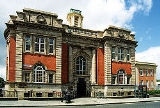
Rathmines Township
One of Rathmines' most prominent buildings is the Town Hall and its clock tower (designed by Sir Thomas DrewSir Thomas Drew
Sir Thomas Drew was an Irish architect.Thomas Drew was born in Victoria Place, Belfast.He was trained under Sir Charles Lanyon before moving to work in Dublin, where he became principal assistant to William George Murray...
, completed in 1899). This building, now occupied by Rathmines College
Rathmines College of Further Education
Rathmines College is an educational institution in Rathmines, County Dublin, Republic of Ireland. Rathmines College offers various Further Education courses, including Full time 1 year Certificates - which lead to Advanced Certificates , two year Higher National Diploma courses and the 1 year...
, once housed a town council
Town council
A town council is a democratically elected form of government for small municipalities or civil parishes. A council may serve as both the representative and executive branch....
for the Rathmines Township, made up of local businessmen and other eminent figures. The Rathmines Township was created by Act of Parliament in 1847, and its area was later renamed "Rathmines and Rathgar" and expanded to take in the areas of Rathgar, Ranelagh, Sandymount
Sandymount
Sandymount is a coastal seaside suburb in Dublin 4 on the Southside of Dublin in Ireland. It is in the Dublin South East Dáil constituency and the East Pembroke Ward. It was once part of Pembroke Township, which took its name from the fact that this area was part of the estate of the Earl of...
and Milltown
Milltown, Dublin
Milltown , Dublin 6, Ireland, is a suburb on the southside of Dublin. The townland got its name well before the 18th or 19th century. Both Milltown and Clonskeagh were "Liberties" of Dublin, following the English invasion and colonisation in 1290....
. The township was initially responsible only for sanitation, but its powers were extended over time to cover most functions of local government
Local government
Local government refers collectively to administrative authorities over areas that are smaller than a state.The term is used to contrast with offices at nation-state level, which are referred to as the central government, national government, or federal government...
.
The township was incorporated into the City of Dublin in 1930, and its functions were taken over by Dublin Corporation, now known as Dublin City Council
Dublin City Council
Dublin City Council is the local authority for the city of Dublin in Ireland. It has 52 members and is the largest local authority in Ireland. Until 2001, it was known as Dublin Corporation.-Legal status:...
. Rathmines is still a local electoral area of Dublin City Council, electing four city councillors.
Places of interest
Rathmines is well known for the large army barracks which is located there, Cathal Brugha BarracksCathal Brugha Barracks
Cathal Brugha Barracks is an Irish Army barracks in Rathmines, Dublin. A key military base of the Irish Defence Forces, it is the headquarters of the Eastern Command, and houses the Military Archives of the Department of Defence.-History and name:...
(known in the past as Portobello Barracks), home to many units of the Irish Army
Irish Army
The Irish Army, officially named simply the Army is the main branch of the Defence Forces of Ireland. Approximately 8,500 men and women serve in the Irish Army, divided into three infantry Brigades...
including the 2nd Infantry Battalion.
Another well known feature is the prominent copper dome of Mary Immaculate, Refuge of Sinners Church. The original dome was destroyed in a fire in 1920 and replaced by the current dome when reopened in 1922. The dome was to be used in St Petersburg but the political and social upheaval in this city caused it to be diverted to Dublin.
Rathmines is also home to two well-known primary and secondary schools, St Mary's College (C.S.Sp,) and St Louis Primary and secondary school. Kildare Place National School
Kildare Place National School
Kildare Place National School is a Church of Ireland primary school in Rathmines, a suburb of Dublin, Ireland . The school is linked to the training college of the Church of Ireland College of Education...
, situated on the grounds of the Church of Ireland College of Education
Church of Ireland College of Education
The Church of Ireland College of Education or C.I.C.E. as it is more commonly known is one of five Irish Colleges of Education which provide a Bachelor of Education degree, the qualification generally required to teach in Irish primary schools...
is also a highly reputable Church of Ireland sponsored primary school on Upper Rathmines Road.
Recently a new multiplex cinmea has been added to the local shopping centre. This has three screens with plans for a fourth, it shows up to date movies and features 3D movies.
Transport
From the 1850s horse-drawn omnibusesBus
A bus is a road vehicle designed to carry passengers. Buses can have a capacity as high as 300 passengers. The most common type of bus is the single-decker bus, with larger loads carried by double-decker buses and articulated buses, and smaller loads carried by midibuses and minibuses; coaches are...
provided transport from Rathmines to the city centre. Portobello Bridge, which had a steep incline, was often a problem for the horses, which led to the fatal accident of 1861.
On 6 October 1871 work was commenced on the Dublin tram system on Rathmines Road, just before Portobello Bridge, and a horse-drawn tram service was in place the following year. The following year also the long-awaited (since the 1861 accident) improvements to Portobello Bridge were carried out, the Tramway Company paying one third of the total cost of £300.
Rathmines and Ranelagh railway station opened on 16 July 1896 and finally closed on 1 January 1959.
Rathmines is served by the Luas
Luas
Luas , also promoted in the development stage as the Dublin Light Rail System, is a tram or light rail system serving Dublin, the first such system in the decades since the closure of the last of the Dublin tramways. In 2007, the system carried 28.4 million passengers, a growth of 10% since...
light rail system. Ranelagh on the Green Line is the most convenient for access to the main street, while the Charlemont and Beechwood stops are also within walking distance of the town.
Dublin Bus
Dublin Bus
Dublin Bus is a public transport operator in Ireland. It operates an extensive bus network of 172 radial, cross-city and peripheral routes and 18 night routes in the city of Dublin and the Greater Dublin Area. The company, established in 1987, is a subsidiary of Córas Iompair Éireann which is...
routes 14, 14A, 15, 15A, 15B, 15E, 15F, 18, 65, 65B, 74, 74A, 83, 128 and 142 serve Rathmines. The area is also served by the Dublin Bus Nitelink routes 15N and 49N on Friday and Saturday nights and on public holidays.
Notable people associated with Rathmines
- Cathal BrughaCathal BrughaCathal Brugha was an Irish revolutionary and politician, active in the Easter Rising, Irish War of Independence, and the Irish Civil War and was the first Ceann Comhairle of Dáil Éireann.-Background:...
, Irish Nationalist, leader lived on Rathmines Road. - Nora Connolly O'BrienNora Connolly O'BrienNora Connolly O'Brien was an activist and writer; she was also a member of the Irish Senate.The second daughter of James Connolly and Lillie Connolly, she was born in Scotland. In 1904, the family moved to the United States and moved to Belfast in 1907...
, second daughter of James ConnollyJames ConnollyJames Connolly was an Irish republican and socialist leader. He was born in the Cowgate area of Edinburgh, Scotland, to Irish immigrant parents and spoke with a Scottish accent throughout his life. He left school for working life at the age of 11, but became one of the leading Marxist theorists of...
, she was an activist and writer; she was also a member of the Irish Senate. lived on Belgrave Square, Rathmines. - Michael Cleary (priest) lived on Rathmines road when the controversy about his child was first reported.
- Frederick William CumberlandFrederick William CumberlandFrederick William Cumberland was a Canadian engineer, architect and political figure. He represented the riding of Algoma in the 1st and 2nd Ontario Parliaments and in the Canadian House of Commons from 1871 to 1872....
(1820–1881), architect, railway manager and politician, grew up in Rathmines. His father Thomas was employed at Dublin Castle. - Andrew Cunningham, 1st Viscount Cunningham of HyndhopeAndrew Cunningham, 1st Viscount Cunningham of HyndhopeAdmiral of the Fleet Andrew Browne Cunningham, 1st Viscount Cunningham of Hyndhope KT, GCB, OM, DSO and two Bars , was a British admiral of the Second World War. Cunningham was widely known by his nickname, "ABC"....
, British admiral of the Second World War. - James and Eugene DavyEugene DavyEugene O'Donnell Davy was an Irish international rugby union fly-half.Davy was born into an affluent family in County Dublin on 26 July 1904. He was one of nine surviving children of Thomas Davy, a merchant, and his wife Alice...
, the brothers that founded Davy StockbrokersDavy StockbrokersDavy is Ireland's largest stockbroker, wealth manager and financial advisor and has offices in Dublin, Belfast, Cork, Galway and London. Davy offer a range of services to private clients, small businesses, corporations and institutional investors....
, were brought up in 29 Terenure Road. - Vincent DowlingVincent DowlingVincent Gerard Dowling is an Emmy Award winning Irish actor and director.He was formerly married to the late Irish actress, Brenda Doyle...
, Director of the Arts, born the sixth of seven children in Rathmines. - Paddy FinucanePaddy FinucaneWing Commander Brendan Eamonn Fergus Finucane DSO, DFC & Two Bars , known as Paddy Finucane, was a Royal Air Force fighter pilot...
, Second World War fighter pilot, was born in Rathmines. - Richard Henry GeogheganRichard H. GeogheganRichard Henry Geoghegan was an Englishman of Irish descent. As a young man he lived for a while in Washington State and then moved to Alaska...
lived at 41 Upper Rathmines Road. He was the first Esperantist in the English-speaking world and was a friend of Irish Nationalist leader Joseph Mary PlunkettJoseph Mary PlunkettJoseph Mary Plunkett was an Irish nationalist, poet, journalist, and a leader of the 1916 Easter Rising.-Background:...
. He designed the original official EsperantoEsperantois the most widely spoken constructed international auxiliary language. Its name derives from Doktoro Esperanto , the pseudonym under which L. L. Zamenhof published the first book detailing Esperanto, the Unua Libro, in 1887...
flag. - Grace GiffordGrace GiffordGrace Evelyn Gifford Plunkett was an Irish artist and cartoonist who was active in the Republican movement...
, an Irish artist and cartoonist who was active in the Republican movement, was born in Rathmines. She married Joseph Plunkett in 1916 only a few hours before he was executed. - Lafcadio HearnLafcadio HearnPatrick Lafcadio Hearn , known also by the Japanese name , was an international writer, known best for his books about Japan, especially his collections of Japanese legends and ghost stories, such as Kwaidan: Stories and Studies of Strange Things...
, ghost-story writer who settled in Japan, was brought up in Rathmines. - The Earl of LongfordEarl of LongfordEarl of Longford is a title that has been created twice in the Peerage of Ireland. It was first bestowed upon Francis Aungier, 3rd Baron Aungier of Longford, in 1677, with remainder to his younger brother Ambrose. He had previously represented Surrey in the House of Commons and had already been...
had a large house in the Grosvenor park area of the Leinster road between Rathmines and Harold's Cross. The house was demolished and replaced with a modern housing estate in recent decades. - Éamonn MacThomáisÉamonn MacThomáisÉamonn MacThomáis was an author, broadcaster, historian, Irish Republican, advocate of the Irish Language and lecturer. He presented his own series on Dublin on RTÉ during the 70s and was well known for guided tours and lectures of his beloved Dublin...
Born in Rathmines in 1927 was an author, broadcaster, historian, Republican, advocate of the Irish Language and lecturer. Noted for numerous RTERTERTÉ is the abbreviation for Raidió Teilifís Éireann, the public broadcasting service of the Republic of Ireland.RTE may also refer to:* Recep Tayyip Erdoğan, 25th Prime Minister of Turkey...
documentaries on his native Dublin. - Constance Markievicz, Irish Revolutionary, in 1903 after a visit to the Ukraine, she and her husband Casimir Markievicz returned to live in a house provided by the Constance's mother in Rathmines to bring up her daughter maeve and stepson Stanislaus.
- John MitchelJohn MitchelJohn Mitchel was an Irish nationalist activist, solicitor and political journalist. Born in Camnish, near Dungiven, County Londonderry, Ireland he became a leading member of both Young Ireland and the Irish Confederation...
was living with his family at 8 Ontario Terrace when he was arrested in 1848. - Conor Cruise O'BrienConor Cruise O'BrienConor Cruise O'Brien often nicknamed "The Cruiser", was an Irish politician, writer, historian and academic. Although his opinion on the role of Britain in Northern Ireland changed over the course of the 1970s and 1980s, he always acknowledge values of, as he saw, the two irreconcilable traditions...
was born in 1917 in Rathmines, the only child of Francis Cruise O'Brien, a journalist who worked for the Freeman's Journal and Kathleen Sheehy. - Walter OsborneWalter OsborneWalter Frederick Osborne was an Irish impressionist landscape and portrait painter. Most of his paintings featured women, children, and the elderly as well as rural scenes.-Career:...
, a famous Irish impressionist painter, was born at 5 Castlewood Ave. - George William RussellGeorge William RussellGeorge William Russell who wrote under the pseudonym Æ , was an Irish nationalist, writer, editor, critic, poet, and painter. He was also a mystical writer, and centre of a group of followers of theosophy in Dublin, for many years.-Organisor:Russell was born in Lurgan, County Armagh...
was educated at Rathmines School. - Francis Sheehy-SkeffingtonFrancis Sheehy-SkeffingtonFrancis Skeffington from Bailieborough, County Cavan, was an Irish suffragist, pacifist and writer. He was a friend and schoolmate of James Joyce, Oliver St John Gogarty, Tom Kettle, and Conor Cruise O'Brien's father, Frank O'Brien...
, Irish suffragist, pacifist and writer, lived in 11 Grosvenor Place Rathmines. - Annie M. P. SmithsonAnnie M. P. SmithsonAnnie Mary Patricia Smithson was an Irish novelist, poet and Nationalist.Smithson was born into a Protestant family in Sandymount, Dublin. She was christened Margaret Anne Jane, but took the names Anne Mary Patricia on her conversion to Catholicism. Her mother and father were first cousins and...
, novelist, nurse and Nationalist, lived at 12 Richmond Hill until her death. - Maev-Ann WrenMaev-Ann WrenMaev-Ann Wren is an Irish economist, journalist, author and former economics editor of the Irish Times newspaper. She has written two books about the Irish health system and her writings have often been mentioned during Dáil and Seanad debates, and in parliamentary committee...
, journalist, economist, author, grew up in Rathmines.
See also
- List of towns and villages in Ireland