


Henry Grattan

Encyclopedia

Irish
Irish may refer to:*Irish cuisine* Ireland, an island in north-western Europe, on which are located:** Northern Ireland, a constituent country of the United Kingdom** Republic of Ireland, a sovereign state...
politician and member of the Irish House of Commons
Irish House of Commons
The Irish House of Commons was the lower house of the Parliament of Ireland, that existed from 1297 until 1800. The upper house was the House of Lords...
and a campaigner for legislative freedom for the Irish Parliament
Parliament of Ireland
The Parliament of Ireland was a legislature that existed in Dublin from 1297 until 1800. In its early mediaeval period during the Lordship of Ireland it consisted of either two or three chambers: the House of Commons, elected by a very restricted suffrage, the House of Lords in which the lords...
in the late 18th century. He opposed the Act of Union 1800
Act of Union 1800
The Acts of Union 1800 describe two complementary Acts, namely:* the Union with Ireland Act 1800 , an Act of the Parliament of Great Britain, and...
that merged the Kingdoms of Ireland
Kingdom of Ireland
The Kingdom of Ireland refers to the country of Ireland in the period between the proclamation of Henry VIII as King of Ireland by the Crown of Ireland Act 1542 and the Act of Union in 1800. It replaced the Lordship of Ireland, which had been created in 1171...
and Great Britain
Kingdom of Great Britain
The former Kingdom of Great Britain, sometimes described as the 'United Kingdom of Great Britain', That the Two Kingdoms of Scotland and England, shall upon the 1st May next ensuing the date hereof, and forever after, be United into One Kingdom by the Name of GREAT BRITAIN. was a sovereign...
.
Early life
Grattan was born at Fishamble St., Dublin, and baptized in the nearby church of St. John the EvangelistChurch of St. John the Evangelist, Dublin
The Church of St. John the Evangelist was a former Church of Ireland church located on the west side of Fishamble Street in the centre of Dublin, Ireland. It was founded in the 12th century, and a great many of its parish records survive.-The Church:...
.
A member of the Anglo-Irish
Anglo-Irish
Anglo-Irish was a term used primarily in the 19th and early 20th centuries to identify a privileged social class in Ireland, whose members were the descendants and successors of the Protestant Ascendancy, mostly belonging to the Church of Ireland, which was the established church of Ireland until...
elite of Protestant
Church of Ireland
The Church of Ireland is an autonomous province of the Anglican Communion. The church operates in all parts of Ireland and is the second largest religious body on the island after the Roman Catholic Church...
background, Grattan was the son of James Grattan MP, of Belcamp Park, County Dublin
County Dublin
County Dublin is a county in Ireland. It is part of the Dublin Region and is also located in the province of Leinster. It is named after the city of Dublin which is the capital of Ireland. County Dublin was one of the first of the parts of Ireland to be shired by King John of England following the...
(d. 1766), and Mary (1724–1768), youngest daughter of Sir Thomas Marlay
Thomas Marlay
Thomas Marlay was an Irish judge, remembered now as the builder of Celbridge Abbey and as the grandfather of the statesman Henry Grattan....
(1691–1756), Attorney-General of Ireland, Chief Baron of the Exchequer and finally Lord Chief Justice of the Court of King's Bench (Ireland)
Court of King's Bench (Ireland)
The Court of King's Bench was one of the senior courts of common law in Ireland. It was a mirror of the Court of King's Bench in England....
. Grattan was a distinguished student at Trinity College, Dublin
Trinity College, Dublin
Trinity College, Dublin , formally known as the College of the Holy and Undivided Trinity of Queen Elizabeth near Dublin, was founded in 1592 by letters patent from Queen Elizabeth I as the "mother of a university", Extracts from Letters Patent of Elizabeth I, 1592: "...we...found and...
where he began a lifelong study of classical literature, and was especially interested in the great orators of antiquity
Classical antiquity
Classical antiquity is a broad term for a long period of cultural history centered on the Mediterranean Sea, comprising the interlocking civilizations of ancient Greece and ancient Rome, collectively known as the Greco-Roman world...
. Like his friend Henry Flood
Henry Flood
Henry Flood , Irish statesman, son of Warden Flood, Lord Chief Justice of the King's Bench for Ireland, was educated at Trinity College, Dublin, and afterwards at Christ Church, Oxford, where he became proficient in the classics...
, Grattan worked on his natural eloquence and oratory skills by studying models such as Bolingbroke
Henry St John, 1st Viscount Bolingbroke
Henry St John, 1st Viscount Bolingbroke was an English politician, government official and political philosopher. He was a leader of the Tories, and supported the Church of England politically despite his atheism. In 1715 he supported the Jacobite rebellion of 1715 which sought to overthrow the...
and Junius
Junius
Junius was the pseudonym of a writer who contributed a series of letters to the Public Advertiser, from 21 January 1769 to 21 January 1772. The signature had been already used, apparently by him, in a letter of 21 November 1768...
. After studying at the King's Inns
King's Inns
The Honorable Society of King's Inns , is the institution which controls the entry of barristers-at-law into the justice system of Ireland...
, Dublin and being called to the Irish bar in 1772 he never seriously practised law but was drawn to politics, influenced by Flood
Henry Flood
Henry Flood , Irish statesman, son of Warden Flood, Lord Chief Justice of the King's Bench for Ireland, was educated at Trinity College, Dublin, and afterwards at Christ Church, Oxford, where he became proficient in the classics...
. He entered the Irish Parliament for Charlemont
Charlemont (Parliament of Ireland constituency)
Charlemont was a constituency represented in the Irish House of Commons until 1800.-History:In the Patriot Parliament of 1689 summoned by King James II, Charlemont was not represented.-1689–1801:...
in 1775, sponsored by Lord Charlemont
James Caulfeild, 1st Earl of Charlemont
James Caulfeild, 1st Earl of Charlemont KP PC was an Irish statesman.The son of the 3rd Viscount Charlemont, he was born in Dublin, and succeeded his father as 4th Viscount in 1734...
, just as Flood had damaged his credibility by accepting office. Grattan quickly superseded Flood in the leadership of the national party, not least because his oratorical powers were unsurpassed among his contemporaries.
In the Irish Parliament
Catholics and Presbyterians—who together made up a large majority of the Irish population—were completely excluded from public life at this time under the Penal LawsPenal Laws (Ireland)
The term Penal Laws in Ireland were a series of laws imposed under English and later British rule that sought to discriminate against Roman Catholics and Protestant dissenters in favour of members of the established Church of Ireland....
, in force in Ireland from 1691 until the early 1780s. The Viceroy and the wealthiest part of the Anglican Church of Ireland
Church of Ireland
The Church of Ireland is an autonomous province of the Anglican Communion. The church operates in all parts of Ireland and is the second largest religious body on the island after the Roman Catholic Church...
minority made all political decisions in Ireland until 1800.
The politicians of the national party now fought for the Irish parliament, not with the intention of liberating the Catholic majority, but to set the Irish parliament free from constitutional bondage to the British privy council
Privy Council of the United Kingdom
Her Majesty's Most Honourable Privy Council, usually known simply as the Privy Council, is a formal body of advisers to the Sovereign in the United Kingdom...
. By virtue of Poynings' Law, a celebrated statute of King Henry VII of England
Henry VII of England
Henry VII was King of England and Lord of Ireland from his seizing the crown on 22 August 1485 until his death on 21 April 1509, as the first monarch of the House of Tudor....
, all proposed Irish legislation had to be submitted to the privy council for its approval under the great seal of England before being passed by the Irish parliament. A bill so approved might be accepted or rejected, but not amended. More recent British acts had further emphasized the complete dependence of the Irish parliament, and the appellate jurisdiction of the Irish House of Lords
Irish House of Lords
The Irish House of Lords was the upper house of the Parliament of Ireland that existed from mediaeval times until 1800. It was abolished along with the Irish House of Commons by the Act of Union.-Function:...
had also been annulled. Moreover, the British Houses claimed and exercised the power to legislate directly for Ireland without even the nominal concurrence of the parliament in Dublin. This was the constitution which William Molyneux
William Molyneux
William Molyneux FRS was an Irish natural philosopher and writer on politics.He was born in Dublin to Samuel Molyneux , lawyer and landowner , and his wife, Anne, née Dowdall. The second of five children, William Molyneux came from a relatively prosperous Anglican background...
and Swift had denounced, which Flood had attacked, and which Grattan was to destroy, becoming leaders of the Patriot movement
Irish Patriot Party
The Irish Patriot Party was the name of a number of different political groupings in Ireland throughout the 18th century. They were primarily supportive of Whig concepts of personal liberty combined with an Irish identity that rejected full independence, but advocated strong self-government within...
.
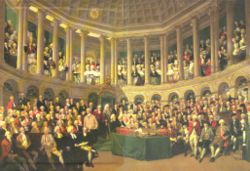
Irish Volunteers (18th century)
The Irish Volunteers were a militia in late 18th century Ireland. The Volunteers were founded in Belfast in 1778 to defend Ireland from the threat of foreign invasion when regular British soldiers were withdrawn from Ireland to fight across the globe during the American War of Independence...
Convention at Dungannon
Dungannon
Dungannon is a medium-sized town in County Tyrone, Northern Ireland. It is the third-largest town in the county and a population of 11,139 people was recorded in the 2001 Census. In August 2006, Dungannon won Ulster In Bloom's Best Kept Town Award for the fifth time...
greatly influenced the decision of the government in 1782
Constitution of 1782
The Constitution of 1782 is a collective term given to a series of legal changes which freed the Parliament of Ireland, a Medieval parliament consisting of the Irish House of Commons and the Irish House of Lords, of legal restrictions that had been imposed by successive Norman, English, and later,...
to resist the agitation no longer. It was through ranks of volunteers drawn up outside the parliament house in Dublin that Grattan passed on 16 April 1782, amidst unparalleled popular enthusiasm, to move a declaration of the independence of the Irish parliament. "I found Ireland on her knees," Grattan exclaimed, "I watched over her with a paternal solicitude; I have traced her progress from injuries to arms, and from arms to liberty. Spirit of Swift, spirit of Molyneux, your genius has prevailed! Ireland is now a nation!" After a month of negotiation the claims of Ireland were conceded. The gratitude of his countrymen to Grattan was shown by a parliamentary grant of £100,000, which had to be reduced by half before he would accept it.
Grattan then asked for the British House of Commons to reconfirm the London government's decision, and on 22 January 1783 the final Act was passed by parliament in London, including the text:
Be it enacted that the right claimed by the people of Ireland to be bound only by laws enacted by his Majesty and the Parliament of that kingdom, in all cases whatever shall be, and is hereby declared to be established and ascertained for ever, and shall at no time be questioned or questionable.In September of the same year, Grattan became a member of the Privy Council of Ireland
Privy Council of Ireland
The Privy Council of Ireland was an institution of the Kingdom of Ireland until 31 December 1800 and of the United Kingdom of Great Britain and Ireland 1801-1922...
. He was expelled in 1798, but was re-admitted on 9 August 1806.
In Dublin, he was a member of Daly's Club
Daly's Club
Daly's Club, with premises known as Daly's Club House, was a gentlemen's club in Dublin, Ireland, a centre of social and political life between its origins in about 1750 and its end in 1823.-History:...
.
"Grattan's Parliament"
One of the first acts of Grattan's parliament was to prove its loyalty to the Constitution by passing a vote for the support of 20,000 sailors for the navy. Grattan was loyal to the crown and the English connection. He was, however, anxious for moderate parliamentary reform, and, unlike Flood, he favored Catholic emancipationCatholic Emancipation
Catholic emancipation or Catholic relief was a process in Great Britain and Ireland in the late 18th century and early 19th century which involved reducing and removing many of the restrictions on Roman Catholics which had been introduced by the Act of Uniformity, the Test Acts and the penal laws...
. It was evident that without reform the Irish House of Commons would not be able to make much use of its newly-won independence. Though now free from constitutional control, it was still subject to the influence of corruption, which the English government had wielded through the Irish borough owners, known as the "undertakers", or more directly through the great executive officers. Grattan's parliament had no control over the Irish executive. The lord lieutenant
Lord Lieutenant of Ireland
The Lord Lieutenant of Ireland was the British King's representative and head of the Irish executive during the Lordship of Ireland , the Kingdom of Ireland and the United Kingdom of Great Britain and Ireland...
and his chief secretary continued to be appointed by the English ministers; their tenure of office depended on the vicissitudes of English, not Irish, party politics; the royal prerogative was exercised in Ireland on the advice of English ministers.
The House of Commons was unrepresentative of the Irish people at a time when democracy was rare in Europe. The majority were excluded either as Roman Catholics or as Presbyterians; two-thirds of the members of the House of Commons were returned by small boroughs at the disposal of individual patrons, whose support was bought by the distribution of peerages and pensions. It was to give stability and true independence to the new constitution that Grattan pressed for reform. Having quarrelled with Flood over simple repeal, Grattan also differed from him on the question of maintaining the Volunteer Convention. He opposed the policy of protective duties, but supported Pitt's famous commercial propositions in 1785 for establishing free trade between Great Britain and Ireland, which, however, had to be abandoned owing to the hostility of the British mercantile classes. Grattan supported the government for a time after 1782, and spoke and voted for the stringent coercive legislation rendered necessary by the Whiteboy outrages in 1785; but as the years passed without Pitt's personal favour towards parliamentary reform resulting in legislation, he gravitated towards the opposition, agitated for commutation of tithes in Ireland, and supported the Whigs on the regency question in 1788. In 1790 Gratten stood for Dublin City
Dublin City (Parliament of Ireland constituency)
Dublin City was a constituency represented in the Irish House of Commons to 1801.-History:In the Patriot Parliament of 1689 summoned by King James II, Dublin City was represented with two members. In the 1760s the radical politician Charles Lucas used the seat as his political base.-1689–1801:...
, a seat he held until 1798. In 1792 he succeeded in carrying an Act conferring the franchise on the Roman Catholics; in 1794 in conjunction with William Ponsonby
William Ponsonby, 1st Baron Ponsonby
William Brabazon Ponsonby, 1st Baron Ponsonby , PC was a leading Irish Whig politician, being a member of the Irish House of Commons, and after 1800, of the United Kingdom parliament. Ponsonby was the son of the Hon...
, he introduced a reform bill which was even less democratic than Flood's bill of 1783. He was as anxious as Flood had been to retain the legislative power in the hands of men of property, for he had through the whole of his life a strong conviction that while Ireland could best be governed by Irish hands, democracy in Ireland would inevitably turn to plunder and anarchy. At the same time he desired to admit the Roman Catholic gentry of property to membership of the House of Commons, a proposal that was the logical corollary of the Relief Act of 1792.
The defeat of Grattan's mild proposals helped to promote more extreme opinions, which, under French revolution
French Revolution
The French Revolution , sometimes distinguished as the 'Great French Revolution' , was a period of radical social and political upheaval in France and Europe. The absolute monarchy that had ruled France for centuries collapsed in three years...
ary influence, were now becoming heard in Ireland. The Catholic question had rapidly become of the first importance, and when a powerful section of the Whigs joined Pitt's ministry in 1794, and it became known that the lord-lieutenancy was to go to Lord Fitzwilliam
William Fitzwilliam
William FitzWilliam may refer to:*William FitzWilliam, 1st Earl of Southampton , English courtier*William FitzWilliam , Lord Deputy of Ireland...
, who shared Grattan's views, expectations were raised that the question was about to be settled in a manner satisfactory to the Irish Catholics. Such seems to have been Pitt's intention, though there has been much controversy as to how far Lord Fitzwilliam had been authorized to pledge the government. After taking Grattan into his confidence, it was arranged that the latter should bring in a Roman Catholic emancipation bill, and that it should then receive government support. But finally it appeared that the viceroy had either misunderstood or exceeded his instructions; and on 19 February 1795, Fitzwilliam was recalled. In the outburst of indignation, followed by increasing disaffection in Ireland, which this event produced, Grattan acted with conspicuous moderation and loyalty, which won for him warm acknowledgments from a member of the British cabinet.
That cabinet, however, doubtless influenced by the wishes of the king, was now determined to firmly resist the Catholic demands, with the result that the country rapidly drifted towards rebellion. Grattan warned the government in a series of masterly speeches of the lawless condition to which Ireland had been driven. He could now count on no more than forty followers in the House of Commons, and his words were unheeded. In protest he retired from parliament in May 1797, and departed from his customary moderation by attacking the government in an inflammatory Letter to the citizens of Dublin.
Rebellion and Union

Irish Rebellion of 1798
The Irish Rebellion of 1798 , also known as the United Irishmen Rebellion , was an uprising in 1798, lasting several months, against British rule in Ireland...
. The Presbyterian-Catholic rebellion in Ulster was overshadowed by a more traditional Catholic uprising in Wexford which was characterised by some indiscriminate sectarian massacres of Protestants. Grattan was cruelly lampooned by James Gillray
James Gillray
James Gillray , was a British caricaturist and printmaker famous for his etched political and social satires, mainly published between 1792 and 1810.- Early life :He was born in Chelsea...
as a rebel leader for his liberal views and his stance against a political union with the Kingdom of Great Britain
Kingdom of Great Britain
The former Kingdom of Great Britain, sometimes described as the 'United Kingdom of Great Britain', That the Two Kingdoms of Scotland and England, shall upon the 1st May next ensuing the date hereof, and forever after, be United into One Kingdom by the Name of GREAT BRITAIN. was a sovereign...
.
Almost immediately, the project of a legislative union between the British and Irish parliaments, which had been from time to time discussed since the beginning of the 18th century, was taken up in earnest by Pitt's government. Grattan denounced the scheme with implacable hostility
Implacable hostility
Implacable hostility arises after separation or divorce and denotes the attitude shown by one parent to another in denying access to, or contact with, their child...
.
The constitution of Grattan's parliament offered no security, as the differences over the regency question had made evident that in matters of imperial interest the policy of the Irish parliament and that of Great Britain
Parliament of Great Britain
The Parliament of Great Britain was formed in 1707 following the ratification of the Acts of Union by both the Parliament of England and Parliament of Scotland...
would be in agreement. At a moment when Britain was engaged in a life-and-death struggle with France
France
The French Republic , The French Republic , The French Republic , (commonly known as France , is a unitary semi-presidential republic in Western Europe with several overseas territories and islands located on other continents and in the Indian, Pacific, and Atlantic oceans. Metropolitan France...
, it was impossible for the ministry to ignore the danger, recently emphasized by the fact that the independent constitution of 1782 offered no safeguard against armed revolt. The nature of the rebellion in Wexford put an end to the growing reconciliation between Roman Catholics and Presbyterians, and the island divided anew into two hostile factions. To those whose understanding of Irish history is limited to the twentieth century it may seem curious that it was from the Protestant Established Church, and particularly from the Orangemen, that the bitterest opposition to the union proceeded. The proposal found support among the Roman Catholic clergy and especially the bishops, while in no part of Ireland was it received with more favor than in the city of Cork
Cork (city)
Cork is the second largest city in the Republic of Ireland and the island of Ireland's third most populous city. It is the principal city and administrative centre of County Cork and the largest city in the province of Munster. Cork has a population of 119,418, while the addition of the suburban...
. This attitude of the Catholics was caused by Pitt's encouragement of the expectation that Catholic emancipation
Catholic Emancipation
Catholic emancipation or Catholic relief was a process in Great Britain and Ireland in the late 18th century and early 19th century which involved reducing and removing many of the restrictions on Roman Catholics which had been introduced by the Act of Uniformity, the Test Acts and the penal laws...
, the commutation of tithes, and the endowment of the Catholic priesthood, would accompany or quickly follow the passing of the measure.
When in 1799 the government brought forward their bill it was defeated in the Irish House of Commons. Grattan was still in retirement. His popularity had declined, and the fact that his proposals for parliamentary reform and Catholic emancipation had become the watchwords of the rebellious United Irishmen had brought him the bitter hostility of the governing classes. He was dismissed from the privy council; his portrait was removed from the hall of Trinity College; the Merchant Guild of Dublin struck his name off their rolls. The threatened destruction of the constitution of 1782 quickly restored its author to his former place in the affections of the Irish people. The parliamentary recess had been employed by the government in securing by lavish corruption a majority in favour of their policy. On 15 January 1800 the Irish parliament met for its last session; on the same day Grattan secured by purchase a seat for Wicklow Borough
Wicklow Borough (Parliament of Ireland constituency)
Wicklow Borough was a constituency represented in the Irish House of Commons to 1800.-1692–1801:...
; and at a late hour, while the debate was proceeding, he appeared to take his seat, and was cheered from the galleries. Grattan's strength gave way when he rose to speak, and he obtained leave to address the House sitting. Nevertheless his speech was a superb effort of oratory; for more than two hours he kept them spellbound. After prolonged debates Grattan, on 26 May, spoke finally against the committal of the bill, ending with an impassioned peroration in which he declared, "I will remain anchored here with fidelity to the fortunes of my country, faithful to her freedom, faithful to her fall." These were the last words spoken by Grattan in the Irish parliament.
The bill establishing the union was carried through its final stages by substantial majorities. One of Grattan's main grounds of opposition to the union had been his dread of seeing the political leadership in Ireland pass out of the hands of the landed gentry; and he prophesied that the time would come when Ireland would send to the united parliament a hundred of the greatest rascals in the kingdom. Like Flood before him, Grattan had no leaning towards democracy; and he anticipated that by the removal of the centre of political interest from Ireland the evil of absenteeism would be intensified.
In the British Parliament
For the next five years, Grattan took no active part in public affairs; it was not till 1805 that he became a Member of the Parliament of the United KingdomParliament of the United Kingdom
The Parliament of the United Kingdom of Great Britain and Northern Ireland is the supreme legislative body in the United Kingdom, British Crown dependencies and British overseas territories, located in London...
for Malton
Malton (UK Parliament constituency)
Malton, also called New Malton, was a constituency of the House of Commons of the Parliament of England in 1295 and 1298, and again from 1640, then of the Parliament of Great Britain from 1707 to 1800 and of the Parliament of the United Kingdom from 1801 to 1885...
. He modestly took his seat on one of the back benches, till Fox
Charles James Fox
Charles James Fox PC , styled The Honourable from 1762, was a prominent British Whig statesman whose parliamentary career spanned thirty-eight years of the late 18th and early 19th centuries and who was particularly noted for being the arch-rival of William Pitt the Younger...
brought him forward, exclaiming, "This is no place for the Irish Demosthenes!" His first speech was on the Catholic question and all agreed with the description of his speech by the Annual Register as one of the most brilliant and eloquent ever made within the walls of parliament. When Fox and William Grenville came into power in 1806 Grattan, who sat at this time for Dublin City
Dublin City (UK Parliament constituency)
Dublin City was an Irish Borough constituency in the House of Commons of the United Kingdom of Great Britain and Ireland. It comprised the city of Dublin in the county of Dublin, and was represented by two Members of Parliament from its creation in 1801 until 1885.In 1885, Dublin City was split...
, was offered, but refused to accept, an office in the government. In the following year he showed the strength of his judgment and character by supporting, in spite of consequent unpopularity in Ireland, a measure for increasing the powers of the executive to deal with Irish disorder. Roman Catholic emancipation, which he continued to advocate with unflagging energy, though now advanced in age, became complicated after 1808 by the question whether a veto on the appointment of Roman Catholic bishops
Royal veto of the appointment of bishops
A proposed Royal veto of the appointment of bishops was a contentious topic in the politics of the United Kingdom, in the period 1808 to 1829. According to the proposal, any restoration of the full episcopal hierarchy of the Catholic Church, in Great Britain, should be subject to a veto of the...
should rest with the crown.
Grattan supported the veto, but a more radical Catholic party was now arising in Ireland under the leadership of Daniel O'Connell
Daniel O'Connell
Daniel O'Connell Daniel O'Connell Daniel O'Connell (6 August 1775 – 15 May 1847; often referred to as The Liberator, or The Emancipator, was an Irish political leader in the first half of the 19th century...
, and Grattan's influence gradually declined. He seldom spoke in parliament after 1810, the most notable exception being in 1815, when he separated himself from the Whigs
British Whig Party
The Whigs were a party in the Parliament of England, Parliament of Great Britain, and Parliament of the United Kingdom, who contested power with the rival Tories from the 1680s to the 1850s. The Whigs' origin lay in constitutional monarchism and opposition to absolute rule...
and supported the final struggle against Napoleon. His last speech of all, in 1819, contained a passage referring to the union he had so passionately resisted, which exhibits the statesmanship and at the same time the equable quality of Grattan's character. His sentiments with regard to the policy of the union remained, he said, unchanged; but the marriage having taken place it is now the duty, as it ought to be the inclination, of every individual to render it as fruitful, as profitable and as advantageous as possible.
Death and legacy
In the following summer, after crossing from Ireland to London when out of health to bring forward the Irish questionIrish question
The Irish Question was a phrase used mainly by members of the British ruling classes from the early 19th century until the 1920s. It was used to describe Irish nationalism and the calls for Irish independence....
once more, he became seriously ill. On his death-bed he spoke generously of Castlereagh
Robert Stewart, Viscount Castlereagh
Robert Stewart, 2nd Marquess of Londonderry, KG, GCH, PC, PC , usually known as Lord CastlereaghThe name Castlereagh derives from the baronies of Castlereagh and Ards, in which the manors of Newtownards and Comber were located...
, and with warm eulogy of his former rival, Flood. He died on 6 June 1820, and was buried in Westminster Abbey
Westminster Abbey
The Collegiate Church of St Peter at Westminster, popularly known as Westminster Abbey, is a large, mainly Gothic church, in the City of Westminster, London, United Kingdom, located just to the west of the Palace of Westminster. It is the traditional place of coronation and burial site for English,...
close to the tombs of Pitt and Fox. His statue is in the outer lobby of the Houses of Parliament at Westminster.
The most searching scrutiny of his private life only increases the respect due to the memory of Grattan as a statesman and the greatest of Irish orators. His patriotism was untainted by self-seeking; he was courageous in risking his popularity for what his sound judgment showed him to be the right course. As Sydney Smith
Sydney Smith
Sydney Smith was an English writer and Anglican cleric. -Life:Born in Woodford, Essex, England, Smith was the son of merchant Robert Smith and Maria Olier , who suffered from epilepsy...
said with truth of Grattan soon after his death: "No government ever dismayed him. The world could not bribe him. He thought only of Ireland; lived for no other object; dedicated to her his beautiful fancy, his elegant wit, his manly courage, and all the splendour of his astonishing eloquence."
The building housing the faculty of Law and Government at Dublin City University has been named in his honour. Grattan Bridge
Grattan Bridge
Grattan Bridge is a road bridge spanning the River Liffey in Dublin, Ireland, and joining Capel Street to Parliament Street and the south quays.-History:...
crossing the river Liffey between Parliament Street on the south side of Dublin and Capel Street on the north side is also named in his honour.
Family
Grattan's father was James Grattan (d. 1766), a RecorderRecorder (judge)
A Recorder is a judicial officer in England and Wales. It now refers to two quite different appointments. The ancient Recorderships of England and Wales now form part of a system of Honorary Recorderships which are filled by the most senior full-time circuit judges...
and then MP for Dublin City
Dublin City (Parliament of Ireland constituency)
Dublin City was a constituency represented in the Irish House of Commons to 1801.-History:In the Patriot Parliament of 1689 summoned by King James II, Dublin City was represented with two members. In the 1760s the radical politician Charles Lucas used the seat as his political base.-1689–1801:...
, who married a daughter of Thomas Marlay.
Grattan had married in 1782 Henrietta Fitzgerald, the daughter of Nicholas Fitzgerald of County Mayo
County Mayo
County Mayo is a county in Ireland. It is located in the West Region and is also part of the province of Connacht. It is named after the village of Mayo, which is now generally known as Mayo Abbey. Mayo County Council is the local authority for the county. The population of the county is 130,552...
(d. 1761), a son of John FitzGerald and Elizabeth Browne. Henrietta's mother Margaret was the daughter of James Stevenson and Ann Price.
The Grattans had two sons and two daughters. The sons were - James Grattan of Tinnehinch, MP for County Wicklow
Wicklow (UK Parliament constituency)
Wicklow was a parliamentary constituency in Ireland, represented in the Parliament of the United Kingdom. From 1801 to 1885 it returned two Members of Parliament to the House of Commons of the United Kingdom of Great Britain and Ireland....
; and Henry Grattan (junior)
Henry Grattan (junior)
Henry Grattan was a Whig Member of Parliament representing Dublin City from 1826 to 1830 in the British House of Commons. From 1831 to 1852, he represented Meath....
of Moyrath, MP for Dublin City
Dublin City (UK Parliament constituency)
Dublin City was an Irish Borough constituency in the House of Commons of the United Kingdom of Great Britain and Ireland. It comprised the city of Dublin in the county of Dublin, and was represented by two Members of Parliament from its creation in 1801 until 1885.In 1885, Dublin City was split...
and then for County Meath
Meath (UK Parliament constituency)
Meath was a parliamentary constituency in Ireland, which from 1801 to 1885 returned two Members of Parliament to the House of Commons of the United Kingdom.-Members of Parliament:-References:...
. His daughter Mary Anne married first John Blachford (1771‐1832), and secondly Thomas, 7th Earl of Carnwath
Earl of Carnwath
The title Earl of Carnwath was created in the Peerage of Scotland in 1639 for the 2nd Lord Dalzell. His father, Sir Robert Dalzell, had been created Lord Dalzell in 1628. The 5th Earl was attainted and the peerage forfeit in 1716, due to the Lord Carnwath's Jacobitism and support for the Fifteen,...
, dying in 1853. Harriet (d.1865) married the Revd Wake of Courteenhall.
Modern
- Mansergh D. Grattan's failure Parliamentary Opposition and the People in Ireland (2005) Irish Academic Press ISBN 0-7165-2815-0
- McDowell R.B. Grattan A Life (2001) Lilliput Press ISBN 1-901866-72-6
- Kelly J. Henry Grattan (1993) Dundalgan Press
Earlier
- Henry Grattan jnr. Memoirs of the Life and Times of the Right Hon. H. Grattan Vol. 1Vol.2(5 vols., London, 1839–1846);
- Grattan's Speeches (ed by H. Grattan, junr., 1822);
Irish Part. Debates; WEH Lecky
William Edward Hartpole Lecky
William Edward Hartpole Lecky, OM was an Irish historian.-Early life:Born at Newtown Park, near Dublin, he was the eldest son of John Hartpole Lecky, a landowner....
, History of England in the Eighteenth century (8 vols., London, 1878–1890) and Leaders of Public Opinion in Ireland (enlarged edition, 2 vols., 1903).
For the controversy concerning the recall of Lord Fitzwilliam see, in addition to the foregoing, Lord Rosebery, Pitt (London, 1891); Lord Ashbourne, Pitt: Some Chapters of his Life (London, 1898); The Pelham Papers (Brit. Mus. Add. Manuscripts 33118); Carlisle Correspondence; Beresford Correspondence; Stanhope Miscellanies; for the Catholic question, W Anshurst, History of Catholic Emancipation (2 vols., London, 1886); Sir Thomas Wyse
Thomas Wyse
Sir Thomas Wyse KCB , an Irish politician and diplomat, belonged to a family claiming descent from a Devon man, Andrew Wyse, who is said to have crossed over to Ireland during the reign of Henry II and obtained lands near Waterford, of which city thirty-three members of the family are said to have...
, Historical Sketch of the late Catholic Association of Ireland (London, 1829); W. J. MacNeven, Pieces of Irish History (New York, 1807) containing an account of the United Irishmen; for the volunteer movement Thomas MacNevin
Thomas MacNevin
Thomas MacNevin was an influential Irish writer and journalist, who died under “peculiarly sad circumstances” in a Bristol asylum. According to T. F...
, History of the Volunteers of 1782 (Dublin, 1845); Proceedings of the Volunteer Delegates of Ireland 1784 (Anon. Pamph. Brit. Mus.).
See also F Hardy, Memoirs of Lord Charlemont (London, 1812); Warden Flood, Memoirs of Henry Flood (London, 1838); Francis Plowden
Francis Plowden (barrister)
Francis Plowden was an English Jesuit, barrister and writer.-Life:He was the son of William Plowden of Plowden Hall. He was educated at St. Omer's College and entered the Jesuit novitiate at Watten in 1766.When the Society was suppressed, he was teaching at the College at Bruges...
, Historical Review of the State of Ireland (London, 1803); Alfred Webb, Compendium of Irish Biography (Dublin, 1878); Sir Jonah Barrington
Jonah Barrington (judge)
Sir Jonah Barrington , was one of no less than sixteen children, six at least, and probably seven were sons of John Barrington, a landowner in County Laois...
, Rise and Fall of the Irish Nation (London, 1833); WJ O'Neill Daunt, Ireland and her Agitators; Lord Mountmorres, History of the Irish Parliament (2 vole., London, 1792); Horace Walpole, Memoirs of the Reign of George III (4 vols., London, 1845 and 1894); Lord Stanhope, Life of William Pitt (4 vols., London, 1861); Thomas Davis, Life of JP Curran (Dublin, 1846) this contains a memoir of Grattan by DO Madden, and Grattan's reply to Lord Clare on the question of the Union; Charles Phillips, Recollections of Curran and some of his Contemporaries (London, 1822); JA Froude
James Anthony Froude
James Anthony Froude , 23 April 1818–20 October 1894, was an English historian, novelist, biographer, and editor of Fraser's Magazine. From his upbringing amidst the Anglo-Catholic Oxford Movement, Froude intended to become a clergyman, but doubts about the doctrines of the Anglican church,...
, The English in Ireland (London, 1881); JG McCarthy, Henry Grattan: an Historical Study (London, 1886); Lord Mahon's History of England, vol. vii. (1858). With special reference to the Union see Castlereagh Correspondence; Cornwallis Correspondence; Westmorland Papers (Irish State Paper Office).
External links
- Chapter on Henry Grattan in The Story Of Ireland, by Emily LawlessEmily LawlessEmily Lawless was an Irish novelist and poet from County Kildare.-Biography :She was born at Lyons House below Lyons Hill, Ardclough, County Kildare. Her grandfather was Valentine Lawless, a member of the United Irishmen and son of a convert from Catholicism to the Church of Ireland. Her father...
, 1896 - 1782 Caricature of Henry Grattan by James Gillray