
All Topics  
Raoul Dufy

 
Raoul Dufy

   Email Print
   Bookmark   Link


Raoul Dufy


Raoul Dufy (3 June 1877 – 23 March 1953) was a French
French people

French people can refer to:* The legal residents and citizens of France, regardless of ancestry. For a legal discussion, see French nationality law....
 Fauvist
Fauvism

Les Fauves were a short-lived and loose grouping of early 20th century Modern artists whose works emphasized painterly qualities and strong colour over the Realism or Representation values retained by Impressionism....
 painter. He developed a colourful, decorative style that became fashionable for designs for ceramics, textiles and decorative schemes for public buildings. He is noted for scenes of open-air social events.
l Dufy was born at Le Havre
Le Havre

Le Havre is a city in the northwest region of France situated on the right bank of the mouth of the Seine River as it outlets into the Bay of the Seine section of the English Channel....
, in Normandy
Normandy

Normandy is a geographical region corresponding to the former Duchy of Normandy. It is situated along the coast of France south of the English Channel between Brittany and Picardy and comprises territory in northern France and the Channel Islands....
, one of a family of nine members. He left school at the age of 14 to work in a coffee importing company.


Discussion
Ask a question about 'Raoul Dufy'
Start a new discussion about 'Raoul Dufy'
Answer questions from other users
Full Discussion Forum


Encyclopedia


Raoul Dufy (3 June 1877 – 23 March 1953) was a French
French people

French people can refer to:* The legal residents and citizens of France, regardless of ancestry. For a legal discussion, see French nationality law....
 Fauvist
Fauvism

Les Fauves were a short-lived and loose grouping of early 20th century Modern artists whose works emphasized painterly qualities and strong colour over the Realism or Representation values retained by Impressionism....
 painter. He developed a colourful, decorative style that became fashionable for designs for ceramics, textiles and decorative schemes for public buildings. He is noted for scenes of open-air social events.

Biography

Raoul Dufy was born at Le Havre
Le Havre

Le Havre is a city in the northwest region of France situated on the right bank of the mouth of the Seine River as it outlets into the Bay of the Seine section of the English Channel....
, in Normandy
Normandy

Normandy is a geographical region corresponding to the former Duchy of Normandy. It is situated along the coast of France south of the English Channel between Brittany and Picardy and comprises territory in northern France and the Channel Islands....
, one of a family of nine members. He left school at the age of 14 to work in a coffee importing company. In 1895 when he was 18, he started evening classes in art at Le Havre École des Beaux-Arts. He and Othon Friesz
Othon Friesz

Othon Friesz , a native of Le Havre, was a French artist of the Fauvism movement.Othon Friesz was born in Le Havre, the son of a long line of shipbuilders and sea captains....
, a school friend, studied the works of Eugène Boudin
Eugène Boudin

Eug?ne Boudin was one of the first France landscape painters to paint outdoors.Boudin was a Marine painter, and expert in the rendering of all that goes upon the sea and along its shores....
 in the museum in Le Havre.

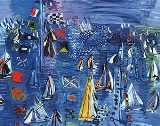
Dufyraoul Regattaatcowes
In 1900, after a year of military service, Raoul won a scholarship enabling him to attend the École Nationale des Beaux-Arts in Paris
Paris

Paris is the Capital of France and the country's largest city. It is situated on the river Seine, in northern France, at the heart of the ?le-de-France Regions of France ....
, where he was a fellow student with Georges Braque
Georges Braque

Georges Braque was a major 20th century French Painting and sculpture who, along with Pablo Picasso, developed the art movement known as cubism....
. The impressionist landscapists, such as Claude Monet
Claude Monet

Claude Monet also known as Oscar-Claude Monet or Claude Oscar Monet was a founder of French impressionism painting, and the most consistent and prolific practitioner of the movement's philosophy of expressing one's perceptions before nature, especially as applied to plein-air landscape painting....
 and Camille Pissarro
Camille Pissarro

Camille Pissarro was a French Impressionist Painting. His importance resides not only in his visual contributions to Impressionism and Post-Impressionism, but also in his patriarchal standing among his colleagues, particularly Paul C?zanne and Paul Gauguin....
, influenced him.

Introduced to Berthe Weill in 1902, she showed his work in her gallery. Henri Matisse
Henri Matisse

Henri Matisse was a France artist, known for his use of colour and his fluid, brilliant and original draftsmanship. As a drawing, printmaking, and Sculpture, but principally as a Painting, Matisse is one of the best-known artists of the 20th century....
's Luxe, Calme et Volupté
Luxe, Calme et Volupté

File:Matisse-Luxe.jpgLuxe, Calme et Volupt? is an oil painting by Henri Matisse from 1904. Its title comes from the poem L'Invitation au voyage, from Charles Baudelaire's volume Les Fleurs du Mal :...
, which Dufy saw at the Salon des Indépendants in 1905, was a revelation to the young artist and directed his interest towards Fauvism
Fauvism

Les Fauves were a short-lived and loose grouping of early 20th century Modern artists whose works emphasized painterly qualities and strong colour over the Realism or Representation values retained by Impressionism....
. Les Fauves (wild beasts) emphasised bright colour and rich bold contours in their work, and Dufy’s painting reflects this approach until about 1909, when contact with the work of Paul Cézanne
Paul Cézanne

Paul C?zanne was a French artist and Post-Impressionist Painting whose work laid the foundations of the transition from the 19th century conception of artistic endeavour to a new and radically different world of art in the 20th century....
 led him to adopt a somewhat subtler technique. It was not until 1920, after he had flirted briefly with yet another style, cubism
Cubism

Cubism was a 20th century avant-garde art movement, pioneered by Pablo Picasso and Georges Braque, that revolutionized European painting and sculpture, and inspired related movements in music and literature....
, that Dufy developed his own distinctive approach involving skeletal structures, arranged in a diminished perspective, and the use of light washes of colour put on by swift brush strokes in a manner that came to be known as stenographic.

Dufy's cheerful oils and watercolours depict yachting scenes, sparkling views of the French Riviera
French Riviera

The C?te d'Azur , often known in English as the French Riviera, is the Mediterranean coastline of the southeastern corner of France, extending from Menton near the Italy border on the east to either Hy?res or Cassis in the west....
, chic parties and musical events. The optimistic and fashionably decorative and illustrative nature of much of his work has meant that his output is less highly critically valued than artists who treat a wider range of social concerns.

In 1938, Dufy completed one of the largest paintings ever done, a huge and immensely popular epic to electricity, the fresco La Fée Electricité for the Exposition Internationale
Exposition Internationale des Arts et Techniques dans la Vie Moderne (1937)

The Exposition Internationale des Arts et Techniques dans la Vie Moderne was held in 1937 in Paris, France. The Mus?e de l'Homme was created at this occasion....
 in Paris.

Dufy also acquired a reputation as an illustrator and an applied artist. He changed the face of fashion and fabric design with his work for Paul Poiret
Paul Poiret

Paul Poiret was a French fashion designer. His contributions to twentieth-century fashion have been likened to Picasso's contributions to twentieth-century art....
. He painted murals for public buildings, and produced a prodigious number of tapestries and ceramic designs. His plates appear in books by Guillaume Apollinaire
Guillaume Apollinaire

Wilhelm Albert Wlodzimierz Apolinary de Waz-Kostrowicki, known as Guillaume Apollinaire was a France poet, writer, and art critic born in Italy to a Polish mother....
, Stéphane Mallarmé
Stéphane Mallarmé

St?phane Mallarm? , whose real name was ?tienne Mallarm?, was a French poet and critic. He was a major French Symbolism poet, and his work antecipated and inspired several revolutionary artistic schools of the early 20th century, such as Dadaism, Surrealism, and Futurism ....
 and André Gide
André Gide

Andr? Paul Guillaume Gide was a France author and winner of the Nobel Prize in literature in 1947. Gide's career ranged from its beginnings in the Symbolism movement, to the advent of Anti-imperialism between the two World Wars....
.

Dufy died near Forcalquier
Forcalquier

Forcalquier is a communes of France of the Alpes-de-Haute-Provence Departments of France in southeastern France. The inhabitants are called the 'Forcalqui?rens'....
, France, on 23 March 1953, and was buried not far from Matisse in the Cimiez Monastery Cemetery in Cimiez
Cimiez

Cimiez is an upper class neighborhood in Nice, France. The area contains the Henri Matisse Museum and the Roman Ruins . In July every year the Nice Jazz Festival is held on the grounds of the Roman Ruins in Cimiez....
, a suburb of the city of Nice, France.

Work outside of painting

In 1909, Raoul Dufy
Raoul Dufy

Raoul Dufy was a French people Fauvism painter. He developed a colourful, decorative style that became fashionable for designs for ceramics, textiles and decorative schemes for public buildings....
 was commissioned by Paul Poiret to design stationery for the house, and also designed textile patterns used in Poiret's garments.

Works

  • , (Web Gallery Private Art Collection)
  • , (1906, Web Gallery Private Art Collection)
  • French modern art exhibition 1939 displayed via The European Library
  • Works by Raoul Dufy (public domain in Canada)