

Ranger 6

Encyclopedia
EWLINE
|
||||
Ranger 6 was designed to achieve a lunar impact trajectory and to transmit high-resolution photographs of the lunar surface during the final minutes of flight up to impact. The spacecraft carried six television vidicon cameras, 2 wide angle (channel F, cameras A and B) and 4 narrow angle (channel P) to accomplish these objectives. The cameras were arranged in two separate chains, or channels, each self-contained with separate power supplies, timers, and transmitters so as to afford the greatest reliability and probability of obtaining high-quality Television
Television
Television is a telecommunication medium for transmitting and receiving moving images that can be monochrome or colored, with accompanying sound...
pictures. No other experiments were carried on the spacecraft. Due to a failure of the camera system no images were returned.
Spacecraft design
Rangers 6, 7Ranger 7
Ranger 7 was the first US space probe to successfully transmit close images of the lunar surface back to Earth. It was also the first completely successful flight of the Ranger program. Launched on 28 July 1964, Ranger 7 was designed to achieve a lunar impact trajectory and to transmit...
, 8
Ranger 8
Ranger 8 was a spacecraft designed to achieve a lunar impact trajectory and to transmit high-resolution photographs of the lunar surface during the final minutes of flight up to impact. The spacecraft carried six television vidicon cameras, two wide angle and four narrow angle to accomplish these...
, and 9
Ranger 9
Ranger 9 was designed to achieve a lunar impact trajectory and to transmit high-resolution photographs of the lunar surface during the final minutes of flight up to impact. The spacecraft carried six television vidicon cameras, 2 wide angle and 4 narrow angle to accomplish these objectives...
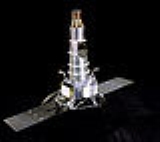
were so-called Block III versions of the Ranger spacecraft. The spacecraft consisted of a hexagonal aluminum frame base 1.5 m across on which was mounted the propulsion and power units, topped by a truncated conical tower which held the TV cameras. Two solar panel
Photovoltaic module
A solar panel is a packaged, connected assembly of solar cells, also known as photovoltaic cells...
wings, each 739 mm wide by 1537 mm long, extended from opposite edges of the base with a full span of 4.6 m, and a pointable high gain dish antenna was hinge mounted at one of the corners of the base away from the solar panels. A cylindrical quasiomnidirectional antenna was seated on top of the conical tower. The overall height of the spacecraft was 3.6 m.
Propulsion for the mid-course trajectory correction was provided by a 224 N thrust monopropellant hydrazine
Hydrazine
Hydrazine is an inorganic compound with the formula N2H4. It is a colourless flammable liquid with an ammonia-like odor. Hydrazine is highly toxic and dangerously unstable unless handled in solution. Approximately 260,000 tons are manufactured annually...
engine with 4 jet-vane vector control. Orientation and attitude control about 3 axes was enabled by 12 nitrogen
Nitrogen
Nitrogen is a chemical element that has the symbol N, atomic number of 7 and atomic mass 14.00674 u. Elemental nitrogen is a colorless, odorless, tasteless, and mostly inert diatomic gas at standard conditions, constituting 78.08% by volume of Earth's atmosphere...
gas jets coupled to a system of 3 gyros
Gyroscope
A gyroscope is a device for measuring or maintaining orientation, based on the principles of angular momentum. In essence, a mechanical gyroscope is a spinning wheel or disk whose axle is free to take any orientation...
, 4 primary Sun sensors, 2 secondary Sun sensors, and an Earth sensor. Power was supplied by 9792 Si solar cells contained in the two solar panels, giving a total array area of 2.3 square meters and producing 200 W. Two 1200 watt.hour AgZnO batteries rated at 26.5 V with a capacity for 9 hours of operation provided power to each of the separate communication/TV camera chains. Two 1000 watt-hour AgZnO batteries stored power for spacecraft operations.
Communications were through the quasiomnidirectional low-gain antenna and the parabolic high-gain antenna. Transmitters aboard the spacecraft included a 60 W TV channel F at 959.52 MHz, a 60 W TV channel P at 960.05 MHz, and a 3 W transponder channel 8 at 960.58 MHz. The telecommunications equipment converted the composite video signal from the camera transmitters into an RF signal for subsequent transmission through the spacecraft high-gain antenna. Sufficient video bandwidth was provided to allow for rapid framing sequences of both narrow- and wide-angle television pictures.
Mission profile
Ranger 6 was launched into an Earth parking orbitParking orbit
A parking orbit is a temporary orbit used during the launch of a satellite or other space probe. A launch vehicle boosts into the parking orbit, then coasts for a while, then fires again to enter the final desired trajectory...
and injected on a lunar trajectory by a second Agena burn. The midcourse trajectory correction was accomplished early in the flight by ground control. On February 2, 1964, 65.5 hours after launch, Ranger 6 impacted the Moon on the eastern edge of Mare Tranquillitatis (Sea of Tranquility). The orientation of the spacecraft to the surface during descent was correct, but no video signal was received and no camera data obtained. A review board determined the most likely cause of failure was due to an arc-over in the TV power system when it inadvertently turned on for 67 seconds approximately 2 minutes after launch during the period of booster-engine separation.
This fourth American attempt at lunar impact was the closest success. The spacecraft, the first Block III type vehicle with a suite of six TV cameras, was sterilized to avoid contaminating the lunar surface. The series would also serve as a test bed for future interplanetary spacecraft by deploying
systems (such as solar panels) that could be used for more ambitious missions. The Block III spacecraft carried a 173-kilogram TV unit (replacing the impact capsule carried on the Block II Ranger spacecraft). The six cameras included two full-scan and four partial-scan cameras. Ranger 6 flew to the Moon successfully and impacted precisely on schedule at 09:24:32 UT on 2 February. Unfortunately, the power supply for the TV camera package had short-circuited three days previously during Atlas booster separation and left the system inoperable. The cameras were to have transmitted high-resolution photos of the lunar approach from 1,448 kilometers to 6.4 kilometers range in support of Project Apollo. Impact coordinates were 9°24' north latitude and 21°30' east longitude.