


Raising card

Encyclopedia
Nap (textile)
Primarily, nap is the raised surface on certain kinds of cloth, such as velvet. Nap can refer additionally to other surfaces that look like the surface of a napped cloth, such as the surface of a felt or beaver hat....
of cloth. Originally, only woolen
Woolen
Woolen or woollen is a type of yarn made from carded wool. Woolen yarn is soft, light, stretchy, and full of air. It is thus a good insulator, and makes a good knitting yarn...
cloth was raised, but now flannelette and other cotton
Cotton
Cotton is a soft, fluffy staple fiber that grows in a boll, or protective capsule, around the seeds of cotton plants of the genus Gossypium. The fiber is almost pure cellulose. The botanical purpose of cotton fiber is to aid in seed dispersal....
fabrics are also raised. Raising is one of the last steps in the finishing
Finishing (textiles)
In textile manufacturing, finishing refers to any process performed on yarn or fabric after weaving or knitting to improve the look, performance, or "hand" of the finished textile or clothing...
process for cloth. It teases out the ends of the fibers in the cloth to produce a nap.
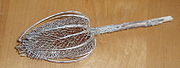
The raising was first done using the fruit pod of a teasel plant, then technology moved on and raising cards were created. A raising card is a brush with metal bristles, similar to hand cards
Carding
Carding is a mechanical process that breaks up locks and unorganised clumps of fibre and then aligns the individual fibres so that they are more or less parallel with each other. The word is derived from the Latin carduus meaning teasel, as dried vegetable teasels were first used to comb the raw wool...
and to the original teasel pod.
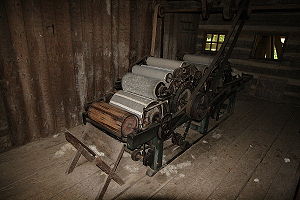
After the raising process, the nap
Nap (textile)
Primarily, nap is the raised surface on certain kinds of cloth, such as velvet. Nap can refer additionally to other surfaces that look like the surface of a napped cloth, such as the surface of a felt or beaver hat....
is uneven. In order to gain an even surface, the nap is then sheared, or cut, to the desired height.