

RAMDAC

Encyclopedia
Random Access Memory Digital-to-Analog Converter (RAMDAC) is a combination of three fast DAC
s with a small SRAM
used in computer graphics display adapters to store the color palette
and to generate the analog signals (usually a voltage amplitude) to drive a color monitor
. The logical color number from the display memory is fed into the address inputs of the SRAM to select a palette entry to appear on the data output of the SRAM. This entry is composed of three separate values corresponding to the three components (red, green, and blue) of the desired physical color. Each component value is fed to a separate DAC, whose analog output goes to the monitor, and ultimately to one of its three electron gun
s (or equivalent in non-CRT
displays).
DAC word lengths range usually from 6 to 10 bit
s. The SRAM's word length is three times the DAC's word length. The SRAM acts as a color lookup table
(CLUT). It usually has 256 entries (and thus an 8-bit
address). If the DAC's word length is also 8 bits, we have a 256 x 24-bit
SRAM which allows a selection of 256 out of 16777216 (16,7 million) possible colors for the display. The contents of this SRAM can be altered when no pixel needs to be generated for transmission to the display. A synchronization
pulse is required to maintain vertical picture stability. Therefore a vertical blanking
pulse
is generated for every frame. This vertical blanking pulse is not visible on the display, nor is any pixel sent. Therefore the D/A
is idle and can allow the user to modify the SRAM color lookup table.
The SRAM can usually be bypassed and the DACs can be fed directly by display data, for Truecolor modes. In fact this has become very much the normal mode of operation of a RAMDAC since the mid-1990s, so the programmable palette is mostly retained only as a legacy feature to ensure compatibility with old software. In many newer graphics cards, the RAMDAC can be clocked much faster in true color modes, when the SRAM is not used.
For a quick estimation on the pixel clock for a given output, you can do:
Usually the RAMDAC rating has to be (quite a bit) better than the pixel clock to produce sharp edges.
As of 2006, the DAC of a modern graphics card runs at a clock rate
of 400 MHz
. However, video cards based on the XGI
Volari XP10 run at 420 MHz DAC. The highest documented DAC frequency ever achieved on a production video card for the PC platform is 550 MHz, set by BarcoMed 5MP2 Aura 76Hz by Barco
. However, DOME Md8/PCI supports up to 2560x3200@68Hz over a single output, which would have 810 MHz pixel clock rate under VESA GTF calculation.
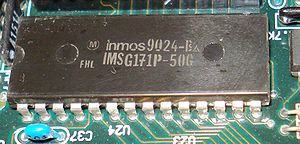 The term "RAMDAC" did not enter into common PC-terminology until IBM
introduced the IBM VGA
display adapter in 1987. The IBM VGA adapter used the INMOS
G171 RAMDAC. The INMOS VGA RAMDAC was a separate chip, featured a 256-color (8-bit CLUT) display from a palette of 262,144 possible values, and supported pixel-rates up to ~30MPixel/sec.
As clone manufacturers copied IBM VGA hardware, they also copied the INMOS VGA RAMDAC. Advances in semiconductor manufacturing and PC processing-power allowed RAMDACs to add "direct-color" operation, which is a mode of operation that allows the SVGA
-controller to pass a pixel's color-value directly to the DAC-inputs, thereby bypassing the RAM lookup-table. Another innovation was Edsun's CEGDAC, which featured hardware-assisted anti-aliasing
for line/vector draw-operations.
By the early 1990s, the PC chip-industry had advanced to the point where RAMDACs were integrated into the display controller chip, thus reducing the number of discrete chips and the cost of video cards. Consequently, the market for standalone RAMDACs disappeared. Today, RAMDACs are still manufactured and sold for niche applications, but in obviously limited quantity.
In modern PCs, the RAMDAC(s) are integrated into the display controller chip, which itself may be mounted on an add-in-board or integrated into the motherboard core-logic chipset. The original purpose of the RAMDAC, to provide a CLUT
-based display-mode, is rarely used, having been supplanted by true-color display-modes. However, many CAD
and video editing applications use hardware overlay
, combined with the programmable palette, to ensure the user interface does not disrupt the rendering of editing window.
As the use of DVI
, HDMI
, and other digital interface technology becomes increasingly mainstream, the "DAC" portion of the RAMDAC will likely become obsolete. Digital interfaces use a TMDS
module.
Digital-to-analog converter
In electronics, a digital-to-analog converter is a device that converts a digital code to an analog signal . An analog-to-digital converter performs the reverse operation...
s with a small SRAM
Static random access memory
Static random-access memory is a type of semiconductor memory where the word static indicates that, unlike dynamic RAM , it does not need to be periodically refreshed, as SRAM uses bistable latching circuitry to store each bit...
used in computer graphics display adapters to store the color palette
Palette (computing)
In computer graphics, a palette is either a given, finite set of colors for the management of digital images , or a small on-screen graphical element for choosing from a limited set of choices, not necessarily colors .Depending on the context In computer graphics, a palette is either a given,...
and to generate the analog signals (usually a voltage amplitude) to drive a color monitor
Computer display
A monitor or display is an electronic visual display for computers. The monitor comprises the display device, circuitry, and an enclosure...
. The logical color number from the display memory is fed into the address inputs of the SRAM to select a palette entry to appear on the data output of the SRAM. This entry is composed of three separate values corresponding to the three components (red, green, and blue) of the desired physical color. Each component value is fed to a separate DAC, whose analog output goes to the monitor, and ultimately to one of its three electron gun
Electron gun
An electron gun is an electrical component that produces an electron beam that has a precise kinetic energy and is most often used in television sets and computer displays which use cathode ray tube technology, as well as in other instruments, such as electron microscopes and particle...
s (or equivalent in non-CRT
Cathode ray tube
The cathode ray tube is a vacuum tube containing an electron gun and a fluorescent screen used to view images. It has a means to accelerate and deflect the electron beam onto the fluorescent screen to create the images. The image may represent electrical waveforms , pictures , radar targets and...
displays).
DAC word lengths range usually from 6 to 10 bit
Bit
A bit is the basic unit of information in computing and telecommunications; it is the amount of information stored by a digital device or other physical system that exists in one of two possible distinct states...
s. The SRAM's word length is three times the DAC's word length. The SRAM acts as a color lookup table
CLUT
A colour look-up table is a mechanism used to transform a range of input colours into another range of colours. It can be a hardware device built into an imaging system or a software function built into an image processing application...
(CLUT). It usually has 256 entries (and thus an 8-bit
8-bit
The first widely adopted 8-bit microprocessor was the Intel 8080, being used in many hobbyist computers of the late 1970s and early 1980s, often running the CP/M operating system. The Zilog Z80 and the Motorola 6800 were also used in similar computers...
address). If the DAC's word length is also 8 bits, we have a 256 x 24-bit
24-bit
Notable 24-bit machines include the ICT 1900 series and the Harris H series.The IBM System/360, announced in 1964, was a popular computer system with 24-bit addressing and 32-bit general registers and arithmetic...
SRAM which allows a selection of 256 out of 16777216 (16,7 million) possible colors for the display. The contents of this SRAM can be altered when no pixel needs to be generated for transmission to the display. A synchronization
Synchronization
Synchronization is timekeeping which requires the coordination of events to operate a system in unison. The familiar conductor of an orchestra serves to keep the orchestra in time....
pulse is required to maintain vertical picture stability. Therefore a vertical blanking
Vertical blanking interval
The vertical blanking interval , also known as the vertical interval or VBLANK, is the time difference between the last line of one frame or field of a raster display, and the beginning of the first line of the next frame. It is present in analog television, VGA, DVI and other signals. During the...
pulse
Pulse (signal processing)
In signal processing, the term pulse has the following meanings:#A rapid, transient change in the amplitude of a signal from a baseline value to a higher or lower value, followed by a rapid return to the baseline value....
is generated for every frame. This vertical blanking pulse is not visible on the display, nor is any pixel sent. Therefore the D/A
Digital-to-analog converter
In electronics, a digital-to-analog converter is a device that converts a digital code to an analog signal . An analog-to-digital converter performs the reverse operation...
is idle and can allow the user to modify the SRAM color lookup table.
The SRAM can usually be bypassed and the DACs can be fed directly by display data, for Truecolor modes. In fact this has become very much the normal mode of operation of a RAMDAC since the mid-1990s, so the programmable palette is mostly retained only as a legacy feature to ensure compatibility with old software. In many newer graphics cards, the RAMDAC can be clocked much faster in true color modes, when the SRAM is not used.
For a quick estimation on the pixel clock for a given output, you can do:
- horizontal pixels x vertical lines x 1.4 (for blankings) x refresh rate
- (based on VESA's GTF calculation sheet)
Usually the RAMDAC rating has to be (quite a bit) better than the pixel clock to produce sharp edges.
As of 2006, the DAC of a modern graphics card runs at a clock rate
Clock rate
The clock rate typically refers to the frequency that a CPU is running at.For example, a crystal oscillator frequency reference typically is synonymous with a fixed sinusoidal waveform, a clock rate is that frequency reference translated by electronic circuitry into a corresponding square wave...
of 400 MHz
Hertz
The hertz is the SI unit of frequency defined as the number of cycles per second of a periodic phenomenon. One of its most common uses is the description of the sine wave, particularly those used in radio and audio applications....
. However, video cards based on the XGI
XGI Technology
XGI Technology Inc. is based upon the old graphics division of SiS spun off as a separate company, and the graphics assets of Trident Microsystems.-History:...
Volari XP10 run at 420 MHz DAC. The highest documented DAC frequency ever achieved on a production video card for the PC platform is 550 MHz, set by BarcoMed 5MP2 Aura 76Hz by Barco
Barco
Barco N.V. is a display hardware manufacturer specialising in video projectors, LCD projectors, DLP projectors, LCoS projectors, LED displays, video walls, flat panel displays, automated luminaires, digital lighting and lighting controls....
. However, DOME Md8/PCI supports up to 2560x3200@68Hz over a single output, which would have 810 MHz pixel clock rate under VESA GTF calculation.
History
IBM
International Business Machines Corporation or IBM is an American multinational technology and consulting corporation headquartered in Armonk, New York, United States. IBM manufactures and sells computer hardware and software, and it offers infrastructure, hosting and consulting services in areas...
introduced the IBM VGA
Video Graphics Array
Video Graphics Array refers specifically to the display hardware first introduced with the IBM PS/2 line of computers in 1987, but through its widespread adoption has also come to mean either an analog computer display standard, the 15-pin D-subminiature VGA connector or the 640×480 resolution...
display adapter in 1987. The IBM VGA adapter used the INMOS
INMOS
Inmos Limited was a British semiconductor company, founded by Iann Barron, with both the head office and the design office at Aztec West in Bristol, it was incorporated in November 1978.- Products :...
G171 RAMDAC. The INMOS VGA RAMDAC was a separate chip, featured a 256-color (8-bit CLUT) display from a palette of 262,144 possible values, and supported pixel-rates up to ~30MPixel/sec.
As clone manufacturers copied IBM VGA hardware, they also copied the INMOS VGA RAMDAC. Advances in semiconductor manufacturing and PC processing-power allowed RAMDACs to add "direct-color" operation, which is a mode of operation that allows the SVGA
Super Video Graphics Array
Super Video Graphics Array or Ultra Video Graphics Array, almost always abbreviated to Super VGA, Ultra VGA or just SVGA or UVGA is a broad term that covers a wide range of computer display standards....
-controller to pass a pixel's color-value directly to the DAC-inputs, thereby bypassing the RAM lookup-table. Another innovation was Edsun's CEGDAC, which featured hardware-assisted anti-aliasing
Anti-aliasing
In digital signal processing, spatial anti-aliasing is the technique of minimizing the distortion artifacts known as aliasing when representing a high-resolution image at a lower resolution...
for line/vector draw-operations.
By the early 1990s, the PC chip-industry had advanced to the point where RAMDACs were integrated into the display controller chip, thus reducing the number of discrete chips and the cost of video cards. Consequently, the market for standalone RAMDACs disappeared. Today, RAMDACs are still manufactured and sold for niche applications, but in obviously limited quantity.
In modern PCs, the RAMDAC(s) are integrated into the display controller chip, which itself may be mounted on an add-in-board or integrated into the motherboard core-logic chipset. The original purpose of the RAMDAC, to provide a CLUT
CLUT
A colour look-up table is a mechanism used to transform a range of input colours into another range of colours. It can be a hardware device built into an imaging system or a software function built into an image processing application...
-based display-mode, is rarely used, having been supplanted by true-color display-modes. However, many CAD
Computer-aided design
Computer-aided design , also known as computer-aided design and drafting , is the use of computer technology for the process of design and design-documentation. Computer Aided Drafting describes the process of drafting with a computer...
and video editing applications use hardware overlay
Hardware overlay
In computing, hardware overlay, a type of video overlay, provides a method of rendering an image to a display screen with a dedicated memory buffer inside computer video hardware. The technique aims to improve the display of a fast-moving video image — such as a computer game, a DVD, or the signal...
, combined with the programmable palette, to ensure the user interface does not disrupt the rendering of editing window.
As the use of DVI
Digital Visual Interface
The Digital Visual Interface is a video interface standard covering the transmission of video between a source device and a display device. The DVI standard has achieved widespread acceptance in the PC industry, both in desktop PCs and monitors...
, HDMI
High-Definition Multimedia Interface
HDMI is a compact audio/video interface for transmitting uncompressed digital data. It is a digital alternative to consumer analog standards, such as radio frequency coaxial cable, composite video, S-Video, SCART, component video, D-Terminal, or VGA...
, and other digital interface technology becomes increasingly mainstream, the "DAC" portion of the RAMDAC will likely become obsolete. Digital interfaces use a TMDS
Transition Minimized Differential Signaling
Transition-minimized differential signaling is a technology for transmitting high-speed serial data and is used by the DVI and HDMI video interfaces, as well as other digital communication interfaces....
module.