

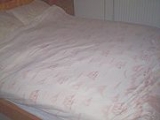
Duvet

Encyclopedia
A duvet (also known as a doona in Australian English
and a dyne in Scandinavian from which the Australian word was derived) from the French
duvet dyˈvɛ "down"), is a type of bedding
— a soft flat bag filled with down
, feather
s, or a synthetic alternative, and protected with a removable cover, analogous to a pillow
and pillow case. Duvets originated in rural Europe
and were made from the down feathers of the eider duck, known for its usefulness as a thermal insulator.
, an Englishman on a grand tour
then passing through Westphalia
, observed with surprise:
s, and quilt
s or other bed covers. The duvet itself fits into a specially made cover, usually of cotton or a cotton blend. The duvet cover is removed and laundered as often as the bottom sheet and pillow cases. The duvet itself may be cleaned much more rarely, and depending on its contents, may require specialist dry cleaning.
A modern duvet, like a sleeping bag
, may be filled with down or feathers of various quality and cost, or silk
, wool
, cotton
, or artificial fibers such as polyester
batting.
A duvet is not to be confused with a comforter
. Although comforters go on top of the traditional sheets and blankets, duvets are used by themselves.
"Continental quilt" was the term used when the item was widely introduced into England during the early 1970s.
Originally this was the standard name used across Australia
. Now, however, particularly in eastern regions, a duvet is often called a "doona", which is the brand name created by Kimptons (Northern Feather). The Tontine Group acquired the trademark in 1991 when Pacific Dunlop took over the company. "Doona" is derived from the equivalent common Scandinavian term dyne and was popularized by the retailer IKEA
in the 1970s.
In India and Pakistan, duvets are known as "ralli quilts" or razai
, and are mostly used in the southern province of Sindh
.
In the US, confusion often occurs as the word "duvet" is sometimes used to refer to a comforter cover rather than the down blanket itself.
In some European countries, any thick, warm blanket may be called a duvet.
, a measurement of thermal insulation
. This enables the purchaser to select a duvet appropriate to the season: the higher the tog rating, the warmer the duvet.
A few manufacturers have marketed combined duvet sets, one of approximately 4.5 tog and one of approximately 9.5 tog. The light-weight one is for summer and the medium one for autumn; snapped together, 14 togs is designed for winter.
" is used in some countries to describe an allowance of one or more days a year when employees can simply phone in and say that they are not coming in to work, even though they have no leave booked and are not ill. The provision of this benefit became fashionable in the late 1990s with many larger companies in the UK.
Australian English
Australian English is the name given to the group of dialects spoken in Australia that form a major variety of the English language....
and a dyne in Scandinavian from which the Australian word was derived) from the French
French language
French is a Romance language spoken as a first language in France, the Romandy region in Switzerland, Wallonia and Brussels in Belgium, Monaco, the regions of Quebec and Acadia in Canada, and by various communities elsewhere. Second-language speakers of French are distributed throughout many parts...
duvet dyˈvɛ "down"), is a type of bedding
Bedding
Bedding refers to the materials laid above the mattress of a bed for hygiene, warmth, to protect the mattress, and for decorative effect. Bedding is the removable and washable portion of a human sleeping environment. It is more easily and economically replaced than the bed itself...
— a soft flat bag filled with down
Down feather
The down of birds is a layer of fine feathers found under the tougher exterior feathers. Very young birds are clad only in down. Powder down is a specialized type of down found only in a few groups of birds. Down is a fine thermal insulator and padding, used in goods such as jackets, bedding,...
, feather
Feather
Feathers are one of the epidermal growths that form the distinctive outer covering, or plumage, on birds and some non-avian theropod dinosaurs. They are considered the most complex integumentary structures found in vertebrates, and indeed a premier example of a complex evolutionary novelty. They...
s, or a synthetic alternative, and protected with a removable cover, analogous to a pillow
Pillow
A pillow is a large cushion support for the head, usually used while sleeping in a bed, or for the body as used on a couch or chair. There are also throw pillows , which are pillows that are purely decorative and not designed for support or comfort...
and pillow case. Duvets originated in rural Europe
Europe
Europe is, by convention, one of the world's seven continents. Comprising the westernmost peninsula of Eurasia, Europe is generally 'divided' from Asia to its east by the watershed divides of the Ural and Caucasus Mountains, the Ural River, the Caspian and Black Seas, and the waterways connecting...
and were made from the down feathers of the eider duck, known for its usefulness as a thermal insulator.
History
In the mid-eighteenth century, Thomas NugentThomas Nugent (travel writer)
Thomas Nugent was an English gentleman travel writer. He travelled across North Germany in 1766. His travelogue was published in two volumes in the form of letters to an imaginary friend....
, an Englishman on a grand tour
Grand Tour
The Grand Tour was the traditional trip of Europe undertaken by mainly upper-class European young men of means. The custom flourished from about 1660 until the advent of large-scale rail transit in the 1840s, and was associated with a standard itinerary. It served as an educational rite of passage...
then passing through Westphalia
Westphalia
Westphalia is a region in Germany, centred on the cities of Arnsberg, Bielefeld, Dortmund, Minden and Münster.Westphalia is roughly the region between the rivers Rhine and Weser, located north and south of the Ruhr River. No exact definition of borders can be given, because the name "Westphalia"...
, observed with surprise:
- "There is one thing very particular to them, that they do not cover themselves with bed-cloaths, but lay one feather-bed over, and another under. This is comfortable enough in winter, but how they can bear their feather-beds over them in summer, as is generally practised, I cannot conceive." — The Grand Tour 1749, vol II. p. 66
Description
Duvets reduce the complexity of making a bed, as it is a single covering instead of the combination of bed sheets, blanketBlanket
A blanket is a type of bedding, generally speaking, a large piece of cloth, intended to keep the user warm, especially while sleeping. Blankets are distinguished from sheets by their thickness and purpose; the thickest sheet is still thinner than the lightest blanket. Blankets are generally used...
s, and quilt
Quilt
A quilt is a type of bed cover, traditionally composed of three layers of fiber: a woven cloth top, a layer of batting or wadding and a woven back, combined using the technique of quilting. “Quilting” refers to the technique of joining at least two fabric layers by stitches or ties...
s or other bed covers. The duvet itself fits into a specially made cover, usually of cotton or a cotton blend. The duvet cover is removed and laundered as often as the bottom sheet and pillow cases. The duvet itself may be cleaned much more rarely, and depending on its contents, may require specialist dry cleaning.
A modern duvet, like a sleeping bag
Sleeping bag
A sleeping bag is a protective "bag" for a person to sleep in, essentially a blanket that can be closed with a zipper or similar means, and functions as a bed in situations where a bed is unavailable . Its primary purpose is to provide warmth and thermal insulation...
, may be filled with down or feathers of various quality and cost, or silk
Silk
Silk is a natural protein fiber, some forms of which can be woven into textiles. The best-known type of silk is obtained from the cocoons of the larvae of the mulberry silkworm Bombyx mori reared in captivity...
, wool
Wool
Wool is the textile fiber obtained from sheep and certain other animals, including cashmere from goats, mohair from goats, qiviut from muskoxen, vicuña, alpaca, camel from animals in the camel family, and angora from rabbits....
, cotton
Cotton
Cotton is a soft, fluffy staple fiber that grows in a boll, or protective capsule, around the seeds of cotton plants of the genus Gossypium. The fiber is almost pure cellulose. The botanical purpose of cotton fiber is to aid in seed dispersal....
, or artificial fibers such as polyester
Polyester
Polyester is a category of polymers which contain the ester functional group in their main chain. Although there are many polyesters, the term "polyester" as a specific material most commonly refers to polyethylene terephthalate...
batting.
A duvet is not to be confused with a comforter
Comforter
A comforter is a type of blanket. Comforters are intended to keep the user warm, especially during sleep, although they can also be used as mattress pads. Comforters are generally large and rectangular in shape, filled with natural or synthetic insulative material and encased in a shell/covering....
. Although comforters go on top of the traditional sheets and blankets, duvets are used by themselves.
Regional variations
Duvets are the most common form of bed covering, especially in northern Europe. They became popular throughout the world in the late 20th century."Continental quilt" was the term used when the item was widely introduced into England during the early 1970s.
Originally this was the standard name used across Australia
Australia
Australia , officially the Commonwealth of Australia, is a country in the Southern Hemisphere comprising the mainland of the Australian continent, the island of Tasmania, and numerous smaller islands in the Indian and Pacific Oceans. It is the world's sixth-largest country by total area...
. Now, however, particularly in eastern regions, a duvet is often called a "doona", which is the brand name created by Kimptons (Northern Feather). The Tontine Group acquired the trademark in 1991 when Pacific Dunlop took over the company. "Doona" is derived from the equivalent common Scandinavian term dyne and was popularized by the retailer IKEA
IKEA
IKEA is a privately held, international home products company that designs and sells ready-to-assemble furniture such as beds and desks, appliances and home accessories. The company is the world's largest furniture retailer...
in the 1970s.
In India and Pakistan, duvets are known as "ralli quilts" or razai
Razai
A razai is a bedquilt used in Afghanistan, Pakistan, North India and Nepal. It is a type of bedding similar to a duvet or comforter. Razais usually have a cotton, silk or velvet cover which is stuffed with cotton wool...
, and are mostly used in the southern province of Sindh
Sindh
Sindh historically referred to as Ba'ab-ul-Islam , is one of the four provinces of Pakistan and historically is home to the Sindhi people. It is also locally known as the "Mehran". Though Muslims form the largest religious group in Sindh, a good number of Christians, Zoroastrians and Hindus can...
.
In the US, confusion often occurs as the word "duvet" is sometimes used to refer to a comforter cover rather than the down blanket itself.
In some European countries, any thick, warm blanket may be called a duvet.
Standards and sizes
Modern manufacturing conventions have resulted in a large number of sizes and standards.Thermal performance (tog rating)
Manufacturers rate the performance of their duvets in togsTog (unit)
The tog is a measure of thermal resistance of a unit area, also known as thermal insulance, commonly used in the textile industry, and often seen quoted on, for example, duvets and carpet underlay....
, a measurement of thermal insulation
Thermal insulation
Thermal insulation is the reduction of the effects of the various processes of heat transfer between objects in thermal contact or in range of radiative influence. Heat transfer is the transfer of thermal energy between objects of differing temperature...
. This enables the purchaser to select a duvet appropriate to the season: the higher the tog rating, the warmer the duvet.
A few manufacturers have marketed combined duvet sets, one of approximately 4.5 tog and one of approximately 9.5 tog. The light-weight one is for summer and the medium one for autumn; snapped together, 14 togs is designed for winter.
Influence on popular culture
The term "duvet dayDuvet day
A Duvet day is a formal allowance of time off given by some employers, most commonly in the United Kingdom and United States.It can be stipulated formally in a contract of employment and is considered part of the remunerations package along with holiday allowance...
" is used in some countries to describe an allowance of one or more days a year when employees can simply phone in and say that they are not coming in to work, even though they have no leave booked and are not ill. The provision of this benefit became fashionable in the late 1990s with many larger companies in the UK.
See also
- ComforterComforterA comforter is a type of blanket. Comforters are intended to keep the user warm, especially during sleep, although they can also be used as mattress pads. Comforters are generally large and rectangular in shape, filled with natural or synthetic insulative material and encased in a shell/covering....
- Fill powerFill powerFill power is a measure of the loft or "fluffiness" of a down product that is loosely related to the insulating value of the down. The higher the fill power the more insulating air pockets the down has and the better insulating ability. Fill power ranges from about 175 cm³/g for feathers to around...
- FutonFutonFuton is an English word derived from Japanese , a term generally referring to the traditional style of Japanese bedding consisting of padded mattresses and quilts pliable enough to be folded and stored away during the day, allowing the room to serve for purposes other than as a bedroom...
- MattressMattressA mattress is a manufactured product to sleep or lie on, consisting of resilient materials and covered with an outer fabric or ticking. In the developed world it is typically part of a bed set and is placed upon a foundation....
- PillowPillowA pillow is a large cushion support for the head, usually used while sleeping in a bed, or for the body as used on a couch or chair. There are also throw pillows , which are pillows that are purely decorative and not designed for support or comfort...
- Silk comforterSilk comforterA silk comforter is a bed covering, most often used as a duvet, and also commonly referred to as a silk duvet, silk quilt, or silk blanket. Originally from China, silk comforters are now more common throughout the world. Their increasing popularity stems from a combination of factors, including...
- TogTog (unit)The tog is a measure of thermal resistance of a unit area, also known as thermal insulance, commonly used in the textile industry, and often seen quoted on, for example, duvets and carpet underlay....
- EiderdownEiderdownEiderdown can refer to:* The down feathers of the eider duck* A kind of comforter or quilt...
- QuiltQuiltA quilt is a type of bed cover, traditionally composed of three layers of fiber: a woven cloth top, a layer of batting or wadding and a woven back, combined using the technique of quilting. “Quilting” refers to the technique of joining at least two fabric layers by stitches or ties...