


Pusyamitra Sunga

Encyclopedia
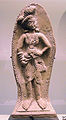
Pusyamitra Sunga was originally a Senapati (General) of the Mauryan empire. In 185 BCE he assassinated the last Mauryan Emperor (Brhadrata
Brhadrata
Brihadratha Maurya was the last ruler of the Mauryan dynasty. He ruled from c. 187–180 BCE. He was killed by his senapati , Pusyamitra Sunga-Reign:According to the Puranas, Brihadratha succeeded and he ruled for seven years...
) during an army review, and proclaimed himself King. He then performed the Ashwamedha Yajna and brought much of Northern India under his rule. Inscriptions of the Shungas have been found as far as the Jalandhar
Jalandhar
Jalandhar is a city in Jalandhar District in the state of Punjab, India. It is located 144 km northwest of the state capital, Chandigarh...
in the Punjab
Punjab region
The Punjab , also spelled Panjab |water]]s"), is a geographical region straddling the border between Pakistan and India which includes Punjab province in Pakistan and the states of the Punjab, Haryana, Himachal Pradesh, Chandigarh and some northern parts of the National Capital Territory of Delhi...
, and the Divyavadana
Divyavadana
The Divyāvadāna, or Divine Stories, is an anthology of Buddhist tales, many originating in the Mūlasarvāstivāda vinaya texts. The stories themselves are therefore quite ancient and may be among the first Buddhist texts ever committed to writing, but this particular collection of them is not...
mentions that his rule extended as far as Sagala
Sagala
Sagala or Sangala, the ancient Greek name for the modern city of Sialkot in present day Pakistan, was a city of located in northern Punjab, Pakistan...
(Sialkot).
Pusyamitra Sunga's Reign
Pushyamitra's reign was marked by warfare, wherein he and his successors fought the Indo Greeks, Kalingas, Satavahanas (Andhras), and possibly the kingdoms of PanchalaPanchala
Panchala is an ancient region of northern India, which corresponds to the geographical area around the Ganges River and Yamuna River, the upper Gangetic plain in particular. This would encompass the modern-day states of Uttarakhand and Uttar Pradesh. During the ancient times, it was home to a...
and Mathura (which may not have been under his rule).
Following the assassination of Brhadrata
Brhadrata
Brihadratha Maurya was the last ruler of the Mauryan dynasty. He ruled from c. 187–180 BCE. He was killed by his senapati , Pusyamitra Sunga-Reign:According to the Puranas, Brihadratha succeeded and he ruled for seven years...
, in 180 BCE the Greco-Bactrian Kingdom
Greco-Bactrian Kingdom
The Greco-Bactrian Kingdom was the easternmost part of the Hellenistic world, covering Bactria and Sogdiana in Central Asia from 250 to 125 BC...
invaded Sunga lands with an army led by Demetrius I of Bactria
Demetrius I of Bactria
Demetrius I was a Buddhist Greco-Bactrian king . He was the son of Euthydemus and succeeded him around 200 BC, after which he conquered extensive areas in what now is eastern Iran, Afghanistan and Pakistan thus creating an Indo-Greek kingdom far from Hellenistic Greece...
. The Greco-Bactrians overran Arachosia, Gedrosia, the Punjab, and perhaps Mathura. Pushyamitra may have regained some of the lost territory, with the Ashvamedha
Ashvamedha
The Ashvamedha was one of the most important royal rituals of Vedic religion, described in detail in the Yajurveda...
terminating at the Indus late in his reign (Kulke? ).
Pusyamitra may have been attacked by King Kharavela
Kharavela
Khārabēḷa was the third and greatest emperor of the Mahāmēghabāhana Dynasty of Kaḷinga . The main source of information about Khārabeḷa is his famous seventeen line rock-cut Hātigumphā inscription in a cave in the Udayagiri hills near Bhubaneswar, Orissa.During the reign of Khārabēḷa, the Chedi...
of Kalinga
Kalinga (India)
Kalinga was an early state in central-eastern India, which comprised most of the modern state of Orissa/Utkal , as well as the Andhra region of the bordering state of Andhra Pradesh. It was a rich and fertile land that extended from the river Damodar/Ganges to Godavari and from Bay of Bengal to...
(modern Orissa
Orissa
Orissa , officially Odisha since Nov 2011, is a state of India, located on the east coast of India, by the Bay of Bengal. It is the modern name of the ancient nation of Kalinga, which was invaded by the Maurya Emperor Ashoka in 261 BC. The modern state of Orissa was established on 1 April...
). Kharavela's inscriptions claim that he forced a King of Magadha
Magadha
Magadha formed one of the sixteen Mahājanapadas or kingdoms in ancient India. The core of the kingdom was the area of Bihar south of the Ganga; its first capital was Rajagriha then Pataliputra...
named "Bahasatimita", (thought to be the Sunga King Brhaspatimitra, or Pusyamitra himself) to bow at his feet. However, this has not been confirmed as dates for Kharavela range several centuries.
Academic debate
Some historians have rejected Pushyamitra' s persecution of Buddhists. The traditional narratives are dated to two centuries after Pushyamitra’s death in Asokâvadâna and the DivyâvadânaDivyavadana
The Divyāvadāna, or Divine Stories, is an anthology of Buddhist tales, many originating in the Mūlasarvāstivāda vinaya texts. The stories themselves are therefore quite ancient and may be among the first Buddhist texts ever committed to writing, but this particular collection of them is not...
, Buddhist books of legend. The traditional accounts are often described as exaggerated. The Asokavadana legend is likely a Buddhist version of Pusyamitra's attack on the Mauryas, reflecting the declining influence of Buddhism in the Sunga Imperial court.
Koenraad Elst
Koenraad Elst
Koenraad Elst is a Belgian writer and orientalist .He was an editor of the New Right Flemish nationalist journal Teksten, Kommentaren en Studies from 1992 to 1995, focusing on criticism of Islam, various other conservative and Flemish separatist publications such as Nucleus, t Pallieterke,...
writes :
The story is in fact given in two near contemporaneous (2nd century A.D.) Buddhist histories, the Asokâvadâna and the Divyâvadâna; the two narratives are almost verbatim the same and very obviously have a common origin.5 This non-contemporary story (which surfaces more than three centuries after the alleged facts) about Pushyamitra’s offering money for the heads of Buddhist monks is rendered improbable by external evidence: the well-attested historical fact that he allowed and patronized the construction of monasteries and Buddhist universities in his domains, as well as the still-extant stupa of Sanchi.6 After Ashoka’s lavish sponsorship of Buddhism, it is perfectly possible that Buddhist institutions fell on slightly harder times under the Sungas, but persecution is quite another matter. The famous historian of Buddhism Etienne Lamotte has observed: “To judge from the documents, Pushyamitra must be acquitted through lack of proof.”
The very same Ashokavadana also attributes similar cruelty to Ashoka
Ashoka
Ashok Maurya or Ashoka , popularly known as Ashoka the Great, was an Indian emperor of the Maurya Dynasty who ruled almost all of the Indian subcontinent from ca. 269 BC to 232 BC. One of India's greatest emperors, Ashoka reigned over most of present-day India after a number of military conquests...
:
“At that time, an incident occurred which greatly enraged the king. A follower of the Nirgrantha (Mahâvîra) painted a picture, showing Buddha prostrating himself at the feet of the Nirgrantha. Ashoka ordered all the Ajivikas of Pundravardhana (North Bengal) to be killed. In one day, eighteen thousand Ajivikas lost their lives. A similar kind of incident took place in the town of Pataliputra. A man who painted such a picture was burnt alive with his family. It was announced that whoever would bring to the king the head of a Nirgrantha would be rewarded with a dînâra (a gold coin). As a result of this, thousands of Nirgranthas lost their lives.”
Among the detractors is Romila Thapar
Romila Thapar
Romila Thapar is an Indian historian whose principal area of study is ancient India.-Work:After graduating from Panjab University, Thapar earned her doctorate under A. L. Basham at the School of Oriental and African Studies, the University of London in 1958...
, who writes that archaeological evidence casts doubt on the claims of Buddhist persecution by Pushyamitra. Support of the Buddhist faith by the Sungas at some point is suggested by an epigraph on the gateway of Barhut, which mentions its erection "during the supremacy of the Sungas".
On the other hand, Sir John Marshall
John Marshall (archaeologist)
Sir John Hubert Marshall was the Director-General of the Archaeological Survey of India from 1902 to 1928...
noted that the Sanchi
Sanchi
Sanchi is a small village in Raisen District of the state of Madhya Pradesh, India, it is located 46 km north east of Bhopal, and 10 km from Besnagar and Vidisha in the central part of the state of Madhya Pradesh. It is the location of several Buddhist monuments dating from the 3rd...
stupa was vandalized during the 2nd century before it was rebuilt later on a larger scale, suggesting the possibility that the original brick stupa built by Ashoka was destroyed by Pusyamitra and then restored by his successor Agnimitra
Agnimitra
Agnimitra was the second King of the Sunga Dynasty of northern India. He succeeded his father, Pusyamitra Sunga, in 149 BCE...
. Similarly, the Deokothar Stupas (geographically located between Sanchi and Barhut) suffered destruction during the same period, also suggesting some kind of involvement of Sunga rule. Proponents also point to the proclamations and claim that the Manu Smriti
Manu Smriti
' , also known as Mānava-Dharmaśāstra , is the most important and earliest metrical work of the Dharmaśāstra textual tradition of Hinduism...
was propagated.
External links
- Koenraad Elst, Why Pushyamitra was more "secular" than Ashoka Article on the alleged Hindu persecution of BuddhismBuddhismBuddhism is a religion and philosophy encompassing a variety of traditions, beliefs and practices, largely based on teachings attributed to Siddhartha Gautama, commonly known as the Buddha . The Buddha lived and taught in the northeastern Indian subcontinent some time between the 6th and 4th...
by Pushyamitra