
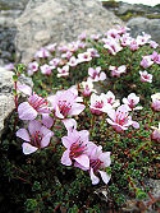
Saxifraga oppositifolia, the
purple saxifrage or
purple mountain saxifrage, is a species of edible plant that is very common all over the high
ArcticThe Arctic is the region around the Earth's North Pole, opposite the Antarctic region around the South Pole. The Arctic includes the Arctic Ocean and parts of Canada, Greenland , Russia, the United States , Iceland, Norway, Sweden and Finland.The word Arctic comes from the Greek αρκτικός , "near...
and also some high
mountainA mountain is a large landform that stretches above the surrounding land in a limited area usually in the form of a peak. A mountain is generally steeper than a hill. The adjective montane is used to describe mountainous areas and things associated with them...
ous areas further south, including northern
BritainGreat Britain is an island lying to the northwest of Continental Europe. It is the ninth largest island in the world, and the largest European island. With a population of about 59.6 million people, it is the third most populated island on Earth. Great Britain is surrounded by over 1000 smaller...
, the
AlpsThe Alps are one of the great mountain range systems of Europe, stretching from Austria and Slovenia in the east; through Italy, Switzerland, Liechtenstein and Germany; to France in the west....
and the
Rocky MountainsThe Rocky Mountains are a major mountain range in western North America. The Rocky Mountains stretch more than from the northernmost part of British Columbia, in Canada, to New Mexico, in the United States. The range's highest peak is Mount Elbert in Colorado at above sea level...
. It is even known to grow in north
GreenlandGreenland is an autonomous constituent country within the Kingdom of Denmark located between the Arctic and Atlantic Oceans, east of the Canadian Arctic Archipelago...
, at 83°15'N, the most northerly plant locality in the world.
It is a low-growing, densely or loosely matted plant growing to 3–5 cm high, with somewhat woody branches of creeping or trailing habit close to the surface. The
leavesIn botany, a leaf is an above-ground plant organ specialized for photosynthesis. For this purpose, a leaf is typically flat and thin. There is continued debate about whether the flatness of leaves evolved to expose the chloroplasts to more light or to increase the absorption of carbon dioxide. In...
are small, rounded, scale-like, opposite in 4 rows, with ciliated margins. The
flowerA flower, sometimes known as a bloom or blossom, is the reproductive structure found in flowering plants . The biological function of a flower is to mediate the union of male sperm with female ovum in order to produce seeds...
s are solitary on short stalks, petals purple or lilac, much longer than the calyx lobes. It is one of the very first spring flowers, continuing to flower during the whole summer in localities where the snow melts later. The flowers grow to about 0.5 inches in diametre.
It grows in all kinds of cold temperate to arctic habitats, from sea level up to 1000 m, in many places colouring the landscape. It is a popular plant in alpine gardens, though difficult to grow in warm climates.
It serves as the
territorial flower of
NunavutNunavut is the largest and newest federal territory of Canada; it was separated officially from the Northwest Territories on April 1, 1999 via the Nunavut Act and the Nunavut Land Claims Agreement Act, though the actual boundaries had been established in 1993...
in
CanadaCanada is a country occupying most of northern North America, extending from the Atlantic Ocean in the east to the Pacific Ocean in the west and northward into the Arctic Ocean...
and the county flower of
County LondonderryCounty Londonderry or County Derry is one of the traditional counties of Ireland. It is located within the province of Ulster and is part of Northern Ireland. It was named after its main town – and later city and administrative centre – Derry , which lies in the north-western corner of...
in
Northern IrelandNorthern Ireland is a part of the United Kingdom of Great Britain and Northern Ireland and it is situated in the north-east of the island of Ireland. It shares a border with the Republic of Ireland to the south and west...
.
The flowers can be picked for food. The semi-sweet petals are edible. The flower is known to the Inuit people as
aupilaktunnguaq.
There are a few subspecies, including:
- Saxifraga oppositifolia ssp. glandulisepala Hultén - Native from Alaska.
- Saxifraga oppositifolia ssp. oppositifolia L. - Native from Continental US.
- Saxifraga oppositifolia ssp. smalliana (Engl. & Irmsch.) Hultén - Native from Alaska.